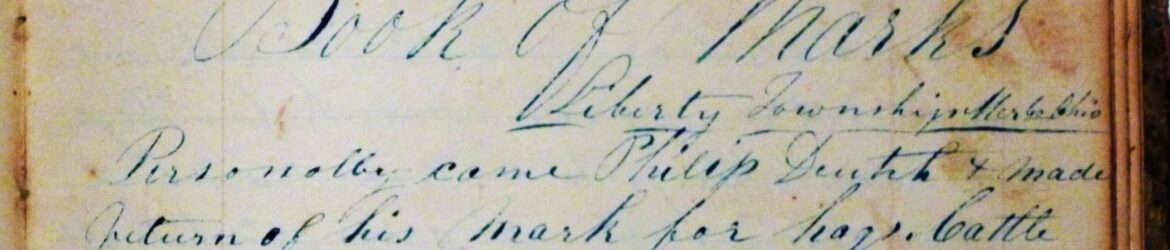
I have written about Mercer County’s old Liberty Township Estray Book three other times. [1] The book dates back to the mid-1800s and pertains to livestock in the township.
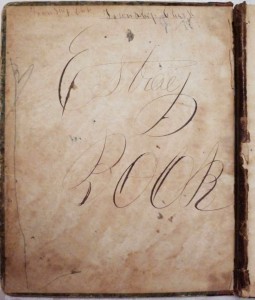
1842 Liberty Township Estray Book
The Liberty Estray Book has two purposes. The first part of the book describes the township estrays, i.e. found or missing livestock. The first entry is that of Jacob Deutsch, 1 January 1842, who found three strays–a black mare with a bay colt and a bay mare.
The rest of the book is the registration of livestock earmarks for the Liberty Township farmers. Unfortunately, some pages have been torn out of the back of the book.
During that time period, most livestock roamed free-range and they sometimes wandered off the farm, an easy thing to do if there were not many fences. The age-old solution was to mark their ears. Animal’s ears were easy to see and cutting marks in distinctive patterns on one or both ears was a good way to identify a farmer’s livestock. Each farmer registered his own earmark for his hogs, sheep, and cattle with the township clerk. One earmark was used for all three animals. That way there was no question to whom the livestock belonged. They specifically mention earmarks for hogs, sheep, and cattle, but not horses. I guess they did not disfigure horses’ ears.
Many times, a farmer’s specific earmark was transferred to another farmer for one reason or another, for example when he moved out of the area. Some marks were transferred several times as time went on.
And of course there was a fee to record an earmark. In 1860 it cost 25 cents to record an earmark in Liberty Township.
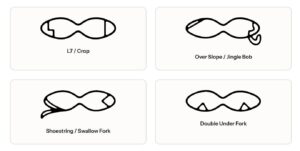
Earmarks are usually described with the left ear pattern first, then the right ear pattern, but the Liberty Township clerk did not always follow this method. The position of the cut on the ear (upper edge, lower edge, tip) and the type of cut (notch, split, crop) combine to create the full description.
Some common earmark terms used in Liberty’s Estray Book:
Crop: Removal of the entire tip of the ear
Split: A cut from the edge toward the center of the ear
Bit: A small V-shaped notch
Under Bit: A small V-shaped notch on the lower edge
Over Bit: A small V-shaped notch on the upper edge
Slope/Under Slope: An angled cut removing part of the ear edge
Swallow Fork: A V-shaped cut from the tip creating a forked appearance
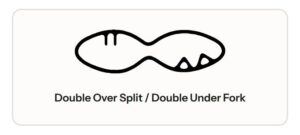
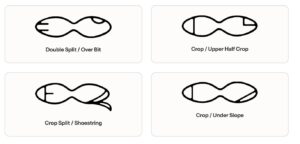
When looking at the examples below, the left ear is shown on the left side of the image and the right ear on the right-as if you’re looking at the animal from behind:
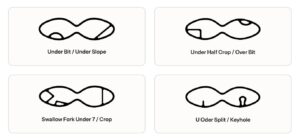
Earmark examples I
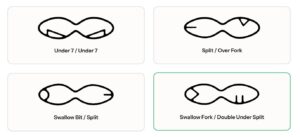
Earmark Examples II
Earmark Examples III
Earmark Example IV

Earmark Examples V
Earmark Examples VI
Later, in the estray portion of the book, found livestock was identified by their earmark. So the earmark system worked.
It is a challenge to go through the book. The pages are not numbered and there is no index. The first 30 pages are the estrays, then the earmark registrations begin with the year 1883. After nine pages of earmarks going back in time to 1871 there is a page entitled Book of Marks, which begins with Philip Deutch in 1842. The next entry is Philip Bolton, 1841. Registrations continue in order by year for another 20 pages, through 1870, to the end of the book, where some pages have been torn out.
Apparently when the clerk began recording in the book in 1841 he left nine pages blank between the estrays and the earmarks. When he got to the end of the book in 1871, recording earmarks, he went back to the beginning of the earmarks section and recorded earmarks, backwards, working his way toward the front of the book, using the nine blank pages, until he got back to the end of the estray section in 1883, when the book was full. It is a little different recording system but I managed to figure it out.
Some townships and counties made diagrams of their earmarks:
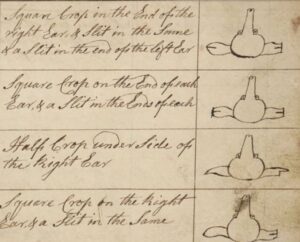
Earmark diagrams in old book
But there are no diagrams in this book, which makes me wonder how the clerk kept track of all the earmarks. How did he know which marks were already registered?
I would imagine there was another earmark registration book, maybe at the county level, that is arranged differently with illustrations.
In the early years earmarks were often recorded in the county court minutes or in specific volumes and were later recorded in books such as Record of Marks books. I don’t know how many of these books survived and it is fortunate that this book is still intact. It is a great piece of Mercer County history.
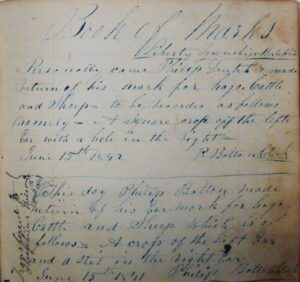
Book of Earmarks, Liberty Township, Mercer County, Ohio, 1841
If your ancestor lived in Liberty Township in the mid-1800s, he may be listed below and you can see what his registered earmark was and the date it was registered. Note, look for alternate name spellings. Some of the names in the book are difficult to read and I transcribed them the best I could, as they were written and spelled.
Albright, John G 14 Feb 1843: square crop off each ear (trans to John Lininger 11 Oct 1859)
Alt, Adam 5 Nov 1877: hole in the left ear & upper bit in same ear
Alt, Frederick 10 Jan 1877: a square crop of each ear & a slit in each ear
Alt, John 1 Dec 1877: a square crop of the left ear & upper bit in right ear
Alt, John 13 Nov 1865: one square notch out of the upper side of the right ear; 1 Dec 1877: his earmark changed & trans to John Alt: a square crop of the left ear & upper bit in right ear
Anders, Frederick 7 Mar 1865: a square crop off the right ear (trans to Henry V Hinton 14 Apr 1865)
Anselment, John 3 Apr 1874: a square crop off each ear with an under notch out of each
Anselment, Lewis 24 Jul 1863: a slit in each ear
Arbaugh, Horace B 17 Mar 1851: a slit in each ear & an under bit in the right (trans to John C Brehm 1 Feb 1866)
Bacher, John 16 Oct 1851: upper half crop of each ear (trans to John J Schaadt 3 Nov 1868)
Bacher, Philip 16 May 1851: upper half crop /left ear; under half crop/right ear
Baker, Jacob 27 Jul 1865: a hole in the right ear and an under half crop from the left ear
Baker, John 6 Aug 1855: a square crop in the right & under slope in the left (trans to Nicholas Hider 9 Sep 1865)
Bance, John 18 Aug 1866: a swallow fork in the left ear and an upper bit in the same ear
Baurer, Michael 6 Apr 1863 (trans to Nicholas Hider 9 September 1865)
Beach, Hiram 26 Nov 1854: a square crop from the left ear & a notch from the upper side of the right (trans to Mary Wernet 13 September 1870)
Betzel, Frederick 4 Apr 1853: a square crop off each ear with 2 slits in each ear & and under bit for each ear
Beverstine, Abraham 15 Nov 1876: a swallow crop in the right ear
Bock, Leonard 24 Jul 1867: two holes in each ear
Bolenbacher, Adam 14 Feb 1843: square crop off the right ear, a slit in the left
Bollenbacher, Jacob 5 May 1881, square crop of the right ear, two slits in the left ear
Bollenbacher, John Jacob 17 Nov 1876: a square crop of the left ear and slit in same & under bit in right ear
Bollenbaucher, George Jr 6 Mar 1860, square crop off each ear & a slit in the right
Bollenbaucher, Jacob 10 May 1866: a square crop off the right ear & an under bit in the left
Bollenbaugh, Adam Jr 6 May 1865: an under half crop of the left ear
Bollenbaugh, George Sr 4 Apr 1853: a crop off the right ear & a slit in the same, under bit in the left ear
Bolton, Philip 15 Jun 1841: a crop of the left ear & a slit in the right ear (trans to Theophilus Wilson 6 Jan 1843)
Bolton, Philip 1843: a crop off the left ear with a slit in the same & a swallow fork in the right ear (trans to Fredrick Kable 24 Nov 1860)
Brahm, John 20 Jun 1873: a slit in each ear with a hole in the right ear
Brechheiser, Martin 10 May 1865: a slit in the left ear and a hole in the right ear
Brehm, John C 9 May 1878: one slit in each ear & an under bit in the right ear
Brehm, Peter 15 Mar 1884: a hole in the ear and upper half crop in the left ear
Burger, Michael 20 Apr 1865: a square crop off the left ear & a slit in the lower side of the right ear (trans to Joseph Felver 1 Apr 1867; trans to Jacob Linn 18 Jul 1876)
Carmony, Henry 11 Oct 1842: a square crop off the left ear (trans to Peter Fisher 10 Feb 1846)
Chapman, John H 20 Apr 1852: sloping crop off the under part of the right ear
Coon, Henry 29 May 1852 (trans from Elisha Horton?): a [square] crop off the left ear & a slit in the stump
Cox, Benjamin 3 Apr 1843: upper half crop of the left ear (trans to Philip Linn 17 Jul 1876)
Daily, Thomas G 15 Jan 1866: a square crop off the right ear and two slits in the left ear
Deaner, Frederic 3 Mar 1865: an under half crop out of each ear
Deitsch, Jacob Sr 1 May 1846 (trans to John Deitsch 28 Jan 1876): 2 slits in the left year
Deitsch, Jacob 21 Dec (trans to John G. Brumen? 20 Oct 1864): a crop of each ear and two slits in each ear
Deitsch, John 28 Jan 1876 (transferred to Anton Feissel 21 Nov 1884): 2 slits in the left ear
Deutch, Jacob 25 Aug 1841: a crop off the right ear with a hole in the left
Deutch, Philip 15 Jun 1842: a square crop off the left ear with a hole in the right ear
Diekes, Mary M 23 Jul 1860: square crop off the right ear & under bit in the left ear (trans to M. Kutsch [no date])
Diekes, Rinehart 23 Jul 1860: a square crop off the right ear & upper half crop off the left ear (trans to John B Drier Oct 1860)
Ditsch [Deitsch] Wm, 1 May 1846: a square crop of the right ear & a half crop of the left
Dixon, Amos 31 Mar 1857: a crop from the right ear & a slit and under bit from the left ear (trans to Henry Grote 9 Apr 1869)
Dixon, Henry 7 Apr 1866: an under bit in each ear; later in book, same date, recorded as a square crop off the right ear & a square notch out of the under side of the right ear
Dixon, Henry 8 Apr 1861: and under bit from each ear (trans to John Myer 7 Apr 1873)
Dixon, Samuel 8 Jun 1855: a square crop from the right ear & swallow fork and under bit in the left (trans to Job Thorp 8 May 1871)
Emerick, Philip 6 Apr 1874: a square crop off the right ear & under notch in the same & an upper notch in the left ear
Feipel, Anton 21 Nov 1884: two slits in the left ear
Fidlir, John 6 Apr 1854: a square crop off the left ear & a swallow fork in the right ear (trans to John Cox 16 Nov 1854)
Fieldheizer, George 22 Oct 1847: a swallow fork in each ear (trans to Jacob Hoffman 19 Nov 1850)
Fieper [Feipel], Nick 16 Feb 1879: one hole in the left ear & upper half crop of right ear
Fipiel [Feipel], Frank 26 Feb 1881, a square notch out of the underside of the left ear
Fisher, John 5 Apr 1842: a slit in the right ear (trans to Henry Doner 8 Apr 1859)
Fisher, Peter 7 Jan 1843: a slit in the left ear (trans to Mathas Kutch 2 Feb 1871)
Freeman, Danl 15 Jun 1841: a crop of the left ear and an under bit in the right ear (Trans to Henry Trisel 25 Feb 1871; Trans to James Steward 9 Dec 1883)
Freeman, William 21 Jan 1843: a crop off the right ear with a slit in the same (trans to Mathas Katch? 2 Feb 1871)
Gillespie, Charles 18 Jan 1851: a square crop of the right ear & an under half crop in the left ear
Glass, Martin 22 Feb 1851: a square crop of the left ear & under slope in right ear the whole length (trans to Christian Kessler 18 Apr 1862)
Grote, Henry 9 Apr 1869: a crop off the right ear & a slit and under bit out of the left ear
Harb, Joseph 31 Jan 1874: a square crop of the right ear with a notch out of the underside of the same & a slit in the left ear
Hardsock, John 11 Feb 1862: a square crop off each ear & a slit in the left ear
Harold, John 1 May 1846: a slit and upper bit in the right ear
Harold, John 25 Nov 1850, (trans from Wm A Watkins): a square crop off each ear & a slit in each ear (trans to John Grabner 9 Nov 1865)
Hengel, Andrew 31 Oct 1868: 2 slits in the right ear & 1 in the left
Hines, Georg 29 May 1871: an upper half crop off the right ear & an under half crop off the left ear
Hinton, Henry V 14 Apr 1868: a square crop off the right ear
Hinton, Thomas E 7 Apr 1865: 2 slits in either ear
Hoofman, Ferdinand [no date]: a square crop off the right ear & under half crop from the left ear
Horton?, Elisha [no date]: a crop off the left ear & a slit in the stump (trans to Henry Coon)
Hough, William 4 Feb 1844: a crop from both ears & a hole in the left ear (trans to William Koch 11 Oct 1859)
Kable, Christian 28 Sep 1866: an upper bit from each ear and a hole in the right ear
Kable, Ferdinand 25 Nov 1850: a square crop of the left ear & a slit in the same & a swallow fork in the right ear (trans 10 Apr 1884 to ?)
Kable, Frederick 21 May 1858: a square crop each ear & under bit out of each ear
Kable, John 5 Nov 1877: a hole in the right ear & an upper bit in the same
Kable, Philip 6 Nov 1877: a hole in the right ear, square crop of same & upper bit of left ear
Kelly, David 30 Apr 1851: a slit in the left ear & a half under crop in the right ear (trans to Wm Gahm 14 May 1874)
Kessler, Christian 16 May 1851: a square crop in the right ear & under slope in left ear the whole length (trans to Jacob Kable 28 Sep 1866)
Kimmel, Henry 4 May 1868: a square crop of the right ear with a hole in the same (trans to J Wineman 6 Jun 1874)
Kimmel, John 15 Mar 1842: a crop off the left ear with a hole in the same (trans to William Kimmel 4 Apr 1853)
Knaar [Kanorr], Aaron 18 Aug 1874: a square crop off the right ear with a slit in the stump with a hole in the left and slit out
Koch, John 6 May 1865: a hole in each ear
Krumer, George 20 Oct 1864: a crop off each ear & two slits in each ear
Kugle, Michael 3 Apri1874: a square crop off each ear with an upper notch out of each ear
Kuhn, Henry 19 Jun 1848: a square crop of the left ear & a slit in the stump (trans to Henry Kuhn 3 Apr 1871)
Kutsch, Jacob 20 Mar 1858: square crop & slit in right ear and a swallow fork in the left ear
Kutsch, Mathas 1 Oct 1857: a swallow fork in the right ear & upper half crop in the left ear (trans to Nicholas Peter 14 Feb 1866)
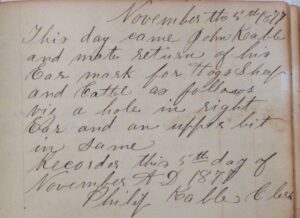
John Kable Liberty Township earmark, 1877
The term stump was used and I could not determine what that term means.
Farmers don’t use cut earmarks as much today. Most livestock today have ear tags instead of the cut earmarks.
The remainder of Liberty Township’s earmark registrations coming soon.
You can contact Karen at karen@karenmillerbennett.com.
[1] Estray Book of Liberty Township, Mercer County, Ohio , Index of Liberty Township Estray Book , Index of Liberty Township Estray Book, Earmarks I-Z
Another source: Ranch Brand Search