Soldiers Depart Van Wert, 22 July 1918

This photo belonged to my grandfather Cornelius Schumm. The photo was taken by D.E. Agler on the west side of the Van Wert Courthouse on 22 July 1918. In the photo are 139 young Van Wert County men before leaving for basic training at Camp Sherman, to ultimately serve with the Allied Forces in Europe during WWI.

22 Jul 1918, Van Wert men to depart for Camp Sherman.

Several thousand people were assembled in Van Wert that day to honor these soldiers and in recognition of the soldiers who had gone before. According to newspaper accounts, the Van Wert County Service Flag was dedicated during this ceremony. The young service men were given comfort kits prepared by the Daughters of the American Revolution, white ribbon badges and carnations from the Womens’ Christian Temperance Union, and small flags and shoe laces from the James Clark Shoe Co.

If you look closely you can see the men are wearing the white ribbons.

22 Jul 1918, Van Wert men to depart for Camp Sherman.

The squad of young men was under the charge of Guy Simpson, assisted by Donald H. Smith, Lewis Walborn, W. McBride, and George Huffine. Rev. George Arthur Frantz, of the Presbyterian Church, gave the address.

22 Jul 1918, Van Wert men to depart for Camp Sherman.

Afterward the Van Wert squad was escorted to the Cincinnati Northern depot, the procession lead by the Scott Band, under the leadership of Prof. L.E. Needler. Public officials, Boy Scouts, and a long line of citizens accompanied the procession. The young men occupied three coaches that were attached to a special train that transported other squads from area counties. The train stopped at Greenville and the men were served a noon meal. The train was scheduled to reach Camp Sherman early in the evening.

22 Jul 1918, Van Wert men to depart for Camp Sherman.

There were eleven changes in the original list of registrants called to report for duty. Lewis Euler, Harold German, Jesse Johnson, Donald Holland, Nathan Lifshitz, Hoer Smith, Leon Talboon, Noble Thomas, Pryse Tumbers, Julius Verbauch and Carl Kreischer were removed from the original list and the vacancies were filled by Geo A. Adams, Noble Noell, James Johnson, Humbert Da Prato, Wm. R. Evans, Carl Reidenbach, Wm. Dunlap, Wm. Kidney, John Hey, Harry Roberts, Delbert Runnion.

Van Wert Daily Bulletin, 22 Jul 1918.

The newspaper has an alphabetical list of the young men in the photo who left for service that day. I transcribed the list of men the best I could, but the newspaper copy is difficult to read and I probably misspelled some names. Plus, the end of the list is illegible. Having said all that, the squad was made up as follows.

William Agler, John Adam, William August.

Ora Bair, Herman Becker, Titus Bell, Paul Becker, Logan Baer, Glenn Brubaker, Joseph Beekman, Oscar Bauer, George Bollenbaugh, Edson Beckwith, John Butcher, Harold Burnett, Edwin Bauer, Perry Bruckhart, Henry Bell, Virgil Baker.

John Clay, Glenn Crawford, Lawrence, Custer, John Coil, Wm. Campbell, Zeda Coombs, Chauncey Crogan, Hiram Cooper, Albert Case, Arnold Carmean, Frank Carder.

William Douglas, Wm. Dunlap, Humbert DaPrato.

Ernest Etzler, Wm. R. Evans, James Eady.

Arthur Frericks, Martin Feldner, Homer Ferris, Robert Fugate, Benjamin Feasby.

Howard Goodwin, Emil Germann, Fred Gerdeman, Walter Gehres, Lawrence Gehres.

Russel Hudman, Adolph Hotman, Floyd Hoaglin, Harry Hansell, Henry Hofman, Roland Hensel, Herbert Hagerman, Gale Hullinger, Evan Hughes, Oscar Harmon, Geo. Hofman, James Heath, John Hey.

Evan Jones, Bryse Johnson, Edward Jones, James Johnson.

Benjamin Kundert, Charles Knoll, Richard Klein, Elmer Kreischer, Lawrence Kreischer, Wm. Konkle, John Klausing, John Klein, Carey Kruch, Wm. Kidney.

Karl Leathers, Perry Levick, Edward Lybarger, John Letter.

Homer McClure, Harry McCarty, Woodie McBride, Lawrence McCarty, Price McClure.

Dall Miller, Russel Miller, Robert Morris, Hobart Mark, Lewis Merkle, Allen Mohler, Frank Mohr.

Jacob Neal, Noble Noell, Orley Neely.

Thomas Owens.

Unfortunately, the rest of the list is illegible.

A little about the WWI draft registration: During World War I there were three registrations. The first, on 5 June 1917, was for all men between the ages of 21 and 31. The second, on 5 June 1918, registered those who attained age 21 after 5 June 1917. (A supplemental registration, included in the second registration, was held 24 August 1918, for those becoming 21 after 5 June 1918.) The third registration was held 12 September 1918, for men age 18 through 45. So this group of men was probably from the second registration.

I am not sure why my grandfather Cornelius Schumm had this photo. Did he know some men in the photo? Was he a relative or close friend of someone in the photo? Since the surnames after the Os are not legible, I can’t know for sure.

However, while looking through newspapers for information about this photo, I read some information about my grandfather Cornelius Schumm, information that I did not know about. More about that next week.

Source: Soldiers Depart, Van Wert Daily Bulletin, Van Wert, Ohio, Newspaperarchive.com.

Tombstone Tuesday-Exedra Monument

Exedra is a rather unusual cemetery monument, usually seen in larger cemeteries.

The word exedra is a Greek word meaning “out of a seat.” Exedra were curved stone benches used by the Ancient Greeks for seating at public events and for entertaining in private homes. The Greeks carried this tradition into their cemeteries, where they positioned curved benches around the grave. This made a suitable place for family and friends of the deceased to gather and converse while still focusing on the deceased.

Here are two local examples of exedra:

Woodlawn Cemetery, Lima, Allen Co Ohio

Greenlawn Cemetery, Auglaize County, Ohio

This is a good example of the circular seating area with graves in the center:

Woodlawn Cemetery, Lima, Allen Co Ohio

Woodlawn Cemetery, Lima, Allen Co Ohio

The exedra in modern cemeteries is often a straight bench and the family name is often inscribed on it.

In Ancient Greece the grave was sometimes topped with a table-tomb monument, where food and wine was placed and served.

Sometimes Greek-style columns are located near the exedra.

Greenlawn Cemetery, Auglaize County, Ohio

March 1911 Blackcreek & Liberty News

Today, back to some of news from Blackcreek and Liberty Townships in 1911, articles taken from The Celina Democrat online images.

The Celina Democrat sometimes printed news from Blackcreek Township, their “Blackcre’k Center” section. This from the 3 March 1911 issue:

The Celina Democrat, 3 Mar 1911

From 19 March 1911:

The Celina Democrat, 17 Mar 1911

I do not know where Forest Hill was but some of the individuals mentioned below also lived in Blackcreek Township. So, Forest Hill may have been in Blackcreek Township. I am not sure who Andy Crawberger mentioned in item no. 4 was. I am thinking it may have been Andrew Kallenberger or a Grauberger. Both families lived in Blackcreek Township. The W.M. Hoehamer mentioned lived in Dublin Township in 1910 and lived in Blackcreek Township in 1920. From the 3 March 1911 issue:

The Celina Democrat, 3 Mar 1911

Some real estate sales, also in the 3 March 1911 issue. It is interesting to see the transactions, some from Blackcreek, Liberty, and Dublin Townships.

The Celina Democrat, 3 Mar 1911

You know what they say about death and taxes. Below is an article about each.

There was quite an increase in the land valuation in Blackcreek and Liberty Townships in 1911. That should be of no surprise. We all know how good the farmland is here. This from the 17 March 1911 issue of The Celina Democrat:

Celina Democrat, 17 Mar 1911

Celina Democrat, 17 Mar 1911

And lastly, a rather interesting piece from the 10 March 1911 issue of The Celina Democrat. From the article’s description the brace was apparently for a casket that was not made to have its lid propped open.

The Celina Democrat, 10 Mar 1911

This may have been the same Henry J. Schmitt, age 32, a mortician who lived in St. Henry, Ohio, in 1910.

FYI, a little about caskets: A half-couch casket has a split lid and the top or the bottom of the casket can be open. A full-couch casket has a lid that is one solid piece and when open you see the entire body.

Tombstone Tuesday-Log Cabin Monument

This log cabin tombstone is located in Roberts Cemetery, Oregon Road, in Mercer County, Ohio, just a few miles from us. It is a unique grave marker and I don’t recall if I have seen another like it.

Nuding monument, Roberts Cemetery, Mercer County, Ohio

The name NUDING is inscribed on the west side of the cabin, the side that looks like like the front, with a door and window.

Nuding monument, Roberts Cemetery, Mercer County, Ohio

A scythe is carved on the south end of the cabin.

Smaller smaller “log” pieces are on the ground near the cabin, inscribed with the names of John Fredrick Nuding (1814-1857) and his wife Barbara (Engle) (1818-1900).

Roberts Cemetery, Mercer County, Ohio

According to Find a Grave.com, John Nuding was born in Germany and was married to Barbara Engle.

Johann Georg Schumm II Family in Ruppertshofen

So far I have written about the parents, grandparents, and in-laws our immigrant ancestor Johann George Schumm II. Today, Johann George Schumm II’s family in Germany, from the Ruppertshofen church records. Once again, the church records give up some surprises.

Ruppertshofen and church.

Our immigrant ancestor Johann George Schumm II (1777-1846) married Anna Maria Fischer (1779-1822) on 28 April 1807. I am calling him Johann George Schumm II to differentiate him from his father, who was also Johann Georg.

Johann Georg II and Anna Maria (Fischer) Schumm had a family of 11 children. Theirs was the largest Schumm family in at least three generations. Of those 11 children 4 died very young, 2 died when they were young adults, and 5 immigrated to America in 1833 with their father Johann Georg II.

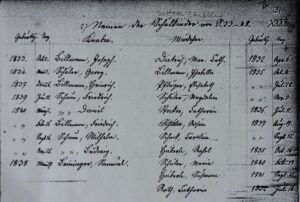
Children of Johann Georg Schumm II & wife Anna Maria (Fischer), from Ruppertshofen Familienbuch, Ancestry.com Image 829/1244

The children of Johann George II and Anna Maria (Fischer) Schumm:

Their first child, Johann Georg Schumm, was born 6 December 1807 and was baptized 8 December 1807. Among his baptismal sponsors was his uncle Johann Albrecht Schumm. Johann Martin Stapf is mentioned after Johann Albreccht’s name. Johann Albrecht Schumm was Johann Georg Schumm II’s younger brother who died in 1813 from wounds he received during the battle of Leipzig. Johann Martin Stapf was Johann Georg Schumm II’s step-father. It looks like the letters S.G.V. follow Johann Martin Stapf’s name and I wonder if they are an abbreviation for Stiefgrossvater or Step-grandfather. Johann Albrecht Schumm was a baptismal sponsor and Johann Martin Stapf is mentioned after his name for the children in this family who were born through 1812. The child Johann Georg died less than two weeks later, on 18 December 1807 and was buried on the 20th.

Their second child, George Michael Schumm, was born 25 November 1808, baptized 26 November 1808, and was confirmed in 1822. He died of consumption on 19 Jul 1831 and was buried on the 21st.  He was 22 years, 7 months, and 21 days old and never married. Just two years later his father and five of his siblings came to America. Johann Albrecht Schumm was one of the baptismal sponsors and Johann Martin Stapf’s name is mentioned after his. 

Their third child, Maria Katharina, was born 20 April 1810, baptized 22 April 1810, and was confirmed in 1824. Johann Albrecht Schumm was one of the baptismal sponsors and Johann Martin Stapf’s name is mentioned after his. Maria Katharina immigrated to America with her father and her 4 brothers in 1833.

It was interesting to find an additional child born to Johann Georg and Anna Maria Schumm. This child, their fourth, is not included in our Schumm history but is included on Johann Georg’s Familienbuch page with his other children, an entry of the child’s birth and baptism. Their fourth child was born 21 October 1811, was baptized, and died that same day. Four sets of baptismal sponsors were listed, Johann Albrecht Schumm was one of the baptismal sponsors and Johann Martin Stapf’s name is mentioned after his. However, they did not name this child and the word totgeboren was used in the record, meaning stillborn. Perhaps the child lived a short time.  

Schumm, unnamed child of JG II & AM (Fischer) Schumm, born & died 21 Oct 1811, Ancestry.com image 635/1108

Their fifth child, Georg Martin, was born 20 November 1812 and was baptized 24 November 1812. Johann Albrecht Schumm was among the baptismal sponsors and Johann Martin Stapf’s name is mentioned after his.  Georg Martin Schumm was confirmed in 1826 and immigrated to America with his father, 3 brothers, and sister in 1833.

Their sixth child, Johann Friedrich, was born 24 April 1814, baptized 27 April 1814, and was confirmed in 1828. He immigrated to America with his father, 3 brothers, and sister in 1833.

Their seventh child, Johann Jacob, was born 26 September 1815, baptized 29 Sep 1815, and confirmed in 1829. He immigrated to America with his father, 3 brothers, and sister in 1833.

Their eighth child, Georg Ludwig, was born 4 March 1817, baptized 6 March 1817, and confirmed in 1831. He immigrated to America with his father, 3 brothers, and sister in 1833.

Their ninth child, Maria Rosine, was born 19 March 1818 and was baptized 20 March 1818. She died of consumption on 20 January 1819, aged 9 months and 29 days. She was buried on 22 January.

Their tenth child, Anna Maria, was born 29 October 1819 and was baptized 1 November 1819. She died on 2 November 1819 from what looks like, when translated, arthritis or gout. She was only 3 days old.

Their eleventh child, Maria Rosine II, was born 6 March 1821, baptized 8 March 1821, and was confirmed 20 April 1834. She remained in Germany after her father and her 5 siblings emigrated to America. Maria Rosine died of complications from childbirth on 27 March 1843. Her child, Margaretha Barbara Schumm, was born 2 February 1843, baptized 28 February, and died 22 May 1843.

Margaretha Barbara Schumm, b.2 Feb 1843, d.22 May 1843, d/o Maria Rosine II, Ancestry.com image 821/1108

This last bit of information is probably new information for most reading this.

The names of baby Margaretha Barbara Schumm’s baptismal sponsors are difficult to read but I wonder if they might have been relatives, aunts or uncles from the maternal Fischer side of the family. That will need more research. I assume one of them took care of baby Margaretha Barbara after Marie Rosine II died. The baby girl lived nearly two months after the mother’s death.

One wonders why the youngest daughter, Maria Rosine II, did not travel to America in 1833 with her father and siblings. She was only 12 years old when they left. Who did she stay with after they lelft? Her 73-year-old step-grandfather Johann Martin Stapf? Did he raise Maria Rosine II after the rest of her family left for America? Or did she, at age 12, take care of him? Or did she stay with one of her Fischer aunts or uncles? Her mother had several living siblings at that time.  

We will probably never know for sure why Maria Rosine stayed behind in Ruppertshofen, but here are couple theories.

The Schumm history says “…Maria Rosine II remained behind in Germany to be a comfort to the maternal grandparents in their declining years. Originally it had been planned to have her follow later but she did not survive the grandparents, dying March 27, 1843…”

However, all four of her biological grandparents were deceased by the time her father and 5 siblings left for America in 1833. Paternal grandparents Johann George Schumm I died in 1791 and his widow Anna Margaretha (Franz) Schumm Stapf died in 1819. Maternal grandparents Georg Michael Fischer died in 1821 and his wife Anna Maria Hohenstein) Fischer died in 1818. The only remaining grandparent was Maria Rosine II’s step-grandfather, widower Johann Martin Stapf, the second husband of her paternal grandmother Anna Margaretha (Franz) Schumm. They married in 1792. Stapf was 12 years younger than Anna Margaretha but nonetheless was probably a father figure to Johann George Schumm II and grandfather to Johann Georg II’s children. Stapf’s name shows up in a number of the family’s church records, such as Johann Georg Schumm II and Anna Maria Fischer’s marriage record and the baptismal records of their first five children. So Stapf was actively involved in the family. Stapf was 73 years old when the Schumm family immigrated to America and Maria Rosine II may have stayed behind to care for him. He and Maria Rosina II probably could have traveled to America with the rest of the family. Was Johann Martin Stapf in ill health? Was he too old to travel? Or was money an issue? Emigrating was costly. Johann Martin Stapf lived another 10 years and died in Ruppertshofen 16 December 1843, residing in that town the rest of his life.

Another theory is that perhaps Johann George Schumm II thought the American frontier was too dangerous and uncertain for young Maria Rosine II, who was only 12 years old in 1833.

I have a theory of my own. I noticed that Maria Rosine II was confirmed in 1834, a year after the rest of her family left Germany. When her family left Germany in 1833 Maria Rosine II would have been in the middle of her Catechism instruction. Their faith was very important to the Schumms and perhaps her father Johann Georg II thought it was more important for Maria Rosine to complete her religious education in Germany, rather than in America, and be confirmed in the church the family had attended for decades. Their church in Ruppertshofen was a sure thing. America was an unknown.

One additional thing to note, concerning Maria Rosine II and her baby. In the first half of the 1800s, in some areas of Germany, particularly in Wuerttemberg, it could be very difficult to get permission to marry. The Community Council/Village Council would grant a couple permission to marry if they felt the couple could support a family. It was all about money. If you had money you could get permission to marry. I attended a conference session a few years ago and the speaker told that for about 10 years one pair of his German ancestors could not get permission to marry, but in the meantime they went ahead and had several children. They started their family while waiting for permission to marry. When you think about that, what’s the point? They started their family and had children anyway, with or without being legally married.

I am not saying this was Maria Rosina’s situation, but she was probably not wealthy and, knowing the way things were in Germany two hundred years ago, it is something to consider.  

That’s the Johann Georg Schumm history, as recorded in the Ruppertshofen church records. It is a story with some sad and unfortunate endings, but also a story with many good endings. It is a family story and legacy that continued on in a new land.

I wonder if Johann Georg Schumm II ever imagined that he would have such a large number of descendants and that his legacy and the faith he nourished would continue on for generations.

I will share any “new” information, if discovered.