Nimrod Headington Journal, 1852, part 6

Trip to California.

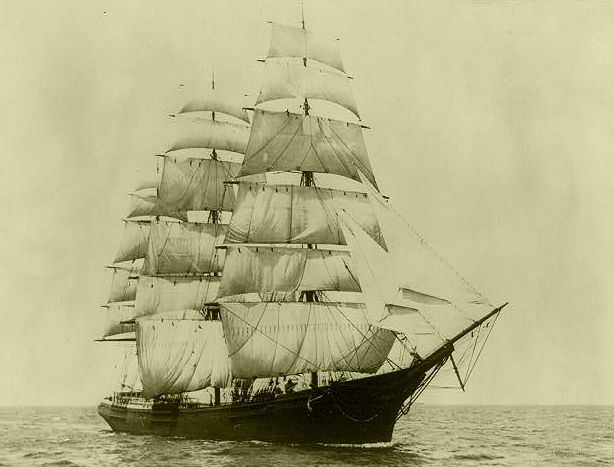
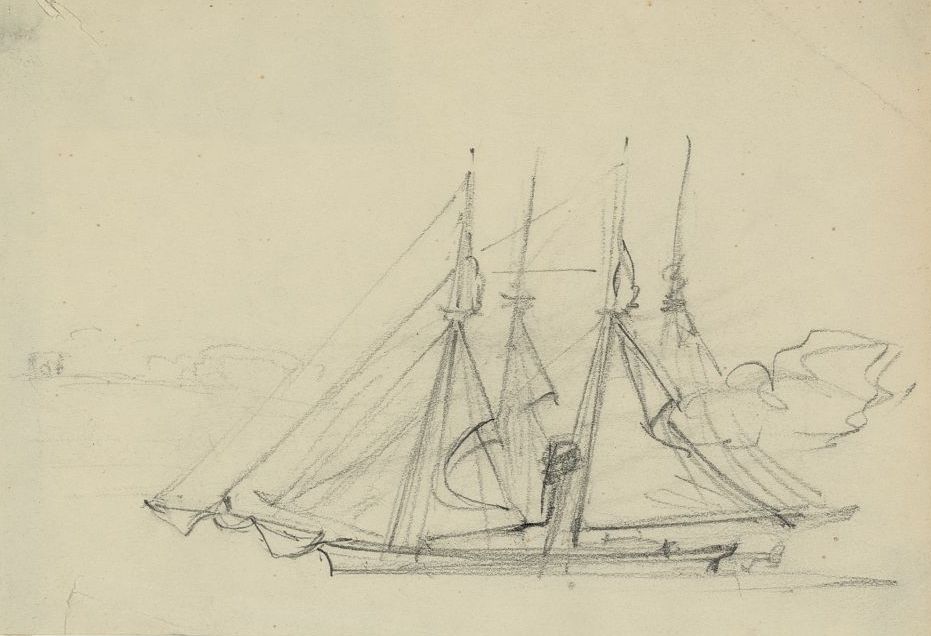
That is what Nimrod Headington [1] called his journal, which details his journey by ship, sailing from New York to the California gold fields in 1852. [2]

This is the sixth in a series of blog posts, the transcription of Headington’s 1852 journal.

Nimrod Headington (1827-1913)

Today’s installment begins on 5 May 1852. They had just sailed around  Cape Horn and were now sailing on the Pacific Ocean.

THE PACIFIC OCEAN

May 5th. This morning we ate breakfast on the Pacific, doubling the cape in the night. The weather was very cold and rough, and the snow fell 4 inches deep on the deck. The next morning a Mrs. Harper from New York, an elderly lady, died at 10 o’clock. She was a very weakly woman when she [died], and she lived far beyond our expectations. She was a widow and had a son in California, also a son and two daughters on board. We saw a number of whales that day, some of the quite close to us. The next day at 2 o’clock, we attended the funeral of Mrs. Harper. The service was read, a hymn sung, and the body was consigned to its watery grave.

The next day the wind blew powerful hard. We came in sight of the western coast of Patagonia and was drifting right toward it. Had it been in the night, we should have run ashore or on the rocks, for the coast along there is very rough and rocky. But we discovered it in time to tack ship and get away.

May 11th. Tremendous storm last night. Sea so rough, and the ship rocked so badly that we had to hold on to our bunks all night to keep from rolling out. Under such circumstances you can easily guess how much we slept. We ran under close-reefed topsails and mizzensails all night. The next night at 8 o’clock Miss Sarah Place died, a daughter of the old man spoken of a being in irons. The next morning we assembled in the cabin to attend the funeral of the deceased lady.  

May 12th. It rained all day and was very dark and foggy. We headed due north with very light winds. In rainy weather at sea, the sea is always smooth. Let the sea be ever so rough and then comes a hard rain, the sea will become calm in a very short time. 

May 13th. The rain continued to fall without ceasing all that day. A man named Alex Black died at 8 o’clock that night and was buried the same hour without any service. This man was from Connersville, Ohio. He was a very nice young man, always cheerful and jolly, going to seek his fortune before marrying the girl he left behind, as one of her comrades told me the sad story of his betrothed and the young lady’s parents objecting on account of his poverty. The death of this young man was mourned by all on board. A death or funeral at sea is always sad, but this was the saddest of all to me.

Before leaving New York, I wished for my wife and family to accompany me, but after I had been out to sea two weeks, I rejoiced that they were not with me. When I saw the wife of Mr. Beesley, a young woman who only a few hours before her death seemed the very picture of health and bid fair for as long life as any of us, buried in the deep blue waters of the great ocean. This was our first death and burial at sea and made us all no doubt all of us thought, “Shall this be my fate?” “Shall I be buried in the sea?” For we all knew that God was no respecter of persons. That when his call comes, we must obey. Sad, sad is a burial at sea.  

May 14th. The sun came out and the captain was able to take the sun’s altitude—the first for several days. This is the only certain means of telling just what latitude and longitude [you] are in. All other means is uncertain half guesswork.   [3]

To be continued…

I will post Nimrod’s journal in increments, but not necessarily every week.

[1] Nimrod Headington (1827-1913) was the son of Nicholas (1790-1856) and Ruth (Phillips) (1794-1865) Headington. He was born in Mt. Vernon, Knox County, Ohio, on 5 August 1827. He married Mary Ann McDonald (1829-1855) in Delaware County, Ohio, in 1849. Nimrod moved to Portland, Jay County, Indiana, by 1860 and a couple years later served in the 34th Indiana Infantry during the Civil War as a Colonel, Lieutenant Colonel, and Major. Nimrod died 7 January 1913 and is buried in Green Park Cemetery, Portland. Nimrod Headington is my fourth great-granduncle, the brother of my fourth great-grandfather, William Headington (1815-1879).

[2] Nimrod Headington at the age of 24, set sail from New York in February 1852, bound for San Francisco, California, to join the gold rush and to hopefully make his fortune. The Panama Canal had not been built at that time and he sailed around the tip of South America to reach the California coast.    

Nimrod Headington kept a diary of his 1852 journey and in 1905 he made a hand-written copy for his daughter Thetis O. Tate. This hand-written copy was eventually passed down to Nimrod’s great-great-granddaughter, Karen (Liffring) Hill (1955-2010). Karen was a book editor and during the last two years of her life she transcribed Nimrod’s journal.

Nimrod’s journal, “Trip to California,” documents his travels between February of 1852 and spring of 1853.

[3] Nimrod Headington’s journal, transcription and photos courtesy of Ross Hill, 2019, used with permission.


Tombstone Tuesday–John G.C. Geisler

John G.C. Geisler, Zion Lutheran Cemetery, Van Wert County, Ohio. (2012 photo by Karen)

This is the tombstone of John G.C. Geisler, located in row 11 of Zion Lutheran Cemetery, Schumm, Van Wert County, Ohio. The marker is inscribed:

JOHN G. C.
Nov. 18, 1866
Jan. 7, 1916
Text: St. Mark, 13:35-37
GEISLER

Johann “John” George Conrad Geisler was born near Schumm, Ohio, on 18 November 1866, the son of Nicholas and Elisabeth (Stemler) Geisler. John was baptized 2 December 1866, with Georg Geisler and Conrad Baals serving as his sponsors.

The Nicholas Geisler family in 1870, living on their farm in Willshire Township: Nicholas, 38; Elisabeth, 41; George, 6; and John 4. [1] A daughter, Anna, was born into the family in the fall of 1870.

The Nicholas Geisler household in 1880, residing in Willshire Township: Nicholas, 49; Elisabeth, 50; George, 16; John, 13; and Anna J, 9. [2]

The Nicholas Geisler family in 1900: Nicholas, 66; Elisabeth, 72; George, 34; John, 32; and Anna, 30. Nicholas was a farmer and none of their 3 children were married. [3]  

The mother Elisabeth Geisler died May 12, 1905. [4]

The Nicholas Geisler household in 1910: Nicholas, 77; George, 46; John, 43; and Anna, 41. The two sons were farming the family farm by this time. [5]

The father Nicholas Geisler died in 1912. [6] It appears the three children remained on the family farm.

John G.C. Geisler died in Willshire Township on 7 January 1916 from Bright’s Disease, heart disease, and dropsy, which he had for several months. He was 49 years, 1 month, and 19 days old and was buried on the 9th. [7] John was a farmer and was survived by his brother and sister, George and Anna Geisler.

Nicholas and Elisabeth (Stemler) Geisler had the following children, according to Zion Schumm’s records:

George Johann Conrad (1864-1943)
Johann George Conrad (1866-1916)
Christoph (1869-1869)
Anna Johanna (1870-1934)

[1] 1870 U.S. Census, Willshire, Van Wert Ohio, p.436B, dwelling 97, family 98, Nicholas Geisler; digital image by subscription, Ancestry.com (https://www.ancestry.com/search/collections/7163/ : viewed 17 Feb 2020).

[2] 1880 U.S. Census, Willshire, Van Wert, Ohio, ED 154, p.446C, family 56, N. Gaesler; digital image by subscription, Ancestry.com (https://www.ancestry.com/search/collections/6742/ : viewed 17 Feb 2020).

[3] 1900 U.S. Census, Willshire, Van Wert, Ohio, ED98, dwelling 198, family 203, Nicklos Giessler;  (https://www.ancestry.com/search/collections/7602/ : viewed 17 Feb 2020).

[4] “Ohio, County Death Records, 1840-2001,” Willshire Township, Van Wert, Deaths, Vol. 3, p.85, Elizabeth Giessler, 12 May 1905; (https://www.familysearch.org/ark:/61903/1:1:F6L3-N97 : viewed 17 Feb 2020).

[5] 1910 U.S. Census, Willshire, Van Wert, Ohio, ED 114, p.3B, dwelling & family 65, Nicholas Geisler; digital image by subscription, Ancestry.com (https://www.ancestry.com/search/collections/7884/ : viewed 17 Feb 2020).

[6] “Ohio, County Death Records, 1840-2001,” Willshire Township, Van Wert, Nicholas Geissler, 15 Feb 1912; (https://www.familysearch.org/ark:/61903/3:1:3QS7-89ZY-T21G?i=88&cc=2128172&personaUrl=%2Fark%3A%2F61903%2F1%3A1%3AF6CF-L2Y : viewed 17 Feb 2020).

[7] “Ohio Deaths, 1908-1953,” Van Wert, John J Geisler, 7 Jan 1916; FamilySearch.org  (https://www.familysearch.org/ark:/61903/3:1:33S7-9PK3-3L9J?i=2455&cc=1307272&personaUrl=%2Fark%3A%2F61903%2F1%3A1%3AX8FY-N46 : viewed 3 Mar 2020).

Nimrod Headington Journal, 1852, part 5

Today, the fifth in a series of blog posts, the transcription the 1852 journal of Nimrod Headington, my fourth great-granduncle. [1]

Nimrod Headington (1827-1913)

Nimrod Headington (1827-1913), at the age of 24, set sail from New York in February 1852, bound for San Francisco, California, to join the gold rush. The Panama Canal had not been built at that time and he sailed around the tip of South America to reach the California coast.    

Nimrod Headington kept a diary of his 1852 journey and in 1905 he made a hand-written copy for his daughter Thetis O. Tate. This hand-written copy was eventually passed down to Nimrod’s great-great-granddaughter, Karen (Liffring) Hill (1955-2010). Karen was a book editor and during the last two years of her life she transcribed Nimrod’s journal.

Nimrod’s journal, “Trip to California,” documents his travels between February of 1852 and spring of 1853.

Today’s installment begins on 10 April 1852, as they sailed toward The Cape, Cape Horn. Their ship had left the port of Rio de Janeiro, Brazil, the evening before.

TO THE CAPE

The next day, we had fair winds and fair weather. We headed southwest by west and were running 10 knots an hour. Several of the passengers were sick. The wind continued about the same. The next day was Sunday, and a shark was seen following our ship. An old sailor whose turn it was to be at the helm that day looked back and saw the shark, and he said, “Look out, boys. Some of us will go overboard before 24 hours, sure enough.” Before the sun set, a man named Richard Frome died and was buried. The next morning at four o’clock. Another man, Andrew Loots, died.

April 13th. Very high winds and rough seas. So much so that the captain said at noon when he was taking the sun’s altitude that it was the heaviest sea that he ever had seen. The next day, the wind and sea ran down, and it was almost a calm. We caught an albatross, a very large bird. It measured twelve feet from tip to tip. They have very large feet but cannot walk. They live principally on the sea and subsist upon small fish and the crumbs from ships. Again the shark appears after our ship. The next day two men died, one by the name of Jessie Morgan of Staten Island and a man named Pickett from the state of Maine. The next day, it was quite calm all day. There were several sick, but none considered dangerous. We were in better heart and hoped that we would not have to bury any more of our fellow passengers in the sea. We were is latitude 30°20’ south. The next day we had fair winds. We headed south by west in latitude 34°40’. We came opposite the Lapatta river [Rio de la Plata], where sailors have to look out for squalls and hard storms. This place is about two hundred miles wide and a very stiff current. We were fortunate in getting through it without encountering any storms. The next day, it rained all day and night so that we had to stay below, and we suffered for want of ventilation.  

Monday, April 16th. The rain ceased, and it cleared off again, and we had fine winds and running 13 knots an hour. 

April 17th. Running at same rate per mile, or knot. We are now in latitude 40°25’, longitude 31°11’. 

April 21st. This morning it is very pleasant. The sailors are engaged in lashing all the casks and barrels to the deck. At 4 p.m. a severe gale came up and blew very hard all night. We were in latitude 43°14’, longitude 32°2’. The next morning, the wind was still blowing very hard, Two of the sailors were at work on the bow of the ship adjusting some ropes when a heavy sea struck the ship that came over the deck and swept one of the sailors off that was working on the bow. Instantly, the cry was, “A man overboard!” A passenger who had great presence of mind sprang to the larboard side of the ship and threw a rope over the side of the ship, and the struggling sailor caught it and was hoisted on board. The water was extremely cold, and the poor fellow was almost frozen.   

April 22d. We encountered a hard storm that lasted 12 hours. We had to close reef the [topgallant sail] and topsails and ran so all day. We had a lottery on board gotten up by the passengers. The prize was a gold watch. Charles Hope was the lucky man.

April 23d. The storm has abated, and we had good sailing, but it is so very cold that we could not stay on deck. Last night a man named Moore had seventy-five dollars stolen out of his carpet bag, which caused quite an excitement, for we thought we had no thieves on board, and one would have thought that this would have been the last place to commit a theft in mid-ocean, when there was no possible chance for escape. All were wondering who the thief could be, but they did not wonder long, for the next morning a man named John North came out with a subscription to make up the amount of the money stolen, and suspicion fell upon him at once that he was the thief, and he soon had to stem the tide, for everybody was pointing at him, and he took another man below and handed him the money to give back to the man begging for money. Say that this was his first offense and should be the last, but he was put into irons and sentenced to leave the ship when we should land at Valparaiso, Chile. At five o’clock on that day, a man named Mathew Stout died and was buried in a few minutes after death. That night was very dark and cold, and the snow fell 2 inches deep upon the deck of the ship. We are now in latitude 51°20’.  

The next morning, it was calm, which is a very uncommon thing in this latitude at this time of year. Old Prince said, “Look out. We always have a storm after a calm in this region.” At twelve o’clock a gentle breeze set in from the northwest, and we were running 4 knots an hour. Another ship came in sight but not close enough to speak.

Sunday it stormed all day so that we had to stay below. The wind blew so hard that it took four men at the helm with rope and tackle to manage the ship to keep it from foundering. The ship ran quartering toward the land and made leeway very fast. So the next morning, we had to tack ship and run west by south. The next day, we had fair winds again. Two men died—Francis Allen and William Bathgate—and buried the same hour. Died of yellow fever. Took sick on Tuesday and died the following Friday. They were taken with diarrhea and pain in the head, soon becoming deranged and remaining so until death relived them.

A man named Place with two daughters from Ann Arbor, Michigan, were among our passengers. One of the daughters made an ugly charge against her father, and the old man was put in irons, but he did not stay in irons long. Promising to do better, he was released.

The next morning, we came in sight of land. This cry of “Land, ho!” caused great excitement on board, some contending it was land and others that it was not. Some cursing the officers of the ship for running so close to it, while others were rejoicing at the sight of land. The land we had sighted was a small island off the south end of Cape Horn.  The next day we had fine sailing, and the captain said to us that we could eat supper off the Pacific Ocean. Supper came, and we were not on the Pacific, and we had sauerkraut and gingerbread for supper, of which we partook with a relish, as we had appetites for anything eatable. The wind continued from the same direction, and the land, heading northwest. We had beans and soft tack for supper but not on the Pacific yet. [2]

To be continued…

It is very interesting to read all the details of his travel by ship. I wonder if the families of those who died on the ship and who were buried at sea ever knew what happened to their loved ones. Or if they just sailed away, never to be heard from again.

I will post Nimrod’s journal in increments, but not necessarily every week.

[1] Nimrod Headington, the son of Nicholas (1790-1856) and Ruth (Phillips) (1794-1865) Headington, was born in Mt. Vernon, Knox County, Ohio, on 5 August 1827. He married Mary Ann McDonald (1829-1855) in Delaware County, Ohio, in 1849 and they had a son a year later. Nimrod moved to Portland, Jay County, Indiana, by 1860 and a couple years later served in the 34th Indiana Infantry during the Civil War as a Colonel, Lieutenant Colonel, and Major. Nimrod died 7 January 1913 and is buried in Green Park Cemetery, Portland. Nimrod Headington is my fourth great-granduncle, the brother of my fourth great-grandfather, William Headington (1815-1879).

[2] Nimrod Headington’s journal, transcription and photos courtesy of Ross Hill, 2019, used with permission.

Tombstone Tuesday-Anna J. Geisler

Anna J Geisler, Zion Lutheran Cemetery, Van Wert County, Ohio. (2012 photo by Karen)

This is the tombstone of Anna J. Geisler, located in row 6 of Zion Lutheran Cemetery, Schumm, Van Wert County, Ohio. The marker is inscribed:

Anna J.
GEISLER
Sept. 11, 1870
June 11, 1934
St. John 8:51

Anna Johanna Geisler was born in Willshire Township on 11 September 1870, the daughter of Johann “Nicholas” and Elisabeth (Stemling) Geisler. She was baptized 18 September 1870, with Mrs. Hanna Steger and Mrs. Anna Baals as her sponsors. Both of her parents were German immigrants.

Anna was born a couple months after the 1870 census was taken and therefore not enumerated in it.  

The Nicholas Geisler household in 1880, residing in Willshire Township: Nicholas, 49; Elisabeth, 50; George, 16; John, 13; and Anna J, 9. [1]

The Nicholas Geisler family in 1900: Nicholas, 66; Elisabeth, 72; George, 34; John, 32; and Anna, 30. This enumeration indicates that Nicholas and Elisabeth had been married 38 years and that Elisabeth had given birth to 3 children, all of whom were still living. Nicholas was a farmer and none of their 3 children were married. Nicholas immigrated in 1849 and Elisabeth in 1853. [2]  

The mother Elisabeth Geisler died May 12, 1905. [3]

The Nicholas Geisler household in 1910: Nicholas, 77; George, 46; John, 43; and Anna, 41. The two sons were farming the family farm by this time. [4]

The father Nicholas Geisler died in 1912 [5] and George and his sister Anna continued to reside in the family home in 1920 [6] and in 1930. [7]

Anna Geisler died in Willshire Township on 11 June 1934 in Willshire Township, at the age of 63 years and 9 months. Her cause of death was a from a cerebral hemorrhage, intestinal infection, and arterial sclerosis. She was buried on the 14th. [8] Anna never married.

I was surprised to see that my maternal great-grandmother, Elizabeth (Schinnerer) Scaer, wife of John Scaer, was the informant for the information on Anna’s death certificate. Anna and Elizabeth must have been fairly close friends and neighbors. Elizabeth Scaer provided a different maiden name for Anna’s mother. Anna’s mother Elisabeth married Nicholas Geisler as a Stemling/Stemler, but the church records indicate that she was a widow when they married. Elizabeth Scaer gave her maiden name as Coffet. Interesting.

Nicholas and Elisabeth Geisler had the following children, according to Zion Schumm’s records:

George Johann Conrad (1864-1943)
Johann George Conrad (1866-1916)
Christoph (1869-1869)
Anna Johanna (1870-1934)

[1] 1880 U.S. Census, Willshire, Van Wert, Ohio, ED 154, p.446C, family 56, N. Gaesler; digital image by subscription, Ancestry.com (https://www.ancestry.com/search/collections/6742/ : viewed 17 Feb 2020).

[2] 1900 U.S. Census, Willshire, Van Wert, Ohio, ED98, dwelling 198, family 203, Nicklos Giessler;  (https://www.ancestry.com/search/collections/7602/ : viewed 17 Feb 2020).

[3] “Ohio, County Death Records, 1840-2001,” Willshire Township, Van Wert, Deaths, Vol. 3, p.85, Elizabeth Giessler, 12 May 1905; (https://www.familysearch.org/ark:/61903/1:1:F6L3-N97 : viewed 17 Feb 2020).

[4] 1910 U.S. Census, Willshire, Van Wert, Ohio, ED 114, p.3B, dwelling & family 65, Nicholas Geisler; digital image by subscription, Ancestry.com (https://www.ancestry.com/search/collections/7884/ : viewed 17 Feb 2020).

[5] “Ohio, County Death Records, 1840-2001,” Willshire Township, Van Wert, Nicholas Geissler, 15 Feb 1912; (https://www.familysearch.org/ark:/61903/3:1:3QS7-89ZY-T21G?i=88&cc=2128172&personaUrl=%2Fark%3A%2F61903%2F1%3A1%3AF6CF-L2Y : viewed 17 Feb 2020).

[6] 1920 U.S. Census, Willshire, Van Wert, Ohio, ED 146, p.6B, dwelling 128, family 129, George Geisler;  digital image by subscription, Ancestry.com (https://www.ancestry.com/search/collections/6061/ : viewed 17 Feb 2020).

[7] 1930 U.S. Census, Willshire, Van Wert, Ohio, ED 24 , p.4B dwelling 81, family 81, George JC Gusler; digital image by subscription, Ancestry.com (https://www.ancestry.com/search/collections/6224/ : viewed 23 Feb 2020).

[8] “Ohio, County Death Records, 1840-2001,” Willshire Township, Van Wert, Anna J Geisler, 11 Jun 1934; (https://www.familysearch.org/ark:/61903/3:1:S3HT-68NH-CK?i=1852&cc=1307272&personaUrl=%2Fark%3A%2F61903%2F1%3A1%3AX67H-LRV : viewed 22 Feb 2020).

Oil Field Debris, early 1900s

Today I am taking a break from Nimrod Headington’s journal that details his journey to the California gold mines via sailing around South America. I will resume his journal in a week or two.

Instead, I am returning to the time of the turn of the century oil boom.

While going through some old photos the other day I came across this photo, which was obviously taken in an oil field. You can see some oil rigs in the distance.

Oil field debris, c. early 1900s, location unknown.

This photo was with a group of Miller photos, so it could have been taken here in Mercer County years ago. There were oil wells near Chatt, but I have a hunch the photo was probably taken out west, where two Miller brothers worked and died in the early 1900s. Chris and Jacob Jr worked in the oil fields of California, Oklahoma, and Texas. [1]

I have looked at this photo before but I never really gave it much thought. This time, as I studied it, I wondered why in the world someone would have a photo of some debris and damaged oil equipment. The photo is mounted on heavy stock and there is absolutely no writing on. There is no photographer’s name nor any identification written on the back.

But the photo obviously meant something to somebody at one time.

I am not even sure what I am looking at, since I do not understand the steps taken after oil was pumped from the ground. This is just a guess, but perhaps these are crude oil distillation devices, heated by furnaces, that were used to heat and separate the crude oil into its different components. There are pipes, valves, and gauges situated above what looks like distillation devices.

There is a lot of wood and corrugated sheet metal debris around, which makes me wonder if all that debris wasn’t originally a building that housed the distillation tanks.

What caused all this damage?

Was there a tornado? An earthquake? An explosion?

Jacob Miller Jr was killed when an oil derrick fell on him near Cushing, Oklahoma, in 1913. This photo does not appear to be related to that accident. But, who knows?

Unfortunately, I will probably never know where or when this photo was taken.

I would love to hear from someone with knowledge about the oil drilling and distillery industry years ago, who may have more insight into this photo.  

Below is a photo of one of the Miller brothers standing by some oil tanks out west.

One of the Miller brothers, to the left.

[1] Half-brothers Chris Miller and Jacob Miller Jr were my great-uncles. Chris (1880-1911) was the son of Jacob Miller and his second wife Margaretha Strabel. Chris died in Texas, from typhoid fever. Jacob Jr (1885-1913) was the son of Jacob Miller and his third wife Christena Rueck. Jacob Jr was killed when an oil derrick fell on him in Oklahoma. My grandfather Carl Miller (1896-1973) was a full brother to Jacob Jr.