Tombstone Tuesday-John, John Jr, & Jacob Rodes

John, John Jr, & Jacob Rodes, Zion Lutheran Cemetery, Van Wert County, Ohio. (2012 photo by Karen)

This is the tombstone of John Rodes Jr, Jacob Rodes, and John Rodes, located in row 3 of Zion Lutheran Cemetery, Schumm, Van Wert County, Ohio. The marker is inscribed:

John Rodes, Jr
Died
May 29, 1851
Aged
55 Y’s, 27 D’s

Jacob Rodes
Died
Aug. 4, 1846
Aged
44 Y’rs, 5 M

John Rodes
Died
16 Aug 1843
Aged
88 Y’s

The names inscribed on this old marble tombstone are somewhat of a mystery. The surname on the tombstone clearly looks like Rodes, but the name in Zion’s church records, written in the old German script, looks like Roth.

Zion Schumm’s death records begin in 1846, so the older John’s death is not recorded there. But the other two deaths and burials are recorded, but both are recorded as what looks like the name “Roth.”

Jacob “Roth” died 4 August 1846, according to his tombstone. He was 44 years, 4 months, and 26 days old and was buried on the 8th, according to the church records. His calculated date of birth would be 9 March 1802.

John “Roth” [Jr] died 31 May 1851 at 9:00 at night, aged 54 years, 11 months, and 2 days.  He was buried on 2 June, all according to the church records. His death date in the church records differs slightly from that on the tombstone. His calculated date of birth would be about 29 June 1796.

The third name, inscribed on the south face of the tombstone, is that of John Rodes [Sr], who died 16 August 1843, at the age of 88 years. His calculated date of birth would be about 1755.

The inscription could be that of a father and his two sons.

I found neither of these surnames (Roth/Rodes) in a search of Willshire Township in the 1840 and 1850 censuses.

In addition, there is a flagstaff by the tombstone. Did the elder Rodes serve in the Revolutionary War or the War of 1812?  

Nimrod Heading Journal, 1852, part 11

Today’s blog post is the eleventh in a series, the transcription of Nimrod Headington’s 1852 journal.

Trip to California, Nimrod Headington’s journal that details his 1852 voyage from New York to San Francisco, where he would stake his claim and pan for gold. [1] [2]

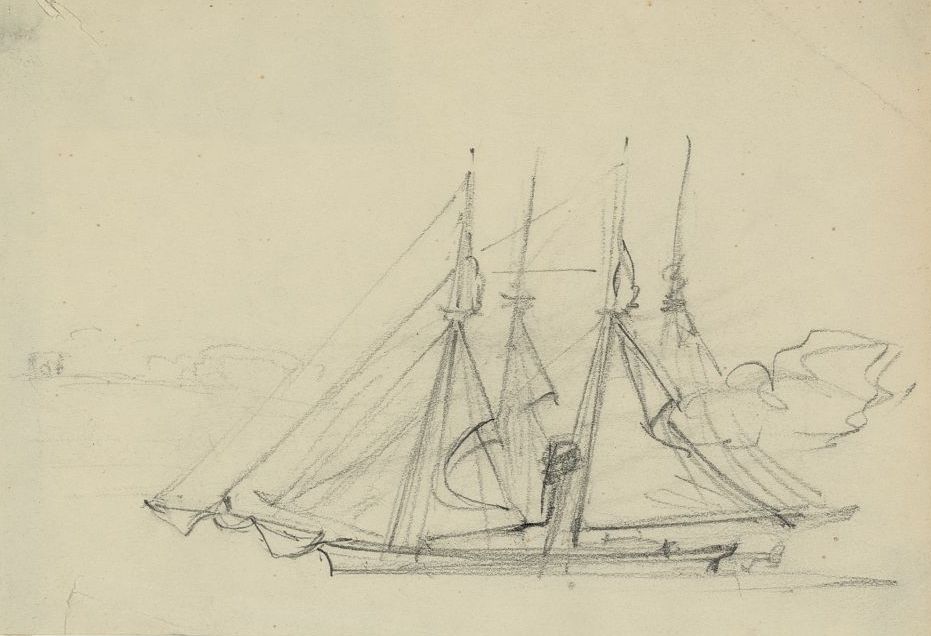
The ship set sail from New York on 16 February 1852 and rounded Cape Horn during the night of 4 May. Today’s installment begins as they sail toward the Equator, just a week away from the longest day of the year.

June 10th. We had fine sailing. The day was clear and bright sun shone. We headed northwest by west and ran 9 knots and hour.

June 11th. The wind still continues from the same direction. This is the eighth day that we had the wind from the same quarter. It did not vary one point in the five days our course was northwest. In latitude 19°24’.

June 13th. Sunday. The weather is very fine, and the same good old breeze sending our ship on its course. We spent the day reading the Bible and other useful books and singing songs. We had lots of good singers on board, and we made the fishes of the sea come up to the surface to see what the noise meant. Sometimes a hundred and fifty or two hundred would join in some chorus.

There was a man on board with two little children that were very interesting—a girl and a boy. The little boy’s name was Jack. I thought of my own little boy I had left at home. I would take him up often and imagine it was Charley. He had light hair and looked like my boy.

June 14th. We struck the southeast Trade Winds and had fine sailing, running 9 knots an hour in latitude 14°55’.

June 15th. Winds continued the same and running at same rate in latitude 12°18’, longitude 92°15’.

June 16th. Wind not quite so strong, but we ran 8 knots an hour. We had a lottery on that day. The prizes were gold watches. Now in latitude 10°9’, longitude 95°8’.

June 17th. We were sailing on with same Trade Winds, still heading northwest with wind right aft, running 10 knots and hour. The ship ran so steady that not a rope was changed during the day or night. The thermometer stood at 95° in latitude 8°15’, longitude 96°14’. 

June 18th. The day was clear, and the sun was hot. Had it not been for the good breeze that still kept up, we should have suffered, for we had no awning up to keep the sun off of us. We saw a finback whale off our lee bow only a short distance from us. This was a different kind of the whale family from what we had seen before. Thermometer 80° in latitude 6°36’, longitude 98°17’.

June 19th. Our good wind still continued and increased in volume, and if there ever was a merry set of men, we of the ship Race Hound were among the merriest of all: after having rocked and tossed around Cape Horn, we began to think of the poem Whatever Is Is for the Best:

Wherefore repine at fortune’s frowns
Sorrow must be thy frequent guest
In every trial think of this:
Whatever is is for the best.

Despair not though thou seldom finds
From care a momentary rest
Press on in faith and fullest hope
Remembering all is for the best.

When sad misfortunes weigh you down
And dark forebodings haunt the breast
Be this thy beacon light through all
Whatever is is for the best.

Then trust in God if you would find
Beyond the great eternal rest
For orders he not all aright
Whatever is is for the best. 

These lines were corresponded by my bunkmate Richard Bliss from Flint, Michigan, a capital good fellow and such a man as I love to meet on such a voyage as this. He was always cheerful and happy. Late this afternoon we had several squalls and light shower s of rain, but nothing serious happened.

June 20th. Sunday came, and the sun shone brightly—not a cloud in the heavens and a most glorious breeze from the west, which was cool. And it was so pleasant that all seemed to rejoice. The awning was spread to keep the sun off or else we should have suffered with heat. But with this and the cool wind that carried so rapidly along, we were quite comfortable. We spent the day in a variety of ways: some reading, some writing, some singing. As for myself, I spent the day reading the Bible, pacing to and from on the deck. My thoughts were constantly on home and the privileges they were enjoying in going to church or of visiting friends that beautiful day, while I was confined to the decks of a ship in the middle of the Pacific Ocean. This seemed the most like a Sabbath day of any day since the beginning of our voyage. The sailors were all still, and the passengers—those of them given to profanity—had in a great measure reformed since the death of so many of their fellow travelers who had fallen victim of a watery grave.  

The thermometer stood at 90° in latitude 2°3’.


June 21st. Our winds were very light, the sky bright and clean. At 12 o’clock noon, we were within 29 miles of the equator and at the rate we are funning we will cross the line about 9 o’clock tonight. We saw a sperm whale close to our ship—the largest we had seen.

June 22nd. On this day the sun reaches its northern extremity and is 22 ½ degrees north of the equator and is the longest day in the year. It is called the ecliptic of the sun. About 10 o’clock our breeze set in a little stronger, and we began to make better speed. And at 12 o’clock we were 20 miles north of the equator. [3]

To be continued…

Nimrod again mentions the name of the ship they were sailing on—the Race Hound [Racehound].

Just this past week I received a very interesting letter from a reader whose great-great-grandfather Sam Durbin was also on the clipper ship Racehound with Nimrod. Sam Durbin, Nimrod Headington, and a couple others, all from Knox County, Ohio, were sailing on the Racehound. Durbin also wrote an account of his voyage to San Francisco and of his California Gold Rush adventures. How interesting to learn that there is another account of this same journey!    

I will post Nimrod’s journal in increments, but not necessarily every week.

[1] Nimrod Headington at the age of 24, set sail from New York in February 1852, bound for San Francisco, California, to join the gold rush and to hopefully make his fortune. The Panama Canal had not been built at that time and he sailed around the tip of South America to reach the California coast.     Nimrod Headington kept a diary of his 1852 journey and in 1905 he made a hand-written copy for his daughter Thetis O. Tate. This hand-written copy was eventually passed down to Nimrod’s great-great-granddaughter, Karen (Liffring) Hill (1955-2010). Karen was a book editor and during the last two years of her life she transcribed Nimrod’s journal. Nimrod’s journal, Trip to California, documents his travels between February of 1852 and spring of 1853.

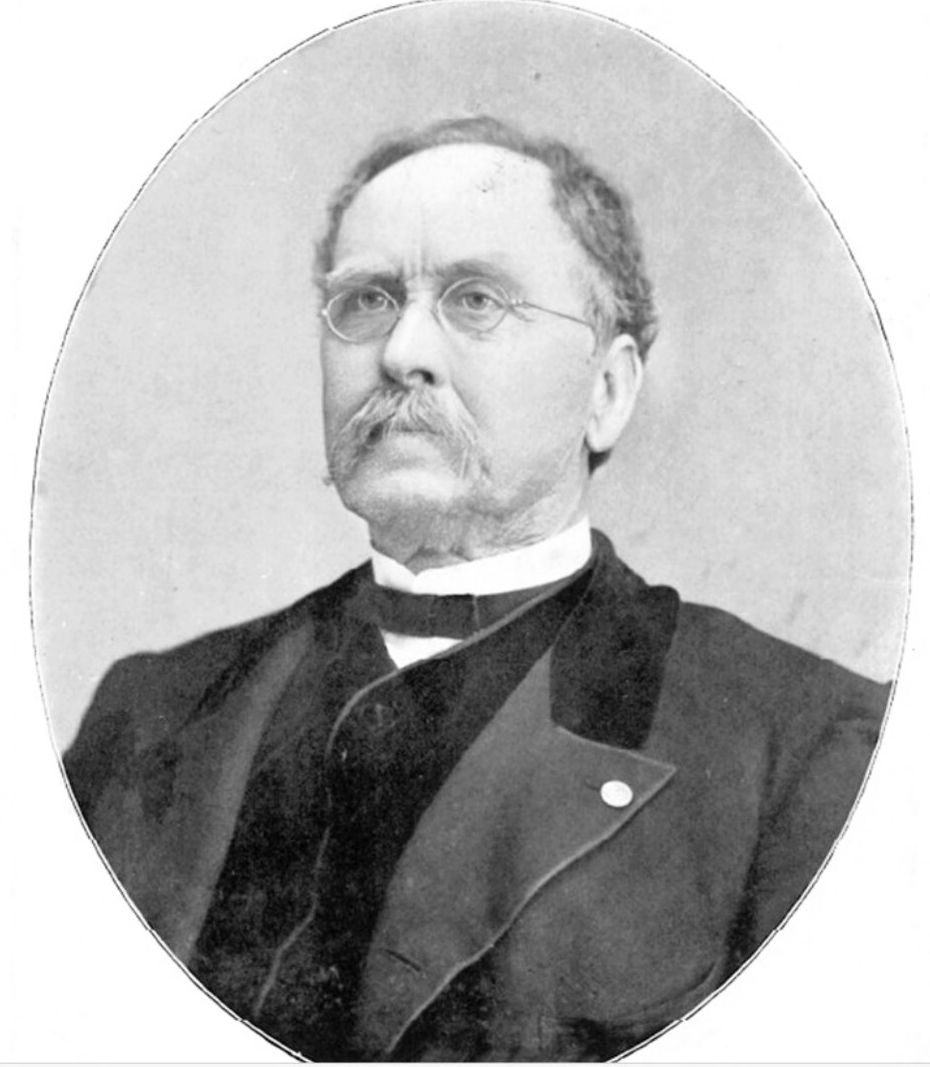
[2] Nimrod Headington (1827-1913) was the son of Nicholas (1790-1856) and Ruth (Phillips) (1794-1865) Headington. He was born in Mt. Vernon, Knox County, Ohio, on 5 August 1827 and married Mary Ann McDonald (1829-1855) in Delaware County, Ohio, in 1849. Nimrod moved to Portland, Jay County, Indiana, by 1860 and during the Civil War served in the 34th Indiana Infantry as a Colonel, Lieutenant Colonel, and Major. Nimrod died 7 January 1913 and is buried in Green Park Cemetery, Portland. Nimrod Headington is my fourth great-granduncle, the brother of my fourth great-grandfather, William Headington (1815-1879).

[3] Nimrod Headington’s journal, transcription and photos courtesy of Ross Hill, 2019, used with permission.
Tombstone Tuesday- Catherine Geisler

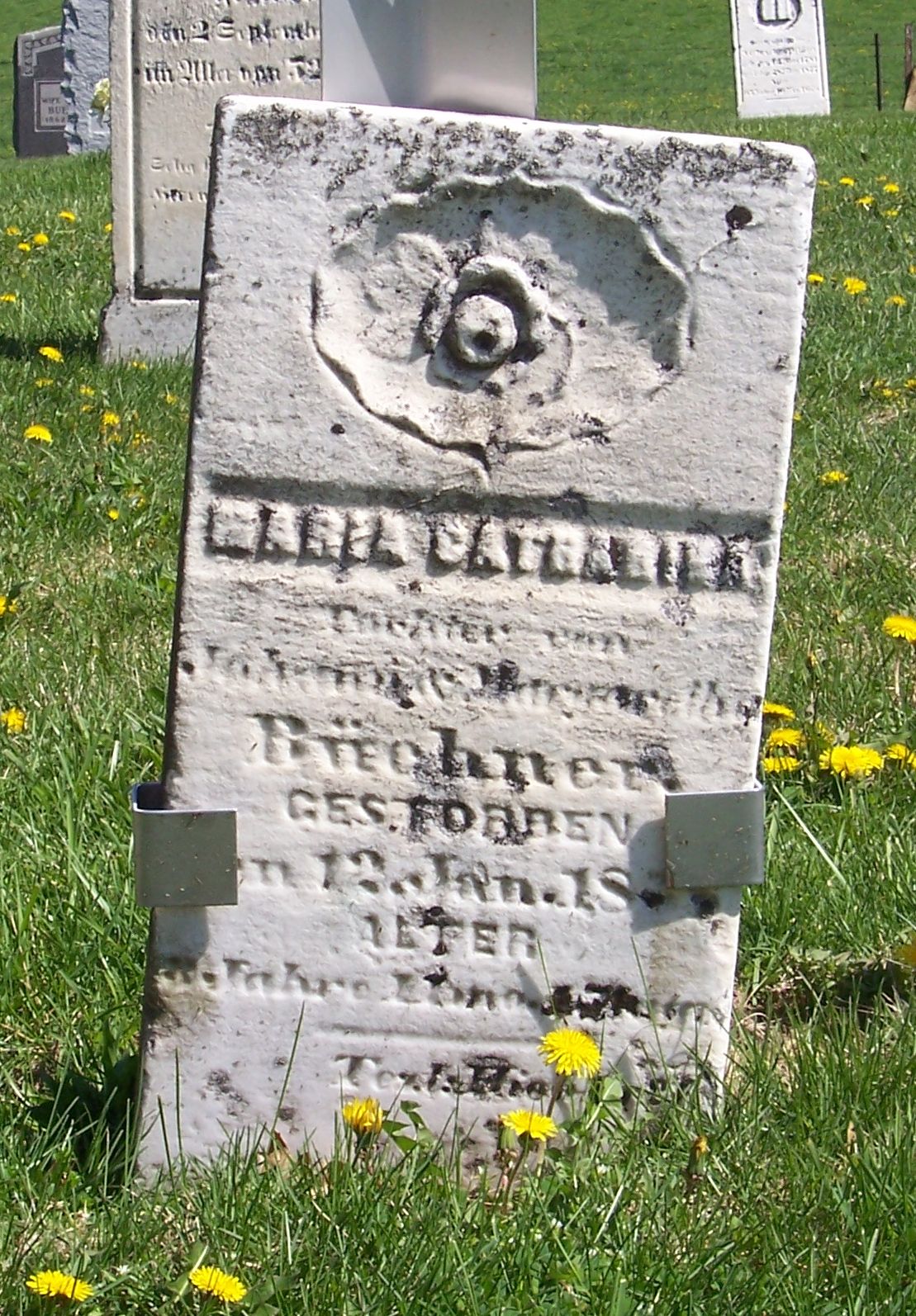
Catherine Geisler, Zion Lutheran Cemetery, Van Wert County, Ohio. (2012 photo by Karen)

This is the tombstone of Catherine Geisler, located in row 10 of Zion Lutheran Cemetery, Schumm, Van Wert County, Ohio. The marker is inscribed:

Catherine
Geisler
Apr. 30, 1868
Mar. 23, 1913
GEISLER

“Catherine” Elisabeth Geisler was born in Willshire Township, Van Wert County, Ohio, on 30 April 1868, the daughter of George and Rosina (Hoffmann) Geisler. She had a twin sister, Anna Magdalene and the twin girls were baptized 3 May 1868, with Mrs. Magdalene Hoffmann, Mrs. Anna Baals, Mrs. Catharine Gayer, and Mrs. Elisabeth Geissler serving as their sponsors. Catherine’s twin sister Anna Magdalene was the second wife of “River Henry” Schumm.

The George Geisler family in 1870: George Geisler, 44, Ohio; Rosina, 41; Fredricka, 8; Magdalena, 2; Catherine, 2; Martin Schinnerer, 12; E Huffman Geisler, 13. [1]

Note that Martin Schinnerer (1858-1933) was living with the Geisler family. Martin was Catherine’s half-brother. Catherine’s mother Rosina (Hoffmann) was first married to Pankratius Schinnerer. They married in 1853 and had four children, three of them dying very young. Martin Schinnerer was their only child who lived to adulthood. Pankratius died in 1857 and widow Rosina (Hoffmann) Schinnerer married Georg Geissler on 12 August 1858. George and Rosina had five children. Catherine’s father Georg Geisler died in 1872 and her mother Rosina, widowed a second time, married Johann Lutz in 1877.

The John Lutz family in 1880: John Lutz, 33; Rosina, 51; Fredricka, 17; Catherine, 12; Magdalena, 12; Martin Schinnerer, 22; Adam Glessing, 30, farm labor. [2]

Catherine’s mother Rosina (Hoffmann) Geissler died 25 November 1899. Catherine entered the Toledo State Hospital about this time.

In 1900 and 1910 Catherine, single, was enumerated as a patient in the Toledo State Hospital. [3] [4]  

Catherine Geisler died in the Toledo State Hospital on 23 March 1913. Death was due to a cerebral hemorrhage. [5] She was 44 years, 10 months, and 23 days old and was buried on the 28th. She had been in the Toledo State Hospital for 15 years, which indicates that she was likely admitted there shortly before her mother passed away. Catherine was survived by her sister Anna Magdalena (Geisler) Schumm and her half-brother Martin Schinnerer. Catherine Geisler never married.  

Children of George and Rosina (Hoffman) Geisler, Catherine and her full siblings:

Conrad Christian Adam (1861-1863)
Catharine Fredricka (1863-bef 1900?), married Adam Glessing?
Johanna Margarethe Elisabeth (1865-1868)
Catharine Elisabeth (1868-1913)
Anna Magdalene (1868-1946), married “River Henry” Schumm

[1] 1870 U.S. Census, Willshire, Van Wert, Ohio, p.435A, dwelling 82, family 83, George Geisler; digital image by subscription, Ancestry.com (https://www.ancestry.com/search/collections/7163/ : viewed 13 Apr 2020).

[2] 1880 U.S. Census, Willshire, Van Wert, Ohio, ED 154, p.443A, family 5, John Lutz;  (https://www.ancestry.com/search/collections/6742/ : viewed 13 Apr 2020)

[3] 1900 U.S. Census, Toledo, Ward 15, Lucas, Ohio, ED 113, p.6, dwelling & family 1, line 47, Catharine E Geisler, age 32; digital image by subscription, Ancestry.com (https://www.ancestry.com/search/collections/7602/ : viewed 13 Apr 2020).

[4] 1910 U.S. Census, Toledo, Ward 10, Lucas, Ohio, ED 131, p.3A, line 33, Catherine E Geisler, age 47; digital image by subscription, Ancestry.com  (https://www.ancestry.com/search/collections/7884/ : viewed 13 Apr 2020).

[5] “Ohio Deaths, 1908-1953,” Toledo, Lucas, Catherine E Geisler, 23 Mar 1913; FamilySearch.org (https://www.familysearch.org/ark:/61903/3:1:33SQ-GPJR-3CJ?i=2973&cc=1307272&personaUrl=%2Fark%3A%2F61903%2F1%3A1%3AX86K-HBW : viewed 13 Apr 2020).

Nimrod Headington Journal, 1852, part 10

Joe and I continue to shelter at home, as are many others. Today is Good Friday and this will be the first time ever that I have not attended Holy Week and Easter services. But through modern technology we are able to see our vicar give sermons on Facebook and listen to local Sunday services on the radio. In addition, here at home we continue to pray, read the Bible, and have devotions. Yes, this year will be different. We will not be able to gather in our churches to celebrate our Lord’s resurrection, but we can still celebrate and rejoice in our homes, knowing that we are all still together in spirit.

Easter Blessings to all. He is risen. He is risen indeed!  

Here are a couple family Easter photos from 2009. Such good memories.

Easter 2009

Easter 2009

Now for today’s blog post, the tenth in a series, the transcription of Nimrod Headington’s 1852 journal.

Trip to California, Nimrod Headington’s journal, details his 1852 voyage from New York to San Francisco, where he would stake his claim and pan for gold. [1] [2]

They set sail from New York on 16 February 1852 and they docked at Valparaiso, Chile, on 24 May, where they stayed several days. Today’s installment begins 2 June 1852, as they sail from Valparaiso.

BACK TO SEA

June 2nd. At 4 o’clock p.m., the wind and tide both being favorable, we weighed anchor, set sail, and were soon out of sight of the city. The next morning, the [Burning] Andes mountains were still in sight, but by 4 o’clock, we were out of sight of them.

June 4th. We had fair winds, running 10 knots an hour, heading northwest. Quite a number of the passengers were seasick again, and several of them with bad diarrhea, two of which were considered dangerously ill. They were William Adams and Joseph Gregg. That night we had a hard storm, but nothing serious happened. We were then in latitude 31°45’, longitude 14°15’.

June 5th. We had continuing winds all day so that we could not make any headway. The sun did not come out, so the observations could not be taken.

June 6th. Fair weather and light breeze from the southeast. We headed southwest and ran 4 knots an hour. 

June 7th. Fine weather, and we had the best day’s sailing we had since crossing the equator—a 12 knot breeze all day and heading straight on our course. Which made us feel good.

Our manner of living was also changed, which was also encouraging to us. As we had previous to running into Valparaiso, lived very poor. About all we had to eat was hard bread and salt beef and tea, and sometime not enough of that, but now we have potatoes and onions. This morning, we had a fight between decks. Two men in mess No. 11 fought over the matter of the knives not being scoured.

June 8th. We had fine weather and fair winds. The carpenter, who is always called Chips at sea, and all the sailors are engaged putting up [rogel masts] on the foremasts, mainmasts, ad mizzenmasts so that we can put on three sails more than we have ever had up, and when they were up, we sailed at a rapid rate, often making 15 and 16 knots an hour. Our sick are all getting better again, which makes all of us feel much better, for we dread to see our fellow mortals buried in the sea. And when this happens, everyone on board cannot help but think who will go next. The very thought of sight of a burial at sea is anything but pleasant to anyone.

June 9th. Cloudy weather and light winds but fair to take us on our course, which was northwest. I thought as the ship was running so steady and the sea was so smooth that I would join the army of washers that were on the upper deck and wash a couple of shirts for myself, and at it I went. This made me think of home more than ever, as I never before undertook to wash clothing. I used to think when at home and see women washing and singing that it was a light job to wash, but now after this trial at washing with salt seawater, with soap having no effect on dirty garments, it was rather amusing at all events. Gentlemen from all over the States came marching out on deck with their dirty garments and laughing and [guying] each other. Some would say, “Oh, Lord. Did I ever think that I should come to this.” Some would say, “If I were at home, I have a good wife, a mother, or a sister to do this kind of work.” This is the fate of all persons going to sea on a long voyage. They must expect all manner of trials and hardships.

If it is a man of a family and of any feeling, he is forced to reflect on his home and friends, a wife and children, or perhaps a father and mother, sister or brother, whose minds are perhaps troubled on account of him who is at sea. If it be the wife, this will undoubtedly be her song:

Come sing a song of absent friends
Who left us all alone
I feel so sad I scarce can smile
For husband dear is gone.

I miss him when from my sweet sleep
I rise at morning light
And, oh, I wish him back again
When mother says good night.

I miss him at the social board
I miss him at my play
Who is so serious when we are sad
Or lively when we are gay.

Oh, haste, good ship and bring him back
Across the ocean’s wave.
I’ll pray to heaven every night
My husband dear to save.  [3]

To be continued…

Well, Nimrod and the other male passengers considered doing laundry onboard ship a trial and hardship. Women’s work. And Nimrod thought it was a light job because he knew women who sang as they did laundry. Seriously? Too funny!

I will post Nimrod’s journal in increments, but not necessarily every week.

[1] Nimrod Headington at the age of 24, set sail from New York in February 1852, bound for San Francisco, California, to join the gold rush and to hopefully make his fortune. The Panama Canal had not been built at that time and he sailed around the tip of South America to reach the California coast.     Nimrod Headington kept a diary of his 1852 journey and in 1905 he made a hand-written copy for his daughter Thetis O. Tate. This hand-written copy was eventually passed down to Nimrod’s great-great-granddaughter, Karen (Liffring) Hill (1955-2010). Karen was a book editor and during the last two years of her life she transcribed Nimrod’s journal. Nimrod’s journal, Trip to California, documents his travels between February of 1852 and spring of 1853.

[2] Nimrod Headington (1827-1913) was the son of Nicholas (1790-1856) and Ruth (Phillips) (1794-1865) Headington. He was born in Mt. Vernon, Knox County, Ohio, on 5 August 1827 and married Mary Ann McDonald (1829-1855) in Delaware County, Ohio, in 1849. Nimrod moved to Portland, Jay County, Indiana, by 1860 and during the Civil War served in the 34th Indiana Infantry as a Colonel, Lieutenant Colonel, and Major. Nimrod died 7 January 1913 and is buried in Green Park Cemetery, Portland. Nimrod Headington is my fourth great-granduncle, the brother of my fourth great-grandfather, William Headington (1815-1879).

[3] Nimrod Headington’s journal, transcription and photos courtesy of Ross Hill, 2019, used with permission.

Tombstone Tuesday-Martin Geisler

Martin Geisler, Zion Lutheran Cemetery, Van Wert County, Ohio. (2012 photo by Karen)

This is the tombstone of Martin Geisler, located in row 5 of Zion Lutheran Cemetery, Schumm, Van Wert County, Ohio. The marker is inscribed:

Hier ruhet in Gott
Martin Geissler
Gestorben
2 September 1852
Alter von 52 Jahren

Here rests in God, Martin Geissler, died 2 September 1852, age 52 years.

Martin Geisler was born in about 1800, according to Zion Schumm’s records. In all probability he was born in Germany.

This appears to be the Martin Geisler family in Willshire Township in 1850: Martin, 50; Anna, 44; Margaretta, 19; Michael, 21; John, 16; Barbara, 12; CM, 6; Theodore, 3; and Catharine, 6 months. Martin was a farmer. All members of the household were born in Germany, except Catharine, who was born in Ohio. [1] This would indicate that the family immigrated about 1858. Also of interest is that the Martin Geisler family was enumerated next to my great-great-grandfather Louis Schumm. They lived very close to each other, possibly next door to each other.

Martin is mentioned in Zion Schumm’s records only one time and that lone entry is his death and burial record. That record indicates Martin Geisler died 2 September 1852 at the age of 52. He was buried on the 3rd.

Other Geislers attended Zion Schumm with Martin and they all may have been related in some way. Some of these other Geislers include:

Michael Geisler [the older] d.1857.

Margaret Geisler, d.1857, age 19.

Margaretha Geisler married Jacob Schrenk in 1867.

John “George” Geisler [son of older Michael Geisler] d.1872, married Rosine Schinnerer in 1858.

Michael Geisler [the younger] married Elisabeth Hartel in 1863 and she died later that same year. Michael Geisler [the younger] married Susanna/Susan Balzell in 1866.  

Nicholas Geisler (1832-1912) married Elisabeth Coffitz in 1863.

Barbara Geisler married Henry Adams 1858; married Michael Greib in 1867.

Madgalena Geisler married Henry Schumm I in 1891.

[1] 1850 U.S. Census, Willshire, Van Wert, Ohio, p.170A, dwelling 332, family 351, Martin Gurser; digital image by subscription, Ancestry.com (https://www.ancestry.com/search/collections/8054/ : viewed 6 Apr 2020).