
1910 Spiritualistic Manifestation in Geneva

Halloween 2022

For the Halloween season, below is an interesting piece about an eerie manifestation in the nearby town of Geneva, Indiana, in 1910.
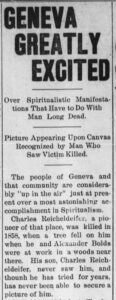
Geneva Excited, Celina Democrat, 2 Sep 1910.

GENEVA GREATLY EXCITED
Over Spiritualistic Manifestations That Have to Do With Man Long Dead.
Picture Appearing Upon Canvas Recognized by Man Who Saw Victim Killed.

The people of Geneva and that community are considerably “up in the air” just at present over a most astonishing accomplishment in Spiritualism.

Charles Reicheldeifer, a pioneer of that place, was killed in 1858, when a tree fell on him when he and Alexander Bolds were at work in a woods near there. His son, Charles Reicheldeifer, never saw him, and thounh [sic] he had tried for years, has never been able to secure a picture of him.

On August 13th last, Charles and his friend, A.P. Hardison, made a trip to Chesterfield Spiritualistic camp near Anderson. At 5 o’clock that afternoon they attended a seance held in a business room there. Mr. Reicheldeifer was asked if he would like to talk to any one [sic], and told the medium he would appreciate a conversation with his father. He made the request in writing, placed it in a slate and was soon answered by message that his father would talk to him. Soon a voice asked him what he wanted and he said he would like a picture of his parent whom he had never seen. The father agreed to set for the picture. A canvass was placed upon the window and the two Geneva men faced it and watched for developments, which came. Soon an ear appeared, then the eyes, and in a few minutes a clear, life-sized photograph of a man dressed in the style of fifty years ago came upon the canvas.

Of course, Charlie could not tell whether it was a photograph of his father or not, but consented to have it finished and framed and sent to him. Ten days later it arrived and was placed on exhibition in Sam Acker’s window at Geneva. It is on the of the finest works of art ever seen there and has attracted much attention.

A day or two ago, Alex Bolds, who, as stated, was with Mr. Reicheldeifer when he was killed, was brought to the store, without being told what was wanted or that a picture had been obtained. As soon as he saw the picture he recognized it as that of his old friend.

The affair has all of the people of that place guessing, and many have made trips to Chesterfield camp since. [1]

Just for the heck I did a little research. FindaGrave.com indicates that Charles Reicheldeifer Sr, memorial no. 20938501, is buried at Hartford Cemetery, Adams County, Indiana. His tombstone apparently does not exist but FindaGrave.com indicates that he died 6 January 1859, at the age of 25. His calculated birth date is 24 June 1833.

According to FindaGrave.com Charles Sr married Sophia Pontius (1829-1898) in 1852 and they had two children, Henry Reicheldeifer (1854-1859) and Charles Reicheldeifer (1858-1927). That explains why Charles Jr never saw his father. Charles Jr was only 9 months old when his father died. This memorial indicates that Charles Sr died in 1859, not 1858, as the news article reported. Charles Sr’s widow Sophia is also buried at Hartford Cemetery, FindaGrave memorial no. 20938631.

And, as I looked over these families I noticed that Alex Bolds, the person who knew Charles Sr, who was with Charles Sr when he died, and who identified his picture image in 1910, was Charles Sr’s brother-in-law. Alexander “Alex” Bolds (1830-1912) married Leah (Pontius) (1835-1907), the sister of Charles Sr’s wife, Sophia Pontius. Alex and Leah Bolds are also buried in Hartford Cemetery.

Charles Reicheldeifer Jr is buried in Westlawn Cemetery, Geneva, FindaGrave memorial no. 59241086.

The characters and families all fit together but the story about the medium, the séance, and the mysterious picture is more of a mystery.

And what about the Chesterfield Spiritualist Camp? According to the Discover Indiana website, “The Chesterfield Spiritualist Camp was established in 1890 outside of Anderson, Indiana. Modern spiritualism emerged in the mid-1800s and involves the science, philosophy, and religion of continuous life, based on the communication through a medium with those in the spirit world. The camp setting was used to meet, exchange ideas, and witness the demonstrations of famous mediums and believers streamed to these sites all over the country.”

Their webpage goes on to tell that they met in tents in the 1870s but as time went on permanent structures were built and people attended the camps all year long.

Spiritualism was particularly strong in Indiana and two state associations were established in 1888 and in 1904. By 1924 almost every state had a spiritualist camp and Indiana had over 50 spiritualist churches, some located in Veedersburg, Angola, Muncie, Yorktown, Crawfordsville, Greensburg, Fort Wayne, North Vernon, and Indianapolis. Attendance was over half a million people and in 1927 the six-week camp session at Chesterfield drew over 20,000 people.

Today, the Chesterfield Spiritualist Camp contains a variety of buildings dating from the 1900s-1950s and is one of the few spiritualist camps that remain today, one located in Florida and another in Maine. Chesterfield was listed in the National Register of Historic Places in 2002. [2]

An interesting story, indeed.

Happy Halloween everyone! Here are a couple more photos of our Halloween display.

Halloween 2022

Halloween 2022

Halloween 2022

[1] The Celina Democrat, Celina, Ohio, 2 Sep 1910, p.8; Library of Congress.gov, viewed 25 Oct 2022.

[2] Chesterfield Spiritualist Camp, Discover Indiana, https://publichistory.iupui.edu/items/show/308 , viewed 26 Oct 2022.
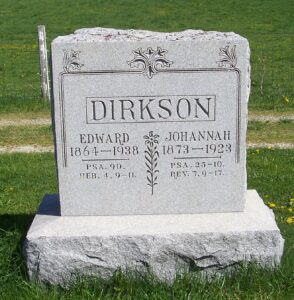
 

Tombstone Tuesday-Edward & Johannah (Meyer) Dirkson

Edward & Johannah (Meyer) Dirkson, Zion Lutheran Cemetery, Van Wert County, Ohio. (2012 photo by Karen)

This is the tombstone of Edward and Johannah (Meyer) Dirkson, located in row 11 of Zion Lutheran Cemetery, Schumm, Van Wert County, Ohio. The marker is inscribed:

DIRKSON
Edward
1864-1938
Psa. 90
Heb. 4, 9-11

Johannah
1873-1923
Psa. 25-10
Rev. 7, 9-17

William “Edward” Dirkson was born 8 July 1864 near Bingen, Adams County, Indiana, the son of Henry (1837-1915) and Lisetta (Aumann) (1844-1923) Dirkson. Edward grew up in Adams County and had younger siblings Anna, Louisa, Mary, and Emilie. [1]

Edward Dirkson married Johanna Meyer in Adams County, Indiana, 24 April 1898, married by Rev. J. Matthias. [2]

Johanna (Hannah) Louisa Meyer was born 15 November 1873 in Preble, Adams County, Indiana, the daughter of Henry William Christian (1832-1883) and Rosina K. (Schueler) (1837-1912) Meyer. Johanna grew up in Adams County, Indiana, and had several siblings, Mary Sophia, Helen Maria, Wilhelmina, William Michael, Sophia R., Edward George, Susanna, Rosine, and Martha Katharine. [3]   

Two years after their marriage Edward and Johanna resided in Preble, Adams County, Indiana. They had no children and Edward, 35, was a farmer. [4]

Their first child, Arthur, was born in May 1901 and burned to death in December of that same year when he pulled a lamp into his crib and caught his bedclothes on fire. Daughter Helena was born less than a year later and died the day after she was born. Daughter Martha was born in 1903 and son Paul in 1906.

In 1910 the couple still resided in Preble and had two children, Martha, 6, and Paul, 4. This census enumeration indicates that the couple had two other children who had died. [5]

By 1920 Edward and Johanna Dirkson and their two children had moved to Willshire Township, where Edward farmed: Edward, 56; Johanna, 45; Martha, 16; and Paul, 14. [6]

Johanna (Meyer) Dirkson died from intestinal peritonitis on 31 January 1923 in Willshire Township, at the age of 49 years, 2 months, and 16 days. She was buried on 2 February. [7]

After Johanna’s death widower Edward Dirkson lived with his children Martha, 26, single, and Paul, 23, single, in Willshire Township. Edward and his son Paul farmed. [8]  

Edward Dirkson died from uremia on 5 July 1938 in Ridge Township, Van Wert County, at the age of 73 years, 11 months, 27 days. He was buried on 8 July. [9]

Edward’s obituary:

Edward Dirkson
Van Wert, July 7-Edward Dirkson, 74, retired farmer of Willshire-tp, died yesterday at Van Wert-co hospital after an extended illness.

Born in Adams-co, Ind., he was the son of Henry and Lizzie Dirkson. He spent most of his life in Adams-co, but for the past 18 years had resided in Willshire and vicinity. He was a member of the Schumm Lutheran church.

Surviving are two children, Paul Dirkson, Harrod, and Mrs. Edward Gunsett, with whom he made his home; and two sisters, Mrs. Anna Schumm, Ft. Wayne, and Mrs. Otto Ewell, Decatur, Ind.

Funeral services will be held Friday at 2 p.m. at the Schumm Lutheran church, with Rev. A. Maueler [sic] officiating. Burial will be in the church cemetery. [10]

Edward and Johanna (Meyer) Dirkson had the following children:
Arthur (1901-1901)
Helena (1902-1902)
Martha Anna Marie (1903-1981), married Edward “Dick” Gunsett
Paul (1906-1987), married Leota M. Kemper

Johanna (Meyer) Dirkson was the great-granddaughter of John Georg Schumm, our Schumm immigrant ancestor and descends from John Georg’s daughter Maria Katharina, who married Michael Schueler.

[1] Census years 1870 & 1880.

[2] “Indiana Marriages, 1811-2019,” Edward Dirkson & Johanna Meyers, 24 Apr 1898 database with images, FamilySearch.org, viewed 24 Oct 2022.

[3] Census year 1880 & FindaGrave.com. Note, this surname is sometimes spelled Meier.

[4] 1900 U.S. Census, Preble, Adams, ED 8, p.8, dwelling 127, family 129, Edward Dieksan; Ancestry.com, viewed 24 Oct 2022.
[5] 1910 U.S. Census, Preble, Adams, ED 8, p.1B, dwelling & family 21, Edward Dirkson; Ancestry.com, viewed 24 Oct 2022.
[6] 1920 U.S. Census, Willshire, Van Wert, ED 146, p.3A, dwelling 55, family 56, Edward Dirkson; Ancestry.com, viewed 24 Oct 2022.
[7] “Ohio, County Death Records, 1840-2001,” Willshire Township, Van Wert County, Johannah Dirkson, 31 Jan 1923; database with images, FamilySearch.org, https://www.familysearch.org/ark:/61903/3:1:3QSQ-G9ZY-TKNL?i=338&cc=2128172&personaUrl=%2Fark%3A%2F61903%2F1%3A1%3AF6CF-GGH , viewed 24 Oct 2022.
[8] 1930 U.S. Census, Willshire, Van Wert, ED 245, p.2B, dwelling 39, family, Edward Derkson; Ancestry.com, viewed 24 Oct 2022.

[9] “Ohio, County Death Records, 1840-2001,” Ridge Township, Van Wert County, Edward Dirkson, 5 Jul 1938; database with images, FamilySearch.org, https://www.familysearch.org/ark:/61903/3:1:3QS7-89ZY-TY35?i=247&cc=2128172&personaUrl=%2Fark%3A%2F61903%2F1%3A1%3AF6CF-RRN , viewed 24 Oct 2022.
[10] The Lima News, Lima, Ohio, 7 Jul 1938, p.2; Ancestry.com, viewed 24 Oct 2022.

The Willshire Canning Company

Willshire had a canning company in the early 1900s, appropriately named The Willshire Canning Company. I do not know a lot about the company or where it was located, just what I have read in a couple sources, The Willshire Herald and Dun and Bradstreet.

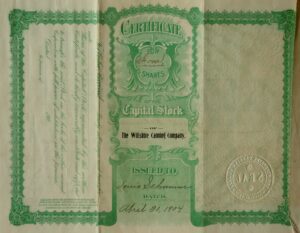
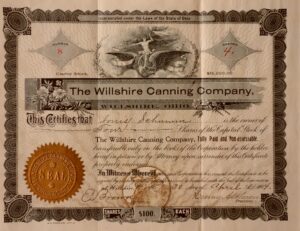
But a recent find shows that my great-grandfather Louis J. Schumm was a shareholder in The Willshire Canning Company. He purchased 4 shares of The Willshire Canning Company stock at $100 a share, issued 30 April 1904, signed by secretary E. Brown and president Henry Altheon. Louis’ stock certificate was number 8, obviously a very early number.

Willshire Canning Co stock certificate, 1904, Louis J Schumm

Willshire Canning Co stock certificate, 1904, Louis J Schumm

The Willshire Canning Company likely began about that time, early 1904. The 5 May 1904 edition of The Willshire Herald mentions The Willshire Canning Company several times and encouraged farmers to grow tomatoes and sweet corn for the company.

Articles from the 5 May 1904 Willshire Herald about the canning company:

The Willshire Canning factory now has over 150 acres of sweet corn and tomatoes contracted. Better get into the band wagon while there is yet a chance to toot a lead horn.

 And,

Farmers, Attention!
All persons desiring to avail themselves of the opportunity to raise sweet corn or tomatoes for the Canning Factory for the coming season, can contract with the processor, Chas. Nachbauer, on or after March 10, at the Hardware Store of Hurless & Brown, Willshire, O.

Professor Catchpole is going to put in his summer vacation superintending and caring for fifteen acres of corn and tomatoes, for the Canning Factory. How much better such a course is than to sit around like a bump on a log and croak against the Canning Factory and its success, as a number of our citizens are doing.

Testimonials from the same paper, letters written to the canning factory’s processor, Chas. Nachbauer:

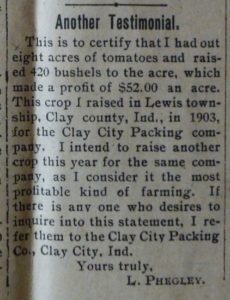
Another Testimonial
This is to certify that I had out eight acres of tomatoes and raised 420 bushels to the acre, which made a profit of $52.00 an acre. This crop I raised in Lewis township, Clay County, Ind., in 1903, for the Clay City Packing company. I intend to raise another crop this year for the same company, as I consider it the most profitable kind of farming. If there is anyone who desires to inquire into this statement, I refer them to the Clay City Packing Co., Clay City, Ind. Yours truly, L. Phegley.

Willshire Herald, 1904

DOES IT PAY?
Read this statement from men who have raised material for canning factories and then ask yourselves this question: DOES IT PAY NOT to RAISE VEGETABLES for the CANNING FACTORY WHEN YOU HAVE THE OPPORTUNITY? Following is the statement of one of them:

Clay City, Ind., April 19, 1904.
“We made a little over One Hundred dollars an acre off our tomatoes. So, you see, it paid us well for raising them. There are a number of others here who did as well. I will give you a few names of farmers around here who say that it paid them to raise tomatoes for the factory.
Wm. Liechty, George Williamson, Robert McKee, Mr. Phegley

And there are many others who would willingly add their testimony, but I think that it is not necessary to mention the names of others. Yours truly, J.P. Scherb, Clay City, Ind.

C.E. Detter is now at Oklahoma City, working up a $15,000 canning factory proposition. He says that city is a hustling, bustling place. [1]

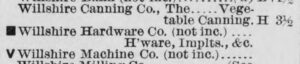
The Willshire Canning Company was first listed in Dun and Bradstreet March 1905 and was in each consecutive issue through 1913, with a consistent H 3½ rating. In 1914 Dun and Bradstreet lists The Willshire Packing Company but not the canning company. I do not know if the packing company replaced the canning company or if the two companies were unrelated. By 1920 The Willshire Packing Company was not listed either. [2]

Dun & Bradstreet, Mar 1905, part 2, p.113

I wonder if my great-grandfather Louis Schumm raised vegetables for the factory?

[1] The Willshire Herald, Willshire, Ohio, 5 May 1904.  

[2] Dun & Bradstreet Reference Book, Library of Congress, www.loc.gov. Vol. 2 of the following issues: Mar 1905:113 [image 197/587]; Jul 1906:116 [image 207/618]; Mar 1907:118 [image 204/629]; Mar 1908:120 [image 248/692]; Mar 1913:119 [image 210/618]; Sep 1920:142-4 [image 198-9/854].

Tombstone Tuesday-Tombstone Shapes

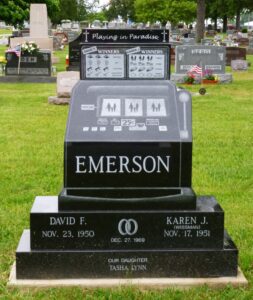
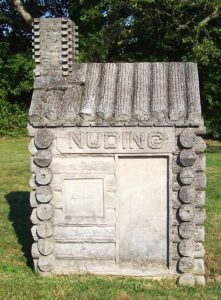
Today, more examples of tombstones with a symbolic shape.

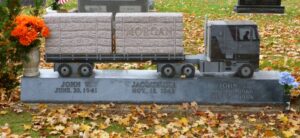
A tombstone in the shape of a semi truck.

Decatur Cemetery, Adams County, Indiana

A marker in the shape of a slot machine.

St. Joseph Cemetery, Auglaize County, Ohio

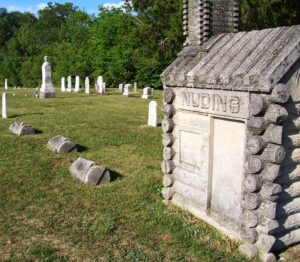
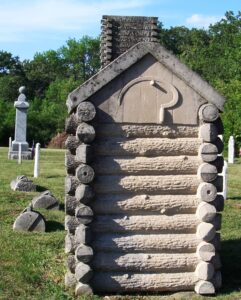
A monument shaped like a log cabin. The little logs are markers for family members.

Roberts Cemetery, Mercer County, Ohio

Roberts Cemetery, Mercer County, Ohio

Roberts Cemetery, Mercer County, Ohio

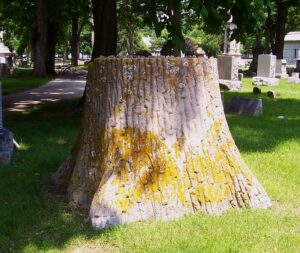
A life-like tree stump marker.

Union Cemetery, Darke County, Ohio

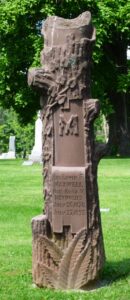
A tombstone shaped like a tree trunk. Many of these are associated with Woodmen of the World.

Woodlawn Cemetery, Lima, Ohio

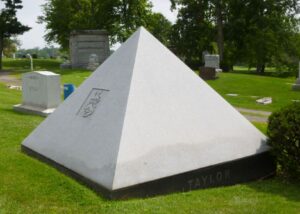
A monument shaped like a pyramid. Legend has it that the devil will not recline on a pyramid-shaped tombstone.

Woodlawn Cemetery, Lima, Ohio

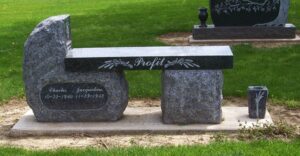
A grave marker shaped like a bench.

Woodlawn Cemetery, Ohio City, Ohio


Mercer County Courthouse Tour

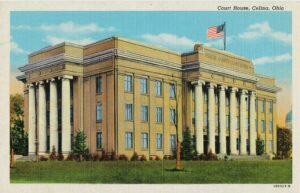
The past couple years there have been several historic anniversaries in our area. Rockford celebrated their Bicentennial in 2020. Well, sort of. Because of the pandemic their celebration was postponed until 2021. This year Willshire observes their Bicentennial. Next year the Mercer County Courthouse will celebrate its 100th anniversary.

Mercer County, Ohio, Courthouse

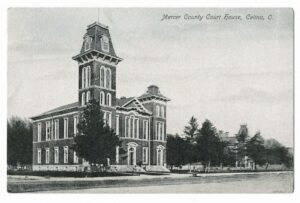
The old courthouse was built in 1868 and stood on the northeast corner of the current courthouse block. The county eventually outgrew that structure. Plus it lacked electricity, plumbing, telephones, and modern heating. In 1920 a bond issue for $500,000 was passed for building a new courthouse. Ground was broken 19 May 1921, the cornerstone was laid 20 July 1921, and the building was dedicated 3 September 1923. Peter M. Hulsken, of Lima, was the architect. The final building cost was under budget and today it is insured for many times that amount.

Old Mercer County Courthouse, built in 1868.

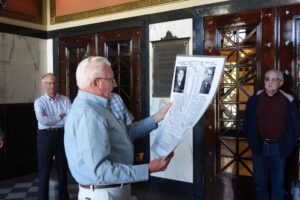
Last weekend the Mercer County Chapter of the Ohio Genealogical Society sponsored a courthouse tour. Kip Wright was our tour guide through the historic and beautiful courthouse. He pointed out some of the courthouse’s architectural elements and told interesting facts about the courthouse.

Today, some photos from last Sunday’s courthouse tour. 

Kip Wright began the tour in the courthouse foyer

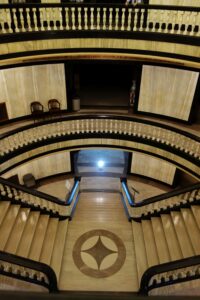
Main stairway, Mercer County Courthouse

The acoustics are amazing when standing in the center of the star. You can whisper and still be heard. Note the three levels of the building.   

Looking down at the first landing

The courthouse ceilings are striking and I spent a lot of time looking up.

Ceiling in entrance area

The beautiful rotunda

There have been a few updates, repairs, and some redecorating over the years. Today, when painting, repairs, or basically any work is needed or desired, the work must adhere to specific guidelines because the courthouse is on the National Register of Historic Places. Paint colors must meet strict historical specifications. Wallpaper is carefully repaired when necessary.

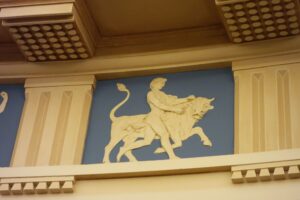
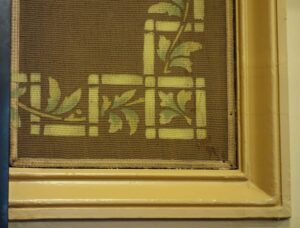
The images on this wallpaper border have a 3-D appearance. Note some of the granite has a wood-grain appearance.

Second floor border

Border and trim on the third floor

Border and trim on the third floor

Third floor

Geologists and other visitors, children in particular, enjoy looking for fossilized shells in the interior materials.

Embedded shells, millions of years old

An elaborate plaster ceiling and light fixture.

Stairway to the third floor

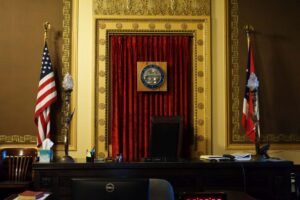
The Common Pleas Courtroom, third floor:

Common Pleas Courtroom

Note the letter v in place of u in the word COURT. The letters u and v were interchangeable in the ancient Latin language. Courthouses often use a v instead of a u to evoke a classical, ancient Roman aesthetic.   

Common Pleas Courtroom

Common Pleas Courtroom

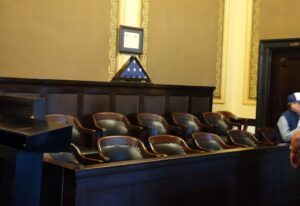
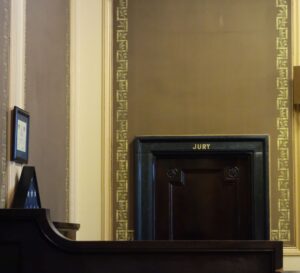
Jury box, Common Pleas Courtroom

Common Pleas Courtroom

Common Pleas Courtroom

Textured wall covering, Common Pleas Courtroom

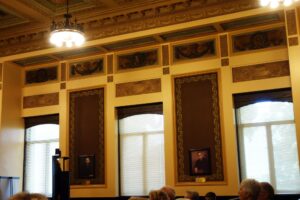
Ceiling, Common Pleas Courtroom                                                                                                                           


Juvenile Courtroom, third floor:

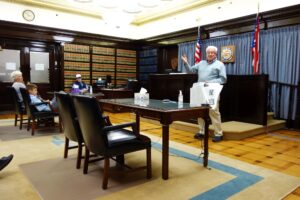
Kip Wright in Juvenile Courtroom

Ceiling in Juvenile Courtroom

Juvenile Courtroom

Visiting the Juvenile Courtroom made me think of when, about 24 years ago, son Jeff appeared in that very courtroom for a minor traffic violation. I accompanied him and it was a learning experience that turned out well for Jeff, but we both remember a side-story to the event. I had previously scheduled an appointment for Glamour Shots to be taken earlier that morning. The Glamour Shots lady made up my face with lots of pancake makeup and styled my hair in a poofier coiffure than I usually wear. Let’s just say that I did not look like my usual conservative self for the photos. There was not much time between the two appointments and I went straight to the courthouse after the photos were taken.  When I arrived at the courthouse Jeff was waiting for me in the hallway outside the Juvenile Courtroom and was shocked to see my altered appearance. I was a little uncomfortable being out in public all made-up, let alone sitting before a judge. Jeff and I still laugh about the way I looked that day.

Glamour Shot photo, 1998

To be clear, I did not wear the feathers and jewelry into the courtroom. They were provided by the Glamour people.

If you get the chance, I encourage you to visit our courthouse and take in its beauty. I have visited nearly a dozen courthouses and this is probably the most beautiful and well-kept courthouse I have been in.

Or, consider taking a courthouse tour. They will be offering tours during the upcoming 100th anniversary year.