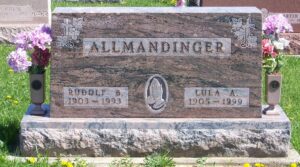
Tombstone Tuesday-Rudolf B & Lula A (Scare) Allmandinger

Rudolf & Lula (Scare) Allmandinger, Zion Lutheran Cemetery, Van Wert County, Ohio (2012 photo by Karen)

This is the tombstone of Rudolf B. and Lula A. (Scare) Allmandinger, located in row 4 of Zion Lutheran Cemetery, Schumm, Van Wert County, Ohio. The marker is inscribed:

ALLMANDINGER
Rudolf B.
1903-1993
Lula A.
1905-1999

Rudolf Benjamin Allmandinger was born in Mercer County, Ohio, on 13 January 1903, the son of Frederick (1869-1953) and Anna Kathrina (Kallenberger) (1875-1944) Allmandinger. Rudolf was baptized at Zion Lutheran Church, Chattanooga, Ohio, 25 January 1903, with his parents serving as sponsors.  

The Frederick Allmandinger family in 1910, residing in Black Creek Township, Mercer County: Frederick, 40; Anna K, 34; George F, 14; Paulena K, 11; Rudolf B, 7; Carl M, 4; and Elizabeth, 2. They lived next door to Andrew Kallenbarger, wife Anna’s parents. [1]  

By 1920 the Frederick Allmandinger family had moved to Liberty Township, Van Wert County: Fred, 56; Anna, 46; George, 24; Paulena, 21; Rudolf, 16; Carl, 14; Elizabeth, 12; and Matilda, 9. The father Fred was a farmer. [1]

Rudolf Allmandinger married Lula Scare 14 July 1929 at Zion Lutheran Church, Schumm. Church records indicate both were members of Zion Schumm’s parish. They were married by Rev. R.O. Bienert and Carl Scare and Matilda Allmandinger, siblings of the couple, were witnesses to their marriage.

Lula Anna Scare was born in Pleasant Township, Van Wert County, Ohio, on 15 December 1905, the daughter of Peter (1862-1946) and Hannah (Schinnerer) (1868-1958) Scare/Scaer. Her family’s surname was originally spelled Scaer but Lula’s father changed the spelling to Scare at some point. I have seen Lula’s maiden name spelled both ways, but most times spelled Scare, the spelling I will use for Lula in this post.

In 1910 the Peter Scare family resided in Pleasant Township and the family included children Herman, 17; Edward, 9; Carl, 7; and Lula, 5. Two of their other children were deceased by this time. Peter was a farmer. [3] By 1920 the Peter Scare family consisted of the parents and children Edward, Carl, and Lula.

After their marriage in 1929 Rudolf and Lula Allmandinger set up housekeeping in Willshire Township, just north of Schumm. Lula’s parents had also moved to Willshire Township by this time and it appears the two families resided in the same household. Rudolf was a farmer. [4]

The Rudolf and Lula Allmandinger had two children by 1940, William, 9, and Emma, 6. The couple still lived with or very near Lula’s parents. [5]

Lula’s father Peter died at home in 1946. 

The Rudolph Allmandinger family in 1950: Rudolf, 47; Lula A, 44; Wm F, 19, son; L Emma M, 16, daughter. It appears Lula’s mother Hannah, a widow now, was living with them. [6]

Lula’s mother Hannah (Schinnerer) Scare died at home in 1958.

In 1993 Rudolf and Lula’s address was 16883 Schumm Road, Willshire, likely the same home they had lived in since their marriage.

Rudolf Allmandinger died 30 June 1993 at Chalet Village, Berne, Indiana, at the age of 90. He was buried on 3 July.

Lula (Scare) Allmandinger died at a Van Wert County nursing home on 26 May 1999. Lula was 93.

Rudolf and Lula (Scare) Allmandinger had two children:
William Frederick Allmandinger (1930-2015), married Coleen S. Wagner
Lula Marcile “Emma” Allmandinger (1934-2022), married Harold Salway

[1] 1910 U.S. Census, Black Creek, Mercer, Ohio, ED 107, p.5A, dwelling & family 99, Fredrick Allmandinger; Ancestry.com, viewed 13 Nov 2022.

[2] 1920 U.S. Census, Liberty, Van Wert, Ohio, ED 127, p.2A, dwelling 5, family 6, Fred Allmandurgh [sic]; Ancestry.com, viewed 13 Nov 2022.

[3] 1910 U.S. Census, Pleasant, Van Wert, Ohio, ED 96, p.1A, dwelling & family 10, Peter Scarr; Ancestry.com, viewed 31 Oct 2022.

[4] 1930 U.S. Census, Willshire, Van Wert, Ohio, ED 24, p.5B, dwelling 104, family 107, Rudalph Almandinger; Ancestry.com, viewed 13 Nov 2022. 

[5] 1940 U.S. Census, Willshire, Van Wert, Ohio, ED 81-28, p.5A, household 90, RB Allmandinger; Ancestry.com, viewed 13 Nov 2022.

[6] 1950 U.S. Census, Willshire, Van Wert, Ohio, ED 81-40, sheet 72, line 16; Rudolph B Allm??ndinger [sic]; Ancestry.com, viewed 13 Nov 2022.

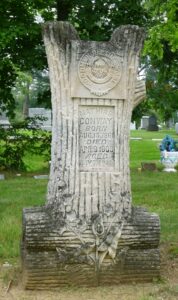
Today Is Veterans Day

Be sure to thank a veteran today, on this Veterans Day 2022.

This federal holiday is observed to honor, thank, and remember our United States veterans.

Veterans Day was originally called Armistice Day and was created to commemorate of the end of World War I. Fighting between the Allied Nations and Germany ceased on the 11th hour of the 11th day of the 11th month in 1918. That date is generally regarded as the end of “the war to end all wars.”

Armistice Day became a legal holiday on 11 November 1938, primarily to honor World War I veterans and dedicated to the cause of world peace. After World War II and the Korean War the name was changed to Veterans Day. On 1 June 1954 Veterans Day became a day to honor American veterans of all wars.

Veterans deserve our thanks and gratitude and so much more.

To all veterans, thank you for your service to our country.  

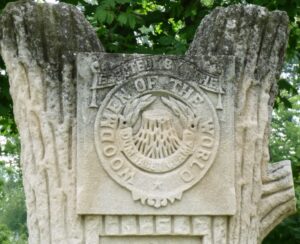
Tombstone Tuesday-Woodmen of the World

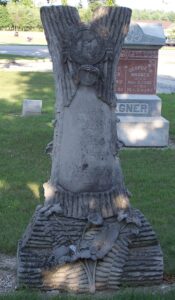
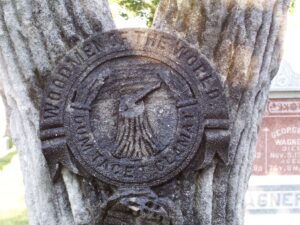
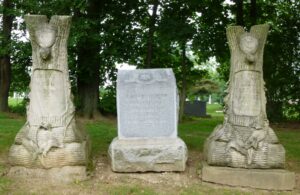
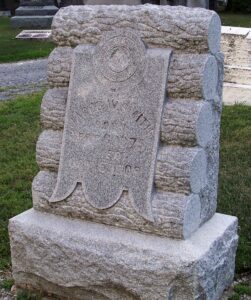
These unique tree-stump markers are easy to spot in a cemetery and are usually associated with the Woodmen of the World.

Woodmen of the World, Greenlawn Cemetery, Lima, Ohio

Woodmen of the World, Greenlawn Cemetery, Lima, Ohio

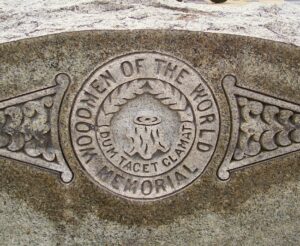
Woodmen of the World (WOW) is a non-profit, fraternal benefit society, owned and governed by its members that combines insurance with a common bond of mutual aid and social membership.

Woodmen of the World, North Grove Cemetery, Celina, Ohio

Woodmen of the World, North Grove Cemetery, Celina, Ohio

Woodmen of the World was founded in 1890 by Joseph Cullen Root as a lodge system similar to the Elks and Moose, controlled by its members, and to provide financial, insurance, and burial benefits to its members.

Early Woodmen certificates entitled holders to a death and monument benefit. Gravestones, often a tree stump, were originally furnished for free but were later were offered only to those who purchased a $100 rider. The tree stump tombstone was abandoned in the late 1920s due to cost. 

Woodmen of the World, Greenlawn Cemetery, Lima, Ohio

Over 45,000 WOW grave markers have been erected nationally. Other symbols seen on Woodmen grave markers include the dove and olive branch (peace), beetle, sledge, sawn log, and axe and wedge (workmanship, progress, and culture).

Woodmen of the World, North Grove Cemetery, Celina, Ohio

Some Woodmen monuments are inscribed with the motto Dum Tacet Clamat, “Though silent, he speaks.”

Woodmen of the World, Greenlawn Cemetery, Wapakoneta, Ohio

Woodmen of the World has spanned 3 centuries. It has merged with other fraternal benefit societies and has evolved into a modern financial services organization that offers life and health insurance, annuities, investments and home mortgages. Today the organization is known as Woodman Life and is one of the largest fraternal benefit societies. They have over 810,000 members who belong to more than 2,000 lodges across the US, conducting volunteer projects that benefit individuals, families, and communities.

Sources: Woodmen of the world and Women of the Woodcraft; History of Woodmen of the World ; WoodmenLife, Wikipedia.org; WoodmenLife.

Willshire Fires-1908, 1914, 1922

A couple weeks ago I wrote about the Willshire Canning Company.

The Willshire Canning Company was started about 1904 and operated for roughly 10 years. It was listed in Dun and Bradstreet from 1905-1913, and may have been called the Willshire Packing Company in 1914. I am not sure if the name of the company changed or if those were two separate companies.

The Willshire Canning Company per se seemed to disappear about 1914 or 1915. Sondra Samples commented that the company may have been destroyed by a major fire in Willshire on New Year’s Eve 1914 and the early morning hours on New Year’s Day 1915.

A couple news articles about Willshire’s fire, New Year’s Eve, 31 December 1914.

Fire Wipes Out Half Block At Willshire
Decatur, Ind., Jan. 1-The new year at Willshire, O., east of this city, was ushered in with a fire that wiped out half a block, including four frame businesses buildings of seven rooms. The loss is estimated at about $25,000. The businesses wiped out were the Willshire Hardware company, Harry Cowan’s grocery, Frank Detter’s barber shop, Dr. Alspaugh’s office, Dr. Christy’s office, Simms & Simms meat market, Cully & Roller’s garage. The greater part of the goods was gotten out. Christ and Altheon carried no insurance on their three rooms, but some insurance was carried by the Cully’s and James Willey on their buildings. The amount is unknown. The origin of the fire is not known. It started in the canter of the block wiped out.
[1]

The next account indicates the fire started in Frank Detter’s barber shop:

Fire At Willshire
The business district in the village of Willshire was swept by a destructive fire last Thursday night, at the hour for the reception of the New Year. A blaze, which had its origin in the rear of the F.A. Detterer
[sic] barber shop soon gained great headway, under the force of a driving wind, and rapidly spread until seven business rooms were laid waste. The Detterer [sic] shop is located on Main street and the fire on the thoroughfare spread until it wiped out the establishment at the place of origin and those of the Willshire Hardware Co., the H.V. Conn grocery, the office of Dr. Alspaugh and Dr. S.K. Christy, the Sims & Sims meat market and Cully & Roller Auto Garage. The loss of stocks was almost total and the damage was on this basis, the buildings being all frame structures. The loss is estimated at $15,000, only partly covered by insurance. [2]

But apparently that New Year’s Eve fire did not destroy the Willshire Canning Factory. A separate fire, eleven months later, on Sunday, 6 November 1915, destroyed the canning factory.

The Willshire Canning factory burned to the ground Sunday morning at 1 o’clock, destroying the factory and its contents, a quantity of canned corn and tomatoes. The plant did not operate this year. It is believed the fire started from a passing locomotive. The loss will probably reach $10,000. [3]

We learn several things from that piece. It appears that the canning factory was located near the railroad tracks. The factory had not been in operation that year, apparently shut down before the fire. One wonders why. Or was it damaged during the New Year’s Eve fire? If it was, it was not mentioned as one of the businesses involved in that earlier fire. And, it appears the only produce they canned was corn and tomatoes, as was also indicated in a 1904 Willshire Herald article.

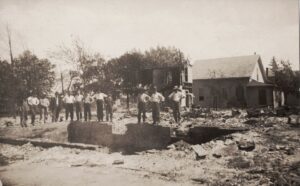
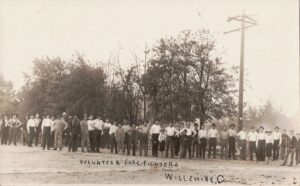
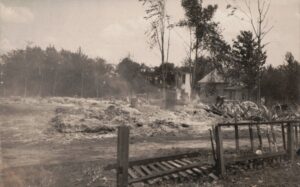
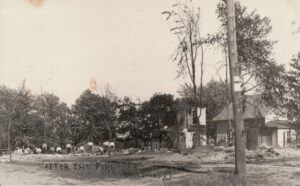
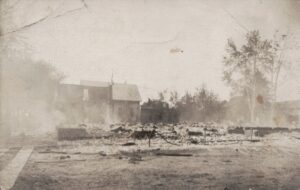
Below are some photo postcard images of an earlier Willshire fire. That the fire started 2:00 a.m. Tuesday morning, 23 June 1908, hand-written on the back.

Willshire fire, 23 June 1908

Willshire fire, 23 June 1908

Willshire fire, 23 June 1908

Willshire fire, 23 June 1908

Willshire fire, 23 June 1908

Like many towns, Willshire had its share of fires over the years. There was another major fire in March 1922:

Village Gutted
Van Wert, O., March 21-The village of Willshire, near, the Indiana state line, was the scene of a fire which destroyed four business houses, including the post office and the Harald
[sic] Printing company. One residence also was burned. Five automobiles and three horses were burned at a livery. [4]

Sustain $100,000 Loss In Big Willshire Fire
Decatur, Ind., March 20-Fire of undetermined origin, which started in the Ward Atchison livery barn at Willshire, Ohio, early today, caused losses estimated at $100,000. Three business houses and one home were damaged by the conflagration. Willshire is nine miles south of here. [5]

I would appreciate hearing from anyone who has additional information about Willshire’s fires.

[1] The Fort Wayne Journal Gazette, Fort Wayne, Ind, 2 Jan 1915, p.4; Newspapers.com, viewed 1 Nov 2022.

[2] The Celina Democrat, Celina, Ohio, 8 Jan 1915, p.1; LibraryofCongress.gov, viewed 1 Nov 2022.

[3] The Fort Wayne News, Fort Wayne, Indiana, 10 Nov 1915, p.11; Newspapers.com, viewed 1 Nov 2022.

[4] Lancaster Eagle-Gazette, Lancaster, Ohio, 21 Mar 1922, p.1; Newspapers.com, viewed 1 Nov 2022.

[5] The Richmond Palladium, Richmond, Ind., 20 Mar 2022, p.1; Newspapers.com, viewed 1 Nov 2022.


1910 Spiritualistic Manifestation in Geneva

Halloween 2022

For the Halloween season, below is an interesting piece about an eerie manifestation in the nearby town of Geneva, Indiana, in 1910.

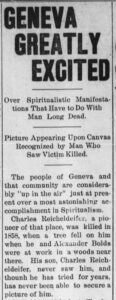
Geneva Excited, Celina Democrat, 2 Sep 1910.

GENEVA GREATLY EXCITED
Over Spiritualistic Manifestations That Have to Do With Man Long Dead.
Picture Appearing Upon Canvas Recognized by Man Who Saw Victim Killed.

The people of Geneva and that community are considerably “up in the air” just at present over a most astonishing accomplishment in Spiritualism.

Charles Reicheldeifer, a pioneer of that place, was killed in 1858, when a tree fell on him when he and Alexander Bolds were at work in a woods near there. His son, Charles Reicheldeifer, never saw him, and thounh [sic] he had tried for years, has never been able to secure a picture of him.

On August 13th last, Charles and his friend, A.P. Hardison, made a trip to Chesterfield Spiritualistic camp near Anderson. At 5 o’clock that afternoon they attended a seance held in a business room there. Mr. Reicheldeifer was asked if he would like to talk to any one [sic], and told the medium he would appreciate a conversation with his father. He made the request in writing, placed it in a slate and was soon answered by message that his father would talk to him. Soon a voice asked him what he wanted and he said he would like a picture of his parent whom he had never seen. The father agreed to set for the picture. A canvass was placed upon the window and the two Geneva men faced it and watched for developments, which came. Soon an ear appeared, then the eyes, and in a few minutes a clear, life-sized photograph of a man dressed in the style of fifty years ago came upon the canvas.

Of course, Charlie could not tell whether it was a photograph of his father or not, but consented to have it finished and framed and sent to him. Ten days later it arrived and was placed on exhibition in Sam Acker’s window at Geneva. It is on the of the finest works of art ever seen there and has attracted much attention.

A day or two ago, Alex Bolds, who, as stated, was with Mr. Reicheldeifer when he was killed, was brought to the store, without being told what was wanted or that a picture had been obtained. As soon as he saw the picture he recognized it as that of his old friend.

The affair has all of the people of that place guessing, and many have made trips to Chesterfield camp since. [1]

Just for the heck I did a little research. FindaGrave.com indicates that Charles Reicheldeifer Sr, memorial no. 20938501, is buried at Hartford Cemetery, Adams County, Indiana. His tombstone apparently does not exist but FindaGrave.com indicates that he died 6 January 1859, at the age of 25. His calculated birth date is 24 June 1833.

According to FindaGrave.com Charles Sr married Sophia Pontius (1829-1898) in 1852 and they had two children, Henry Reicheldeifer (1854-1859) and Charles Reicheldeifer (1858-1927). That explains why Charles Jr never saw his father. Charles Jr was only 9 months old when his father died. This memorial indicates that Charles Sr died in 1859, not 1858, as the news article reported. Charles Sr’s widow Sophia is also buried at Hartford Cemetery, FindaGrave memorial no. 20938631.

And, as I looked over these families I noticed that Alex Bolds, the person who knew Charles Sr, who was with Charles Sr when he died, and who identified his picture image in 1910, was Charles Sr’s brother-in-law. Alexander “Alex” Bolds (1830-1912) married Leah (Pontius) (1835-1907), the sister of Charles Sr’s wife, Sophia Pontius. Alex and Leah Bolds are also buried in Hartford Cemetery.

Charles Reicheldeifer Jr is buried in Westlawn Cemetery, Geneva, FindaGrave memorial no. 59241086.

The characters and families all fit together but the story about the medium, the séance, and the mysterious picture is more of a mystery.

And what about the Chesterfield Spiritualist Camp? According to the Discover Indiana website, “The Chesterfield Spiritualist Camp was established in 1890 outside of Anderson, Indiana. Modern spiritualism emerged in the mid-1800s and involves the science, philosophy, and religion of continuous life, based on the communication through a medium with those in the spirit world. The camp setting was used to meet, exchange ideas, and witness the demonstrations of famous mediums and believers streamed to these sites all over the country.”

Their webpage goes on to tell that they met in tents in the 1870s but as time went on permanent structures were built and people attended the camps all year long.

Spiritualism was particularly strong in Indiana and two state associations were established in 1888 and in 1904. By 1924 almost every state had a spiritualist camp and Indiana had over 50 spiritualist churches, some located in Veedersburg, Angola, Muncie, Yorktown, Crawfordsville, Greensburg, Fort Wayne, North Vernon, and Indianapolis. Attendance was over half a million people and in 1927 the six-week camp session at Chesterfield drew over 20,000 people.

Today, the Chesterfield Spiritualist Camp contains a variety of buildings dating from the 1900s-1950s and is one of the few spiritualist camps that remain today, one located in Florida and another in Maine. Chesterfield was listed in the National Register of Historic Places in 2002. [2]

An interesting story, indeed.

Happy Halloween everyone! Here are a couple more photos of our Halloween display.

Halloween 2022

Halloween 2022

Halloween 2022

[1] The Celina Democrat, Celina, Ohio, 2 Sep 1910, p.8; Library of Congress.gov, viewed 25 Oct 2022.

[2] Chesterfield Spiritualist Camp, Discover Indiana, https://publichistory.iupui.edu/items/show/308 , viewed 26 Oct 2022.