Happy New Year!

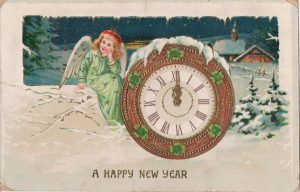
Happy New Year!

This past week I learned a couple new definitions for this specific time of year. Maybe these words and phrases have been around awhile. I had just never heard of them. See if you have heard of them.

Twixmas: the days between Christmas and New Year’s Eve, from 27-30 December. The word Twixmas is derived from the English word Betwixt, meaning between, and is the time period between all the holiday festivities, when things slow down. It is a time to relax around the house, watch a lot of TV, finish the Christmas leftovers, and return presents.

I believe we used to call this Christmas Break.

My first question is why doesn’t Twixmas begin on the 26th? Why can’t people begin this relaxing time the day after Christmas?

Twixmas doesn’t seem to be such a big deal if you are retired. Retirement certainly has its advantages and many days are Twixmas-like around here.

Good Riddance Day/Regrets Day: 28 December, when you throw out unpleasant memories from the year, memories that you want to forget. Symbolically, you write down unpleasant memories and throw them away.

The idea of writing an unpleasant memory down and burning, throwing, or flushing it away has been around awhile. This tactic has not been a successful memory-blocker for me. I can burn or flush away lots of little pieces of paper inscribed with bad recollections, but the unpleasant memories still resurface from time to time. Maybe I need a hotter incinerator or a bigger toilet.  

More importantly, December 28 has a Christian significance. The day is known as Holy Innocents Day or Childermas, in honor of the children of Israel who were killed by King Herod in his attempt to find and kill baby Jesus.

Although the 28th has passed, there are still a few days of Twixmas left to enjoy.

Wishing everyone a happy, healthy, and prosperous 2023. 


Tombstone Tuesday-Aaron L. & Glendora (Stump) Allmandinger

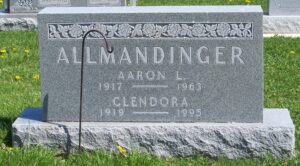
Aaron L & Glendora Allmandinger, Zion Lutheran Cemetery, Van Wert County, Ohio. (2012 photo by Karen)

This is the tombstone of Aaron L. and Glendora (Stump) Allmandinger, located in row 5 of Zion Lutheran Cemetery, Schumm, Van Wert County, Ohio. The marker is inscribed:

ALLMANDINGER
Aaron L.
1917-1963

Glendora
1918-1995

Aaron Ludwig Allmandinger was born 14 April 1917 near Schumm in Van Wert County, Ohio, the son of William Carl (1867-1919) and Barbara Sophia (Hoehamer) (1877-1929) Allmandinger. Aaron was baptized at home by Rev. George Meyer on 6 May 1917 with Richard and Walter Allmandinger serving as his sponsors.   

Aaron also had a twin sister, Anna Barbara.

Aaron Allmandinger’s father William died in July of 1919, leaving a widow and 12 children. Aaron was only 2 years old at the time.

In 1920 widow Barbara Allmandinger resided in Willshire Township with her 12 children: Barbara 42, head; Richard E, 21; Walter L, 19; Maria M, 28; Caroline K, 17; Bertha M, 16; Hugo J, 13; Frederick N, 12; Lillie L, 9; Minnie L, 8, Martin W, 6; Aaron L, 2; and Anna B, 2. [1]

Aaron’s mother Barbara (Hoehamer) Allmandinger died in February 1929. In 1930 Aaron and his twin sister Anna lived with their older brother Walter and his wife Paula: Walter Allmandinger, 30, head; Paula, 29, wife; Aaron, 12, brother; and Anna H, 13 [sic], sister. [2]

In 1940 Aaron was a lodger in the home of Emery Haster in Ridge Township, Van Wert County, and he worked as a farm laborer. [3]

Aaron Allmandinger married Glendora Stump on 8 June 1941 at Zion Lutheran, Schumm. Witnesses to the marriage were Doyt Stump and Miss Minnie Allmandinger.

Glendora Stump was born in Van Wert County on 2 June 1919, the daughter of Byron C. (1897-1982) and Gladys Matilda (Brown) (1899-1981) Stump.

The Byron Stump family in 1930, living in Pleasant Township, where Byron farmed: Byron C, 32, head; Gladys M, 31, wife; Glendora, 10, daughter; Wilbur D, 8, son; and Marcell M, 4, daughter. [4] In 1940 there was an additional child in the family, Ellen, 3. [5]

In 1950, 9 years after their marriage, Aaron and Glendora lived in Pleasant Township, Van Wert County, with their two sons, Kenneth, 7, and Ronald, 3. [6]

Aaron Allmandinger died in Van Wert on 17 October 1963, when the car he was driving was hit by a train. The accident occurred at the Penn RR crossing at North Market Street. Aaron was 46 years old and was buried on the 20th.

Aaron Allmandinger’s obituary:

Aaron Allmandinger Is Killed By Train
Aaron L. Allmandinger, 46, farmer residing five miles south of Van Wert, O., was killed Thursday afternoon when the car he was driving was struck by a three-diesel unit on the Pennsylvania railroad crossing near the courthouse in Van Wert.

The auto was carried 1,500 feet by the unit. Death was caused by a skull fracture.

Harod Saway [sic], owner of the car and an employee of Allmandinger had left the vehicle in the super shopping only minutes before the crash.

The victim is survived by his wife Glendora; three sons, Kenneth of Ohio City, O., Russell and Terry, at home; five brothers, Richard and Walter of Willshire, O., route 1, Frederick and Martin of Ohio City, O., route 1 and Hugo of Fort Wayne; and four sisters, Mrs. Walter K??? [sic] of Fort Wayne, Mrs. William Beard of Convoy, O., route 2, Mrs. Minnie Drydale of Chicago, and Mrs. Lillie M??? [sic] of Evanston, Ill.

Funeral rites will be held at 2:30 p.m. Sunday at the Saint [sic] Lutheran church in Willshire township. Friends may call at the Cowan & Son funeral home in Van Wert after 7 p.m. today until 12 noon Sunday, when the body will be removed to the church. [7]  

Aaron’s widow Glendora married Lloyd Girod in 1969. Lloyd died 10 years later, in 1979.

Glendora (Stump) Allmandinger Girod died in Van Wert County on 11 April 1995, at the age of 75.

Glendora’s obituary:

Ohio City
Glendora Allmandinger Girod, 75, died at 7:35, at her home.

She was born June 2, 1919, in Van Wert County, to Byron C. and Gladys Malinda Brown Stump. On June 8, 1941, she married Aaron Ludwig Allmandinger, who died Oct. 17, 1963. In 1969, she married Lloyd Girod, who died March 10, 1979.

Mrs. Girod was a homemaker. She was a member of Zion Lutheran Church and the Ladies Aid in Schumm. She was a 1937 graduate of Ohio City-Liberty High School. She was a member of the Van Wert County Extension Home Makers Club.

Survivors include three sons, Kenneth E. Allmandinger and Ronald W. Allmandinger, both of Van Wert, and Terry L. Allmandinger of Monett, Mo., and a stepson, Carl Girod of Plant City, Fla.; a stepdaughter, Evelyn (Hugh) Pugh of Venedocia; two sisters, Marcell Williams of Jackson, Mich., and Ellen Kohn of Ohio City; and six grandchildren and six great-grandchildren.

Services will begin at 11 a.m. Friday at Zion Lutheran Church, Schumm. The Rev. William Britton will officiate. Burial will e in Schumm Cemetery, Ohio City.

Friends may call 2 to 9 p.m. Thursday at Cowan and Son Funeral Home, Van Wert, and an hour before services Friday at the church. Memorial Contributions may be made to the Van Wert Area Visiting Nurses Association or Zion Lutheran Church. [8]

Aaron and Glendora (Stump) Allmandinger had the following children:
Kenneth E. Allmandinger (1942-2020), married Peggy E. McNeal
Ronald Wayne Allmandinger
Terry L. Allmandinger

[1] 1920 U.S. Census, Willshire, Van Wert, Ohio, Ed 146, p.3A, dwelling 52, family 53, Barbara S Allmindinger [sic]; Ancestry.com.

[2] 1930 U.S. Census, Willshire, Van Wert, Ohio, ED24, p.2B, dwelling, family, Walter Allmandinger; Ancestry.com.

[3] 1940 U.S. Census, Ridge, Van Wert, Ohio, ED 81-17, p.9B, Emery Haster; Ancestry.com.

[4] 1930 U.S. Census, Pleasant, Van Wert, Ohio, ED 12, p.5B, dwelling & family 126, Byron C Stump; Ancestry.com.

[5] 1940 U.S. Census, Liberty, Van Wert, Ohio, ED 81-7, p.1B, household 13, SJ Stump; Ancestry.com.

[6] 1950 U.S. Census, Pleasant, Van Wert, Ohio, ED 81-25, sheet 8, Aaron Allmandinger; Ancestry.com.

[7] Aaron Ludwig Allmandinger obituary, 18 Oct 1963, FindaGrave.com, memorial no. 34046980.

[8] The Lima News, Lima, Ohio, 12 April 1995, p.10; Newspapers.com, viewed 26 Dec 2022.

 

Tombstone Tuesday-Dash Meaning

We took a little vacation to Holmes County a couple weeks ago. The weather was pretty nice for December and while there we took the time to visit one of my favorite cemeteries, West Lawn Cemetery, in Baltic, Tuscarawas County. Some of my Scaer/Scarr ancestors lived in that area in the late 1800s before moving to Allen County, Indiana. In fact, my great-grandfather John Scaer was born in Baltic in 1865.

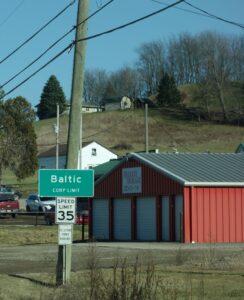
Baltic, Tuscarawas County, Ohio

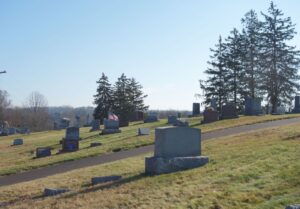
West Lawn Cemetery is on the west edge of Baltic and is located on a hill.

West Lawn Cemetery, Baltic, Ohio

We usually visit this cemetery when we are in the Holmes County area, along with a stop at one of our favorite wineries, the Baltic Mill Winery, located in a beautiful old mill in town.

Baltic Mill Winery

It was a nice sunny day when we were at the cemetery and on this visit we explored the new section.

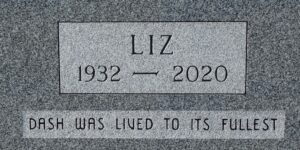
I noticed this saying, inscribed on the Baab tombstone.

Dash inscription, West Lawn Cemetery, Baltic, Ohio, Baab monument

DASH WAS LIVED TO ITS FULLEST  

It took me a few seconds to understand its meaning.

Can you figure out the meaning?

Dash inscription, West Lawn Cemetery, Baltic, Ohio, Baab monument

The DASH refers to the dash between the birth and death years. In this case, the dash between 1932-2022.

On many tombstones, and in genealogy in general, the vital statistics of a person’s life are reduced to two dates, their birth date and their death date, with a dash between the two dates.

The birth and death years are important but there is so much more to someone’s life.

For most people, most of their lifetime is what happens during the time period represented by the dash. The period of time between the two dates.

The dash is your life.  

We should all make the most of our dash.

1909 Christmas Greeting to Effie Morrison

Sending Christmas greeting cards has been a tradition since the 1840s and Christmas postcards were certainly popular in this area in the early 1900s.

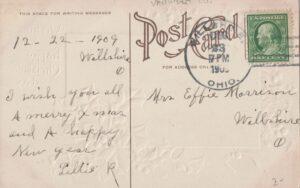
This is another Christmas postcard, postmarked Willshire, Ohio, December 23, 1909. It is addressed to Mrs. Effie Morrison, Willshire, O.

1909 postcard addressed to Effie Morrison, Willshire postmark.

The sender wrote the note on 12-22-1909, from Willshire, O, and wrote:

I wish you all a Merry Xmas and a happy New Year. Lillie R.

The message is short and sweet.

1909 postcard addressed to Effie Morrison, Willshire postmark.

I don’t know who Lillie R. was but there were two Effie Morrisons living in the area, both living in Black Creek Township, Mercer County.

The first was Effie R. (Koontz) Morrison (1869-1959), the daughter of Joel and Anna J. (Frock) Koontz. She married Robert R. Morrison (1870-1933) about 1896 and in 1910 they lived south of Willshire, in Black Creek Township, on Brandt Pike, which likely is now State Route 49. Robert and Effie moved to Celina by 1920. They had no children and are buried in North Grove Cemetery, Celina.

I suspect this postcard was sent to Effie R. since they probably had a Willshire address.

The other Effie, Effie A. (Latimer) Morrison (1871-1945), lived on Rutledge Pike, Black Creek Township, in 1910 and probably had a Rockford address. Effie A. was the daughter of John and Emily (Stevenson/Stephenson) Latimer and married Frank D. Morrison in 1894. Frank D. Morrison (1868-1964) and Robert R. Morrison were brothers, so the two Effies were sisters-in-laws. Effie A. and Frank D. Morrison had four daughters Hattie, Lottie, Bessie, and Mabel. Effie A. (Latimer) Morrison is buried in East Bethel Cemetery, Black Creek Township.

Another nice vintage Christmas postcard.

Tombstone Tuesday-Lighthouse Symbol

Lighthouses have stood on coastlines for centuries, warning and guiding sailors to a safe passage.

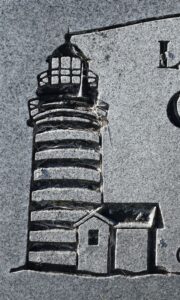
A lighthouse image inscribed on a tombstone can have several meanings.

Lighthouse symbol, West Lawn Cemetery, Baltic, Tuscarawas County, Ohio

Lighthouses symbolize strength. Most stand on the edge of cliffs and rocks, standing strong against the storms and rough sea waves.

Lighthouses symbolize vigilance. The lighthouse keeper is reliable, always on duty at the lighthouse, keeping watch 24 hours a day, every day of the year, guiding sailors.

A lighthouse is a source of hope and can be a lifesaver. Its beacon of light guides people to a safe haven, especially those lost at sea and ships seeking safe harbor. Lighthouses are erected in locations where there would likely be death without them. Built near dangerous rocks, hidden sandbars, and strong currents, they give hope for safe passage.

Lighthouses are a guiding light and an important navigation tool, guiding sailors safely to shore. They symbolize the hope and faith in Jesus as the Guiding Light. In addition, the Guiding Light Principle encourages people to follow a moral and right path.

The lighthouse provides safety for the lighthouse keeper and people on the coastline who may need shelter.

Finally, the lighthouse symbolizes the end of a journey. One has crossed the sea of life, the journey has ended and the lighthouse is a welcoming sign the journey is coming to a happy ending.