Tombstone Tuesday-Arnold L. & Naomi M. (Schumm) Schumm

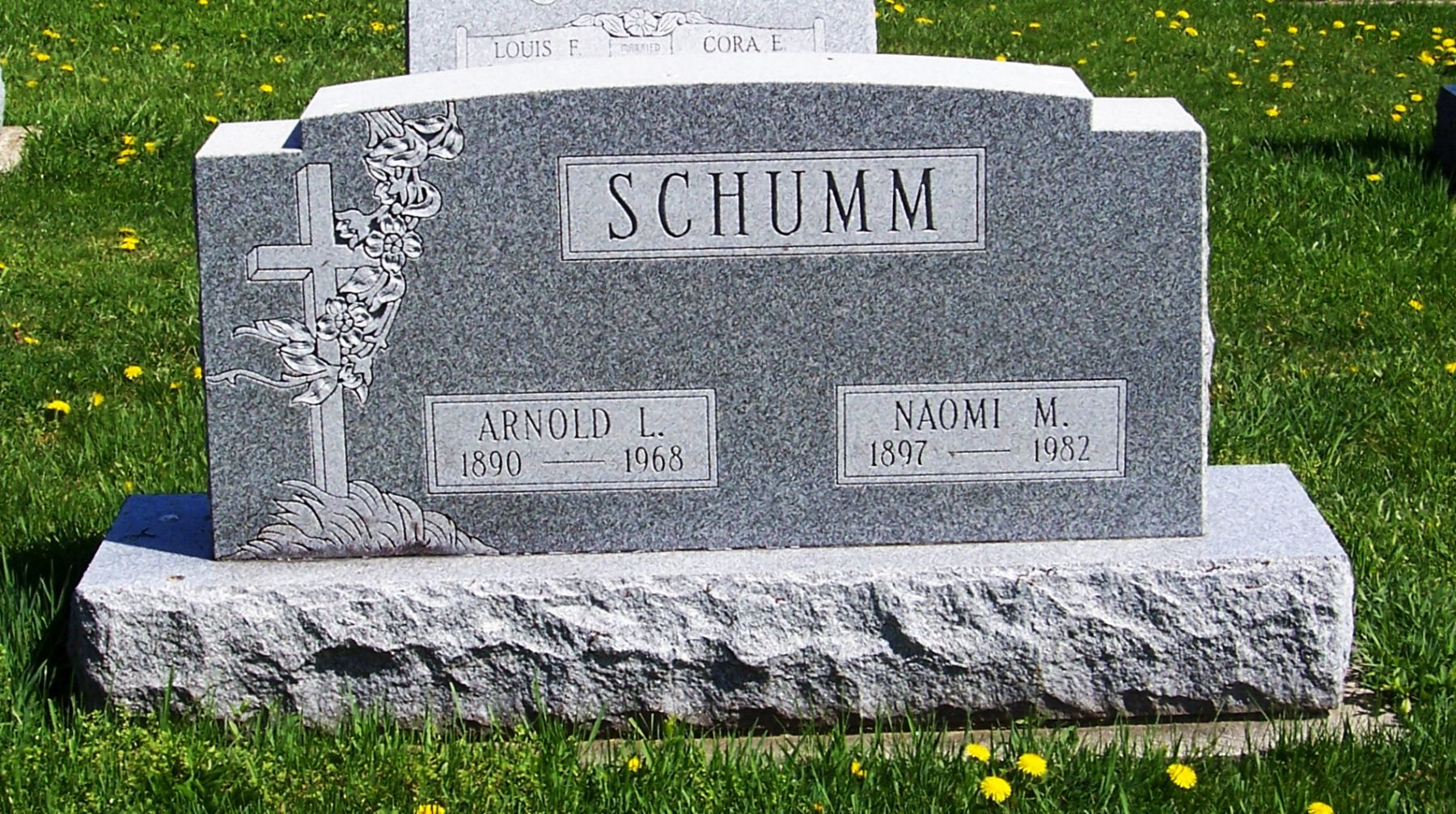
Arnold L & Naomi M (Schumm) Schumm, Zion Lutheran Cemetery, Van Wert County, Ohio. (2012 photo by Karen)

This is the tombstone of Arnold L. and Naomi (Schumm) Schumm, located in row 7 of Zion Lutheran Cemetery, Schumm, Van Wert County, Ohio. The marker is inscribed:

SCHUMM
Arnold L.
1890-1968

Naomi M.
1897-1982

Arnold Ludwig Schumm was born 7 August 1890, the son of John Christian Schumm and Wilhelmine “Minnie” Breuninger. He was baptized at Zion Schumm on 17 August 1890, with Henry Schumm II and Wilhelm Buchner II serving as his sponsors.

Arnold’s mother Minnie (Breuninger) Schumm died in 1899.

Arnold Schumm, age 10, with his family in 1900: John Schumm, 50; Victor A, 18; Hilda M, 16; Lydia, 16; Elizabeth, 12; Arnold, 10; Salome, 7; and Otis, 23. His father John Schumm was a farmer. [1]

The John Schumm family in 1910: John, 60; Hilda, 26; Lydia, 26; Arnold, 19; and Salome, 17. [2]

The John Schumm family in 1920: John, 70; Arnold, 28; and Salome, 25. [3]

Arnold Schumm married Naomi Schumm on 16 November 1922 at the home of Naomi’s parents in Black Creek Township, Mercer County, Ohio. Rev. Bienert officiated and Amos Schumm and Salome Schumm were witnesses to their marriage.   

Naomi Margaretha Schumm was the daughter of Fredrick Jr and Mary (Buchner) Schumm and was born 2 March 1897. She was the fifth and last child born to Friedrick and Mary Schumm. Her mother Mary (Buchner) was the second wife of Frederick Jr and Naomi had six living step-siblings when she was born.

Naomi Schumm was baptized at home on 14 March 1897, with Mrs. Heinrich Buchner and Barbara Schumm serving as her sponsors.

Naomi Schumm, with her family in 1900, on the family’s farm in Mercer County: Friedrich Schumm, 56; Mary, 39; Hugo, 24; Leona, 22; Henrietta, 20; Lawrence, 15; Amos, 8; Erna, 5; and Naomi, 3. [4]

Naomi‘s father Frederick Schumm Jr died 24 December 1907.

In 1910 Naomi lived with her widowed mother Mary (Buchner) Schumm and Naomi’s siblings: Mary Schumm, 49; William, 25; Amos, 18; Erna, 15; and Naomi, 12. [5]

Naomi lived with her brother Amos and his family in 1920. Their mother Mary (Buchner) Schumm also lived with them: Amos, 28; Esther, 26; Ruth, 0; Naomi, 22; and Mary, 58. [6]

In 1926, four years after their marriage, Naomi gave birth to twins, a boy and girl, but they died the same day or were stillborn. A daughter, Lois, was born in 1928.

Naomi’s mother Mary (Buchner) Schumm died 16 February 1930.

The Arnold Schumm family in 1930: Arnold, 39; Naomi, 32; and Lois, 1. [7]

Arnold and Naomi had two more children in the next ten years. Frederick was born in 1933 and Wilma in 1936.

The Arnold Schumm family in 1940: Arnold, 49; Naomi, 43; Lois, 11; Frederick, 6; and Wilma, 3. Arnold was a farmer. [8]

Arnold Schumm died at Lutheran Hospital in Fort Wayne, Indiana, on 29 March 1968. He died from an aneurysm and atherosclerosis and was buried on 1 April. [9]

His widow Naomi (Schumm) Schumm died in Van Wert County on 26 January 1982.

Arnold and Naomi (Schumm) Schumm had the following children:
Twins, male & female (1926-1926)
Lois M (1928-2002)
Frederick J (1933-2015), married Eileen Saalfrank
Wilma Louise (1936-2020), married Paul Frederick Schmidt

[1] 1900 U.S. Census, Willshire, Van Wert, Ohio, ED 98, p.11, dwelling 216, family 221, John Schumm; digital image by subscription, Ancestry.com (https://www.ancestry.com/search/collections/7602/ : viewed 28 Jun 2020).

[2] 1910 U.S. Census, Willshire, Van Wert, Ohio, ED 114, p.6A, dwelling 111, family 112, John G Schumm; digital image by subscription, Ancestry.com (https://www.ancestry.com/search/collections/7884/ : viewed 28 Jun 2020).

[3] 1920 U.S. Census, Willshire, Van Wert, Ohio, ED 146, p.2B, dwelling & family 42, John C Schumm; digital image by subscription, Ancestry.com (https://www.ancestry.com/search/collections/6061/ : viewed 28 Jun 2020).

[4] 1900 U.S. Census, Black Creek, Mercer, Ohio, ED 74, p.2, dwelling & family 29, Frederick Schumm; digital image by subscription, Ancestry.com (https://www.ancestry.com/search/collections/7602/ : viewed 17 May 2020).

[5] 1910 U.S. Census, Black Creek, Mercer, Ohio, ED 107, p.2A, dwelling & family 26, Marry Schwinn; digital image by subscription, Ancestry.com (https://www.ancestry.com/search/collections/7884/ : viewed 17 May 2020).

[6] 1920 U.S. Census, Black Creek, Mercer, Ohio, ED 124, p.1B, dwelling & family 15, Amos Schumm; digital image by subscription, Ancestry.com (https://www.ancestry.com/search/collections/6061/ : viewed 28 Jun 2020).

[7] 1930 U.S. Census, Willshire, Van Wert, Ohio, ED, p. dwelling 95, house, 97, Arnold Schuman; digital image by subscription, Ancestry.com (https://www.ancestry.com/search/collections/6224/ : viewed 28 Jun 2020).

[8] 1940 U.S. Census, Willshire, Van Wert, Ohio, ED 81-28, p.5A, house visited 41, Arnold Schumm; Schumm; digital image by subscription, Ancestry.com (https://www.ancestry.com/search/collections/2442/ : viewed 28 Jun 2020).

[9] Indiana Death Certificates, 1899-2011, 1968, roll 5, Arnold Louis Schumm death certificate, 29 Mar 1968; digital image by subscription, Ancestry.com, viewed 28 Jun 2020.

Fourth of July 2020

Tomorrow is the Fourth of July, also known as Independence Day, the day we have celebrated as our nation’s birthday since 1776. It has been 244 years since the Continental Congress officially adopted the Declaration of Independence, declaring that the thirteen colonies were no longer part of Great Britain, but were independent sovereign states that were part of a new nation.

This Fourth of July holiday will be much different than the ones we remember in years past. Many local fireworks displays and pubic events have been canceled. A few communities still plan to have fireworks but here at home we will probably watch a national celebration display on TV.

This whole year has been out of the ordinary and each month brings a new and different calamity. We have seen a pandemic, the shut-down of most everything in many states, stay-at-home orders, the threat of murder hornets, a Sahara dust storm, and destructive riots all over the country. American citizens have experienced a lot so far in 2020. Stop! Enough! It has been bleak and depressing at times and the unrest and uncertainty continues.

And here we are, half way through the year, at the 2020 July 4th weekend.

Now is the time. The time to celebrate our great nation and to be thankful we live here. We are so fortunate to live in America. 

Now is the time to be patriotic. The time to fly our flag. The time to respect our flag.

Now is the time to remember the Pledge of Allegiance to the Flag of the United States of America. To think about what it means and take that meaning to heart.

Now is the time to proudly sing our National Anthem.

Now is the time to use our First Amendment right to speak up for our democracy and for freedom.

Now is the time to stand up for our liberties and our Bill of Rights. Freedom of Speech. Freedom of Religion. The right to keep and bear arms, just to mention a few.   

Now is the time to wear red, white, and blue. The time to be a patriot.

We live in the greatest nation on earth. Many people from other nations want to come to America and become American citizens. They would not want to come here if they did not feel they would have a better life here. America provides liberty, justice, freedom, and unlimited opportunities for all. 

Now, more than ever, is the time to stand up for America.

Now is the time. Before it is too late.

Below is The American’s Creed, which we recite it at our DAR meetings. It was the winning submission in a 1917 national writing contest for a creed of the United States. William Tyler Page used phrases from the Declaration of Independence, the Preamble to the Constitution and Lincoln’s Gettysburg Address in his entry. The American’s Creed was adopted by the U.S. House of Representatives in 1918.:

The American’s Creed
I believe in the United States of America as a government of the people, by the people, for the people; whose just powers are derived from the consent of the governed; a democracy in a republic; a sovereign Nation of many sovereign States; a perfect union, one and inseparable; established upon those principles of freedom, equality, justice, and humanity for which American patriots sacrificed their lives and fortunes.

I therefore believe it is my duty to my country to love it, to support it Constitution, to obey its laws, to respect its flag, and to defend it against all enemies. —William Tyler Page

From a patriotic song:

“And I’m proud to an American, where at least I know I’m free. And I won’t forget the men who died, who gave that right to me.” –Lee Greenwood

Have a happy and safe Independence Day!

God Bless America!


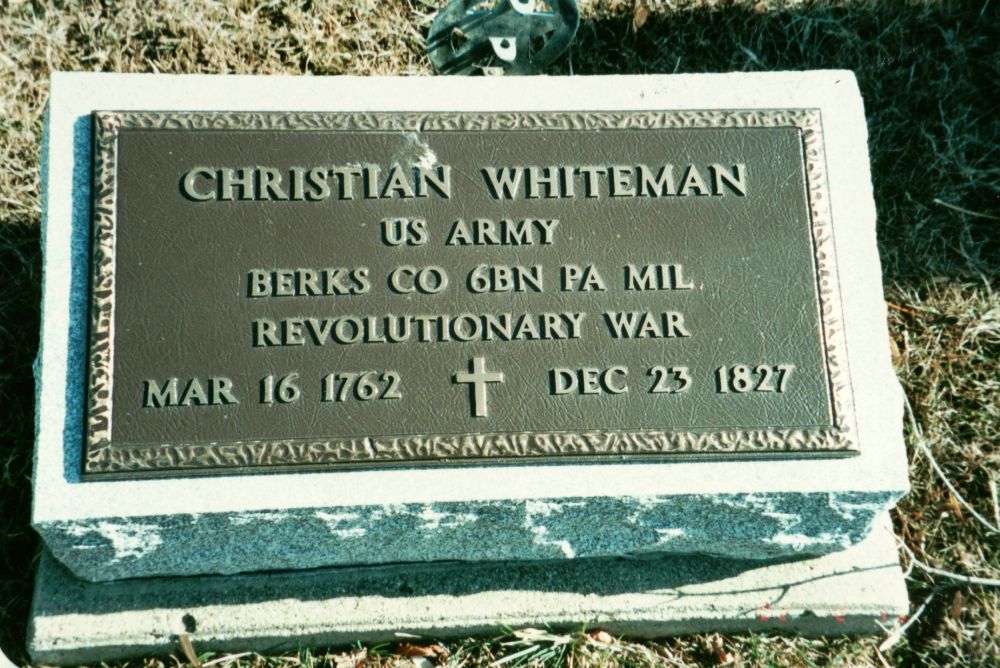
Tombstone Tuesday-Christian Whiteman

In honor of Independence Day, which we celebrate this weekend, today’s blog post features my Revolutionary War ancestor, Christian Whiteman.

Christian, my fifth great-grandfather, fought for American independence during the Revolutionary War. He was a private in the Berks County, 6th Battalion, Pennsylvania Militia during the Revolution and is the ancestor that I proved for membership in The Daughters of the American Revolution (DAR).

Christian Whiteman, Reber Hill Cemetery, Pickaway County, Ohio. (2002 photo by Karen)

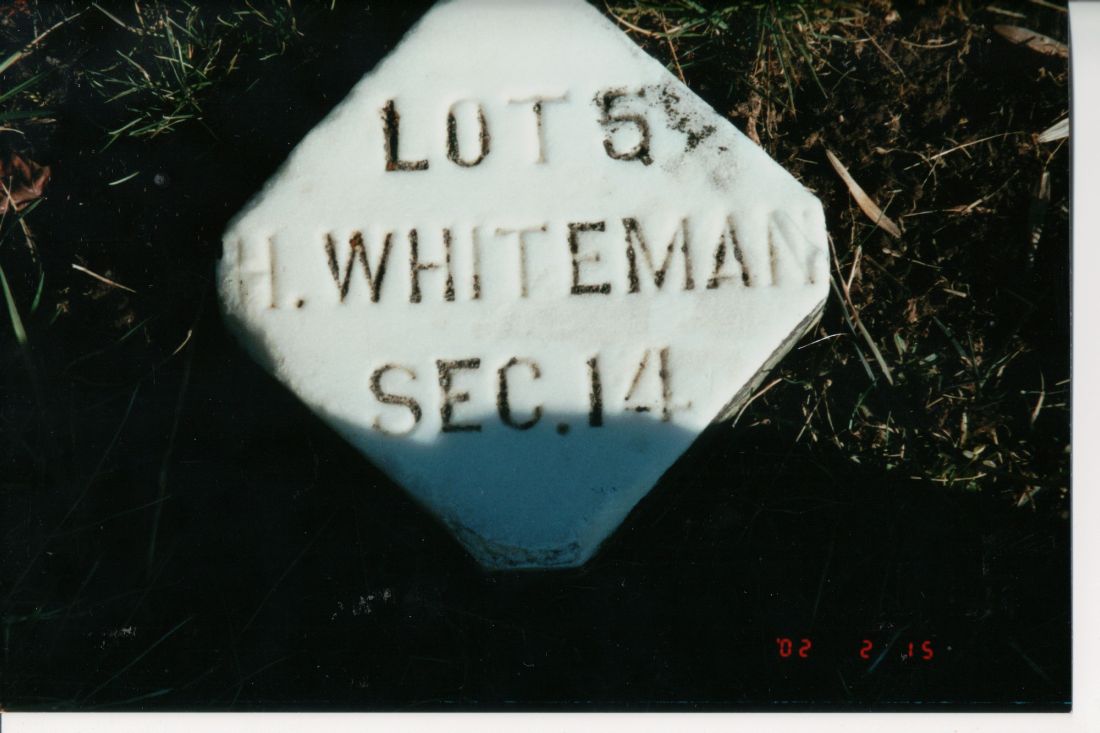
Christian Whiteman’s marker is located in Section 14 of Reber Hill Cemetery, Walnut Township, Pickaway County, Ohio. The marker is inscribed:

CHRISTIAN WHITEMAN
US ARMY
BERKS CO 6BN PA MIL
REVOLUTIONARY WAR
MAR 16, 1762   Dec 23, 1827

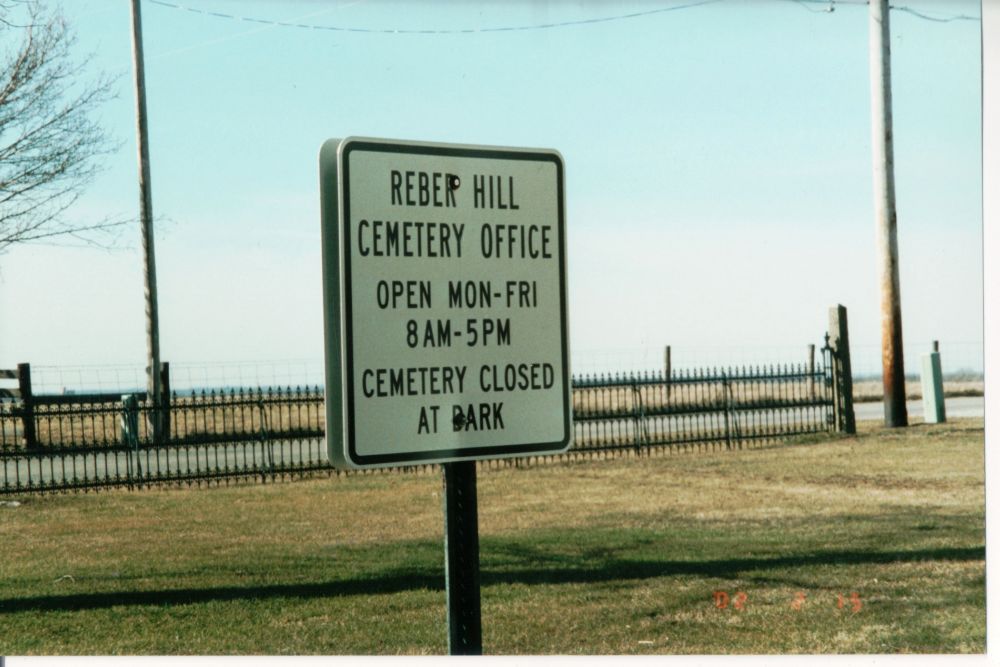
We took a research trip to Reber Hill Cemetery in 2002, located at 16810 Winchester Road, Ashville, Oho. The caretaker at Reber Hill Cemetery has a file that contains many burial cards and according to Christian’s card, Christian Whiteman’s remains were moved to Reber Hill Cemetery on 14 September 1894. The caretaker noted that remains from several small local cemeteries were moved to Reber Hill. 

Whiteman Section 14, Reber Hill Cemetery. (2002 photo by Karen)

It is unknown where Christian was first buried. Perhaps he was first buried on one of the Whiteman properties in Pickaway or Fairfield County.

Christian Whiteman was born 16 March 1762 in Berks County, Pennsylvania, the son of Johann Weidman/Whiteman and Anna Barbara.

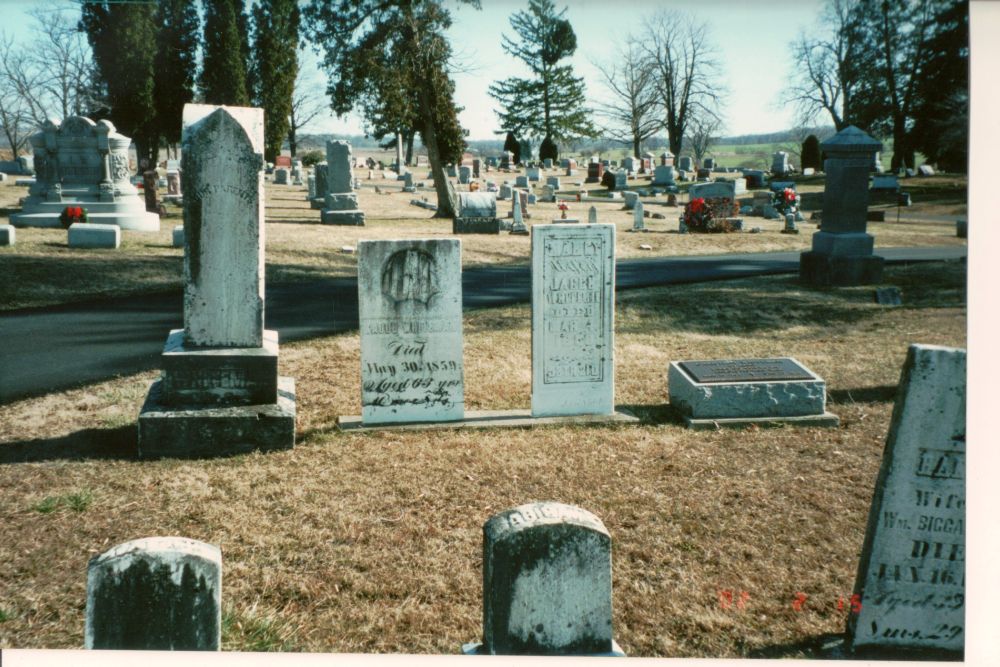
Christian married twice during his lifetime and both marriages took place in Pennsylvania. His first marriage was to Catherine Greiner (1758-1796). Christian and his first wife had two children, Jacob (1795-1859) and Sarah (1796-1880). Jacob, Jacob’s wife, and their son Henry are also buried in the same Section of Reber Hill Cemetery.

Christian’s son Jacob, Jacob’s wife and son are also buried in Section 14. (2002 photo by Karen)

Christian’s first wife died about 1796 and he married Hannah Huey in about 1798. Hannah (1773-1850) was the daughter of James and Elizabeth Huey.

In 1798-99 Christian Whiteman and his family resided in Georges Township, Fayette County, western Pennsylvania, where Christian paid taxes. [1] Christian and his family were enumerated in the U.S. census in 1800 in Georges Township. In the household were 2 males 0-10, 1 male 10-16, 1 male 26-45, 1 female 0-10, and 1 female 26-45. [2]

Christian and his family moved to Ohio a few years later. Between 1804-1805 Christian purchased over 300 acres of land in Fairfield County, Ohio. [3] Christian was among the taxpayers in Amanda Township in 1806. [4] This was not a residence tax and does not prove that Christian was actually living in Fairfield County in 1806.

But in 1810 Christian was a Resident Taxpayer in Fairfield County and that indicates he was living there. He owned 315 acres of land in Section 30, Township 13 [Amanda Township] and paid a Resident Tax of $3.15. [5]

Christian Whiteman died in Amanda Township, Fairfield County, on 23 December 1827. He was buried on or near one of the family farms but was moved to Reber Hill Cemetery about 60 years later.

Reber Hill Cemetery, Pickaway County, Ohio. (2002 photo by Karen.)

Christian did not leave a will. He didn’t have to. Instead of writing a will, he left some interesting land deeds, where he divided his land among his children before he died. Those maintenance deeds in both Pickaway and Fairfield Counties contain a lot of family information and is of great genealogical interest.

Christian’s widow Hannah (Huey) Whiteman died 26 November 1850 is buried in Cheshire Cemetery, Delaware County, Ohio.

Christian and Hannah (Huey) Whiteman had seven children:
James E. (1799-1873), married Mary North
Elizabeth (1800-1854), married Jacob Ekelberry
John (1803-?) married Sarah Smith
Mary (c1805-1855), married Isaac Huey
Christian (c1806-1845), married Mary/Polly Neigh
Henry (1809-1864), married Sarah Wilson
Anna (1811-1838), never married

I descend from Christian Whiteman’s daughter Mary, who married Isaac Huey. Mary and Isaac, along with some other members of Christian’s family, moved to Jay County, Indiana, a few years after Christian’s death. Christian and some of his descendants left some very interesting legal documents that give priceless genealogical information.

[1] Fayette County, Pennsylvania Taxpayers, 1785-1799, T.L.C. Genealogy (Miami Beach, Florida, 1991), 167.

[2] 1800 U.S. Census, Georges, Fayette County, Pennsylvania, p. 554, line 5, Christian Whiteman; digital image by subscription, Ancestry.com (https://www.ancestry.com/search/collections/7590/ : accessed 29 June 2014).

[3]  Tract Book and Entries, Congress Lands 22 Ranges and U.S. Military Lands, Vol. 1, Auditor of State [Ohio], LOV 230:476, 480, microfilm #GR8285, Ohio Historical Society, Columbus, Ohio. 

[4] Esther Weygandt Powell, compiler, Early Ohio Tax Records (1971; reprint, Baltimore, Maryland : Genealogical Publishing Co., Inc., 1985), 102.

[5] Resident Duplicate for Fairfield County, Ohio, 1910, microfilm #GR2343, p. 1, Ohio Historical Society, Columbus, Ohio.

Nimrod Headington Journal, 1852, part 20

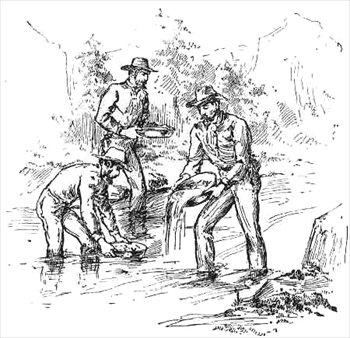
Today’s blog post is the twentieth in a series, the transcription of Nimrod Headington’s 1852 journal, Trip to California.

In his journal Nimrod Headington details his 1852 voyage from New York to San Francisco and his search for gold in California. [1] [2]

Nimrod, with several others from Knox County, Ohio, set sail from New York on 16 February 1852, traveling on the clipper ship Racehound. After 5 months at sea, on 18 July 1852, they docked at San Francisco.

In today’s blog post, Nimrod continues his search for gold in California. It is February 1853, a year since Nimrod left his home and family in Ohio. He has yet to strike it rich. In reality, Nimrod is poorer than when he started his journey.      

Spring 1853

February 1st. This morning McCafferty, Moffitt, and myself went to work washing our dirt, but we had poor luck, only getting ten dollars between us.

February 2nd. One year ago this morning I left my home, and I am as poor as a church mouse. Our occupation today was same as yesterday, but we made better wages. When we panned out, we had made ten dollars and a half each that day.

February 3rd. Still washing at our dirt. There was four of us at work that day. We were working away, all in fine spirits, and everything seemed to be going all right. John McCafferty was at the machine, and the rest of us was shoveling in the dirt. The machine was set down low in the ditch so that it made it very high to throw the tailings out. And about 10 o’clock they began to fall back on him. So I went up to fix so the tailings could not run back on him. I was going to lay a log close to the edge of the bank to prevent it. I went and got the log on my shoulder, carrying it to the place, and when I got onto the gravel, it gave way. And I went down, log and all. I had to throw the log to save myself, and it went end foremost and struck right in the bottom of our riffle box. And in an instant, whatever gold we had was gone. We supposed that we had 30 or 40 dollars in the box and was ready to go to work at noon again. And we got forty dollars that afternoon. This made us feel right nice.

February 4th. We pulled down our dam and moved it up higher, so we did not make anything that day.

February 5th. We went to work again and washed top dirt all day, so we did not make much that day. But we weighed our week’s work and divided it. We had one hundred and twenty-seven dollars apiece. Still feeling better.

Sunday morning. Moffitt and McCafferty started to the Rabbit Creek House for provisions—a distance of 8 miles—but fortunately they met a mule train coming in that they bought flour and cornmeal off. They paid 45 cents for flour and 27 cents for meal and were home again at noon. We then began to think that we were going to live again. 

February 7th. Went to work washing dirt again. And there was a company below that commenced work, and they backed the water up on us. So we were about to have trouble with them. But after a little jangling, we got them to fix their race so as to carry the water off. And we had no further trouble. Today a train of 30 mules came in loaded with provisions for sweet and [sour]. Charles Watkins was very sick and Henry went for his brother, who lived in a cabin about a half mile away.

February 8th. We worked hard all day and only got one course between us. And we had to pay ten dollars for water. Another mule train arrived, and now provisions are getting plenty and cheaper—flour 55 cents a lb., cornmeal 45, potatoes, 35, beans, 25, butter $1.25, pork not to be had at any price, rice 35 cents, sugar 37, molasses $3 per gallon.

February 9th. Three of us washed dirt today, and one of us worked for Mr. Cosgrove for $6.00. And we panned out $34. Then add the $6.00 made up $40–$10 apiece. 

February 10th. Three of us washed dirt, and one worked by the day as before. We made sixteen dollars and fifty cents apiece for this day’s work, and we began to feel like somebody.

February 11th. Today we got thirty dollars.

February 12th. Worked until noon, and we may go ten dollars.

February 13th. The ditch caved in, and we did not get to wash any [dirt] this day.

February 15th. Today we threw out all of the dirt that had caved into the ditch ad got everything ready to work in the morning. While we were eating supper, Charles Watkins got a letter from his brother who had gone down in the valley some time before, and he wanted to go to him very bad. And I wanted to get rid of him just as bad. And he [badgered] me to buy him out and I made him an offer, and he took me up. So I was rid of him the next morning. Provisions still getting plentiful and cheaper. We could buy flour at 30 cents a lb. Nothing special happened this week, except on Saturday evening. We had a snowstorm, but it did not last long, and the next morning it was clear.

February 20th. Sunday we went to a store where they had a pair of gold scales to divide our dust that we had got in the last 3 days, and we had $46 apiece. The day passed off very pleasantly.

February 21st. Monday morning. Commenced [work] again but had to stop on account of another company that wanted to clean out [their] tail race below us. The race was so narrow that only one could work it at one time.

 February 22nd. Jacob Hardaker and myself went out toward the table mountain prospecting, but we found nothing but bear tracks.

February 23rd. Snow fell all day so that all the miners kept indoors all day. [3]

To be continued…

I will post Nimrod’s journal in increments, but not necessarily every week.

[1] Nimrod Headington at the age of 24, set sail from New York in February 1852, bound for San Francisco, California, to join the gold rush and to hopefully make his fortune. The Panama Canal had not been built at that time and he sailed around the tip of South America to reach the California coast. Nimrod Headington kept a diary of his 1852 journey and in 1905 he made a hand-written copy for his daughter Thetis O. Tate. This hand-written copy was eventually passed down to Nimrod’s great-great-granddaughter, Karen (Liffring) Hill (1955-2010). Karen was a book editor and during the last two years of her life she transcribed Nimrod’s journal. Nimrod’s journal, Trip to California, documents his travels between February of 1852 and spring of 1853.

[2] Nimrod Headington (1827-1913) was the son of Nicholas (1790-1856) and Ruth (Phillips) (1794-1865) Headington. He was born in Mt. Vernon, Knox County, Ohio, on 5 August 1827 and married Mary Ann McDonald (1829-1855) in Delaware County, Ohio, in 1849. Nimrod moved to Portland, Jay County, Indiana, by 1860 and during the Civil War served in the 34th Indiana Infantry as a Colonel, Lieutenant Colonel, and Major. Nimrod died 7 January 1913 and is buried in Green Park Cemetery, Portland. Nimrod Headington is my fourth great-granduncle, the brother of my fourth great-grandfather, William Headington (1815-1879).

[3] Nimrod Headington’s journal, transcription, and photos courtesy of Ross Hill, 2019, used with permission.


Tombstone Tuesday-Frederick H. Schumm

Frederick H. Schumm, Zion Lutheran Cemetery, Van Wert County, Ohio. (2012 photo by Karen)

This is the tombstone of Frederick H. Schumm, located in row 10 of Zion Lutheran Cemetery, Schumm, Van Wert County, Ohio. The marker is inscribed:

Frederick H.
Son of
Hugo A. & Ada A.
Schumm
June 18, 1909
Nov. 20, 1924

Frederick Herman Schumm was born near Schumm, Ohio, on 18 June 1909, the son of Hugo A. and Ada (Wilson) Schumm. He was baptized at home on 4 July 1909, with Minnie E. Schumm, William L. Schumm, and Jacob F. Schumm serving as his sponsors.

Frederick Herman Schumm, enumerated in the 1910 census with his parents: Hugo, 34; Ada, 27; and Frederick, under one year. All were born in Ohio. [1]

The Hugo Schumm family in 1920: Hugo, 43; Ada, 36; and Frederick, 10. [2]

A second child, Marcile Margery, was born to Hugo and Ada Schumm on 30 January 1920, just 3 weeks after the census was taken.

Frederick Herman Schumm died in Willshire Township on 20 November 1924 at the age of 15 years, 5 months, and 2 days old. He died from tubercular peritonitis and whooping cough, after an illness of 3 months. He was buried on the 23rd. [3]

Frederick’s father Hugo Schumm died in 1932 and his mother Ada died in 1933. They are buried next to their son Frederick Herman. Frederick’s sister Marcile Schumm was raised by their aunt and uncle Walter and Erna (Schumm) Schumm after the death of her parents. Marcile later married John F. Buchner and she died in 1988.

[1] 1910 U.S. Census, Willshire, Van Wert, Ohio, ED 114, p6B, dwelling 122, family 123, Hugo Schumm; digital image by subscription, Ancestry.com (https://www.ancestry.com/search/collections/7884/ : viewed 15 Jun 2020).

[2] 1920 U.S. Census, Willshire, Van Wert, Ohio, ED 146, p.3B, dwelling 58, family 59, Hugo H Schumm; digital image by subscription, Ancestry.com (https://www.ancestry.com/search/collections/6061/ : viewed 15 Jun 2020).

[3] “Ohio Deaths, 1908-1953,” Van Wert, Ohio, Frederick H Schumm, 20 Nov 1924; database with images, FamilySearch.org (https://www.familysearch.org/ark:/61903/3:1:33SQ-GPKX-91PN?i=1193&cc=1307272&personaUrl=%2Fark%3A%2F61903%2F1%3A1%3AX69N-LJH : viewed 21 Jun 2020).