The Two Headington House Hotels

Name something Portland, Indiana, and Celina, Ohio, have in common.

Actually, the towns probably have several things in common, but I am thinking of one specific thing that relates to my family history.

Both Portland and Celina had a Headington House Hotel at one time.

I have Headington ancestry and I have learned that I am distantly connected to the proprietors of both establishments.

The Headington surname was rather common in Portland, but not common in Celina. I knew about Portland’s Headington House, built in 1870 by Nimrod Headington (1827-1913), but I was surprised to learn that Celina also had a Headington House, information that I learned from Joyce Alig.

Although both homes were built just a year apart, one in 1870 and the other in 1871, Celina’s stately home would not be known as the Headington House until the 1930s.   

Portland’s Headington House

The Headington House in Portland was built in 1870 by Nimrod Headington. Nimrod Headington was the brother of my fourth great-grandfather, William Headington. The Headingtons were originally from Maryland.

A couple years ago I posted Nimrod Headington’s 1852 journal, Trip to California, in a number of installments. In his journal, Headington recounted his travels from Knox County, Ohio, to New York, where he boarded the sailing ship Racehound and sailed around South America to California, to join the California gold rush. After his adventure he returned to Knox County, served in the Civil War, and eventually moved to Portland, where he built the Headington House Hotel and later was appointed the town’s postmaster.
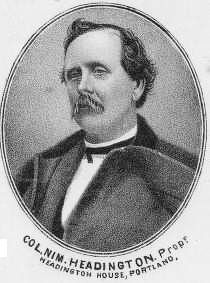
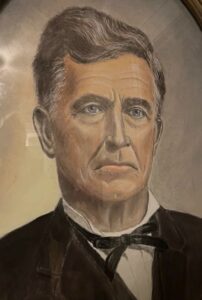
Nimrod Headington (1827-1913)

Nimrod Headington ran the hotel for 12 years, according to his 1901 biography. The 1880 census indicates Nimrod Headington was a hotel keeper in Portland.

 Below is an ad for Portland’s Headington House, printed in the Fort Wayne Daily Gazette, 16 December 1873:
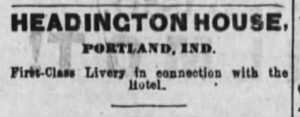
1873 ad for Headington House, from Ft. Wayne Daily Gazette.

Unfortunately, the ad does not give the address of the Hotel. I do not know where the hotel was located, how long it operated, or if it is still standing. I have no photo of it.

Celina’s Headington House

Celina’s Headington House Hotel did not start out as the Headington House. It was originally the Snyder Home, built in 1871 by Alexis Parker Jones Snyder, aka A.P.J. Snyder (1828-1901). Snyder was one of the early publishers of Mercer County newspapers, papers known through the years as The Mercer County Standard, The Western Standard, and today as The Daily Standard.

The Snyder House was located on the northwest corner of East Market and North Ash Street in Celina. The address was 129 E. Market. It was just east of today’s The Daily Standard Building and across the street from the Riley House, currently the home of Mercer County Historical Museum.

The six-bedroom cost $700 to build in 1871.
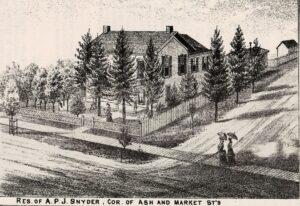
Snyder home, later the Headington House, Celina, Ohio, 1882 sketch, Mercer/Van Wert County History.

The Snyder House stayed in the Snyder family until 1925, when the family sold it to John and Jennie S. Bedell. In 1937 widow Jennie S. Bedell sold the house and property to widow Elma D. (Hartzell) Headington (1892-1970).

Elma was the widow of Kenneth Glen Headington. So technically, I was related to her husband Ken Headington (1888-1933).

The 1940 census shows Elma’s address as 129 East Market, but no occupation was given for her.

The 1953 and 1960 Celina City Directories both indicate that Elma Headington was the widow of KG, living at the Headington House Hotel, 129 E. Market St. The next entry is the Headington House Hotel, 129 E. Market, furnished rooms. Both entries have the same phone number, 3134. [1] 
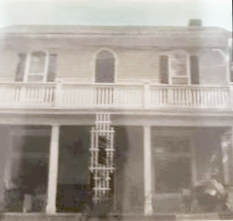
Headington House, Celina, Ohio

Elma (Hartzell) Headington died in Celina 6 May 1970. According to her obituary she was born in Fort Recovery 24 March 1892, the daughter of George Douglas and Mary Elizabeth (Stoner) Hartzell. Elma married Kenneth Headington in 1916 and he died in 1933.

Her obituary said that Elma Headington owned and operated the Headington House in Celina since 1934 and that she had closed her doors a week before her death.

After Elma’s death the house and property passed to her daughter Jean. The Standard Printing Company purchased the property from Elma’s daughter in 1972.

Celina’s Headington House, originally the Snyder House, was torn down sometime after 1972 and the Standard Printing Company added an addition to their existing structure where the house once stood.

I have only the old sketch of the house but I would love to see a more recent photo, before it was torn down.

A couple other interesting bits of Headington trivia:

There is village named Headington in the U.K. In the village of Headington there is a Headington House, built 1775-1783, as well as a Headington Manor House. It appears both are still standing.

Nimrod Headington had a niece named Celina Headington (1854-1856). Celina was the daughter of William and Mary Ann (Cottrell) Headington, my direct Headington ancestors. William and Nimrod were brothers.

Next week, how I am related to Ken Headington.

[1] U.S., City Directories, 1822-1995, Celina, Ohio, 1953, p.231 and 1960, p.339, Elma Headington & Headington House; database on-line, Ancestry.com.
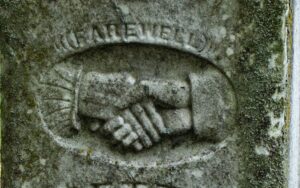
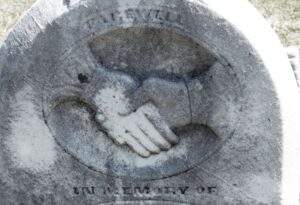
Tombstone Tuesday-Clasped Hands Symbol

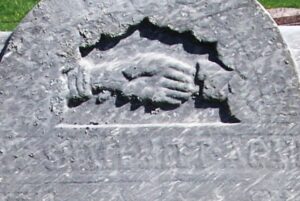
A common carving seen on older tombstones is a pair of clasped hands, what appears to be a handshake. This symbol was commonly used during the Victorian era.

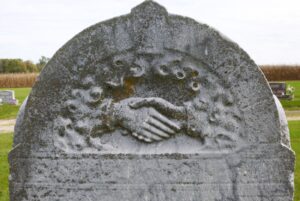
Clasped hands, Elm Grove Cemetery, St. Marys, Ohio.

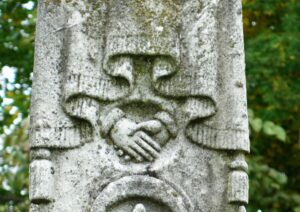
Clasped hands most often represent the hands of a husband and wife. Usually a cuff is visible on each wrist and the cuffs are usually different, one masculine, a man’s shirt cuff, and the other feminine, the cuff of a lacy blouse or dress. Some hands have straight fingers and others have bent fingers.

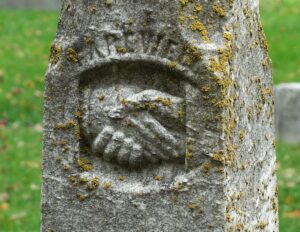
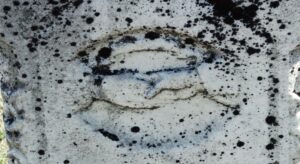
Clasped hands, Ridge-Slater Cemetery, Van Wert County, Ohio.

Clasped hands with different cuffs symbolize holy matrimony/marriage. They may symbolize the spouse who died first guiding their partner to heaven and greeting them there.

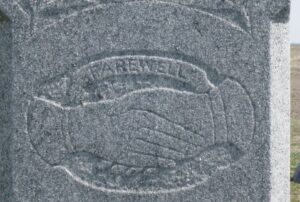
Greenbriar Cemetery, Van Wert County, Ohio.

Sometimes the word farewell or the phrase we will meet again is written near the hands.

Clasped hands, Elm Grove Cemetery, St. Marys, Ohio.

Clasped hands may symbolize a final farewell to the deceased or a heavenly welcome.

East Bethel Cemetery, Mercer County, Ohio.

Clasped hands, Elm Grove Cemetery, St. Marys, Ohio.

Clasped hands, Zion Lutheran Cemetery, Schumm, Ohio.

Clasped hands, Ridge-Slater Cemetery, Van Wert County, Ohio.

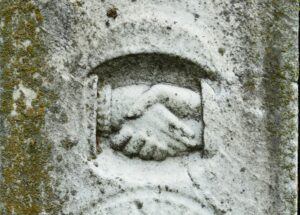
Occasionally the clasped hands symbol will have two men’s cuffs, symbolizing God grasping the deceased’s hand and welcoming them into heaven and eternal life.  

Clasped hands with same cuffs, Elm Grove Cemetery, St. Marys, Ohio.

James Henry Brewster Home, Independence, Kansas

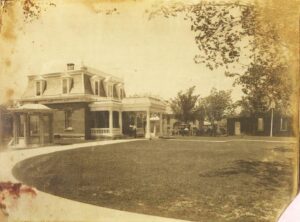
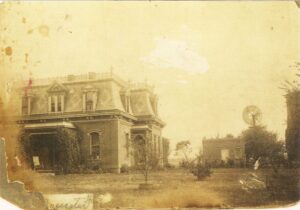
Today Karen’s Chatt travels virtually to Montgomery County, Kansas, to the once grand home of James Henry Brewster. His home is often referred to as a mansion by family members.

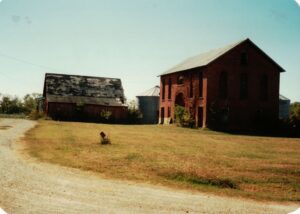
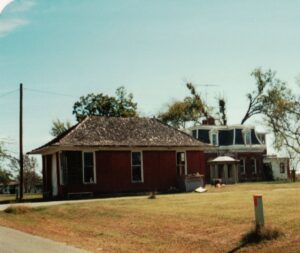
James Henry Brewster home, c1910.

I have written about James Henry Brewster (1841-1916) before. He was my great-great-great-uncle, the brother of my great-great-grandfather Daniel Brewster (1845-1917). My Brewster ancestors originally came from Pennsylvania. Daniel Brewster lived most of his life in Adams County, Indiana, but his brother James Henry moved farther west.

After leaving Pennsylvania James Henry Brewster resided in New Philadelphia, Ohio, until 1884, when he moved to a farm east of Independence, Kansas. He made a beautiful home on that farm, a home that “had all the modern conveniences and comforts of the best homes of the city.”

Another side of James Henry Brewster home, c1910.

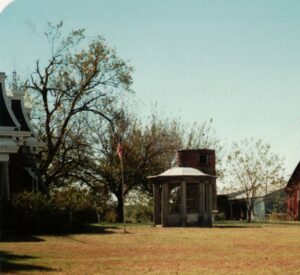
There was a gazebo on each side of the house. At one time they contained large bird cages that held bright colorful parrots.

Another view of gazebo, James Henry Brewster home, c1999.

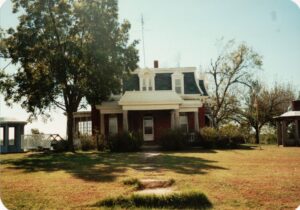
A beautiful chandelier hung from the front porch.

At a time when Independence had no park, James Henry prepared an attractive park on his farm which was the scene of many public gatherings.

James Henry Brewster home, c1999. Note the gazebo on either side.

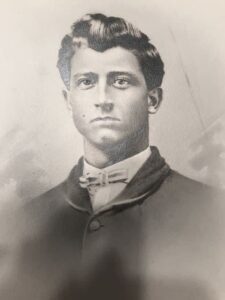
James Henry Brewster was a well-known Montgomery County, Kansas, general building contractor. He erected the Montgomery County Court House, the Lincoln School, the Washington School, and other prominent buildings in Independence.

Young James Henry Brewster.

James Henry was a business leader in Montgomery County. He was an oil and gas operator, selling natural gas to Independence until they got their own refinery. He tried to get a railroad from Caney to Cherryvale, going through Independence and by his farm. He had the project financed and traveled to London, England, with Col. Porter of Caney on project business. Although the prospects were good at one time the financial conditions in the east and in Europe made it necessary to abandon the project. [1]

James Henry was a successful farmer. He served in the Civil War and he was in the First National Bank, Coffeyville, Kansas, when the Dalton Gang committed their final bank robbery on 5 October 1892.

Barns, James Henry Brewster home, c1999.

Carriage house, James Henry Brewster home, c1999.

And James Henry was a family man. He married Jane Newton in New Philadelphia, Ohio, in 1866 and they had 11 children.

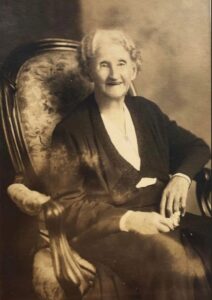
Jane (Newton) Brewster (1840-1940, wife of James Henry.

James Henry Brewster, undated photo.

James Henry Brewster, 1913

Apparently, James Henry Brewster’s mansion is not currently occupied and has run down over the years. However, in its day it was quite impressive.

Thanks to Deb, a direct descent of James Henry Brewster and my fourth cousin, for sharing these photos and some family stories. Deb descends from James Henry’s daughter Caroline “Callie” (Brewster) Wilson (1870-1947). Deb’s mother, now in her 80s, visited the mansion when she was a child and hopes to get to see it again someday.   

[1] Find a Grave.com, James Henry Brewster memorial no.32067930, Mount Hope Cemetery, Independence, Kansas; citing obituary, Independence Daily Reporter, Independence, Kansas, 12 Mar 1916.


Tombstone Tuesday-Henry P. & Mary A. (Allmandinger) Bender

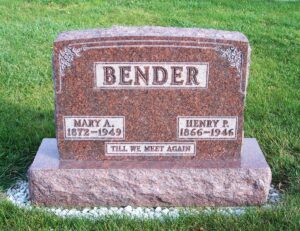
Henry P & Mary A (Allmandinger) Bender, Zion Lutheran Cemetery, Chattanooga, Ohio. (2011 photo by Karen)

This is the tombstone of Henry P. and Mary A. (Allmandinger) Bender, located in row 10 of Zion Lutheran Cemetery, Chattanooga, Ohio. The marker is inscribed:

BENDER
Mary A.
1872-1949

Henry P.
1866-1946

Till We Meet Again

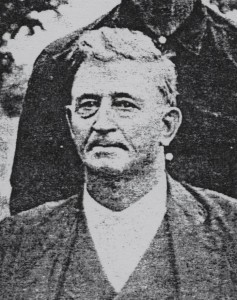
Heinrich Philipp “Henry” Bender was born in Traiss, Hessen, Germany 6 April 1866, the son of Johann and Elisabeth (Baumback) Bender. [1] Henry immigrated to America about 1886, according to the 1910 census.

Henry Bender married Maria Anna “Mary” Allmandinger in Mercer County, Ohio, on 8 November 1892. They were married by Rev. J.F.C. Soller, a Lutheran Minister. [2]

Mary Allmandinger was born in Ohio on 9 May 1872, the daughter of John Lewis (1829-1888) and Rosina (Schneider) (1833-1915) Allmandinger. Mary’s parents were German immigrants.

In 1880 the Lewis Allmandinger family lived in Blackcreek Township: Lewis, 51; Rosena, 46; Lewis, 23; Michael, 22; John, 17; Jacob, 15; William, 12; Fredrick, 10; Mary, 8; and Lena, 6. All the children were born in Ohio and Lewis was a farmer. [3]

After their marriage in 1892 Henry and Mary Bender lived in Adams County, Indiana. Their family in 1900: Henry, 33; Mary, 28; Rosa, 6; Carl, 4; and Clara, 1. This enumeration indicates that Henry was a day laborer, that Henry and Mary had been married 7 years, and that Mary had given birth to 3 children, all of whom were living. [4]  

By 1910 Henry and Mary Bender had moved to Blackcreek Township: Henry, 44; Mary, 50; Carl, 14; Clara, 11; Harold, 7; and Hugo, 4. Henry was a farmer. This enumeration indicates that Henry was born in Germany and immigrated to America in 1886. His wife Mary had given birth to 5 children, all of whom were living. They lived on “Baker Road” and Henry could speak English. [5]

The Henry Bender family in 1920: Henry, 52; Mary, 47; Carl, 23; Clara, 21; Harold, 16; and Hugo, 13. Henry’s occupation was farmer and truck and stock dealer. [6] 

In 1930 the Benders lived on East Pontiac Street in Fort Wayne: Henry, 63; Mary, 57; Hugo, 24; and Mary, 20, daughter-in-law. Henry worked as a trucker at a steam railroad station. This enumeration indicates Henry immigrated in 1881. [7]

Henry and Mary moved back to Blackcreek Township by 1935 and by 1940 all of the Bender children had left home. Their household in 1940: Henry, 74, and Mary, 67. [8]

Henry Bender died of “old age” on 10 January 1946, aged 78 years, 9 months, and 4 days. He was buried on the 14th.

Mary (Allmandinger) Bender died of a heart attack on 8 Mary 1949 in or near Chattanooga, Ohio, aged 76 years, 7 months, and 29 days. She was buried on the 11th.

Henry and Mary Bender had the following children, all of whom were baptized at Zion Chatt:
Rosa Elisabeth (1893-1982), married Henry Fahncke
Carl Ludwig/Lewis (1895-1972), married Bertha Maury
Clara Rebecka (1898-1980), married Adolph Schaadt
Harold Roman (1903-1974), married Margaret May Lehman
Hugo Edwin (1905-2004), married Mary Lena McClintock

Henry Bender was one of the last living German immigrants in Zion Lutheran, Chatt’s congregation.

While looking through the church records I also noticed that Clara Bender was a baptismal sponsor for my great aunt Clara Miller in 1918.

[1] Germany, Select Births & Baptisms, 1558-1898, Philipp Heinrich Bender; database online, Ancestry.com, viewed 6 Feb 2022.

[2] Ohio Marriage Records 1774-1993, Henry Bender & Mary Allmandinger, 8 November 1892; digital image, Ancestry.com, viewed 6 Feb 2022.

[3] 1880 U.S. Census, Black Creek, Mercer, Ohio, Ed 179, p.323A, line 38, Lewis Allmanding; digital image by subscription, Ancestry.com, viewed 6 Feb 2022.

[4] 1900 U.S. Census, Jefferson, Adams, Indiana, ED 4, p.5, dwelling & family 87, Henry Bender; digital image by subscription, Ancestry.com, viewed 6 Feb 2022.

[5] 1910 U.S. Census, Black Creek, Mercer, Ohio Ed 107, p.4A, dwelling & family 76, Henry P. Bender; digital image by subscription, Ancestry.com, viewed 6 Feb 2022.

[6] 1920 U.S. Census, Black Creek, Mercer, Ohio, ED 124, p.11B, dwelling & family 218, Henry Bender; digital image by subscription, Ancestry.com, viewed 6 Feb 2022.

[7] 1930 U.S. Census, Fort Wayne, Allen, Indiana, ED 41, p.10, dwelling232, family 241, Henry Bender; digital image by subscription, Ancestry.com, viewed 6 Feb 2022.

[8] 1940 U.S. Census, Black Creek, Mercer, Ohio, ED 54-1, p.9A, house visited 184, Henry Bender; digital image by subscription, Ancestry.com, viewed 6 Feb 2022.

The Last Germans

Who were the last German immigrants in the congregations of Zion Chatt and Zion Schumm?

I am talking about immigrants from Germany, not the local families with the surname German.

Our area was settled primarily by German immigrants. There were several major waves of German migrations to America. My Schumm ancestors emigrated from Wuerttemberg in 1833. My Breuningers immigrated about 1840 and the Schinnerers about 1850. The Miller side of my family came over later. Jacob Miller (1843-1918) immigrated in 1871 and his wife Christina Reuck (1858-1945) immigrated about 1880. 

These German immigrants on both sides of my family were Lutheran. (I am about 75% German. Most of my Grandma Gertrude (Brewster) Miller’s branch of my family were not German. That branch had been in America much longer, some going back to Revolutionary War times and before.)

These German Lutherans brought their values, customs, traditions, and their faith with them. The constitutions of Zion Lutheran Chatt and Zion Lutheran Schumm were both written in German, written in the old Gothic Script. That was their language. They spoke, read, and wrote German although they were living in America.

Even though I have a number of German immigrant ancestors, I obviously never knew any of them. They had all passed away before I was born. My last living family immigrant was my dad’s grandmother Christine (Rueck) Miller, who died in 1945. She died seven years before I was born but my dad knew her. She lived with my dad’s family when he was a boy growing up near Chatt.

The Schumms immigrated in 1833 and the last living Schumm immigrant was Fredrick Schumm (1814-1902). My direct Schumm immigrant ancestor, Fredrick’s brother Louis Schumm (1817-1855), died rather young and had passed away before the Millers and Ruecks immigrated. Some of my other immigrant ancestors on my Schumm branch also passed away over a century ago: Louis Breuninger (1819-1890), his wife Maria (Seckel) Breuninger (1827-1910), and Fredrick Schinnerer (1824-1905).  

I am most familiar with the German immigrant ancestors in my family but of course there were many other German immigrants in both Zion congregations.

Thinking about all this brings up the question, who were the last living German immigrants at Zion Chatt and at Zion Schumm? I believe I have identified the last immigrants in the congregations. They all immigrated in the late 1800s and died between 1935-1962.

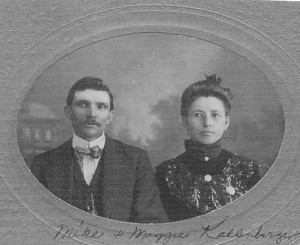
Mike & Maggie (Rueck-Miller) Kallenberger (1879-1962)

From Zion Chatt, Maggie (Rueck-Miller) Kallenberger (1879-1962) was born in Steinbach, Wuerttemberg, 26 March 1879, and immigrated about 1880, when she was just an infant. Maggie died in Van Wert County on 27 October 1962, aged 82, and is buried in Zion Chatt’s cemetery. She was married to Michael John Kallenberger (1871-1952).  

From Zion Lutheran Chatt, Henry Philip Bender (1866-1946) was born in Germany 6 April 1866 and immigrated about 1886. Henry died 10 January 1946, aged 79 years, and is buried in Zion Chatt’s cemetery. He was married to Mary Allmandinger (1872-1949), who was born in Ohio.

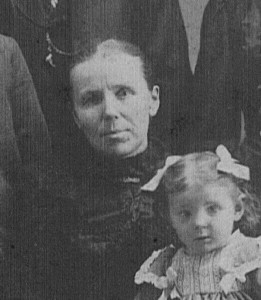
Also a member of Zion Chatt, Christina (Rueck) Miller (1858-1945), my great-grandmother, was born in Steinbach, Wuerttemberg, on 29 December 1858, and immigrated about 1880. Christina died near Chatt on 17 June 1945, aged 86 years, and is buried in the Chattanooga Mausoleum. She was married to Jacob Miller (1843-1918), also a German immigrant and she was the mother of Maggie (Rueck-Miller) Kallenberger.

From Zion Lutheran Schumm, Leonard G. Stegmeier (1856-1940) was born in Steinbach, Wuerttemberg, 13 May 1856 and immigrated about 1879. Leonhard died in Convoy on 16 December 1940, aged 84 years, and is buried in Zion Schumm’s cemetery. Leonard was married to Katharine Rettig (1860-1927), who was born in Willshire Township.

Also from Zion Schumm, Anna Katharina (Meisinger) Sauer was born in Germany 23 July 1855 and immigrated about 1895. Anna died near Schumm on 12 July 1935, aged of 79 years, and is buried in Zion Schumm’s cemetery. She was the wife of John Sauer (1850-1900), who was also an immigrant.

I notice that several came from Steinbach. Also interesting that my great-grandmother Christina (Rueck) Miller was one of the last German immigrants in Zion Chatt’s congregation.

Christine (Rueck) Miller with Clara (c1900)

It would be so very interesting to talk with these German immigrants. Imagine the family history they knew!