Nimrod Headington Journal, 1852, part 18

Today’s blog post is the eighteenth in a series, the transcription of Nimrod Headington’s 1852 journal, Trip to California.

In his journal Nimrod Headington details his 1852 voyage from New York to San Francisco and his search for gold in California. [1] [2]

Nimrod, with several others from Knox County, Ohio, set sail from New York on 16 February 1852, traveling on the clipper ship Racehound. After 5 months at sea they docked at San Francisco on 18 July 1852.

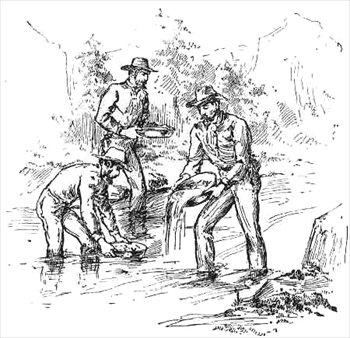
In today’s blog post, Nimrod continues his search for gold in California in December of 1852. Times were hard and lean for Nimrod and his companions as they panned for gold. Would they find gold and strike it rich?    

From December 24th to January 9th we were unable to work on account of the deep snow Think of men working when the snow was eleven foot deep. But on the 9th of January, we went to work in earnest, thinking that the weather had settled and that we were going to make something to buy grub with, as we were all about out of money. But we had only worked two days when it commenced to snow again, and we got three feet more snow on top of what we had, which made it almost impossible to get out at all; however, with great difficulty, we managed to get from our cabin to our claim and worked until noon. And we panned about $12.00 in gold dust, which was three dollars apiece for us.   

The next day we were compelled to go for provisions. We were entirely out of flour, and when we reached the store where we expected to get flour, the store was out. But we found some cornmeal and salt pork. We paid 40 cents a pound for meal, 60 for pork, and 35 cents for beans.

Sunday morning came, and we thought it was going to be fair. It had stopped snowing. But at 12 o’clock it commenced to rain. We began to get pretty discouraged. For the weather [being] so bad we could not work, and we were out of money and almost out of provisions again. And we had no hope of a mule train coming up with provisions. It was impossible for them to get through the deep snow. We began to think that hard times had caught us sure. The nearest port where provisions could be procured was 10 miles. So we had to either pack provisions 10 miles over the snow or abandon our claims. If we left our claims, we were in danger of losing them, for the law was that if a man was not working on his claim, it was forfeited and the next man that came along could jump in and go to work and hold the claim. We talked and planned all that rainy, lonesome day what we had better do.

Monday morning it was clear again, but at 10 it commenced raining again and rained all day and all night. The next day we were called upon to assist a man in getting some mules over to the Mountain Spring House. The rain had settled down to about 8 feet. We had a funny time with the mules. We got them over Slate Creek and got part of them up the mountain on the west side and then went back to try to get the rest of them up. And just as we got back to where we left the others, we looked up and here came the mules that we had worked so hard to get up the mountain coming back. The owner was so mad that he was going to shoot the lead mule, and I begged him not to do that. And he put up his revolver, and we went to work again. And we succeeded in getting them all up the mountain except one. He got down in the snow, and we could not get him up. The man gave us $20.00 for helping him. So we had a little money again to buy provisions.

The next day we worked for a Mr. Sackett of Cleveland, Ohio, who was cutting a ditch along the side of the mountain to bring the water into the diggings where our claims were. For this day’s work we received $6 apiece, adding $24 to our money for provisions. The cutting of this ditch was just what we wanted, for our claims were not worth much unless we could get water enough to run a sluice. The next day we had to get wood and provisions, for we were out of both. Two of us went to getting wood, and two to go for provisions. We calculated to buy some potatoes and pork, as flour or meal could not be had. Inquiring the price of potatoes, we were informed that they were worth 35 cents per pound, and pork was not to be had at any price. However, we returned to our cabin again to consult with the other boys what was best to do. The conclusion was that one should go to Chandlersville, a little town that was a short distance north of us, and this journey was put upon me. And I accordingly went and succeeded in getting us 50 lbs. of potatoes at 25 cents a pound, and I was to get some pork, but there was none. I found a few pounds of lard, which I bought at 50 cents a pound and then returned home with all that I was able to pack through the deep snow.

Sunday came, and the day was very pleasant. And I spent [it] in a variety of ways: part of the time singing, and part reading, and part of the time writing in this journal and thinking of home and my little family and the year past. How soon it had slipped away. But when the thought came to the morning I left my home, it seemed like it had been 10 years. And I could not think of staying that much longer in this land of starvation, for it really seemed that starvation was staring us in the face. When it got so that there was no provisions to be bought at any price and there was but very few that had a store of provisions laid in. And those that had would not sell a pound of anything.

On the 16th of January, we commenced to work again on our claim. Worked hard all day in the water and got $16. The next morning we went to work again in good hope to make more, but when we came to clean up, we were disappointed, for we only had $8.00. This was only $2 apiece, and that would barely board us. As provision was so scarce and high, we were bound to come on an allowance. We had to make our loaves of bread of cornmeal a little smaller and then divide it equally between us. The balance of our living consisted chiefly of beans, which we had to cook without any meat or anything else to season them with, as meat had got to 40 cents per pound. I began to think this pretty hard times when we had to work all day from daylight until dark in mud and water and then go hungry. However, we were a jolly set of fellows, and as serious as it looked, we did not get discouraged. And [we] resolved to stand by one another through thick and thin as long as we could, with the hope that luck would come our way by and by. [3]

To be continued…

I will post Nimrod’s journal in increments, but not necessarily every week.

[1] Nimrod Headington at the age of 24, set sail from New York in February 1852, bound for San Francisco, California, to join the gold rush and to hopefully make his fortune. The Panama Canal had not been built at that time and he sailed around the tip of South America to reach the California coast.     Nimrod Headington kept a diary of his 1852 journey and in 1905 he made a hand-written copy for his daughter Thetis O. Tate. This hand-written copy was eventually passed down to Nimrod’s great-great-granddaughter, Karen (Liffring) Hill (1955-2010). Karen was a book editor and during the last two years of her life she transcribed Nimrod’s journal. Nimrod’s journal, Trip to California, documents his travels between February of 1852 and spring of 1853.

[2] Nimrod Headington (1827-1913) was the son of Nicholas (1790-1856) and Ruth (Phillips) (1794-1865) Headington. He was born in Mt. Vernon, Knox County, Ohio, on 5 August 1827 and married Mary Ann McDonald (1829-1855) in Delaware County, Ohio, in 1849. Nimrod moved to Portland, Jay County, Indiana, by 1860 and during the Civil War served in the 34th Indiana Infantry as a Colonel, Lieutenant Colonel, and Major. Nimrod died 7 January 1913 and is buried in Green Park Cemetery, Portland. Nimrod Headington is my fourth great-granduncle, the brother of my fourth great-grandfather, William Headington (1815-1879).

[3] Nimrod Headington’s journal, transcription, and photos courtesy of Ross Hill, 2019, used with permission.

Tombstone Tuesday-Walter E. & Erna T. (Schumm) Schumm

Walter T. & Erna T. Schumm, Zion Lutheran Ceetery, Van Wert County, Ohio. (2012 photo by Karen)

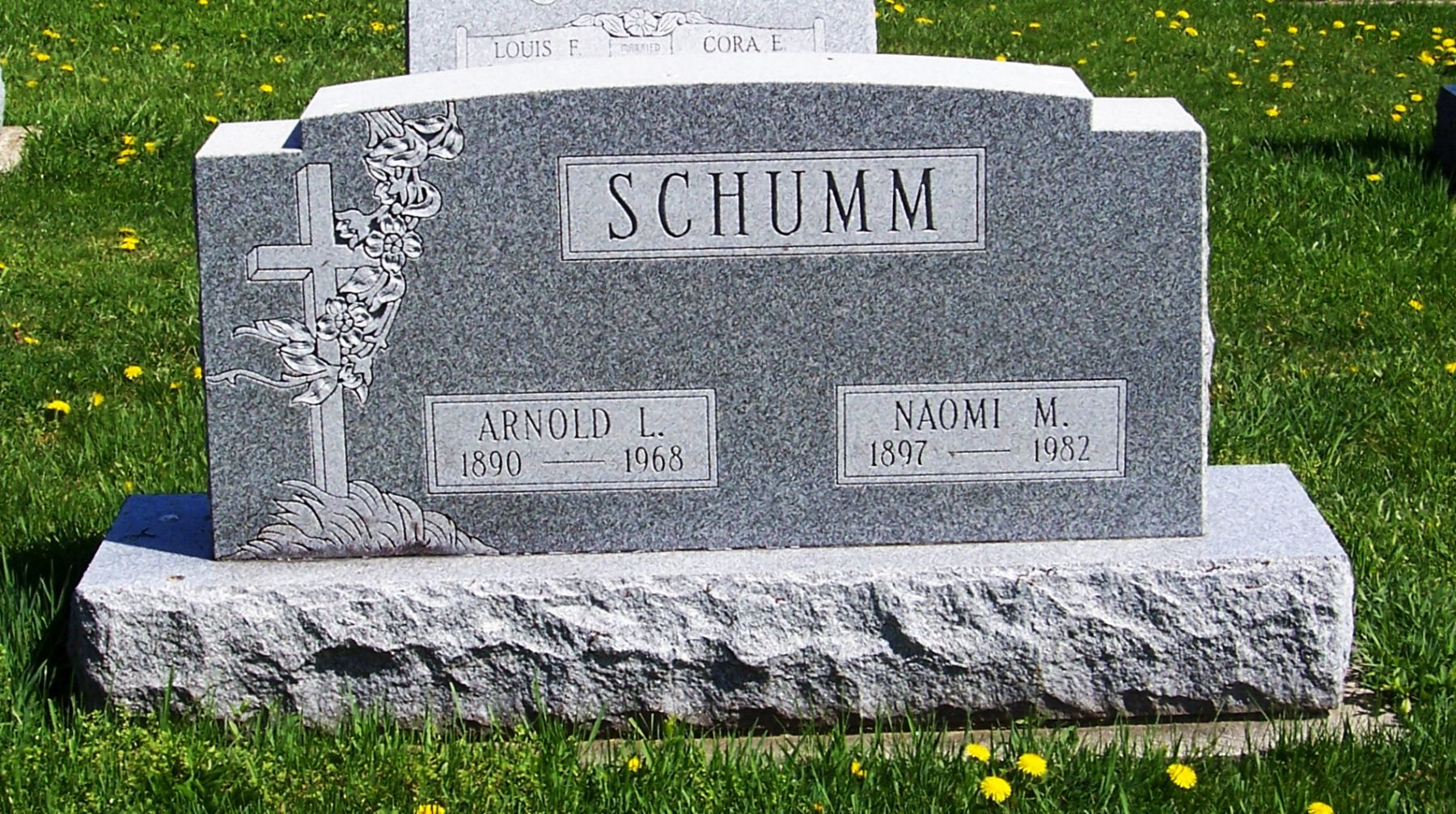
This is the tombstone of Walter E. and Erna T. (Schumm) Schumm, located in row 6 of Zion Lutheran Cemetery, Schumm Van Wert County, Ohio. The marker is inscribed:

SCHUMM
Walter E.
1888-1967
Erna T.
1894-1971

Walter Emanuel Schumm was born 16 November 1888, the fourth child born to George Henry and Anna (Roehm) Schumm. He was baptized at the church on 25 November 1888, with Martin Schumm and Henry Roehm serving as his sponsors.

Walter Schumm, with his family in 1900: Henry G Schumm, 45; Annie M, 43; Amelia, 19; Annie W, 17; Walter E, 11; Esther, 6; and Maria, 79. [1]

Walter‘s family in 1910: HG Schumm, 55; Minnie, 47; George Limecooly, 16, step-son; Margaret Limecooly, 12, step-daughter; Walter Schumm, 21, son; and Esther, 16, daughter. [2]

Walter Schumm married Erna Schumm on 25 May 1918 at the home of the bride’s mother, married by Rev. George J. Meyer. H.G. Schumm and Naomi Schumm were witnessed to the marriage. It is interesting to note that their siblings had married just 10 days before, when Erna’s brother Amos C. Schumm married Walter’s sister Esther Schumm. Amos and Esther Schumm were featured in last week’s Tombstone Tuesday.

Erna Theresa Schumm was born 9 November 1894, the third child born to Frederick (Jr) and Mary (Buchner) Schumm. She was baptized at home on 18 November 1894, with Henry Buchner and Mrs. Maria Neubrecht serving as her sponsors. Her mother Mary (Buchner) was the second wife of Frederick Jr and Erna had six living step-siblings when she was born. Erna‘s older full sister Justina Louise Schumm died in infancy.

Erna Schumm, with her family in 1900: Friedrich Schumm, 56; Mary, 39; Hugo A, 24; Leona B, 22; Henrietta A, 20; Lawrence W, 15; Amos C, 8; Erna T, 5; and Naomi M, 3. The family lived on a farm in Black Creek Township, Mercer County, Ohio. [3]

Erna‘s father Frederick Schumm Jr died 24 December 1907.

In 1910 Erna lived with her widowed mother Mary (Buchner) Schumm and her siblings: Mary Schumm, 49; William, 25; Amos, 18; Erna, 15; and Naomi, 12. [4]

Two years after their 1918 marriage, Walter and Erna Schumm in 1920: Walter E, 31, and Erna T, 25, living in Willshire Township, where Walter farmed. They lived very close, probably next door to Walter’s father Henry George Schumm and his second wife Mina (Kroemer). [5]

In 1940, three of Walter and Erna Schumm’s nieces lived with them: Walter, 51; Erna, 45; Marcile, 20; Hilda, 12; and Virginia, 13. All were Schumms. [6] According to the census, Marcile, Hilda, and Virginia Schumm were nieces, but that was not actually true for all three girls.

The specifics: Marcile Schumm (1920-1988) was the daughter of Hugo & Ada (Wilson) Schumm. Walter and Marcile were second cousins once removed; Marcile was Erna’s niece. Hilda Schumm (1928-1993), was the daughter of Amos and Esther (Schumm) Schumm. Both Walter and Erna had the same relationship to Hilda: second cousins once removed and Hilda was niece to both. Virginia Schumm (1926-1983) was the daughter of Charles and Amelia (Germann) Schumm. Walter and Virginia were first and second cousins once removed; Erna and Virginia were second cousins once removed. So, Marcile and Hilda were nieces and Virginia was a relative, but not a niece. And remember, years ago relationships were often stated differently than as we understand them today.  

Walter Schumm died 13 March 1967 in Van Wert County. Walter’s obituary:

Walter E. Schumm
Walter E. Schumm, 78, a retired farmer of Rt. 1, Willshire, died at 10:25 p.m. Monday at the Van Rue Geriatric Center. He had been in failing health for two years and seriously ill one year.

Born Nov. 16, 1888, in Willshire Township, he was the son of Henry G. and Anna (Roehm) Schumm. He was a lifetime resident of the Willshire area. His widow, Erna T., whom he married May 25, 1918, survives.

Mrs. Schumm served as secretary of the Zion Lutheran Church in Willshire Township for a number of years. He was a member of the church and the Lutheran Laymen’s League.

Survivors include a niece, Mrs. Marcile (Schumm) Buechner of Sacramento, Calif., who was raised by the Schumms, and a sister, Mrs. Amos (Esther) Schumm of Rockford. Three sisters preceded him in death.

Funeral services will be held at 11:30 a.m. Friday at Cowan and Son Funeral Home and at 2 p.m. Friday at the Zion Lutheran Church. The Rev. Elmer W. Braun will officiate. Burial will be in the church cemetery.

Friends may call at the funeral home from 7 to 9 p.m. Wednesday and Thursday afternoon and evening. Friends may call at the church from 1 p.m. to 2 p.m. Friday. [7]

Erna (Schumm) Schumm died 25 August 1971 in Van Wert County. Erna’s obituary:

Erna T. Schumm
Willshire-Services for Mrs. Erna T. Schumm, 76, of Rt. 1, will be 2 p.m. Saturday in Zion Lutheran Church, near here, Rev. Robert D. Schuler officiating. Burial will be in the church cemetery.

Mrs. Schumm died 1:29 p.m. Wednesday in Van Wert County Hospital, following a long illness.

She was born Nov. 9, 1894, in Mercer County, the daughter of Frederick and Mary Buechner Schumm. She married Walter E. Schumm, who died March 13, 1967.

Also surviving are a brother, Amos of Rt. 1, Rockford; and a sister, Mrs. Naomi Schumm of Rt. 1, Willshire. Two brothers and two sisters are deceased.

Friends may call at Cowan and Son Funeral Home, Van Wert, after 1 p.m. Friday and at the church after 12:30 p.m. Saturday. [8]   

Walter and Erna (Schumm) Schumm had no children but they raised Marcile Schumm after the death of both her parents in the early 1930s. Marcile was Erna’s niece, the daughter of Erna’s half brother Anton “Hugo“ Schumm.

[1] 1900 U.S. Census, Willshire, Van Wert, Ohio, ED 97, p.10, dwelling193, family 206, Henry G Schumm; digital image by subscription, Ancestry.com (https://www.ancestry.com/search/collections/7602/ : viewed 31 May 2020).

[2] 1910 U.S. Census, Willshire, Van Wert, Ohio, ED 114, p.6A, dwelling 110, family 111, HG Schumm; digital image by subscription, Ancestry.com (https://www.ancestry.com/search/collections/7884/ : viewed 31 May 2020).

[3] 1900 U.S. Census, Black Creek, Mercer, Ohio, ED 74, p.2, dwelling & family 29, Frederick Schumm; digital image by subscription, Ancestry.com (https://www.ancestry.com/search/collections/7602/ : viewed 17 May 2020).

[4] 1910 U.S. Census, Black Creek, Mercer, Ohio, ED 107, p.2A, dwelling & family 26, Marry Schwinn; digital image by subscription, Ancestry.com (https://www.ancestry.com/search/collections/7884/ : viewed 17 May 2020).

[5] 1920 U.S. Census, Willshire, Van Wert, Ohio, ED 146, p.3A, dwelling & family 50, Walter E Schumm; digital image by subscription, Ancestry.com (https://www.ancestry.com/search/collections/6061/ : viewed 8 Jun 2020).

[6] 1940 U.S. Census, Willshire, Van Wert, Ohio, ED 81-28, p. 4B, house no 27, visited 86, Walter Schumm; digital image by subscription, Ancestry.com (https://www.ancestry.com/search/collections/2442/ : viewed 8 Jun 2020).

[7] Van Wert Time Bulletin, Van Wert, Ohio, 14 Mar 1967, p.2, Walter E. Schumm obituary; digital image by subscription, Ancestry.com, viewed 8 Jun 2020.

[8] The Lima News, Lima, Ohio, 26 Aug 1971, p.4, Erna T. Schumm obituary; digital image by subscription, Ancestry.com, viewed 8 Jun 2020.

Nimrod Headington Journal, 1852, part 17

Today’s blog post is the seventeenth in a series, the transcription of Nimrod Headington’s 1852 journal, Trip to California.

In his journal Nimrod Headington details his 1852 voyage from New York to San Francisco and his search for gold in California. [1] [2]

Nimrod, with several others from Knox County, Ohio, set sail from New York on 16 February 1852, traveling on the clipper ship Racehound. After 5 months at sea they docked at San Francisco on 18 July 1852.

In today’s blog post, Nimrod continues his search for gold in California in the late summer through Christmas, 1852.

I was to relate a circumstance that happened at Frenchman’s Bar while I was there. It happened on Thursday night while I was at church. A man came to the cabin of Mr. Ross. He was a gambler and commenced to gamble, as all of those houses that kept boarders had a gambling table. His cash soon gave out. He had a large buckskin sack that he said was full of gold dust. He showed the sack to Mr. Ross and told him that he did not want to break in on it and asked him to loan him ten dollars, which he did, supposing he would shortly pay him back. The gambler was soon fleeced out of that ten dollars. He got up and set around from a while and then slipped off and came over to the house of Mr. Higgins, where I was boarding, and commenced playing again. He soon lost, and the buckskin sack was again exhibited, and he borrowed money again. This time the lender had the sack opened and found nothing in it but black sand. And a row was kicked up immediately, and Mr. Ross was informed of the contents of the sack. He came up immediately and took the gambler by the throat and demanded his money. The fellow said he had not a cent of money in the world. They took him out stripped of all clothing but his pants and tied him to a tree and gave him twelve lashes and then gave him one hour to leave.

When they were fixing to whip the gambler, there was a man named Brown in [favor of] having the fellow whipped, and the gambler drew from a scabbard that hung by his side a large butcher knife, intending to stab Brown, but Mr. Ross was standing right behind him and caught his arm. In drawing the knife, he struck a small boy in the shoulder, inflicting a severe wound. When they had the gambler tied to the tree and had given him 12 lashes, the little boy said, “Now give him 12 lashes for me.” They untied the fellow and let him go. And with the blood running down into his boots, he was soon out of sight. 

Search for Gold Continues

Now I will return to the Sierra diggings. I came here on the 20th of September, 1852, on Sunday and stayed at the Sierra House at Chandlersville. He charged me one dollar for meals and nothing for lodging. This morning I started out prospecting, but I was sick for the first time since I left home. I layed down by a large red cedar log and layed there all day. Has it [not] been for some medicine my partners had given me, I would have had the [cholera]. The next day I felt some better but not able to work. But the next day I felt strong enough to work, and I went to digging holes in the ground to find gold. I kept this up for 5 days without any success. So I gave up prospecting and went and hired to work for 3 dollars a day to an Englishman. I worked 7 days and then quit. And then in company with 3 other men from [Ceeder Country Soway] by the name of McAfferty, Hardacher, and Moffit, we took a contract digging a ditch 125 feet long, 6 feet wide at the top and 4 feet at the bottom. It took us 26 days to do the work. We got six hundred dollars in cash and the dirt that we threw out of the ditch, which proved to be fairly good paying dirt.

After we completed this job, I jumped a claim that a man had forfeited by not keeping notices on it or working it. I went to work on it, and while I was sinking the first hole, this man came along and ordered me off. But I paid no heed to him. He went away, and I never saw him afterwards. After working this claim for a short time, I found a chance to buy a share in a claim with three other men: a Mr. Henry from Iowa and two men named Watkins from Kentucky. They had four claims of one hundred feet each and a small cabin, for which I paid $85.00. And then we held equal shared in the claims.

We had on hand 80 dollars’ worth of provisions at that time, which was only about enough to last us 2 weeks, as provisions were very high. At that time, $80.00 would not buy much more than one man could carry at one load. Flour was selling for 40 cents per pound, cornmeal at 28 cent, pork 59 cents, sugar 25 cents, molasses for $3.00 per gallon. Boarding by the week at boarding houses $14.00 to $16.00, in advance wages $6.00 per day.

We commenced to work this claim in the first day of December, 1852, and we worked 6 days without finding anything—the gold being so fine, we could not save it. On the seventh day the snow began to fall and continued for five days and nights without any letup, rendering the roads all impassable and covered up our cabins entirely. That caused a great many of the miners to leave this port and flee to the valley, especially those of them that had no claims and were about out of money. On account of the great depth of the snow, provisions were bound to be higher. On the 24th we were obliged to buy some provisions for ourselves. We had to pay 50 cents a pound for flour, 60 cents for pork, 40 cents for cornmeal. The next day, Christmas, we bought some dried peaches, for which we paid 60 cents a pound. And then we made duff for dinner, which we relished, but just how clean it was I will not tell you. The snow fell all day, and I felt very lonesome. Often thought of home and friends and the comforts with which they were surrounded on all sides in that land of peace and plenty. [3]

To be continued…

I will post Nimrod’s journal in increments, but not necessarily every week.

[1] Nimrod Headington at the age of 24, set sail from New York in February 1852, bound for San Francisco, California, to join the gold rush and to hopefully make his fortune. The Panama Canal had not been built at that time and he sailed around the tip of South America to reach the California coast.     Nimrod Headington kept a diary of his 1852 journey and in 1905 he made a hand-written copy for his daughter Thetis O. Tate. This hand-written copy was eventually passed down to Nimrod’s great-great-granddaughter, Karen (Liffring) Hill (1955-2010). Karen was a book editor and during the last two years of her life she transcribed Nimrod’s journal. Nimrod’s journal, Trip to California, documents his travels between February of 1852 and spring of 1853.

[2] Nimrod Headington (1827-1913) was the son of Nicholas (1790-1856) and Ruth (Phillips) (1794-1865) Headington. He was born in Mt. Vernon, Knox County, Ohio, on 5 August 1827 and married Mary Ann McDonald (1829-1855) in Delaware County, Ohio, in 1849. Nimrod moved to Portland, Jay County, Indiana, by 1860 and during the Civil War served in the 34th Indiana Infantry as a Colonel, Lieutenant Colonel, and Major. Nimrod died 7 January 1913 and is buried in Green Park Cemetery, Portland. Nimrod Headington is my fourth great-granduncle, the brother of my fourth great-grandfather, William Headington (1815-1879).

[3] Nimrod Headington’s journal, transcription, and photos courtesy of Ross Hill, 2019, used with permission.

Tombstone Tuesday-Amos C. & Esther E. (Schumm) Schumm

Amos C. & Esther E. (Schumm) Schumm, Zion Lutheran Cemetery, Van Wert County, Ohio. (2012 photo by Karen)

This is the tombstone of Amos C. and Esther E. (Schumm) Schumm, located in row 8 of Zion Lutheran Cemetery, Schumm Van Wert County, Ohio. The marker is inscribed:

SCHUMM
Amos C.
1891-1974
Esther E.
1893-1983
Married May 15, 1918

Amos Clemens Schumm was born 10 October 1891, the second child born to Frederick (Jr) and Mary (Buchner) Schumm. He was baptized 18 October 1891, with Henry Schumm and John Buchner Jr serving as his sponsors. His older sister Justina Louise Schumm died in infancy. His mother Mary (Buchner) was the second wife of his father Frederick, and Amos had six living step-siblings when he was born.   

Amos Schumm, with his family in 1900: Friedrich Schumm, 56; Mary, 39; Hugo A, 24; Leona B, 22; Henrietta A, 20; Lawrence W, 15; Amos C, 8; Erna F, 5; and Naomi M, 3. The family lived on a farm in Black Creek Township, Mercer County, Ohio. [1]

Amos‘ father Frederick Schumm Jr died 24 December 1907.

In 1910 Amos lived with his widowed mother Mary (Buchner) Schumm and his siblings: Mary Schumm, 49; William, 25; Amos, 18; Erna, 15; and Naomi, 12. [2]

Amos Schumm married Esther Schumm in Zion Schumm’s parsonage on 15 March 1918, married by Rev. George J. Meyer. Witnesses to their marriage were Aaron Buchner and Naomi Schumm.

The bride, Esther Emilie Schumm, was born 25 August 1893, the fifth child of George Henry [HG] and Anna (Roehm) Schumm. Esther was baptized 3 September 1893 and Mrs. John Schumm and Emilie Schumm served as her sponsors.

Esther Schumm, with her family in 1900: Henry G Schumm, 45; Annie M, 43; Amelia, 19; Annie W, 17; Walter E, 11; Esther, 6; and Maria, 79. [3]

Esther’s family in 1910: HG Schumm, 55; Minnie, 47; George Limecooly, 16, step-son; Margaret Limecooly, 12, step-daughter; Walter Schumm, 21, son; and Esther, 16, daughter. [4]

After their 1918 marriage, the Amos Schumm family in 1920: Amos, 28; Esther, 26; Ruth, 1 month; Naomi, 22; and Mary, 58. [5] Mary was Mary (Buchner) Schumm, Amos’ widowed mother and Naomi was Amos’ sister.

The Amos Schumm family in 1930: Amos C, 38; Esther E, 36; Ruthe E, 10; Betty L, 9; A Junior, 7; Helen M, 5; and Hildegarde, 2. Amos was a farmer. [6]

The Amos Schumm family in 1940, living on route 33: Amos C, 48; Esther, 46; Ruth, 20; Betty, 19; Amos, 17; Helen, 15; and Hildegarde, 12. Amos was a farmer. [7]

Amos Schumm died in the Adams County Memorial Hospital, Decatur, Indiana, on 13 April 1974. He died 4 days after having a heart attack and was buried on the 16th.  His obituary:

Amos Schumm
Rockford-Amos C. Schumm, 82, of Rt. 2, died at 2:35 p.m. Saturday in the Adams County Hospital, Decatur, Ind., where he was admitted Monday.

Surviving are his wife, Esther; four daughters, Betty, at home, Mrs. Melvin (Ruth) Buuck of Decatur, Ind., Mrs. Vincent (Helen) Muntzinger of Fort Wayne, Ind., and Mrs. Glenn (Hildegarde) Buxton of Celina; a son, Amos Jr. of Tempe, Ariz; a sister, Mrs. Arnold Schumm of Willshire; 14 grandchildren and six great-grandchildren.

He was a member of the Zion Lutheran Church at Schumm, where services will be held at 2 p.m. Tuesday, Rev. Robert Schuler officiating. Burial will e in the church cemetery.

Friends may call at the Ketcham-Ripley Funeral Home, Rockford, after 2 p.m. Monday. [8]

Esther (Schumm) Schumm died in Mercer County, Ohio, on 26 June 1983, at the age of 89. [9]

Amos C and Esther (Schumm) Schumm had the following children:

Ruth Esther (1919-1997), married Melvin Buuck
Betty Louise (1921-2011), not married
Amos Jr “Jack“ (1922-1998), married Blossom Wegmann
Helen M (living) married Vincent Muntzinger
Hildegarde Irene (1928-1993), married Glenn Buxton

[1] 1900 U.S. Census, Black Creek, Mercer, Ohio, ED 74, p.2, dwelling & family 29, Frederick Schumm; digital image by subscription, Ancestry.com (https://www.ancestry.com/search/collections/7602/ : viewed 17 May 2020).

[2] 1910 U.S. Census, Black Creek, Mercer, Ohio, ED 107, p.2A, dwelling & family 26, Marry Schwinn; digital image by subscription, Ancestry.com (https://www.ancestry.com/search/collections/7884/ : viewed 17 May 2020).

[3] 1900 U.S. Census, Willshire, Van Wert, Ohio, ED 97, p.10, dwelling193, family 206, Henry G Schumm; digital image by subscription, Ancestry.com (https://www.ancestry.com/search/collections/7602/ : viewed 31 May 2020).

[4] 1910 U.S. Census, Willshire, Van Wert, Ohio, ED 114, p.6A, dwelling 110, family 111, HG Schumm; digital image by subscription, Ancestry.com (https://www.ancestry.com/search/collections/7884/ : viewed 31 May 2020).

[5] 1920 U.S. Census, Black Creek, Mercer, Ohio, ED 124, p.1B, dwelling & family 16, Amos Schumm; digital image by subscription, Ancestry.com (https://www.ancestry.com/search/collections/6061/ : viewed 17 May 2020).

[6] 1930 U.S. Census, Black Creek, Mercer, Ohio, ED 1, p.1A, dwelling & family 2, Amos C Schwinn; digital image by subscription, Ancestry. Com (https://www.ancestry.com/search/collections/6224/ : viewed 31 May 2020).

[7] 1940 U.S. Census, Black Creek, Mercer, Ohio, ED 54-1, p. 1A, household 1, Amos C Schumm; digital image by subscription, Ancestry.com (https://www.ancestry.com/search/collections/2442/ : viewed 31 May 2020).

[8] The Lima News, Lima, Ohio, 14 Apr 1974, p.4; digital image by subscription, Ancestry.com, viewed 31 May 2020.

[9] “Ohio Death Index, 1908-1932, 1939-1944, 1958-2007,” Esther E Schumm, 1983; database, FamilySearch.org, viewed 31 May 2020.

Nimrod Headington Journal, 1852, part 16

Today’s blog post is the sixteenth in a series, the transcription of Nimrod Headington’s 1852 journal, Trip to California.

In his journal Nimrod Headington details his 1852 voyage from New York to San Francisco and his search for gold in California. [1] [2]

Nimrod, with several others from Knox County, Ohio, set sail from New York on 16 February 1852, traveling on the clipper ship Racehound. After 5 months at sea, rounding Cape Horn during the night of 4 May, and docking at Rio de Janeiro, Brazil, and Valparaiso, Chile, they finally reached their destination, San Francisco, on 18 July 1852.

Nimrod Headington (1827-1913)

In today’s blog post, Nimrod begins his search for gold in California. I am repeating a little from the last post to set the scene.    

July 18th. This morning when we got up, we were right close to the land. Just as the sun came up, a pilot came on board to pilot us into port. We passed through the Golden Gate at 11 o’clock and dropped anchor. We had to pay one dollar to be taken on shore, as they would not allow our ship’s boats to land our passengers. One of them attempted to go but had to come back. The rules of the port had to be complied with. We landed at the Pacific Wharf and took dinner at the Howard House, for which we paid fifty cents.

At 4 o’clock we went on board the river steamer Brighton for Sacramento and landed the next morning at 8 o’clock. Here we stopped at the Globe Hotel and remained there until the next day. Here we took the stage for Marysville and landed there at 4 o’clock in the afternoon and stopped at the Eagle Hotel. Our bills were 50 cents per meal and nothing for the lodging.

The next morning we took the stage again for Dobbins Ranch, which was 25 miles from Marysville, for which we paid four dollars each. We landed there just as the sun was setting. We had to pay one dollar for a meal.

The next morning we started out on foot, bound for Frenchman’s Bar on the Uba River. The road was very rough and hilly, and we had our blankets and luggage to carry. We came very near giving out. We had been to sea so long and having no exercise that were not in very good trim for traveling on foot. I was more fleshy heavy than I ever was in my life—and consequently short to breath.

When we got to the ranch, we put up at the house of John Higgins. We inquired of him the prospect for mining, and he made us believe that it was excellent. We asked him the price of boarding, and he told us ten dollars a week in advance. So we paid him ten dollars each for a week’s board, and then bought a pick and shovel, for which we paid five dollars each. Feeling very tired, we did not start out that day.

The next we shouldered our picks and shovels and pans and started out, but after digging several holes and washing the dirt, we could find nothing that looked like gold. The next two days we attended with the same kind of success. After a search of three days in vain, we concluded that this kind of work would not do. We should soon be minus what little money we had left. So we determined to hire by the month, as wages was good. So myself and one of my company went to a steam mill owned by an old Chilean named Lameis, where we had no trouble in getting employment of a hundred dollars a month.

He set my partner to driving oxen teams made up of the wildest kinds of Mexican cattle that did not know gee, haw, nor anything else and had to be lassoed every morning to get the yoke on them. He kept 3 or 4 Mexican men for that purpose. We went to work, but we did not stay long, as they did not give us enough to eat. And what was there the dogs would not eat without the dog was starving. When we went to the table, the boy that waited on the table would come around and lay a dirty looking cake at each plate and say, “One hombre, one bret.” And this was all we could get. At the end of seven days, we could stand it no longer, and we called on the old man for a settlement. He paid us off very promptly, and we left him alone to enjoy his dirty hash.

We then went back to Frenchman’s Bar, where we bought a share in a fluming company that was [searching] the bed of the river, for which we paid two hundred dollars down and agreed to pay four hundred more when they got it out the claim. So we worked on this way for two months. But before we got the water all dammed off, there was not work for us all. So I left them and went to Dry Creek, distance of 15 miles, for the purpose of taking up some claims then but could find none worth taking. But I stayed there some three weeks and worked by the day at four dollars a day.

While I was there, the news came to me that our river investment was a total failure. We had lost our money and hard work. I set down and studied the matter all over, and finally I came to the conclusion to go to Sierras old diggings about 50 miles up the mountains and at the base of Table Mountain—or more properly Sierra Nevada Mountain on the east side of Slate Creek. On leaving Dry Creek, I left the 2 men, Braddock and Durbin, with whom I had doubled the cape and with whom I had been partners since we landed in California. And I never met them again while in the state.

The country up here in the Sierra Nevada mountains is very rough—so much so that wagons cannot get up here. Everything is brought up here by pack trains. Trains of mules with pack saddles on will come up, 50 or 60 in a train, all loaded with provisions or something that the miners have to use. Each mule will carry from 2 to 3 hundred pounds. A man goes before on a horse with a bell on, and the mules will follow, one right behind the other. Sometimes the train is half a mile long. A Mexican follows behind to see that no mule drops out of the train or loses his load.

These pack trains are all owned and operated by Mexicans. You can hear them when they get within ten miles of us, coming down the mountain on the west side of Slate Creek swearing at the mules in Spanish. Their mule talk is hepo mulo sacare camacho.

There was a cabin close to our cabin that had a parrot, and that parrot would always hear the mule train coming before anybody would know of it, and it would begin to holler hepo mulo. Then in about 6 or 7 hours the train would arrive in camp with its cargo. [3]

To be continued…

I would love to have heard that parrot! Hilarious! Nimrod’s account gives us a vivid description of the conditions he encountered and so far his search for gold seems rather difficult.

I will post Nimrod’s journal in increments, but not necessarily every week.

[1] Nimrod Headington at the age of 24, set sail from New York in February 1852, bound for San Francisco, California, to join the gold rush and to hopefully make his fortune. The Panama Canal had not been built at that time and he sailed around the tip of South America to reach the California coast.     Nimrod Headington kept a diary of his 1852 journey and in 1905 he made a hand-written copy for his daughter Thetis O. Tate. This hand-written copy was eventually passed down to Nimrod’s great-great-granddaughter, Karen (Liffring) Hill (1955-2010). Karen was a book editor and during the last two years of her life she transcribed Nimrod’s journal. Nimrod’s journal, Trip to California, documents his travels between February of 1852 and spring of 1853.

[2] Nimrod Headington (1827-1913) was the son of Nicholas (1790-1856) and Ruth (Phillips) (1794-1865) Headington. He was born in Mt. Vernon, Knox County, Ohio, on 5 August 1827 and married Mary Ann McDonald (1829-1855) in Delaware County, Ohio, in 1849. Nimrod moved to Portland, Jay County, Indiana, by 1860 and during the Civil War served in the 34th Indiana Infantry as a Colonel, Lieutenant Colonel, and Major. Nimrod died 7 January 1913 and is buried in Green Park Cemetery, Portland. Nimrod Headington is my fourth great-granduncle, the brother of my fourth great-grandfather, William Headington (1815-1879).

[3] Nimrod Headington’s journal, transcription, and photos courtesy of Ross Hill, 2019, used with permission.