Tombstone Tuesday-GAR Symbol

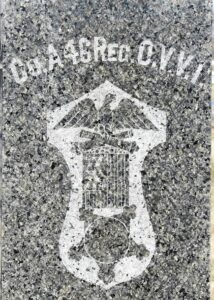
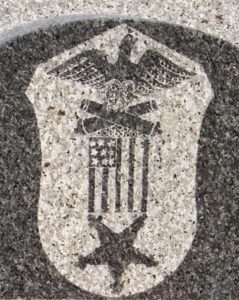
This patriotic tombstone inscription is the symbol of the Grand Army of the Republic.

GAR symbol, Woodlawn Cemetery, Ohio City, Van Wert County, Ohio.

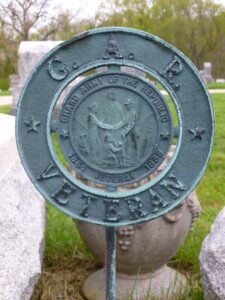
The Grand Army of the Republic (GAR) was a patriotic organization comprised of Union Civil War Veterans. One of its purposes was the “defense of the late soldiery of the United States, morally, socially, and politically.” The organization was founded in Springfield, Illinois, in 1866 and had more than 400,000 members at its peak in 1890. In its day the GAR was a powerful political influence and was usually aligned with Republican policy.

GAR symbol, Woodlawn Cemetery, Ohio City, Van Wert County, Ohio.

As the Civil War veterans passed away the GAR dwindled and the organization permanently dissolved in 1956. Their records went to the Library of Congress in Washington, DC, and their badges, flags, and official seal went to the Smithsonian Institution.

Sometimes the soldier’s service information in is also inscribed on the tombstone.

Riverside Cemetery, Rockford, Ohio.

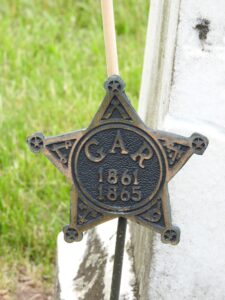
There may be a GAR flag staff at the base of the veteran’s tombstone.

GAR flag staff, Willshire Cemetery, Willshire, Ohio.

GAR flag staff, Zion Lutheran Cemetery, Schumm, Ohio.

Memorial Day, which was observed yesterday, began as a way to remember and honor both Union and Confederate soldiers who were killed in battle during the Civil War. After WWI Memorial Day was extended to honor Americans who died in all wars. Now on Memorial Day we honor all American veterans who have died. 

Woodlawn Cemetery, Ohio City, Van Wert County, Ohio.

Clues in the 1850 Mortality Schedule

As I was researching this week’s Tombstone Tuesday about Michael Billman I found some additional information about a woman who I theorize was his daughter.

The records of Zion Lutheran Schumm indicate that Louisa A. Billman married John Bienz on 7 November 1848 at Zion. The bride and groom were both from Zion. Their marriage is also recorded in Van Wert County Probate, which indicates they were married by Rev. George Streckfuss, [1] Zion Schumm’s minister at that time.

Noted at the end of their church marriage entry is that Louisa died 18 June 1849. The couple was married less than a year when she died.

And Louisa was very young. Zion Schumm’s records indicate that she was 17 years, 6 months, and 11 days old when she died. Her date of birth is calculated as 7 December 1831.   

Louisa (Billman) Bienz was in my database but I did not have much information about her, just that she was married to John Bienz.

But this week I found some additional information about Louisa Billman from an interesting record group that I do not use very often, the U.S. Census Mortality Schedule. The Mortality Schedules contain good, but specific information and I usually do not find many people I am looking for in it.

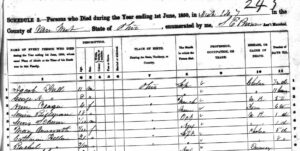
1850 Mortality Schedule, Willshire Township.

Only four mortality schedules were taken. They list the people who died in the 12 months before (1 June through 31 May) the federal census was taken in the years 1850, 1860, 1870, and 1880. These schedules list the dead person’s name, age, sex, color, whether married or widowed, birthplace, month of death, occupation, and cause of death. Mortality schedules were taken along with population schedules but they are separate from the population schedules. Ancestry.com has most of the mortality schedules, although a few states/years are missing. FamilySearch.org has the 1850 mortality schedule images and indexes.

The first column of the 1850 Mortality Schedule lists the Name of every person who died during the year ending 1 June 1850, whose usual place of abode at the time of his death was in this family.

The regular census was taken in June and since the information was intended to include those who died the year before the census was taken, the Van Wert County’s 1850 Mortality Schedule includes Louisa (Billman) Bienz, who died 18 June 1849.

The mortality schedule gives this information about Louisa: Louisa Billman, female, 18 years of age, born in Ohio, died in June 1849 from a fever that she had for 6 weeks. [2] Interesting that her maiden name was given instead of her married name. Note that this record shows she was 18 years of age, while the church record gives her age as 17. Either way, she was a young bride but I did not see that her father gave his consent for her marriage.

The best thing about seeing Louisa’s death date in the mortality schedule is that it corrected some information for me. The name Louisa looks like Louis In Zion Schumm’s old church records, which are written in the old Gothic script. I had transcribed her death record as Louis Bienz and did not know who he was. But now I know it is the death record of Louisa (Billman) Bienz. Mystery solved! 

On the line below Louisa’s death entry in the mortality schedule is the name Lewis Schumm, 1 month old, male, born in Ohio, died in October 1849 of UK[?], which he had for 1 day. Zion Schumm’s records confirm that Ludwig Schumm, son of Jacob Schumm, was buried 12 October 1849, age 1 day. I believe the letters under cause of death are UK, for unknown.   

The mortality schedules are an interesting source of information, although they are limited to a very specific time period.

[1] “Ohio Marriages, 1800-1958,” Van Wert, Vol. 1, p.55, John Bienz & Louisa A. Billman, 1 Dec 1848; FamilySearch (https://www.familysearch.org/ark:/61903/3:1:9392-S5QV-CZ?i=51&cc=1614804: viewed 27 May 2021).

[2] U.S. Federal Census Mortality Schedules, 1850-1885, Non-population Census Schedules for Ohio, 1850-1880, Van Wert, Ohio, 1849, District 147, p.243, line 4, Louisa Billman; Ancestry.com (https://www.ancestry.com/search/collections/8756/ : viewed 24 May 2021).

Tombstone Tuesday-Michael Billman

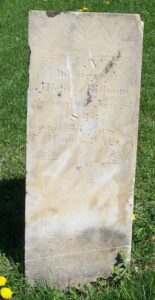
Michael Billman, Zion Lutheran Cemetery, Van Wert County, Ohio. (2012 photo by Karen)

This is the tombstone of Michael Billman, located in row 9 of Zion Lutheran Cemetery, Schumm, Van Wert County, Ohio. The marker is inscribed:

IN
Memory of
Michael Billman
who died June 9th
1846
aged 47 years
11 mo & 9 d.

Michael Billman was born either 30 June 1798 or 1 July 1798, as calculated from his tombstone. (One birth date calculator showed he was born 31 June!)

Michael Billman’s death is the first death that is recorded in Zion Schumm’s church records, although there may have been an older set of church records that did not survive. Their records simply show that he was 48 years of age when he died of typhus and that he was buried on 10 June 1846.  

The Michael Billman family in 1840, living in Willshire Township: males, 2/under 5; 1/5-9; 1/10-14; 1/15-19, 1/40-49; females, 1/under 5; 1/5-9; 1/40-49. [1]

This is likely Michael Billman’s family, as recorded in the 1850 census, living very close to my great-great-grandfather Louis Schumm: Maria Billman, 50; Daniel, 24; John, 22; Joseph, 17; Isabel, 15; Henry, 13; Frederick, 10 and Catharine, 8. [2] This would make sense, since Hannah and Louise were married before 1850. If these were all his children, then Michael also had at least 5 sons, too.

I do not have much information about the Billman family, but I do have a couple theories. There were a few Billmans that attended Zion Lutheran Schumm during that time period, a woman old enough to be his wife and some younger women.   

The older female Billman, simply called Mrs. Billman in the Zion Schumm’s records, died 29 September 1876 at about 76 years of age. That would put her date of birth around 1800 and she may have been Michael’s widow. Van Wert County death records show that her name was Mary Billman, that she was a widow and a housekeeper who died of dropsy in Willshire Township. This record shows that she was born in Pennsylvania and was 17 years, 5 months, and 29 days old. [3] They likely wrote her age down wrong. A 17-year-old could have been a widow who died of dropsy but she was probably the same 76 year-old Mrs. Billman from the church records who died on the very same day.

There were at least four younger Billman females in Zion Schumm’s that could have been daughters of Michael Billman. These women are:

Hannah Billman (1822-1878), married Jacob Schumm (1815-1853) in 1839; marr. George Steger in 1854
Catharine Billman (1842-1881), married John Fischer in 1858 at Zion Schumm
Louise A. Billman (1831-1849), married John Bienz (1823-1898) in 1848 in Van Wert County
Isabelle Billman (1835-1885), married Henry Volland in 1853 at Zion Schumm

Michael Billman, Zion Lutheran Cemetery, Van Wert County, Ohio. (2012 photo by Karen)

There are just a few of these very old sandstone grave markers that survive in Zion Schumm’s Cemetery. Sandstone markers are very susceptible to the elements, moisture and freezing and thawing being the worst. I suspect that there were other sandstone markers in the cemetery at one time that did not survive over the years.

Most of the sandstone markers in this cemetery date from about 1840-1846. In fact, it seems that quite a few people died in 1846. That year seems to have been particularly deadly for one reason or another.

[1] 1840 U.S. Census, Willshire, Van Wert, Ohio, p.69, Michael Bellman; digital image by subscription, Ancestry.com (https://www.ancestry.com/search/collections/8057/ : viewed 24 May 2021).

[2] 1850 U.S. Census, Willshire, Van Wert, Ohio, p.736, dwelling 331, family 350, Maria Billman; digital image by subscription, Ancestry.com (https://www.ancestry.com/search/collections/8054/ : viewed 24 May 2021).

[3] “Ohio, County Death Records, 1840-2001,” Van Wert, Vol. 1, p.116, Mary Billman, 29 Sep 1876; FamilySearch.org (https://www.familysearch.org/ark:/61903/3:1:S3HY-672V-8L?i=231&cc=2128172&personaUrl=%2Fark%3A%2F61903%2F1%3A1%3AF6NJ-V48 : viewed 24 May 2021).
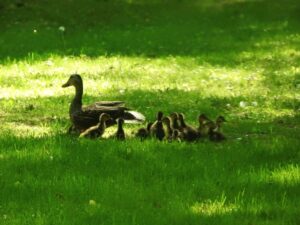
Ducklings Galore! (not genealogy related, but cute)

We have lived here on our wooded lot for well over forty years. We have a pond in our back yard and nearly every spring some ducks arrive but they only stay a couple weeks. A variety of ducks will visit but mainly we get mallard ducks and wood ducks.

We have always hoped to see little ducklings here but we never had. Once a female mallard nested just south of our house but right before her eggs hatched a racoon got into them and destroyed them all.

We noticed that a mallard pair has a regular routine when they have a nest. Mr. Mallard will stay on the pond just about all the time. Mrs. Mallard will sit on the nest most of the time but leaves the nest in the evening to swim and cool off in the pond and then grab a bite to eat with her mate under the bird feeder. Then she will go back and sit on the nest. We have noticed this same behavior for several years but there were never any ducklings.

Until this year.

The mallards’ routine was the same this year and we suspected she had a nest somewhere in the woods. We were correct. When we got up Wednesday morning we saw 13 fluffy little ducklings eating corn.

13 little mallard ducklings.

Ducklings following their mom into the pond.

Then they lined up and followed their mom into the water and swam across the pond. That must have been a huge journey for those little guys. 

The ducklings made it across the pond.


Funny though, the minute the ducklings appeared the male mallard disappeared! Dad is MIA but Mom is a very attentive and tends to her little ducklings very well.

Tombstone Tuesday-Urn Symbol

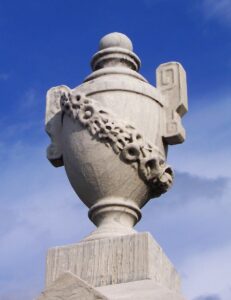
One of the earliest and most commonly used gravestone icons is the likeness of an urn placed on top of a tombstone or carved onto the grave marker.

The urn was one of the first symbols used that replaced the death head and soul effigy in the 19th century after the Revolutionary War. The willow tree icon was the other.

Urn embellished with flowers, Zion Lutheran Cemetery, Chattanooga, Ohio. (2011 photo by Karen)

The urn is a symbol of death because an urn is used as a container for the deceased’s ashes. The urn motif was commonly used during the 1800s even though cremation was seldom practiced during that time period.  

Greeks used the urn as a symbol of mourning because it held the ashes of the dead.

Urns can also symbolize the immortality of the soul. Egyptians believed that life would some day be restored if the vital body parts were placed and stored in an urn.

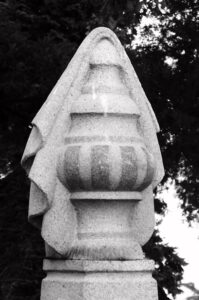
Draped urn, Woodlawn Cemetery, Van Wert County, Ohio. (2005 photo by Karen)

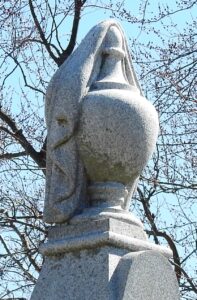
Draped urn, Riverside Cemetery, Rockford, Mercer County, Ohio. (2021 photo by Karen)

Some cemetery urns are draped. Drapes were commonly used during the Victorian era and symbolize mourning and the separation of life and death. It symbolizes a veil between earth and heaven.

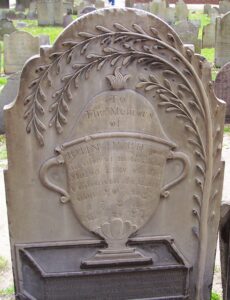
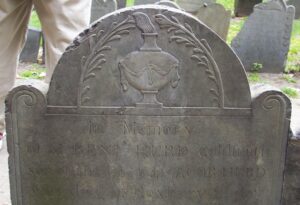
Urn with flame, Granary Burial Ground, Boston. (2009 photo by Karen)

Urn with flame, Granary Burial Ground, Boston. (2009 photo by Karen)

An urn with a flame symbolizes the soul rising from the ashes and undying remembrance.

The phrase gone to pot may derive from the use of a funeral urn that holds ashes.