Willshire, Reported Disabilities in the 1880 Census

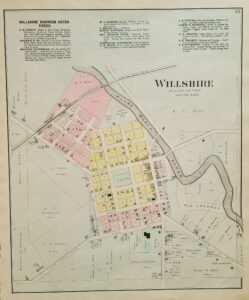
Recently I have been scouring the censuses for information about the inhabitants of the village of Willshire during the last half of the 1800s. Willshire is of particular interest this year because they are celebrating the 200th anniversary of the founding of the town by Captain James Riley. Their Bicentennial.

As I was going through the 1880 census of Willshire Township I noticed something that I had missed before. Totally missed.

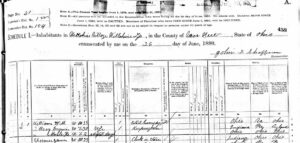
1880 Census, Willshire village, 26 June 1880.

In addition to all the good information the 1880 census provides (relationship to the head of household, marital status, place of birth of each individual’s father & mother, etc.), the 1880 census has some other unique categories.

Category 15: Is the person [on the day of the Enumerator’s visit] sick or temporarily disabled, so as to be unable to attend to ordinary business or duties? If so, what is the sickness or disability? Individuals who were born or who died after 1 June 1880 were not to be included in the 1880 census, even though the enumerator may not have questioned them until well after that date.

There was enough space under Category No. 15 to write a comment. Under the next five categories were boxes to be checked, if applicable: No. 16: blind; No. 17: deaf & dumb; No. 18: idiotic; No. 19: insane; and No. 20: maimed, crippled, bedridden, or otherwise disabled.

Willshire Township’s 1880 census taker, John F. Shaffner, actually wrote a number of notations in Category No. 15 and I I found the information quite interesting. Actually, it appears he wrote more under Category 15 than the average census taker.

Just to compare, I looked at a couple other 1880 enumerations, in local townships Blackcreek and Dublin. I noticed there were a couple illnesses written in Category 15, but not nearly as many as Shaffner wrote in Willshire Township.

But that was not all that Shaffner did. He drew a line through some names and wrote dead in the Category 15 area. I wondered what that was all about. Was that the normal thing to do? I did not see any names that were crossed off and noted as dead in Blackcreek or Dublin. Granted, I did not do an extensive census comparison, but it appears Shaffner went above and beyond with his notations, which is a good thing for us now.

John F. Shaffner, Willshire village and Willshire Township’s 1880 enumerator, was a physician in Willshire. Perhaps that was the reason he noted more illnesses and diseases and added the deaths after the fact. He probably had personal knowledge of these facts. Insider information. He was probably the family physician for many of these people.

Concerning the names Shaffner crossed off as dead, I wondered when the person died and how long after the census was taken did they die. Shaffner would not have enumerated a person if they were already dead, so when did he adjust the census and note that the person had died? Did he do this for everyone who had died in the township shortly after the census was taken?

Just to get an idea, I did a little research on a couple people in the township.

On 23 June 1880 Shaffner enumerated Abesh Dague, 57, female, born in Virginia. That was all crossed out and dead was written in Column 15. [2] Find a Grave.com shows that Abashaba Dague died 21 August 1880 and is buried at Heilman/Smith Cemetery. Apparently Shaffner went back and adjusted the census nearly 2 months later.

But Shaffner did not do this for everyone who died. I recently wrote a Tombstone Tuesday about Christene Huber, enumerated in Willshire Township by Shaffner as Mary Hoser on 25 June 1880. In Column 15 Shaffner wrote cancer of uterus. [3] Christene Huber [aka Mary Hoser as written in the 1880 census] died about 2 weeks later, on 4 July 1880. She is buried in Zion Lutheran Cemetery, Schumm. Her name was not crossed out and dead was not written in Column 15 on the census page.

It appears that Shaffner was a little inconsistent. However, it is all very interesting and it is nice to have the additional information about people.

So what additional facts can we learn from columns 15-20 in the 1880 census for Willshire village and Willshire Township? Below is what I found. I copied the surnames basically as they were written and spelled in the census. I focused mainly on Category No. 15 but I also noted if any of the above-mentioned categories (16-20) were checked.

Willshire village, enumerated 26 June-30 June 1880, Categories 15-20:

Delilah Ann Park, 27, wife of Alfred Park, had hip joint disease and was disabled.
Almira Avery, 28, wife of Thomas Avery, died, name crossed out.
Margret Davis, 86, living with widow Caroline Barber, had hip disease.
Francis Gene Paster, 14, son of William P. Paster, died, name crossed out.   
Mary Hoff, 27, wife of John P. Hoff, died, name crossed out.
Josephine Hoff, 14 days old, daughter of John P. Hoff, died, name crossed out.
John Thatcher, 75, living with Israel Kemp, died.
Henrietta Seman, 5 months, daughter of John Seman, died, name crossed out.
Joseph Lynch, 42, died, name crossed out.
Adam Kuhm, 43, had consumption and was disabled.
Charley Hammond, 4 months, son of James Hammond, died, name crossed out.
Francis E. Hard, 26, daughter of William B. Hard, died, name crossed out.
Arrilla F. Majors, 9, daughter of George W. Majors, died, name crossed out.
Henry Sherman Majors, 15, son of George W. Majors, was disabled.
Daniel Avery, 32, brother-in-law of Daniel Troutner, died, name crossed out.

I counted 520 individuals enumerated in village of Willshire in 1880, counting everyone, including children.

Willshire Township, enumerated 1 June-25 June 1880, Categories 15-20:

Elisabeth Schinnerer, 38, wife of Fredrick Schinnerer, was disabled.
Barbara Schinnerer, 17, daughter of Fredrick Schinnerer, was disabled.
Alden Presho, 57, had heart disease.
Elija Willey, 50, had pneumonia.
Aaron Rice, 14, nephew of Pheby Bodley, had white swelling. [1]
Margaret Springer, 81, had a dislocated hip.
Jacob Long, 70, had asthma.
Sharon J. Troutner, daughter of George Troutner, had spinal disease.
Christian Voltz, 45, was blind.
Joshua Chilcote, 72, died, name crossed off.
Hethcote S. Chilcote, 28, son of Joshua, had consumption.
William Harshman, 54, was blind.
R. Robison, 77, male, died.
J. Jones, 63, widow, living with Frederick Eller, was crippled.
Almira Billman, 41, wife of John Billman, had dyspepsia.
George Bienz, 24, son of Jacob Bienz, was disabled.
Jacob Dull, 7 months, son of Sylvester Dull, name crossed out.
Jane Crawshaw, 72, died, name crossed off.
Sahais A. Foor, 18, daughter of Joseph, was deaf and dumb.
George Stager, 67, was deaf and dumb.
William Medaugh, 28, had paralysis on his left side.
William A. Walters, 10, son of William C. Walters, died, name crossed out.
Rachel Wagers/Uagers?, 47, John Wagers/Uagers household, died, name crossed out.
Michael Wolf, 74, in John Wagers household, had white swelling and was disabled. 
William B. Sheets, 3, son of Oliver W. Sheets, had paralysis on his right side and was disabled.
Andrew Park, 90, retired farmer, was feeble. [4]

Those individuals died sometime relatively soon after they were enumerated in the census. This information may be helpful in determining what happened to some family members. Often, in genealogy research, people have a way of disappearing. In addition, our ancestors’ health information may be of interest to us today, to help determine hereditary issues.

Illnesses and diseases. Something more to look at when browsing through the 1880 census.

[1] White swelling, aka bone tuberculosis, Mycobacterium tuberculosis, Winter fever: a bacterial infection of the bones; tuberculosis arthritis, especially in the knee or hips, causing swelling, stiffness, and fluid accumulation in the joints; most often occurring at middle-age or in children.

[2] 1880 U.S. Census, Willshire, Van Wert, Ohio, ED 154, p.27 [penned], family 244, Abesh Dague; Ancestry.com, viewed 23 Mar 2022.

[3] 1880 U.S. Census Willshire, Van Wert, Ohio, ED 154, p.457A [stamped], p.29 [penned], family 258, Mary Hoser; digital image by subscription, Ancestry.com, viewed 6 Mar 2022.

[4] 1880 U.S. Census Willshire, Van Wert, Ohio, ED 154; digital images by subscription, Ancestry.com, viewed 6 Mar 2022.

Tombstone Tuesday-Christena Magdalena (Ehret) Huber

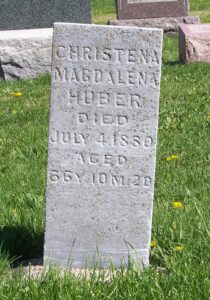
Christena Magdalena Huber, Zion Lutheran Cemetery, Van Wert County, Ohio (2012 photo by Karen)

This is the tombstone of Christena Magdalena (Ehret) Huber, located in row 9 of Zion Lutheran Cemetery, Schumm, Van Wert County, Ohio. The marker is inscribed:

Christena
Huber
Died
July 4, 1880
Aged 66 Y, 10 M, 2 D

Christena Magdalena Ehret was born 21 September 1813 in Markgroeningen, Oberamt Ludwigsburg, Wuerttemberg, the daughter of Johann Adam Ehret and Christina Magdalena Gerna/Gerne/Grona. [1] [2] As calculated from her tombstone and as written in Zion Schumm’s records, her date of birth would be 2 September 1813, but I would consider the date in the old German church records as the most accurate.

Christena Ehret and Michael Huber married 7 September 1841 in Markgroeningen. [2]

Michael Huber was born 30 May 1816 in Schwieberdingen, Wuerttemberg, the son of Balthas Huber (1777-1862) and Anna Maria (Mayle) Huber (1783-1829). [2]   

A daughter, Caroline Huber, was born to Michael and Christena Huber on 10 June 1842 in Wuerttemberg. [3] [4]

Michael Huber, wife Christena, and daughter Caroline immigrated to America in June 1853. [4]

In 1860 the Michael Huber family lived in Blackcreek Township, Mercer County, and had a Shanes Crossing address. The family in 1860: Michael Huber, 44; Christena Huber, 46; Caroline Huber, 18. All three family members were born in Wuerttemberg and Michael was a farmer. [5]

The Michael Huber family in 1870, residing in Blackcreek Township: Michael Huber, 54; Christena M Huber, 57; Caroline Huber, 28; and Flora Laukhart, 6, [granddaughter]. Flora was the daughter of Caroline Huber and Casimere B. Laukhart (1818-1879). All three Hubers were born in Wuerttemberg and Flora was born in Ohio. [6]   

Michael Huber died 29 March 1877 and was buried in row 9 of Zion Schumm’s cemetery. [7]

In 1880 Christena Huber, 70, widow, lived with her daughter Caroline [Huber], 36, divorced, and granddaughter Flora Laukhart, 11. This enumeration indicates that Christena and Caroline were born in Bavaria and that Flora was born in Ohio. The enumeration also indicates that Christena had cancer of the uterus, which I believe is an unusual thing to mention in the census. [8]

That 1880 census was taken in Willshire Township on 25 June 1880 and Christena (Ehret) Huber died less than 2 weeks later, on 4 July 1880. Zion Schumm’s records indicate she died of a prolonged illness and was 66 years, 10 months, and 2 days old. She was buried on the 5th.  

[1] Note by kmb: I translated these surnames the best I could but I am still uncertain of the actual spelling of some.

[2] Wuerttemberg, Germany, Lutheran Baptisms, Marriages, and Burials, 1500-1985, Markgroeningen, Taufen & Heiraten 1703-1933, year 1841 no.21, Michael Huber & Christina Madgalene Ehret, married 7 Sep 1841; online database, Ancestry.com, viewed 6 Mar 2022.

[3] Wuerttemberg, Germany, Lutheran Baptisms, Marriages, and Burials, 1500-1985, Schwieberdingen Taufen, Tote, Heiraten, Notizen & Toten, 1558-1810, year 1842 no.42, Karolina Huber, born 10 Jun 1842.

[4] Wuerttemberg, Germany, Family Tables, 1550-1985, Schwieberdingen, Konfirmation & Familienbucher, 1723-1866, p. 182, Michael Huber family; online database, Ancestry.com, viewed 6 Mary 2022.

[5] 1860 U.S. Census, Black Creek, Mercer, Ohio, p.329, dwelling 581, family 586, Michael Huber; digital image by subscription, Ancestry.com, viewed 6 Mar 2022.

[6] 1870 U.S. Census, Black Creek, Mercer, Ohio, p.23A, dwelling & family 62, Michael Hoober; digital image by subscription, Ancestry.com, viewed 6 Mar 2022.

[7] Ohio, County Death Records, 1840-2001, Van Wert, Vol.1, 1867-1908, p.120 Michael Huber, 29 Mar 1877; database with images, FamilySearch.org, viewed 6 Mar 2022.

[8] 1880 U.S. Census Willshire, Van Wert, Ohio, ED 154, p.457A, family 258, Mary Hoser; digital image by subscription, Ancestry.com, viewed 6 Mar 2022.

Willshire Hotel Information in the 1850-1880 Censuses

After writing about Willshire’s hotels last week I wanted to see what I could learn about the town’s hotels and their proprietors in the census records. I was primarily looking for information about the best-known Willshire hotel, the one most of us remember as the Straubinger Hotel, built in 1850 by Dr. John W. Pearce and razed in 1964.

Straubinger Hotel

I started with the 1850 census, the first census to show occupations as well as more information in general.

I was looking for hotel information but the first thing I noticed was that there were quite a number of physicians living in Willshire in 1850. Five physicians total! There was physician and hotel builder, Dr. John W. Pearce, 34, with his wife and children: Emeline, 29; Thomas, 6; Mary, 4; and Laura, 2. Although Dr. J.W. Pearce built the hotel he reportedly never lived there. In addition to Dr. J.W. Pearce, there was Dr. J.C. Book, 27, Pennsylvania; Dr. David H. Parrot, 28, Ohio; Dr. Amos Gulick, 48, Virginia; and Dr. Thomas J. Pearce, 29, Ohio. I do not know if the two Dr. Pearces were related. All the physicians had families except Dr. David Parrot. [1]

Back to Willshire’s lodging. J.W. Banks was a landlord in the village, probably operating a boarding house or hotel. David Major, merchant, had five people with varying occupations living with him and his family: David H. Parrot, 28, [born in] Ohio, physician; Alden Breslian, 26, New York, laborer; Eguacius [?] Cook, 19, Pennsylvania, clerk; And. W. Porter, 40, Pennsylvania, merchant; and R. Tenner/Tanner, 16, female, Ohio, occupation not given. Major may have had a boarding house or rented rooms.

In 1860 Clarinda Hasper/Harper, 45, born in Pennsylvania, ran a boarding house. That was the only mention of a boarding house/hotel in Willshire in the 1860 census. She had three young Harpers living with her and I wonder if she was a widow. Four boarders resided there: Wm Slis, 26, cabinetmaker; A. Patten, 25, physician; ? Albian, 17, school teacher; and Henry McMans, 20, occupation not given. Clarinda could have been running the hotel. 

There were only three physicians in Willshire in 1860: Dr. J.W. Pearce, 44 and family; Dr. Wm. M. Stephison, 45, Pennsylvania, and family; and Dr. A. Patton, 25, Ohio. Dr. A. Patten was one of the boarders at Harper’s boarding house. [2]

In 1870 it appears there was very active hotel with a livery stable in Willshire. Enumerated at that same dwelling, very likely the hotel we remember: F.S. Johnson, 25, Ohio, hotel keeper; Mary Johnson, 22, Ohio, [his wife?], hotel clerk; Joseph Billman, 27, Indiana, hostler at the livery stable; N.S. Davenport, 44, New York, ret. [retired? retail?] grocer; Mary Watkins, 29, Vermont, cook at the hotel; Doris Teleshpore, 20, Canada, no occupation given, likely a boarder; and Alfred Park, 18, Ohio, worked in the livery stable.

Willshire had five physicians in 1870: Dr. J.W. Pearce, 56, Ohio; Dr. Marchard Croninger, 48, Ohio, and family; Dr. John F. Shaffner, 41, Pennsylvania, and family; J.S. Estell, 26, Ohio, and D.W. Estell, 55, Pennsylvania. Both Estells had their own family and perhaps they were related.

There were a couple “book and shoemakers.” I hadn’t thought of those two occupations being connected but I guess it makes sense if they worked with leather and binding. I also love that Willshire had a bonnet maker in 1870, Sarah Pierce. [3]

In 1880 we first see Adam Straubinger, 37, Prussia, hotel keeper. His wife Matilda is shown as landlady. They had children Anna, 8, Catherine, 4, Lucy, 2, and George W, 1, all born in Ohio. Also at the hotel was Catharine Oaches, 73, Prussia, mother-in-law, who assisted at the hotel; William Thomas, 26, Ohio, hotel clerk; Louisa J. Cook, 20, Indiana, cook at hotel; John Detterer, 29, Ohio, boarder, wagon maker; Wm. F. R. Davis, 22, Ohio, boarder, agriculture clerk.

Stephen C. Flinn, 31, Ohio, was also a hotel keeper in Willshire in 1880. His wife Bertha, 21, Indiana, was a housekeeper. Jos. Morningstar, 22, Indiana, and Mary Jones, 33, Indiana, worked at the hotel. It appears there were two hotels in Willshire in 1880.

In 1880 Ann Crowinger, 44, Ohio, widow, ran a boarding house. Her daughter Ida, 23, taught music.

Willshire was still blessed with physicians in 1880: Dr. J.W. Pearce, 65 was still there; Dr. John K. Ross, 35, Indiana, and family; Dr. S.K. Christy, 27, single, Pennsylvania; Dr. Timothy Hawkins, 35, Pennsylvania, and family; and Dr. J.F. Shaffner, 51, Pennsylvania, and family. Dr. Shaffner and wife had couple boarders in their home: Sylvester Brock, 40, Ohio, worked in drug store; Agi Keefer, 20, Ohio, stone cutter; and F.G. Marple, 20, Ohio, stone cutter.

In addition to all the physicians in Willshire, in 1880 there were also 2 dentists: Christopher C. Scott, 27, with family, and his brother John D. Scott, 44 single, both born in Ohio. [4]

Look for more to come. I will continue on with this in the 1900 census.

[1] 1850 U.S. Census, Willshire, Van Wert, Ohio, p.325-327 [penned]; Ancestry.com, viewed 17 Mar 2022.

[2] 1860 U.S. Census, Willshire, Van Wert, Ohio, p.174-176 [penned]; Ancestry.com, viewed 17 Mar 2022.

[3] 1870 U.S. Census, Willshire, Van Wert, Ohio, p.2-7; Ancestry.com, viewed 17 Mar 2022.

[4] 1880 U.S. Census, Willshire, Van Wert, Ohio, ED 154, p.32-41 [penned]; Ancestry.com, viewed 17 Mar 2022.

Tombstone Tuesday-Rock of Ages Symbol

The Rock of Ages tombstone inscription is usually depicted as a woman clinging to a cross, symbolizing faith. She is in a turbulent sea of waves and is clinging to the cross to be saved. One’s soul is lost in the sea of sin and the only hope is to cling to the Cross of Christ.

Rock of Ages, Woodlawn Cemetery, Ohio City, Ohio.

This symbol is usually associated with verses from the hymn Rock of Ages Cleft for Me or To the Cross I Cling. It can also be associated with verse “I will cling to the Old Rugged Cross.” from the hymn, The Old Rugged Cross.

Sometimes the words Rock of Ages are with the inscription. Columns, symbolizing the entrance to Heaven, may be inscribed on either side of the symbol, too. The guiding star shows the way to heaven.  

Rock of Ages, Woodlawn Cemetery, Ohio City, Ohio.

Other verses or poems are often seen with this inscription.

Rock of Ages, Woodlawn, Ohio City, Ohio.

The Rock of Ages inscriptions below are a reverse color combination and stand side by side in Zion Lutheran Cemetery, Chattanooga. One with a dark cross, the other a white cross.

Rock of Ages, Zion Lutheran Cemetery, Chattanooga, Ohio.

Rock of Ages, Zion Lutheran Cemetery, Chattanooga, Ohio.

This tombstone has obviously been embellished with paint, but shows the image very well.

Rock of Ages, Woodlawn Cemetery, Ohio City, Ohio.

Willshire’s Straubinger Hotel

A few weeks ago I wrote about the Headington House Hotels, once located in Portland, Indiana, and Celina, Ohio. Soon after I was asked about the hotel that was in Willshire years ago.

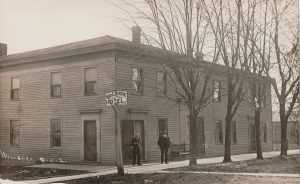
Straubinger Hotel, Willshire, Ohio


I remember that old hotel building. Our Willshire School sixth grade class took a field trip there in 1963 and our class was photographed outside the building.

Straubinger Hotel, 1963, Willshire 6th grade.

I also remember when Mary Stetler had her ice cream parlor there. Some very good ice cream, I might add. The old hotel was torn down in 1964.

Dale Jones & Mary Stetler, 1960, Frosty Zip located in old hotel.

Willshire is celebrating its bicentennial this year. 1822-2022. There is a focus on the town’s history and Willshire’s Bicentennial Committee is planning events throughout the year.

We attended one of those events a few weeks ago, which featured Darrell Groman, who portrayed Willshire’s founder, Captain James Riley. Riley platted the town of Willshire in 1822.

There were also some historical displays about Willshire at that event. Sondra displayed a nice collection of old local newspaper clippings about the history of Willshire’s hotel. Sondra is a true Willshire historian and had originally provided most of the information for the news articles. She graciously allowed me to photograph the news clippings and to share the information here.

From those newspaper articles, here is a brief history of Willshire’s hotels:

Willshire has had several hotels over the years. William Case built a hotel in Willshire 1836. Solomon Hartzog reportedly started a mercantile and hotel in Willshire in the spring of 1848 but died later that same year. The Oregon House, later known as the Straubinger Hotel, the building many of us remember, was built in 1850. Another, the Thatcher Hotel, was located on the west side of State Street, across the street from the Straubinger Hotel. A 1908 fire destroyed the Thatcher Hotel and several other buildings in the village. Moses Foreman was the proprietor of the American Hotel, location unknown. The Depot Hotel was built by the railroad in 1884 and it burned down in 1906.

The most well-known Willshire hotel, the Straubinger Hotel, survived the longest, operating over a century and standing even longer. The structure was built in 1850 for Dr. J.W. Pearce, although it is believed that he never resided there. Such establishments were known as taverns at that time. The hotel was first called the Oregon House and was located on the southeast corner of State and Simpson Streets. Although the hotel faced west, facing State Street, Simpson Street was the main business section in Willshire at that time and most businesses faced Simpson Street.  

Straubinger Hotel

The hotel was built with hewn timbers, was neatly boarded, and had hand-made roof shingles. The interior trim was said to be black walnut. The rooms were described as spacious with ceilings that were not lofty. A tavern was located in the south room and contained two long sturdy tables for diners. There were 12 guest rooms on the second floor. A livery for the horses was located on the east side of the building. Travelers came on horseback and at one time it was the only hotel between St. Marys and Fort Wayne. It was a well-traveled route and many travelers stopped there for a meal or a night’s stay.  

Straubinger Hotel in its hayday

A rowdy celebration just after the end of the Civil War damaged rooms and furnishings on the first floor. Mr. Alberts, the hotel’s proprietor at the time and reportedly a Southern sympathizer, invited soldier boys and their sweethearts to an open house and dance. The event included free food and drinks. Things got out of hand and riot broke out. A new cookstove and dining room furniture were reportedly thrown out of the windows and the north side of the first floor caved in. Women and children were smuggled out and were taken across the river in small boats. One of the children who was smuggled out, a four-year-old girl, became the wife of Judge Merriman of Decatur years later. In the 1930s the Merrimans returned to the hotel to celebrate their 47th wedding anniversary and stayed there overnight.

People gathered around the hotel

The hotel had several names over time, changing as the proprietors came and went. These names included Oregon House, Lamb House, Pearce House, Willshire Hotel, and lastly, the Straubinger Hotel.

Adam Straubinger (1840-1917) was born in Germany in 1840 and settled in St. Marys in 1861. He moved to Willshire in 1874 and worked as a miller there for several years. In 1877 Straubinger decided to go into the hotel business and purchased the hotel. He and his family ran the Straubinger Hotel for nearly 75 years and lived there as well. He and his wife Matilda had 12 children and several of the children were born in the hotel. Three of their children died in infancy but John, George, Ben, Russell, Anthony, Flodeltha (Mrs. A.F. Passwater), Anna, Lucy, and Katherine grew up in the hotel. One of Adam’s granddaughters was Virginia Painter (1916-2012), daughter of Flodeltha (Straubinger) & A.F. Passwater.

At one time the hotel was the social center for refined parties and receptions. A guest once left $3000 under his pillow and the money was promptly returned to him. During the oil boom in the early 1900s the hotel housed oil field workers.

Willshire Hotel. Could one of the men be Adam Straubinger?

The hotel was still in operation and open to lodgers on its 100th anniversary in 1950, although meals were not served there anymore. Dining room service was discontinued about 1948. In 1950 it was run by three of Adam Straubinger’s unmarried children, Kate, Lucy, and Ben.

Kate, Lucy, and Ben Staubinger carried on the business until Dale Jones purchased the building in 1953. Mary Stetler rented space for a cream station and her Frosty Zip ice cream parlor was located there for 10 years.

The remaining Straubingers moved into the former home of Emma (Buchanan) Lautzenheiser, across from the village park.

Straubinger Hotel before it was razed in 1964

The 114-year-old hotel was razed in 1964. A small cement block building was built on the lot and it housed the Frosty Zip for several years.  

Straubinger Hotel razed, 1964

Many of the Straubingers are buried in Willshire Cemetery.   

Thank you to Sondra for collecting, saving, and sharing all this information about a part of Willshire’s history.