Tombstone Tuesday-Tombstone Shapes

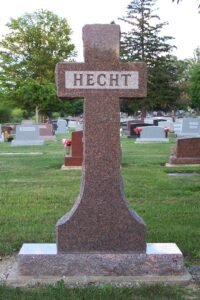
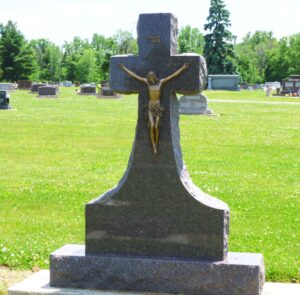
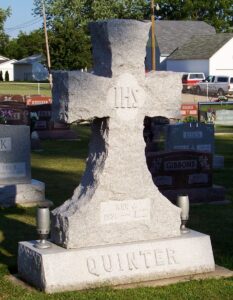
Sometimes the entire tombstone is a symbolic shape.

These large crosses are statements of faith.

North Grove Cemetery, Celina, Ohio

Green Park Cemetery, Portland, Indiana

Catholic Cemetery, Celina, Ohio

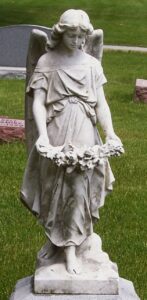
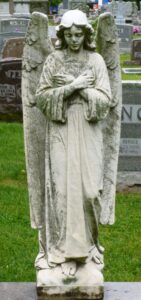
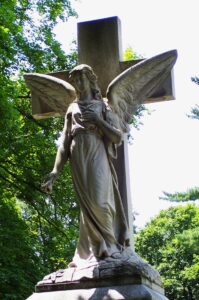
Angels monuments mark some grave-sites.

Greenlawn Cemetery, Wapakoneta, Ohio

St. Joseph Cemetery, Wapakoneta, Ohio

Union Cemetery, Dark County, Ohio

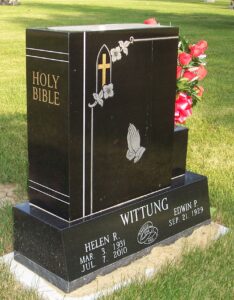
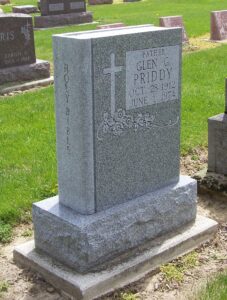
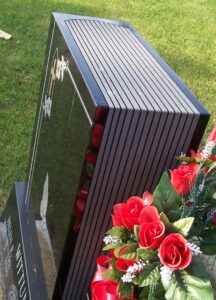
Two Bible markers. One end of each is cut to resemble pages.

Woodlawn Cemetery, Ohio City, Ohio

Woodlawn Cemetery, Ohio City, Ohio

Woodlawn Cemetery, Ohio City, Ohio

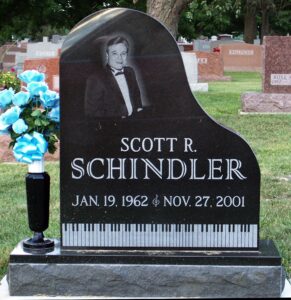
A piano monument.

North Grove Cemetery, Celina, Ohio

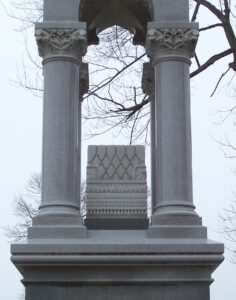
A chair is the feature of this substantial monument that rises above the cemetery.

Greenlawn Cemetery, Wapakoneta, Ohio

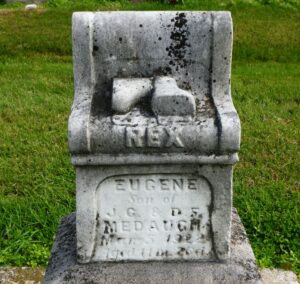
A child’s chair with boots.

Greenbriar Cemetery, Van Wert County, Ohio

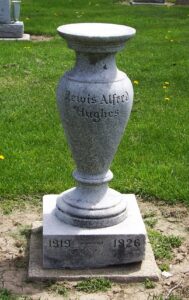
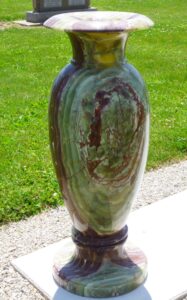
Large urn monuments.

Woodlawn Cemetery, Ohio City, Ohio

Green Park Cemetery, Portland, Indiana

I will post some more of the unique monuments next week.

Summer 2022 Photos

Warning. This post is not genealogy related.

It certainly looks and feels like fall. Where did the summer go? It was a good summer. We kept busy working in the yard, nurtured our pollinator garden, and spent few days in Amish country.  

I enjoy taking photos and here are some of my photos from Summer 2022.

We raised and released 74 Monarch Butterflies but still have one chrysalis and wonder if it will produce a butterfly. The days are shorter and cooler and the time for Monarchs to head to Mexico will soon end.

Monarch (male)

We have other butterflies, too.

Giant Swallowtail

Giant Swallowtail

Painted Lady

Spicebush Swallowtails

Monarch & Spicebush Swallowtail

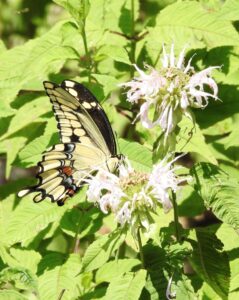
Tiger Swallowtail

Tiger Swallowtail

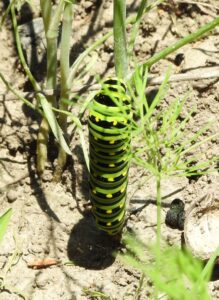
Black Swallowtail caterpillar

We had a family of Mallard ducklings that hatched in May, stayed in and around the pond and grew over the summer, then left abruptly the end of July. It was fun watching them every day and seeing them grow.  

Mallard ducklings about half grown

A deer showed up one day and the ducks swam by to check him out.

Deer & Mallard family

We also see a variety of birds.

Bluebird

Hummingbird

Pileated Woodpecker

Red-headed Woodpecker

Tufted Titmouse getting a drink

We saw a Praying Mantis this past week.

Praying Mantis

As if we don’t see enough Amish around here, we like to visit the Amish areas in Holmes County, Ohio, and Shipshewana, Indiana. This year we attended Bluegrass concerts in both areas.

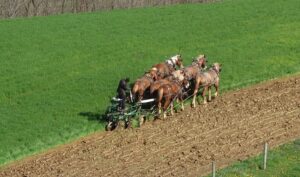
I enjoyed watching this farmer work his field, the view from our room.

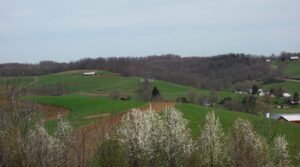
Holmes County in April

Holmes County, April, plowing on the hill

Rhonda Vincent, Berlin, OH, April 2022

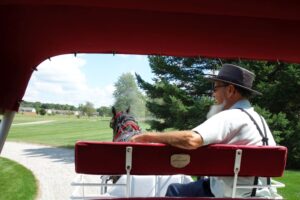
We took a carriage ride in Middlebury, Indiana.

Middlebury, Indiana

Shipshewana

We saw three Bluegrass shows at the Blue Gate Theater in Shipshewana. By the way, Vincent of Dailey & Vincent is Rhonda Vincent’s brother.

Dailey & Vincent, Blue Gate, Shipshewana, September 2022

What a fun summer! One nice thing about living in Ohio is the changing of the seasons and we look forward to the beauty of the next season. 


Tombstone Tuesday-Hildred W. & Roman C. Schumm

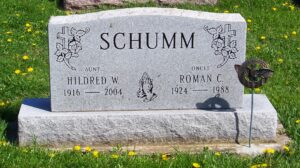
Hildred W & Roman C Schumm, Zion Lutheran Cemetery, Van Wert County, Ohio. (2012 photo by Karen)

This is the tombstone of Hildred and Roman Schumm, located in row 10 of Zion Lutheran Cemetery, Schumm, Van Wert County, Ohio. The marker is inscribed:

SCHUMM
Aunt
Hildred W.
1916-2004
Uncle
Roman C.
1924-1988

Hildred and Roma were two of three siblings born to Oscar Albert (1890-1984) and Hilda Marie (Schumm) (1883-1974) Schumm.

“Hildred” Wilhelmine Maria Schumm was born 27 August 1916 near Schumm. She was baptized at Zion Lutheran Schumm by Rev. George Meyer on 10 September 1916, with Mrs. Maria Schumm and Salome Schumm serving as her sponsors.     

The Oscar Schumm family in 1920: Oscar Schumm, 29; Hilda Schumm, 36, wife; and Hildred, 3, daughter. Oscar was a farmer. [1]

“Roman” Curtis Schumm was born 12 May 1924 near Schumm, Ohio. He was baptized at Zion Schumm by Rev. R.O. Bienert on 25 May 1924, with Arnold L. Schumm and Otto G. Schumm serving as his sponsors.     

The Oscar Schumm family in 1930: Oscar, 39; Hilda, 46, wife; Hildred, 13, daughter; Harold, 8, son; Roman, 5, son; and Maria Schumm, 74. Maria Schumm was Oscar’s widowed mother, Maria (Heffner) Schumm. [2]

The Oscar Schumm family in 1940: Oscar, 43, farmer; Hilda, 56; Hildred, 23 [no occupation given]; Harold, 18, farm labor; and Roman, 15. [3]

Roman Schumm served in the U.S. Army during WWII, enlisting as a private 12 June 1945. [4] His draft card indicates that his employer was Archie Hileman. [5]

The Oscar Schumm family in 1950: Oscar A Schumm, 59, head, laborer; Hilda M, 66, wife: Hildred M, 33, daughter, [no occupation given]; Harold P, 28, son, laborer; and Roman B, 25, son, laborer. [6]

Their mother Hilda (Schumm) Schumm died 28 September 1974 and their father Oscar Schumm died 2 February 1984.

Roman Schumm died 11 January 1988 in Van Wert, aged 63. He was buried on the 14th.  

Roman’s obituary:

Roman C. Schumm, 63, route 1, Willshire, O., died at 3:57 p.m. Monday in Van Wert County Hospital, Van Wert, O., of an apparent heart attack.

He was a farmer and a World War II veteran. Survivors include a sister, Hildred Schumm, route 1, Willshire. He was a member of the Zion Lutheran Church, Schumm, and the American Legion in Willshire.

Services will be held at 1 p.m. Thursday in Zion Lutheran Church, Schumm, O. Friends may call from 2-9 p.m. Wednesday at Ketcham-Ripley Funeral Home, Rockford, and one hour prior to services at the church Thursday. Burial will be in the church cemetery. Memorials are to the church or Wren EMS.
[7]

Hildred Schumm died at Shane Hill Nursing Home, Rockford, on 12 May 2004, at age 87. She was buried on the 15th.

Hildred’s obituary:

Hildred W. Schumm, 87, of Rockford, Ohio, passed away Wednesday, May 12, 2004 at the Laurels of Shane Hill Nursing Center. She was born in Van Wert County August 27, 1916 to Oscar A. Schumm and Hilda M. Schumm.

Hildred worked for the General Electric Company in Decatur, Indiana. She was a member of the Zion Lutheran Church in Schumm, Ohio and a member of the Ladies Aid.

She is survived by 2 nephews, Jim Schumm (Karen), Rockford, OH, John Schumm, Rockford, OH, 1 niece, Kay Schumm, Rockford, OH; 2 great-nephews, Michael Schumm and David Schumm; 1 great niece, Jennifer Schumm; and several cousins.

She was preceded in death by her 2 brothers, Roman Schumm and Harold Schumm. Visitation for Ms. Schumm is 4-7pm (Ohio Time/E.S.T.) Friday, May 14, 2004 at Haggard & Sefton Funeral Home, Decatur, IN. Funeral Service is 11:00 am (Ohio Time/E.S.T.) Saturday, May 15, 2004 at Haggard & Sefton Funeral Home with Pastor Robert Becker officiating. Burial is at the Zion Lutheran Cemetery, Schumm, Ohio. All memorials will be donated to the Zion Lutheran Church, Schumm, Ohio. [8]

Hildred and Roman had a brother:
Harold P Schumm (1921-1988), married Leahline Pearl Case

[1] 1920 U.S. Census, Willshire, Van Wert, Ohio, ED 146, p.3B, dwelling 59, family 60, Oscar A Schumm; digital image, Ancestry.com, viewed 1 Nov 2020.

[2] 1930 U.S. Census, Willshire, Van Wert, Ohio, ED 24, p.2B, dwelling 42, family 43, Oscar Schumm; digital image, Ancestry.com, viewed 1 Nov 2020.

[3] 1940 U.S. Census, Willshire, Ohio, ED 81-28, p.4B, house visited 81, Oscar Schumm; digital image, Ancestry.com, viewed 25 Oct 2020.

[4] U.S., WWII Army Enlistment Records, 1938-1946, Record Group 64, Box 15633, reel 387, Roman Schumm; Ancestry.com, viewed 3 Oct 2022.

[5] Draft Registration Cards for Ohio, 10/16/1940-03/31/1947, Records of the Selective Service System 147, box 1287, Roman Curtis Schumm; Ancestry.com, viewed 3 Oct 2022.

[6] 1950 U.S. Census, Willshire, Van Wert, Ohio, ED 81-40, p.16, dwelling 232, Oscar A Schumm; digital image, Ancestry.com, viewed 3 Oct 2022.  

[7] Roman C. Schumm obituary, Decatur Daily Democrat, Adams Co, Ind, 12 January 1988; Find a Grave.com, Roman C. Schumm memorial no. 34047245.

[8] Hildred Schumm obituary, Tributearchive.com, viewed 3 Oct 2022.

Take Weekly Baths

Take Weekly Baths. That was the headline in Aurora, Illinois, in September 1910 and that made me think about bathing practices years ago.
We don’t think twice about taking a daily bath or shower these days. We take hot running water for granted and have nice, luxurious, bathtubs and showers.

But bathing years ago was a whole lot of work. There was no running water and no bathtub, as we know a bathtub today, positioned in a designated area.

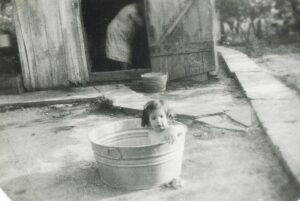
Instead, for bathing, most people used a round metal wash tub that held several gallons of water. That same tub may have been used to wash clothing during the week. For both purposes the water had to be drawn from the well, brought into the house, heated on the stove, then poured into the tub. Because of this, baths were often taken in the kitchen so a person would not have to carry the hot water very far. Afterward, the bath water had to be ladled back into buckets and carried away.

Grandma multi-tasking while child bathes.

Saturday night was often bath night. Family members usually bathed one at a time in the same water. I have read the usual bathing order was father, mother, then children, from oldest to youngest. I think a bathing order by dirtiness makes more sense. I would push for the cleanest to bathe first and the dirtiest to go last. That’s just me.

Hair was shampooed during bath time and was lathered up and then rinsed by pouring water over the head. Clean clothes were worn after the bath.

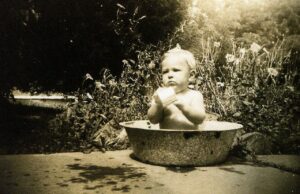
Of course children fit in the wash tub better than the adults.

Bathing outside in a small tub.

Some homes had a full-sized tub for adults, which folded up against the wall, like a Murphy Bed.

Baths could also have been taken at a bath house or barber shop, but I am not sure how common that was in rural areas.

Adults may not have taken a daily bath, but they usually washed themselves down regularly, using a wash basin or bowl.

Times have certainly changed. Today most homes have more than one bathroom and bathing is a whole lot easier and convenient. And more private!

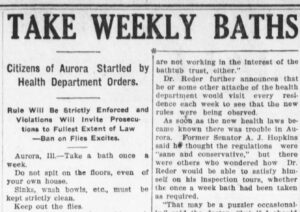
I found the following 1910 newspaper article while browsing through issues of the Celina Democrat. Note that the article pertains to Aurora, Illinois, not to Mercer County, Ohio. Good, practical advice, perhaps enacted incorrectly. Here are some highlights from the 1910 article:

Celina Democrat, 10 September 1910

TAKE WEEKLY BATHS
Citizens of Aurora Startled by Health Department Orders. Rule Will Be Strictly Enforced and Violations Will Invite Prosecutions to Fullest Extent of Law—Ban on Flies Excites.

Take a bath once a week.
Do not spit on the floors, even of your own house.
Sinks, wash bowls, etc., must be kept strictly clean.
Keep out the flies.
Sweep the floors thoroughly each day and scrub them at least once each week.
No more than 2 persons may sleep in a small room and not more than 5 in a room of moderate size.
All rooms, especially sleeping rooms, must be kept clean and well ventilated.
Windows must be kept open in all bedrooms.
Bed clothing must be thoroughly aired at least once a week.
Yards must be kept free from disease breeding rubbish and refuse.
Place garbage in regulation cans and set them out on day of collection.

….rules will be strictly enforced and violations will invite prosecution to the fullest extent of the law… From their police chief: “Those rules go…every one must take his bath and do the rest of the stunts. And I want to say right now that we are not working in the interest of the bathtub trust, either.”

…[a health officer] would visit every residence each week to see that the new rules were being observed…

…As soon as the new health laws became known there was trouble in Aurora. Former Senator A.J. Hopkins said he thought the regulations were sane and conservative but there were others who wondered how Dr. Reder [their health officer] would be able to satisfy himself on his inspection tours, whether the once a week bath had been taken as required…

Ok. Let’s stop right here. Some of this makes me uncomfortable, although I also wonder how Dr. Reder planned to verify that a weekly bath was taken. A time-consuming task, without a doubt. But Dr. Reder has that all worked out. Read on: 

[Dr. Reder, commenting about verifying whether a person took their weekly bath or not]: …but if I should hale the wrong man, woman or child into court, wouldn’t it be a matter of evidence? The wise ones will have their alibis—I mean they will be able to show that they took their dip or soak or whatever the variety was. Proof will lie with members of the family, you know, or receipts at the barber shop…

…Every portable bathtub in Aurora was bought up within an hour after the proclamation. Dealers in plumbing supplies all sent in rush orders for bathroom equipment and hot water attachments for kitchen stoves. The towel department of the dry goods stores did a rushing business…

…Next to the bathing regulations, the ban on flies most excited Auroraites…Dr Reder did not intend to be unreasonable but wouldn’t say how many flies to the cubic yard would be allowed without a penalty…However, less blue bottle flies than of the ordinary or garden variety will be permitted. He suggested that parents offer rewards of say five cents a hundred to stimulate the activity of their children with wadded newspapers. (Celina Democrat, 10 September 1910)

They evidently had a fly plague of Biblical proportions if they were counting flies by the cubic yard. Was Dr. Reder also counting flies? Was $.05/hundred a good price for swatted flies? I wonder how that fly business all worked out.

So, what in the world was going on in Aurora in September 1910 that brought about these health rules? They obviously had some serious health problems. This was about 8 years before the Spanish Flue epidemic, so it was not that. It was probably tuberculosis, which caused more deaths than any other infectious disease in the 1910s, killing one in every five hundred individuals in the U.S. in 1906.

By that time they had some knowledge that microorganisms caused many communicable diseases and the public health system was developing public health education programs. They needed to educate the public about sanitation control and that personal hygiene would help control contagious diseases such as tuberculosis.

This was the way Aurora’s Department of Health dealt with their health issue, but perhaps just educating the public would have achieved the desired results without being legally heavy-handed and without the threat of prosecution.

Sadly, I see some similarities to the government overreach we experienced during our most recent pandemic.

I wonder if Aurora’s cleanliness laws were ever enforced and if anyone was prosecuted for not bathing or for not swatting flies.

I think I’ll ponder that while taking a soaking bath.


Tombstone Tuesday-2 Railroad Acronyms

Today I am highlighting two tombstone symbols that are acronyms of railroad organizations. These inscriptions are on two tombstones at Woodlawn Cemetery, Ohio City, and are the only two inscriptions I have seen that are related to the railroad. I think they are rather unusual.

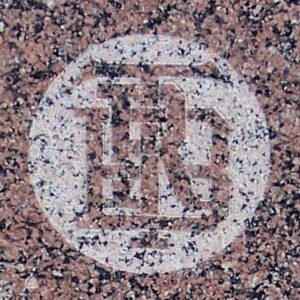
The first symbolizes the Brotherhood of Railroad Trainmen (BRT). BRT was a labor organization for railroad employees founded in 1883 to negotiate contracts with railroad management and provide insurance for members.

BRT, Grover Demler tombstone, Woodlawn Cemetery, Ohio City, Ohio,

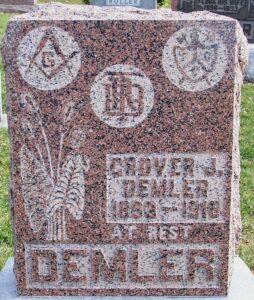
This inscription is on the tombstone of Grover J. Demler (1893-1918). Demler, originally from Ohio City, was a freight brakeman for the Erie Railroad to Huntington, Indiana, where he lived and was a member of Huntington’s B. of R. T. lodge. Demler died in Huntington from complications of influenza during the Spanish Flue Pandemic. Demler was also a Mason and a member of the Knights of Pythias.

Grover Demler, Woodlawn Cemetery, Ohio City, Ohio.

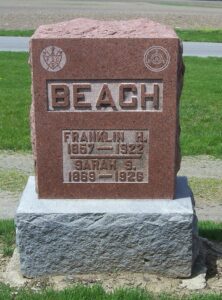
The other railroad organization symbol is the Benefit Association of Railway Employees (B.A.R.E.).

Benefit Association of Railway Employees/BARE, Beach tombstone, Woodlawn Cemetery, Ohio City, Ohio.

This BARE inscription is on the tombstone of Franklin H. Beach (1869-1926) a railroad worker who was struck and killed by a freight train east of Ohio City. Beach was also a member of the Knights of Pythias.

Franklin Beach, Woodlawn Cemetery, Ohio City, Ohio.

BARE was originally founded in 1913 as the Brotherhood of All Railway Employees, established by two insurance men and two North Western Railway employees.

In 1917 The Brotherhood of All Railway Employees adopted a new name and became the Benefit Association of Railway Employees (B.A.R.E.). The name change reflected their growth and defined their purpose. This was considered the Golden Age of Railroads.

In 1922 BARE became a mutual insurance company and was owned by its policy owners. The home office was in Chicago and by 1928 they had over 135,000 members. In 1929 the company began insuring individuals outside the railroad industry and in 1945 they established a life insurance department. The Benefit Association of Railway Employees celebrated their 50th anniversary in 1963 and changed their name to the Benefit Trust Life Insurance Company.

Two unusual inscriptions, indeed.