Tombstone Tuesday-Walther League Symbol

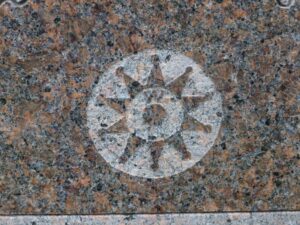
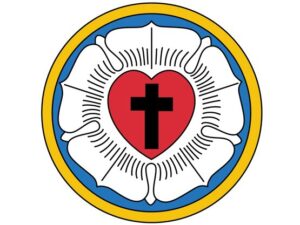
This is the symbol for the Walther League, a youth society for the Lutheran Church Missouri Synod (LCMS).

Walther League symbol, Immanuel Lutheran Church, Decatur, Indiana

The International Walther League was formed in 1893 and named after Rev. C.R.W. Walther. [1] The goal of the league was to assist in keeping young people within the Church.

Over the years the league established Lutheran hospices and supported the Evangelical Lutheran Sanitarium in Wheat Ridge, Colorado, which it owned and operated from 1927-1959. The league sent out over 400,000 Bibles and prayer books to U.S. servicemen during WWI and provided aid to the European Relief effort after the war. During the Great Depression the league ran local food banks and soup kitchens and helped fund the new Lutheran Hour radio program. By 1936 the Walther League had 85,000 members in 2,180 societies. An estimated 25,000 Walther Leaguers served in the military during WWII and the league turned their focus to aiding its military members. After WWII the league attracted a younger age group, of high school age. However, the high schoolers could not provide the financial support the working-age young adult members had provided and the league suffered financial and other problems. In 1977 the LCMS dropped its affiliation with the league and in 1989 the Walther League’s board of directors met for the last time. [2]

[1] The Walther League was named after Rev. Carl Ferdinand Wilhelm Walther (1811-1887), a German-American Lutheran minister. Rev. Walther was the first president of the Lutheran Church Missouri Synod from 1847-1850 and was reportedly its most influential theologian. Walther was born in Langenchursdorf, Kingdom of Saxony, educated at the University of Leipzig, emigrated to America in 1838, and accepted a Doctor of Theology degree from Capital University, Columbus, Ohio, in 1877. He is described as a man who gave up his homeland for the freedom to speak freely, to believe freely, and to live freely, by emigrating from Germany to the United States. Walther died in St. Louis, Missouri in 1887.

[2] “A Short History of the Walther League,” Walther League Redux, https://waltherleague.com/ , viewed 24 Apr 2023.

A Bienz-Ross Photo Mystery

Last week I showed three very old Schumm-related documents, the 1835 baptismal certificate of Magdalene Schueler, Magdalene Schueler’s 1850 confirmation certificate, and the 1853 baptismal certificate Johann Friedrich Bienz (Jr), the son of Magdalene and her husband John Bienz (Sr). See below for a summary of these individuals. [1]  

With the three documents was this photo:

Lee Ross, Robert & Effie (Koontz) Morrison, Alice (Koontz), Jesse & Frank Ross; Photo to Grandma Bence from Alice Ross, April 1902

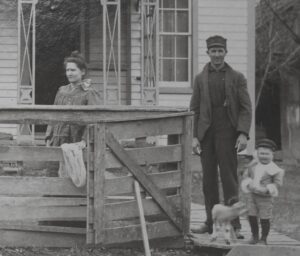
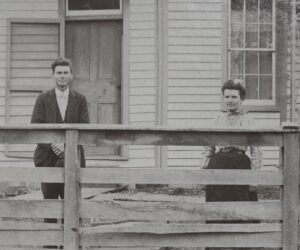
A closeup of the individuals in the photo:

Alice (Koontz) & Jesse Ross, Frank Ross; Photo to Grandma Bence from Alice Ross, April 1902

Robert & Effie (Koontz) Morrison; Photo to Grandma Bence from Alice Ross, April 1902

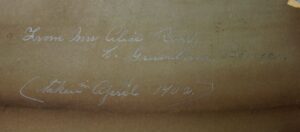
Someone wrote the following on the back of the photo:

From Mrs. Alice Ross
to Grandma Bence
Taken in April 1902

Bentz II [this may have been written by the photographer]

From Mrs. Alice Ross, to Grandma Bence, taken April 1902

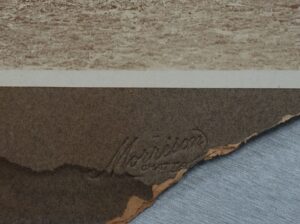
I have been trying to figure out who the people in this photo are, but it has me stumped. The home in this photo was very likely in the Blackcreek or Liberty Township area because the photo was taken by Morrison Photography, Chattanooga, Ohio.

1902 photo taken by Morrison Photography, Chattanooga, Ohio

I believe the surname Bence is what we know as Bienz today and since the photo was with the three other old documents I am guessing the photo has a connection to the John Bienz (Sr) family. But I cannot find a Bienz/Ross connection.

Or maybe there is no family connection. Perhaps Grandma Bence was a grandmother figure to Alice and her family.

The Mrs. Alice Ross may be Alice (Koontz) Ross (1874-1947), wife of Jesse Ross, daughter of Joel D. and Anna J (Frock) Koontz. Alice and her parents lived in Blackcreek Township, Alice grew up in Blackcreek, and Alice and Jesse lived in Blackcreek in 1900. Alice had two young boys in 1900 who would be about the same age as the two boys in the photo. It is my best guess that Jesse and Alice Ross and their two boys are four of the individuals in the photo. In addition, Alice’s sister Effie married Robert Morrison. Was Robert the photographer? Is that the connection?

Also, two Bienz families lived in Blackcreek Township in 1900, Joseph W. Bienz (1864-1961), with wife Lucy (Billman) (1869-1928) and their children, as well as Joseph’s mother Mary (Harrod) Bienz (1836-1905). Either woman could have been Grandma Bence.

Help!

Maybe someone will recognize the names, the individuals, or the house and will be able to solve this mystery.

Note by kmb: After posting this blog a reader identified the individuals on the photo as, left to right, Lee Ross, Robert & Effie (Koontz) Morrison, Alice (Koontz), Jesse, Frank Ross. I have updated the information under the photos. Thank you!

[1] A summary of the family relationships connecting the three certificates: Magdalene Schueler (1835-1916) was the daughter of Michael Schueler (1808-1880) and his wife Maria Katherine Schumm (1810-1938). Wife Maria Katherine Schumm was the daughter of immigrant John Georg Schumm (1777-1846) and she immigrated to America in 1833 with her father and four brothers. The Schumm immigrants first settled in Holmes County, Ohio, where, in 1833, Maria Katherine Schumm married Michael Schueler. Their second child, Catharina “Magdalene” Schueler, was born in Holmes County on 3 November 1835. About 1838 the Schumms and the Michael Schueler family moved to Van Wert County, where they purchased land and established the village of Schumm and Zion Lutheran Church. Magdalene Schueler married John Bienz (Sr) (1823-1898) at Zion Schumm in 1852. Their first child, Johann Friedrich Bienz (Jr) (1853-1918), was born 20 June 1853.

Tombstone Tuesday-Luther Rose Symbol

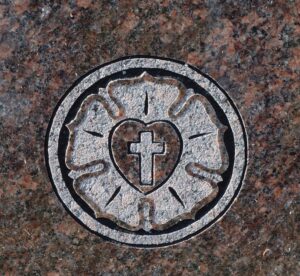
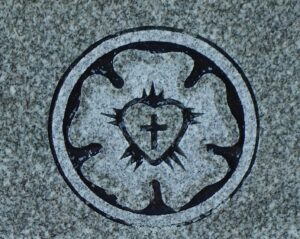
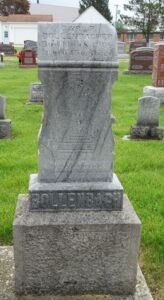
The image on these tombstones is the Luther Rose, the symbol for Lutheranism. The seal was designed by Martin Luther in 1516 and it symbolizes the basic elements of Christian theology.

Luther Rose, West Lawn Cemetery, Baltic, Tuscarawas County, Ohio (2022 photo by Karen)

Luther Rose, West Lawn Cemetery, Baltic, Tuscarawas County, Ohio (2022 photo by Karen)

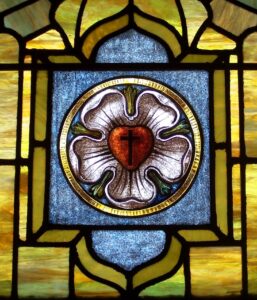
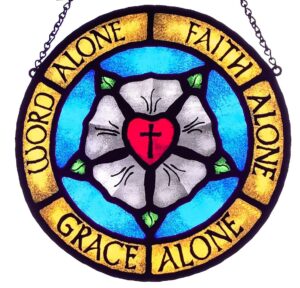
This Luther Rose is on one of our stained glass windows at Zion Lutheran, Chatt:

Luther Rose in stained glass.

Luther Rose:

Luther Rose

The meaning of the Luther Rose seal with portions of Luther’s description of the seal to a friend, Martin Luther, from the wilderness of Koburg Castle, 8 July 1530:

The center of the seal is a black cross in a red heart, “…so that I myself would be reminded that faith in the Crucified saves us…a black cross, which mortifies and which should also cause pain, it leaves the heart in its natural color…it does not kill but keeps alive…”

“…Such a heart should stand in the middle of a white rose, to show that faith gives joy, comfort, and peace…it places the believer into a white, joyous rose, for this faith does not give peace and joy like the world gives…for white [not red] is the color of the spirits and the angels…”

“…Such a rose should stand in a sky-blue field, symbolizing that such joy in spirit and faith is a beginning of the heavenly future joy, which begins already, but is grasped in hope, not yet revealed.”

“And around this field is a golden ring, symbolizing that such blessedness in Heaven lasts forever and has no end. Such blessedness is exquisite, beyond all joy and goods, just as gold is the most valuable, most valuable, most precious and best metal…”

This Luther Rose is hand painted in Zion Chatt’s sanctuary:

Hand-painted Luther Rose

Another example, with Luther’s confession that we are saved by Grace Alone, Faith Alone, and Word Alone:

Luther Rose

What a meaningful and beautiful symbol for a tombstone.

3 Old Schumm, Schueler, Bienz-related Documents

Recently a Schumm relative shared three wonderful old Schumm documents. These documents are very old and it is amazing that they were saved all these years and are in such good condition.

Before showing images of the documents, a little history about the individuals mentioned in them.

All three documents involve Magdalene Schueler (1835-1916), the daughter of Michael Schueler (1808-1880) and his wife Maria Katherine Schumm (1810-1938). Wife Maria Katherine Schumm was the daughter of immigrant John Georg Schumm (1777-1846) and she immigrated to America in 1833 with her father and four brothers. The Schumm immigrants first settled in Holmes County, Ohio, where, in 1833, Maria Katherine Schumm married Michael Schueler. Their second child, Catharina “Magdalene” Schueler, was born in Holmes County on 3 November 1835. About 1838 the Schumms and the Michael Schueler family moved to Van Wert County, where they purchased land and established the village of Schumm and Zion Lutheran Church. Magdalene Schueler married John Bienz (Sr) (1823-1898) at Zion Schumm in 1852. Their first child, Johann Friedrich Bienz (Jr) (1853-1918), was born 20 June 1853.

Now, the documents.

Magdalene Schueler 1835 baptismal certificate

The oldest document is the baptismal certificate of Catharina “Magdalene” Schueler, daughter of Michael and Cathrine [Katherine] (Schumm) Schueler. Magdalene was born 3 Nov 1835 in Holmes County, Ohio, and baptized 10 November 1835. This document is interesting because the certificate gives the birth places of her parents: Michael Schueler, born in Binzelberg [Binselberg], Wuerttemberg, and Cathrine [Katherine] Schumm born in Ruppertshofen, Wuerttemberg. Magdalene Schueler’s baptismal sponsors were Magdalena Schumm, Cathrine Lillich, and Barbara Gehrig. [1]

Magdalene Schueler 1835 baptismal certificate

The next name on Magdalene’s baptismal certificate is Colredo, who would have been Rev. Henry Colloredo, the first minister of Zion Lutheran Church in Winesburg, Holmes County. Rev. Colloredo, a theological student when he first came to Winesburg, ministered there from 1833-1836, during the time the Schumms, Schuelers, and Pfluegers attended church at Winesburg. [2] The parishioners did not have a church building at Winesburg until about 1841 but met in the home of Peter Schallioll.  I have a transcribed list of Rev. Colloredo’s baptisms at Winesburg, but there are no Schuelers on that list. Perhaps it was not recorded in the records or did not survive, but we see the original certificate.

Written on the lower right is “Ev. Luth Parish, Holmes County, Ohio” and written on the lower left is “Preble Township, Adams County, Indiana, 21 April 64.” The Preble reference was apparently written much later. Michael Schueler’s wife Katharine (Schumm) died in Schumm in 1838 and widower Michael Schueler married Catharine Lakehard in 1839. They stayed in Willshire Township for a few years but moved to Preble County, Indiana, by 1860. The Preble reference may have been added later, perhaps when Magdalene joined the church there. Perhaps she showed them her baptismal certificate to prove when and where she was baptized.

Magdalene Schueler 1850 confirmation certificate

The second document is Rosina “Magdalena” Schueler’s confirmation certificate, confirmed at Zion Lutheran, Schumm, on 29 Mar 1850 by Rev. Johann G. Streckfuss. Although her first name is different, this document indicates Magdalene was born 3 November 1835, the same birth date written on the baptismal certificate above and I believe she is the same person. As was the custom at that time, she went by her middle name, “Magdalene.” I have seen this before, where the first name varies between documents, while the person went by their middle name.

Magdalene was confirmed by Rev. Johann G. Streckfuss, Zion Schumm’s minister from 1847-1856.

Three years after her confirmation, Magdalene Schueler married Johann Bienz (Sr) (1823-1898) on 15 April 1852 at Zion Schumm. Their first child was Johann Friedrich Bienz (Jr) (1853-1918).

Johann Bienz 1853 baptismal certificate

The third document is the baptismal certificate of Johann Friedrich Bienz, the son of the above-mentioned Magdalene Schueler and husband Johann Bienz. Their son Johann Friedrich Bienz was born 20 June 1853 and baptized 22 June 1853 at Zion Lutheran, Schumm, by the above-mentioned Rev. Johann G. Streckfuss.

Johann Friedrich Bienz (Jr) married Mary “Virginia” Bleichner in 1882.

What wonderful family documents! Three documents that all fit together, saved all these years. What a treasure!

[1] Note by kmb: I am not sure who Magdalina Schumm was. Friedrich Schumm (1814-1902) married Magdalena Meyer in 1838, in Holmes County, but their marriage occurred after this event.]

[2] Rev. Colloredo is mentioned on p.29 of our 2010 Schumm History book and in subsequent Schumm history/genealogy updates since the 2010 book, with a little history of the Winesburg church.

Tombstone Tuesday-Walter & Helen (Backus) Krueckeberg

Walter & Helen Krueckeberg, Zion Lutheran Cemetery, Van Wert County, Ohio. (2012 photo by Karen)

This is the tombstone of Walter and Helen Krueckeberg, located in row 9 of Zion Lutheran Cemetery, Van Wert County, Ohio. The marker is inscribed:

KRUECKEBERG
Walter
May 9, 1910
Dec 29, 2000
Helen
Aug 28, 1911
July 12, 1999

Walter Friedrich Krueckeberg was born in Van Wert County, Ohio, on 9 May 1910, the fifth child of Carl H. (1877-1943) and Vilenna M. (Bienz) (1879-1964) Krueckeberg. Walter was baptized 22 May 1910 at Zion Lutheran Church, Schumm, with Friedrich Bienz and Friedrich Thieme serving as his baptismal sponsors.

The 1910 census was enumerated in Willshire Township the very same day Walter Krueckeberg was born. Walter was apparently born after census taker Clyde Jones took the Carl Krueckeberg family information, and as a result, Walter was not enumerated in that census. On that census day Carl and Vilenna Krueckeberg indicated that they had 4 children. That must have been a busy and hectic day for the Carl Krueckeberg family, having a new baby as well as a visit from the census taker.

Walter Krueckeberg was enumerated in the next U.S. Census, the 1920 census, with his parents and siblings: Charles/Carl Krueckeberg, 42; Vilenna, 40; Leo, 17; Hugo, 16; Elvira, 13; Henoch, 11; Walter, 9; and Loretta, 2. The father Carl was a farmer. [1] By 1930 all but two of the Krueckeberg children had left home. Just Walter, age 20, and his sister Luetta, 12, resided at home with their parents Carl and Vilenna. [2]

Walter Krueckeberg married Helen Backus 28 March 1937. [3]  

Helen was born in New Bremen, Auglaize County, Ohio, 28 August 1911, the daughter of Harry H. (1882-1955) and Emma (Harlamert) (1888-1954) Backus.

By 1920 the Harry Backus family had moved to Convoy, Van Wert County, Ohio, where they resided on Walnut Street: Harry, 37 head; Emma, 31, wife; Helen, 8, daughter; Wilma, 5, daughter; Anna R, 1, daughter; and Georgianna Backus, 62, mother. The father Harry was a Watkins salesman. [4]

By 1930 the Harry Backus family had moved again, moving to Maple Street in Convoy: Harry H, 47; Emma, 41; Helen G, 18; Wilma, 15; Anna R, 11; James H McCullough, 26, boarder; and Robert L Fogt, 23, boarder. The father Harry did cabinetry in a factory and daughter Helen was a clerk in a dry goods store. [5]

At the time of their 1937 marriage Walter Krueckeberg lived in Willshire Township and his bride Helen Backus lived in Convoy. Walter was a farmer and Helen worked as a clerk. [3]

I found their wedding announcement in a newspaper. They married on Easter Sunday morning. Remember when wedding announcements like this were published:

Helen Backus, Walter Krueckeberg Marriage Solemnized Yesterday
Vows Exchanged in Emanuel Lutheran Parsonage Easter Morn
An early Eastern [sic] morning wedding was solemnized at 8:30 a.m. Sunday at the parsonage of Emanuel Lutheran church on West Maple avenue when Miss Helen Backus, eldest daughter of Mr. and Mrs. Harry Backus of Convoy became the bride of Walter Krueckeberg, son of Mr. and Mrs. Charles Krueckeberg of near Willshire. The Rev. Herold Kramer, pastor of Emmanuel Lutheran church read the single ring ceremony which was witnessed by the attendants, Miss Wilma Backus, sister of the bride, and Henoch Krueckeberg, the bridegroom’s brother.

The bride’s gown was of Bernese blue knife-pleated chiffon and with it she wore accessories of light grey. Her flowers were a corsage of Talisman roses and sweet peas. Her sister wore a gown of French rose with navy accessories. Her flowers were briarcliff roses.

Mrs. Krueckeberg a graduate of Convoy-Tully high school, is employed as a saleswoman at the J.P. Skinner and company store. Mr. Krueckeberg was graduated from Willshire high school. He is a well known Willshire township farmer.

A three course wedding dinner was served at noon Sunday at the home of the bride’s parents in Convoy with members of the immediate families as guests. The dinner appointments were carried out in a pink and white color note which was also evident in the table centerpiece which was an arrangement of pink roses and snapdragons in two crystal bowls.

Mr. and Mrs. Krueckeberg left Sunday afternoon for a wedding trip to points in southern Ohio and in Kentucky and after their return will be at home on a farm in Willshire township. [6]

By 1940 Walter and Helen had one child, James. The Walter Krueckeberg family in 1940: Walter, 29; Helen, 28; and James E, 9 months. Walter was a farmer. [7]  

By 1950 Walter and Helen had 3 children: James E, 10; Janice Ann, 6; and Kenneth C, 2. Walter continued to farm. [8]

Walter & Helen Krueckeberg, 1971 Zion Lutheran, Schumm, directory.

Walter and Helen were active members of Zion Lutheran Church, Schumm.

Helen died in a long-term care facility in Mercer County 12 July 1999, at the age of 87.

Walter died in a long-term care facility in Van Wert County on 29 December 2000, at the age of 90.

Walter and Helen (Backus) Krueckeberg had three children: James, Janice, and Kenneth.

It is interesting to note that one of Helen (Backus) Krueckeberg’s two sisters, Anna Ruth Backus (1919-1970), married Adolph Ferdinand Dietrich (1918-2000), son of Henry Jacob (1869-1935) and Maria Elizabeth (Schumm) (1881-1966) Dietrich.  

[1] 1920 U.S. Census, Willshire, Van Wert, Ohio, Ed 145, p.3B, dwelling & family 57, Charlery [sic] Krueckeberg; digital image, Ancestry.com, viewed 16 Apr 2023.

[2] 1930 U.S. Census, Willshire, Van Wert, Ohio, Ed 24, p.5B, dwelling 110, family 113, Chas H Krueckeberg; digital image, Ancestry.com, viewed 16 Apr 2023.

[3] Ohio, U.S., County Marriage Records, 1774-1993, Van Wert County, Ohio, p.190, Walter Krueckeberg & Helen Backus, 28 March 1937; digital image, Ancestry.com, viewed 16 Apr 2023.

[4] 1920 U.S. Census, Tully, Van Wert, Ohio, ED 137, p.10A, dwelling 267, family 273, Harry Backhus [sic]; digital image, Ancestry.com, viewed 16 Apr 2023.

[5] 1930 U.S. Census, Convoy, Van Wert, Ohio, ED 14, p.9B, dwelling & family 265, Harry H Backhus [sic]; digital image, Ancestry.com, viewed 16 Apr 2023.

[6] “Vows Exchanged in Emanuel Lutheran Parsonage Easter Morn,” Van Wert Times Bulletin, Van Wert, Ohio, 29 Mar 1937; NewspaperArchive.com, viewed 17 Apr 2023.

[7] 1940 U.S. Census, Willshire, Van Wert, Ohio, ED 81-28, p.5B, household 107, Walter Krueckenberg [sic]; digital image, Ancestry.com, viewed 16 Apr 2023.

[8] 1950 U.S. Census, Willshire, Van Wert, Ohio, ED 81-40, p.8, dwelling 119, Walter F Krueckeberg; digital image, Ancestry.com, viewed 16 Apr 2023.