Who Do? 1916 Mount Carmel Bible Class

A few years ago I wrote about the Mount Carmel EUB Sunday School Class of 1914. My paternal grandmother Gertrude “Gertie” (Brewster) Miller (1896-1973) was a member of that class.

Mount Carmel church, a frame structure, was located in rural Jefferson Township, Adams County, Indiana. It had a Geneva address and was located about two miles from the Indiana-Ohio state line, about 4-5 miles southwest of Chatt. Google Maps indicates that the address of the church was E 900 S, S 450 E. In 1914 it was an Evangelical United Brethren (EUB) church. Philip Brewster, Gertie’s father and my great-grandfather, was a janitor at the church for many years.  

Here is a photo of the 1916 Charter Member organizational certificate of Mount Carmel church’s adult Bible class, with 25 signatures of the Bible class members.  
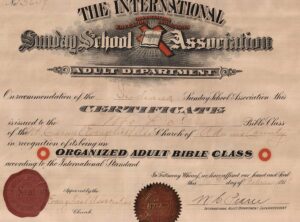
1916 Mount Carmel EUB Bible class certificate.

THE INTERNATIONAL SUNDAY SCHOOL ASSOCIATION, Adult Department
On recommendation of the Indiana Sunday School Association this certificate is issued to the
Who Do? Bible Class of the Mt. Carmel Evangelical Assoc. Church of Adams County.
ORGANIZED ADULT BIBLE CLASS according to the International Standard.
In Testimony Whereof, we have affixed our hand and seal this 11th day of February 1916.

Approved by the Evangelical Association Church.

Signed, W.C. Pearce, International Adult Department Superintendent.

For the Indiana Sunday School Association. B. Cornelius, Adult Department Superintendent.
CHARTER MEMBER


Who Do? That’s an interesting name for a Bible Class. There must be a story behind that name.

My grandma, Gertie Brewster, was one of the 25 young women who signed the certificate.
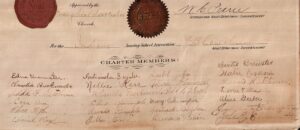
Signatures of 1916 Mount Carmel Bible class certificate.

Their signatures:
Edna Brewster, Claudia Buckmaster, Adda F. Ketcham, Cora Arn, Clara Fogle, Eloise Reef, Indianola Snyder, Nellie Kerr, Blanche Beerbower, Cleo Rumple, Arveda Rumple, Ella Arn, Isabel Zehr, Marie Sprunger, Ida L. Kerr, Mary Champer, Gertrude Snyder, Anna Durbin, Gertie Brewster, Halie Evans, Bessie Ketcham, Leona Fetters, Alice Gerber, Jeanette Charleston, Zola E. Charleston.

Here is a photo of the 1914 Mount Carmel Sunday School class. My grandma Gertrude and her sister Alpha (Brewster) Derickson (1898-1968) are among the class members.
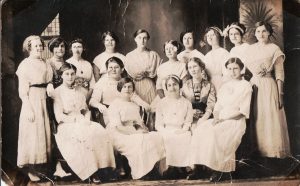
1914 Mount Carmel Sunday School class.

Several of those in the 1914 photo were in the 1916 Bible class and signed the certificate. Those in the 1914 photo, with their maiden and married names:

Seated, left to right: Iva (Irwin) Charleston, Edna (Brewster) Abnet, Alpha (Brewster) Derickson, Clara (Fogle) Becher, Blanch (Beerbower) Foreman, and Janie (Irwin) Arnold.

Standing, left to right: Lola (Charleston) Taylor, Anna (Ketchum) Durbin, Cleo (Rumple) Pyle, Jannette (Charleston) Striker, Ethel (Evans) Houseman, Mary Champer, Gertrude (Brewster) Miller, Augusta (Brewster) Rockwood, Addie (Ketchum) Hisey, and Eathel (Evans) Dailey.

The Who Do? Bible class, consisting of young women. I wonder if the young men of the congregation also had a Bible class.
A WWII Paratrooper in the Family

This is a very patriotic time of year. In addition to Memorial Day and Independence Day, D-Day and Flag Day fall between those two well-known Federal Holidays. The entire month of May is designated to honor military members and their families, past and present. I wrote about those designated days in a few weeks ago.

June also has a number of Military Holidays, some I have not heard of:

  • Don’t Give Up the Ship Day (1 June)
  • D-Day (6 June)
  • Flag Day (14 June)
  • Pause for the Pledge Day (14 June)
  • US Army Birthday (14 June)
  • Bunker Hill Day (16 June)
  • US Coast Guard Auxiliary Birthday (23 June)
  • PTSD Awareness Day (27 June)
  • Operation Red Wings Observance (28 June)

Whole weeks in June are devoted to patriotic observances and honoring the military:

  • America the Beautiful Week (first full week of June)
  • Greencare for Troops Week (17-23 June)
  • Honor America Days (14 June-4 July)
  • National Flag Week (9-15 June)

I put up my patriotic decorations and U.S. flags before Memorial and leave them up until after Independence Day. The red, white, and blue colors are beautiful and uplifting, as well as patriotic!

I was going through some old Schumm family photos the other day and I found a couple interesting photos that my grandpa Schumm had saved.

My grandpa Cornelius Schumm had a sister Frieda (1893-1945), who married Richard Allmandinger (1898-1982). They had a son, Louis William Allmandinger (1925-2013), who was also my grandpa’s nephew.

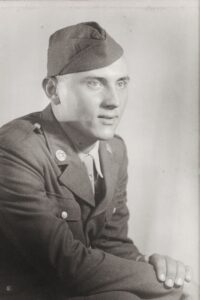
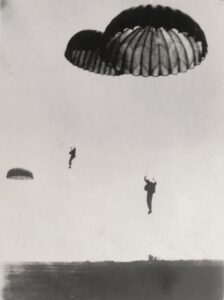
Grandpa saved a couple photos of his nephew Louis Allmandinger in his WWII Army uniform, dated 1944, and a photo of Louis parachuting in Japan, dated 1947.

Louis Allmandinger (1925-2013), 11th Airborne, 1944.

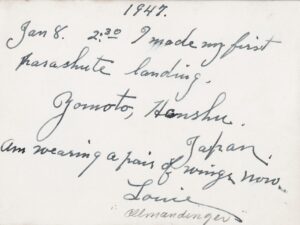
Written on the back of the photo below: Jan 8, 1947. I made my first parachute landing. Yomoto [?], Honshu, Japan. Am wearing a pair of wings now. Louie.

Louis Allmandinger, 11th Airborne, parachuting in Japan, 1947.


Louis Allmandinger, 11th Airborne, 1947, back of above photo.

Louis was a U.S. Army paratrooper in the 11th Airborne. The 11th Airborne Division was activated on 25 February 1943, during WWII, and held in reserve in the U.S. until June 1944 when it was transferred to the Pacific Theater. They saw some combat in the Philippines.

The 11th Airborne was in Honshu, Japan, as part of the post-war occupation and that was where Louis made his first parachute landing in 1947.

Honshu is Japan’s largest and most populous island. Honshu contains Japan’s highest mountain, Mount Fuji, and Japan’s largest lake, Lake Biwa.

I know nothing more about Louis’ war service, but I appreciate that these photos were saved all these years.

During the war years Louis probably attended Zion Lutheran Church, Schumm, where over a dozen of their young men served in WWII.

Again, Thank You to our veterans, past and present.

Tombstone Tuesday-Wilhelm & Peter Linn

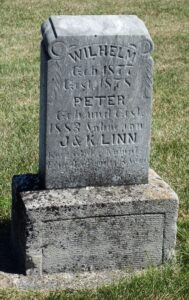
Wilhelm & Peter Linn, St. Paul Lutheran Cemetery, Liberty Twp, Mercer County. (2023 photo by Karen)

This is the tombstone of Wilhelm and Peter Linn, located in row 4 of St. Paul Lutheran Church Cemetery, Liberty Township, Mercer County, Ohio. The tombstone is inscribed:

WILHELM
Geb. 1877
Gest. 1878
PETER
Geb. Und Gest.
1883  Sohns von
 J & K LINN

Wilhelm, born 1877, died 1878; Peter, born and died 1883, Sons of J & K Linn.

Wilhelm and Peter were the sons of Jacob (1838-1919) and Katharina (Mueller) (1839-1913) Linn. Their parents were born in Bavaria, married there, and three of their sons, Jacob, Henry, and Philip, were born in Bavaria. The family immigrated to America in 1872 and settled in Liberty Township south of Chattanooga, where five more sons were born to the couple.

Their mother Katharina (Mueller) was the sister of my great-grandfather, Jacob Mueller. The Mueller name was later Americanized to Miller.

Son Wilhelm Linn was born in Liberty Township on 17 January 1877. [1] Wilhelm died in Liberty Township on 3 August 1878, at the age of 1 year, 6 months. His cause of death appears to be recorded as teething. [2]

Peter Linn was born in Liberty Township on 14 February 1883. [3] Peter died in Liberty Township on 1 March 1883 from spasms/fits. He was 14 days old. [4]

Wilhelm and Peter had six brothers who lived to adulthood, Phillip, Jacob, Christian, Henry, John, and Fredrick.

[1] “Ohio, County Births, 1841-2003,” Mercer, Vol. 1, p.202, William Linn, 17 Jan 1877; FamilySearch.org.

[2] “Ohio, County Death Records, 1840-2001,” Mercer, Vol. 1, p.118, William Linn, 3 Aug 1878; FamilySearch.org.

[3] “Ohio, County Births, 1841-2003,” Mercer, Vol. 1, p.376, Peter Linn, 14 Feb 1883; FamilySearch.org.

[4] “Ohio, County Death Records, 1840-2001,” Mercer, Vol. 1, p.186, Peter Linn, 1 Mar 1883; FamilySearch.org.

Flag Day

Old Glory. The Stars & Stripes. The Grand Old Flag. The Star-Spangled Banner. The Red, White, and Blue. The American Standard. The United States Flag. These are all nicknames for our American Flag.   

Some other, less familiar nicknames for our flag are The Banner, The National Flag, The Colors, The Standard, The Symbol of Freedom, The Patriot’s Flag, The National Ensign, The Emblem, The American Colors, and The Freedom Flag.

Today is Flag Day. A day of national observance to commemorate the adoption of the United States flag by the Second Continental Congress on 14 June 1777.

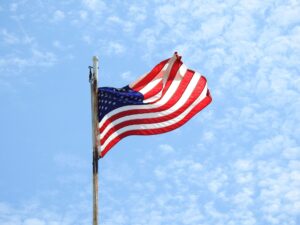
American flag flying at Willshire Cemetery, Memorial Day 2023

Our American flag is a symbol of freedom, national pride, patriotism, democracy, and unity. It represents our country’s values, history, and people. Our flag is recognized around the world.   

In 1885 a Wisconsin schoolteacher urged his students to observe 14 June as Flag Birthday. In 1916 President Woodrow Wilson issued a presidential proclamation establishing a national Flag Day on 14 June. In 1949 Congressional legislation designated 14 June as national Flag Day.

Flag Day is not a national holiday, but many Americans celebrate the day by displaying the flag. Some communities have parades and ceremonies.

In 1777 the Continental Congress adopted a resolution that the flag of the United States be thirteen stripes, alternate red and white; that the union be thirteen stars, white in a blue field indicating a new constellation. The 13 stars represented each of the 13 colonies. Over time, the number of stars has increased as states were added.

Old Glory has undergone 27 official design changes since is adoption in 1777.

The current American flag design, with 50 stars, has been used since 4 July 1960, after addition of the 50th state, Hawaii.

The red color symbolizes valor and bravery, the white color symbolizes purity and innocence, and the blue color represents vigilance, perseverance, and justice.

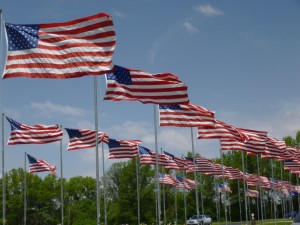
Resthaven Memory Gardens, Auglaize County, Ohio. (2014 by Karen)

Our Flag is protected by the U.S. Flag Code, which provides guidelines for its proper display, handling and disposal. The American Flag should be handled with respect and should not touch the ground. It should be illuminated during the dark if flown 24 hours a day. The American flag should be disposed of properly, not discarded in the trash.

The nickname Old Glory originates from a flag owned by 19th-century American sea captain William Driver, who flew the flag during his career at sea and later took it to Nashville, Tennessee.

Old Glory still stands strong, representing our great nation and its values.

Remember to proudly fly your American Flag today and show your national pride.

Tombstone Tuesday-Some Cemetery Terms

Occasionally we run across cemetery terms that are unfamiliar. Some terms have similar definitions and some terms are sometimes used interchangeably.  

Cenotaph–A monument placed on a grave to honor an individual whose remains are interred elsewhere or whose remains cannot be recovered. An empty grave, often used to memorialize the deaths of those lost in war or another part of the world.

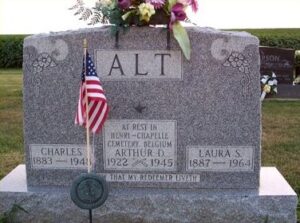
Cenotaph, St. Paul Lutheran Cemetery, Liberty Township.

Casket–A rectangular, decorative container for holding a body at the time of burial, usually constructed of wood or metal.

Coffin–A tapered, six-sided container for holding a body at the time of burial, usually constructed of wood. The words coffin and casket are often used interchangeably.

Vault–A sealed and lined container placed around a casket to prevent the grave from sinking and to protect the casket.

Interment–Burial in the ground, entombment in a mausoleum, or the scattering of cremains.

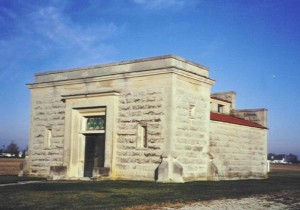
Mausoleum–An above-ground structure to house multiple deceased individuals within crypts. It may be indoor or outdoor, public, or private, for a specific family. It may contain sections for cremated remains.

Chattanooga Mausoleum, Chattanooga, Ohio

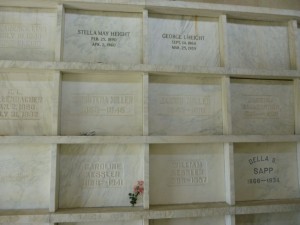
Crypt–A sealed enclosure for a casket, usually within a mausoleum.

Crypts  inside Chattanooga Mausoleum.

Sarcophagus–An above ground chamber for a casket entombment, usually made of granite or stone.

Sepulcher–A burial vault, crypt, or small room where human remains are laid to rest.

Entombment–Burial of a casketed body or cremated remains, within a crypt or niche, within a mausoleum, sarcophagus, or columbarium.

Cremains–Cremated remains.

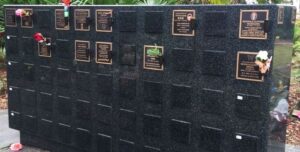
Columbarium–A structure designed to hold cremated remains. It may be inside or outside, freestanding or part of a larger structure, sometimes housed within a mausoleum.

Columbarium

Niche–A space in a columbarium, mausoleum, or niche wall to hold an urn containing cremains.

Cremation Plot-An in-ground space that holds and urn with an individual’s cremains.  

Inurnment–Placement of cremains in an urn, followed by placement into a niche.

Scattering Garden/Cremation Garden–An area within a cemetery where cremains are scattered or buried.

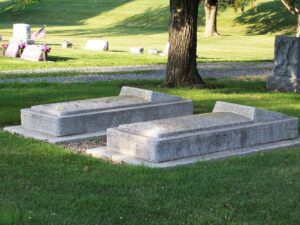
Ledger Grave Marker–A decorative stone slab that covers the entire grave.

North Grove Cemetery, Celina

Epitaph–Text or a literary piece inscribed on a grave marker or memorial. Biographical information is not part of an epitaph.