Late Jacob Rueck Not Revolutionist.
That 1918 Portland, Oregon, newspaper headline caught my attention as I was searching on GenealogyBank.com. Could the article be referring to my great-great-grandfather Jacob Rueck? He lived near Portland, Oregon. What in the world was this article from the Oregonian about?
Jacob Rueck had died 23 January 1918, about two weeks before the headline and article was printed. Jacob was a German immigrant, born 24 December 1828 in Appensee, Württemberg. He married Maria Regina Gross in 1855 and they and their children immigrated to America in 1880. The Ruecks lived east of Willshire for about four years until Jacob sold his 120 acre farm there and moved to Oregon in 1884.
All moved to Oregon except Jacob’s daughter Christina, her daughter Maggie, and his son Fred. Fred changed the spelling of his name to Ruck and settled in Oklahoma while Christine and Maggie stayed here in Ohio. Christina had married Jacob Miller in 1882 and they were my great-grandparents.
This is 1918 article that got my attention:
Late Jacob Rueck Not Revolutionist.
AURORA, Or., Feb. 6—(To the Editor)—From the news notices of the death of the late Jacob Rueck, of Macksburg, many have gained the impression that he was an exile from Germany, following the revolution of 1848 in that country. Mr. Rueck’s family wish to make it clear that he had no part in the German revolution and that he did not leave that country until several years later, in 1880.
His Success and prominence in Clackamas County for 34 years are evidence of his integrity and good citizenship. [1]
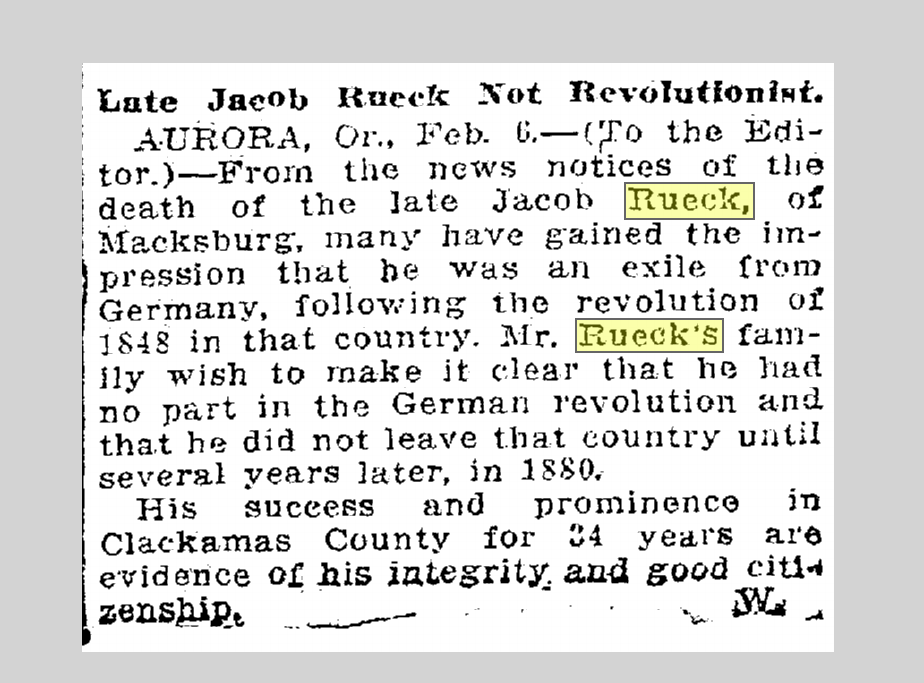
“Oregonian,” Portland, Oregon, 7 February 1918.
The Rueck family took great pains to set the record straight. There was obviously something in Jacob’s obituary that precipitated some unfavorable ideas and/or comments about Jacob’s past and questioned his American patriotism. But what was it?
Unfortunately I could not locate Jacob’s obituary in the Oregonian, but I did find his obituary in The Oregon Daily Journal:
Jacob Rueck Passes At Aurora, Aged 89
Aurora, Or., Jan. 31—Jack Rueck died Monday at his Clackamas county home near Macksburg, aged 89. He came to Oregon in 1884 and lived on the same farm at Macksburg until his death. He was born in Germany in 1828. He is survived by five sons, Carl Rueck of cob R. Rueck and George Rueck of Macksburg and David R. Rueck of San Jose, Cal., and Fred Rueck of Oklahoma. He also leaves three daughters, Mrs. Regina Rueck and Mrs. Katie Harms of Macksburg and Mrs. Christian Muller of Chattanooga, Ohio. [2]
That was a pretty basic obituary that did not indicate why some people thought Jacob was a German exile. And what was the 1848 German Revolution? I did some research.
The Revolution of 1848, aka the March Revolution, was caused by mass unemployment, poverty, and famine after years of poor crops. Educated persons, businessmen, students, and professors wanted a unified government and were considered liberals. They wanted to abolish feudal restrictions and have greater religious tolerance, governmental responsibility, and freedom of expression. The middle-class was committed to these liberal principles and as a result a series of rebellions broke out in the Germanic states. Prussia, Austria, and the conservative aristocracy quickly suppressed the revolution and liberals were forced into exile to escape political persecution. They became known as Forty-Eighters. Many of these exiles immigrated to the United States. [3] [4] [5]
Apparently some persons in the Portland area thought Jacob Rueck was one of these exiles.
The time period was also likely a factor. It was 1918. World War I was raging when Jacob Rueck died. There was hostility toward German-Americans and anything German. Anti-German hysteria caused the persecution of German-Americans. Some of this hostility was evidently directed at the Rueck family.
It was undoubtedly a difficult time for the Rueck family. They mourned the death of Jacob while trying to maintain that he was a patriotic American.
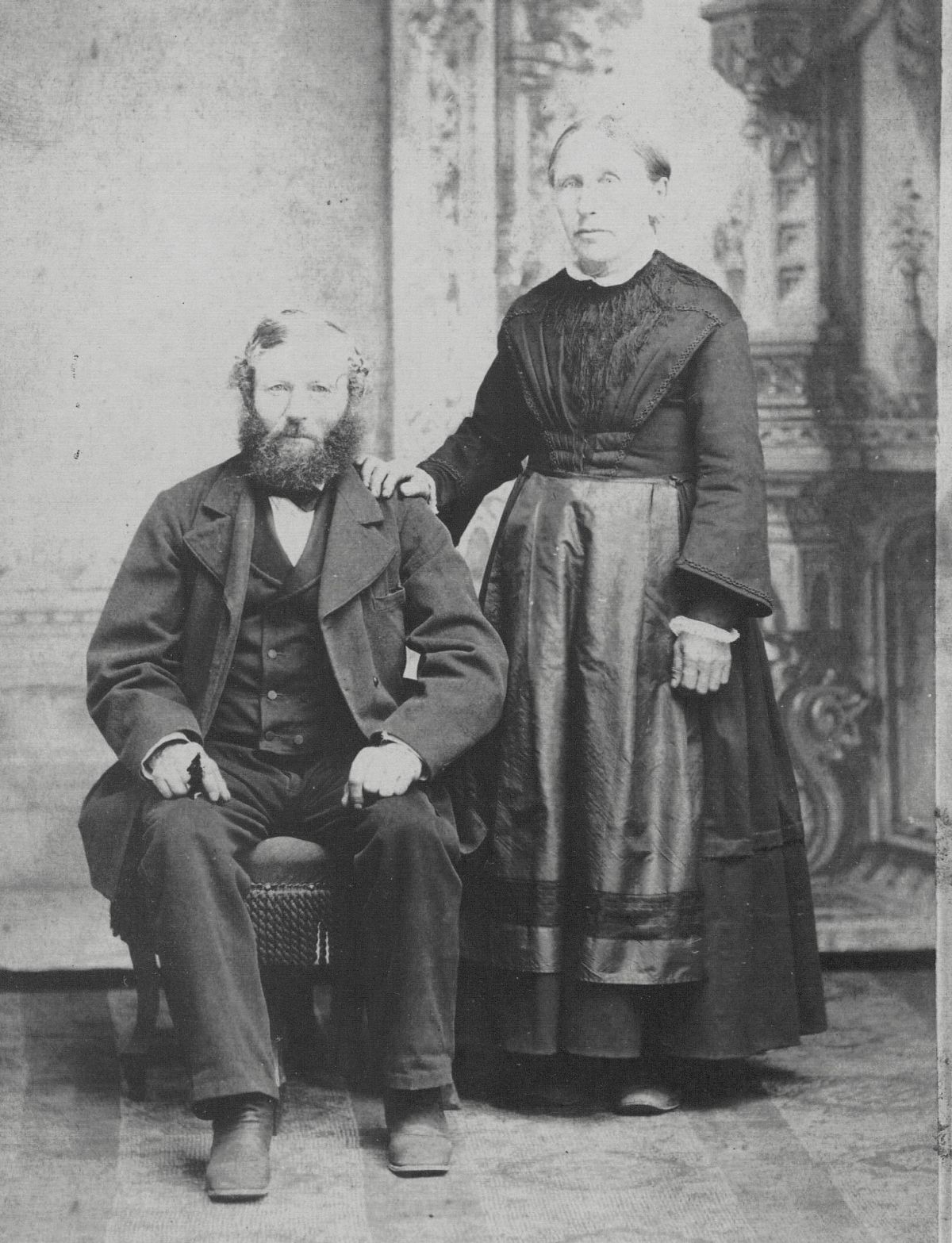
Jacob & Regina (Gross) Rueck
From a research standpoint there is some good information in the short article. Some information I knew, other information it confirmed: Jacob immigrated in 1880. [I have not found this family on a passenger list, but I figured they immigrated in about 1880.] Jacob lived in Clackamas County for 34 years. [He sold his Van Wert County farm in 1884, 34 years earlier.] He lived in Macksburg and likely died there shortly before 6 February 1918. [I know his death date and Census enumerations indicate that he lived in Clackamas, Oregon.] He had family living in the area. Good information.
And now we know that Jacob Rueck was not a Revolutionist.
[1] Oregonian, Portland, Oregon, Thursday, 7 February 1918, p.10, digital image by subscription, GenealogyBank.com (www.genealogybank.com : accessed 4 February 2015).
[2] The Oregon Daily Journal, Portland, Oregon, Thursday 31 January 1918, p.15, digital image by subscription, Newspapers.com (www.newspapers.com : accessed 4 February 2015).
[3] George K. Schweitzer, German Genealogical Research, (No place : Genealogical Sources Unltd, 1995), 27.
[4] Wendy K. Uncapher, Lands of the German Empire and Before, (Janesville, WI : Origins, 2000), 88.
[5] “Revolutions of 1848 in the German States,” Wikipedia.org (en.wikipedia.org : accessed 4 February 2015).