Excavating C.L. Schumm Pond

Problem: a low-lying, wet, unfarmable area on a farm.

Solution: a pond.

A reasonable solution, especially when your son-in-law has earth-moving equipment.

Back in the 1960s my Grandpa Cornelius Schumm (1896-1986) had a low area on his farm, located a little northeast of his barn.

His son-in-law Alvin Krueckeberg had the excavation equipment and turned that low area into a nice farm pond.

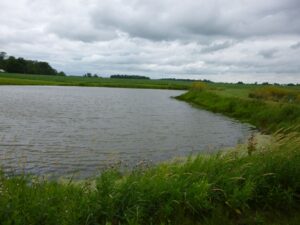
Cornelius Schumm farm pond, 2017.

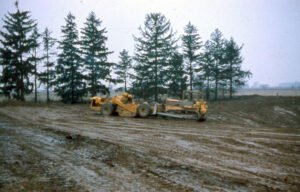
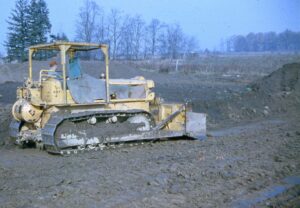
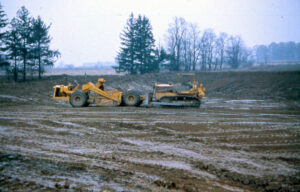
Here are couple photos of the Cornelius Schumm excavation. Although I do not have an exact year, I believe the Schumm farm was created in the early 1960s. 

Excavating Cornelius Schumm farm pond, early 1960s.

Excavating Cornelius Schumm farm pond, early 1960s.

Excavating Cornelius Schumm farm pond, early 1960s.

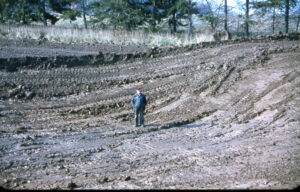
My Grandpa Schumm standing in his newly excavated pond.

Cornelius Schumm standing in his pond excavation, early 1960s.

Alvin Krueckeberg (1928-2019) excavated other ponds in the area. One of them was for Ned Alspaugh in 1974, across from Zion Lutheran Church at Schumm, which I wrote about a couple weeks ago.

Tombstone Tuesday-John Martin Schumm

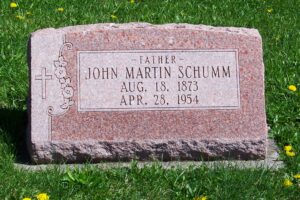
John Martin Schumm, Zion Lutheran Cemetery, Van Wert County, Ohio. (2012 photo by Karen)

This is the tombstone of John Martin Schumm, located in row 4 of Zion Lutheran Cemetery, Schumm, Van Wert County, Ohio. The marker is inscribed:

Father
JOHN MARTIN SCHUMM
Aug. 18, 1873
Apr. 28, 1954

John Martin Schumm was born near Willshire on 18 August 1873, the first of ten children born to “River Henry” and Anna Rosine (Schinnerer) Schumm. He was baptized 24 August 1873 with Johann Schumm and Martin Schinnerer serving as his sponsors.

The Henry Schumm family in 1880: Henry, 35; Rosina, 26; John, 6; Clara, 4; William, 3; Hannah, 2; and Edward, 4 months. The father Henry Schumm was a farmer. [1]

John Martin’s mother Rosina (Schinnerer) Schumm died in 1890 and his father married Magdalena “Lena” Geisler in 1891. The Henry Schumm family in 1900: Henry, 55; Lena, 32; John, 26; Mina, 23; Hannah, 22; Gustav, 18; William, 16; Tillie, 14; Joseph, 12; Louis, 8; Herman, 6; and Theodore, 2. John Martin Schumm worked on the family farm. [2]  

By 1910 John Martin Schumm, 36, and his younger brother Joseph, 22, had left the family farm and were boarders at Willshire’s Straubinger Hotel. John Martin was a contractor and Joseph was a carpenter. [3]  

John Martin Schumm married Hester “Elizabeth” (Boroff) Smith at the parsonage of Zion Lutheran Church, Schumm, on 9 February 1911. Widow Elizabeth Smith was from Ohio City and her husband Edwin Augustus Smith died in 1909.

In 1920 the John Martin Schumm family lived on Hogan Street in Willshire, where John Martin worked as a house carpenter. The John Martin Schumm family in 1920: John Schumm, 46; Elizabeth Schumm, 34; Dolores Schumm, 2; and Leone I Smith, 12, daughter from Elizabeth’s first marriage. [4]

The John Martin Schumm family in 1930: John Schumm, 55, head; Elizabeth Schumm, 43, wife; Leone Smith, 23, stepdaughter; Dolores Schumm, 12, daughter; and Donald Schumm, 7, son. John Martin Schumm worked at a grain elevator in 1930. [5]

The John Martin Schumm family in 1940: John, 66; Elizabeth, 55; and Donald, 17. [6] No occupation is given here for John but at some point, according to his obituary, he was a marshal and constable in Willshire.

John Martin Schumm died at his home in Willshire on 28 April 1954.

John Martin Schumm
Willshire-Rites were to be held this afternoon for John Martin Schumm, 80, Willshire marshal, who died Wednesday at his home following a cerebral hemorrhage Burial was to be made in the Zion Evangelical Lutheran Church Cemetery in Willshire Township with the Cowan Funeral Home in charge.

Mr. Schumm, who was born Aug. 18, 1873, in Willshire Township, served as marshal and constable for 20 years.

Surviving are his widow, Elizabeth; two children; a stepdaughter; two sisters; two brothers; three half-brothers, and nine grandchildren.

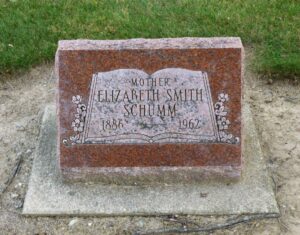
John Martin’s widow Elizabeth died 31 March 1962 and is buried in Tomlinson Cemetery, Mercer County, Ohio.

John Martin and Elizabeth (Boroff) Schumm had two children:
Dolores Louise Schumm (1917-1976), married Doyle C. Shady
Donald Wayne Schumm (1922-2009), married Barbara Baker

[1] 1880 U.S. Census, Willshire, Van Wert, Ohio, ED 154, p.443A, family 4, Henry Schumm; digital image, Ancestry.com (https://www.ancestry.com/search/collections/6742/ : viewed 1 Nov 2021).

[2] 1900 U.S. Census, Willshire, Van Wert, Ohio, ED 97, p.8, dwelling 170, family 183, Henry Schumm; digital image, Ancestry.com (https://www.ancestry.com/search/collections/7602/ : viewed 1 Nov 2021).  

[3] 1910 U.S. Census, Willshire, Van Wert, Ohio, ED 114, p.14A, dwelling & family 120, Adam Stranbinger; digital image, Ancestry.com (https://www.ancestry.com/search/collections/7884/ : viewed 1 Nov 2021).  

[4] 1920 U.S. Census, Willshire, Van Wert, Ohio, ED 146, p.7A, dwelling & family 2, John M Schumm; digital image, Ancestry.com (https://www.ancestry.com/search/collections/6061/ : viewed 1 Nov 2021).

[5] 1930 U.S. Census, Willshire, Van Wert, Ohio, ED 22, p.1A, dwelling & family 14, John Schumm; digital image, Ancestry.com (https://www.ancestry.com/search/collections/6224/ : viewed 1 Nov 2021).  

[6] 1940 U.S. Census, Willshire, Van Wert, Ohio, ED 81-26, p.2A, house 34, John Schman; digital image, Ancestry.com (https://www.ancestry.com/search/collections/2442/ : viewed 1 Nov 2021).

[7] John Martin Schumm obituary, The Lima News, Lima, Ohio, 30 Apr 1954, p.2; digital image, Ancestry.com, viewed 1 Nov 2021)

More Halloween Hauntings

Halloween is just a few days away.

A few years ago I wrote a blog post, Haunted Mercer County, which turned out to be a fairly popular post. People still write me about it. We had fun researching that post, visiting those local haunts, trying to verify the supernatural stories or debunk them.

I was looking though Haunted Ohio IV, one book in the series by Chris Woodyard, looking for information about other haunted places in our area.

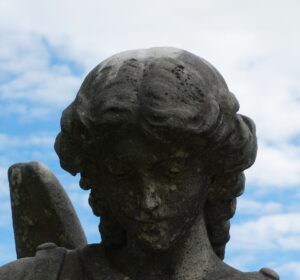
The book mentions the Curse of Saint Michael, a curse connected to a white marble statue of the Archangel Michael, located in the Catholic cemetery in St. Marys. The Curse of Saint Michael will kill those who look into his eyes. A girl was reportedly paralyzed by just looking into its eyes.

Assuming this legend refers to the town of St. Marys in neighboring Auglaize County, Gethsemane Cemetery is the Catholic cemetery there.

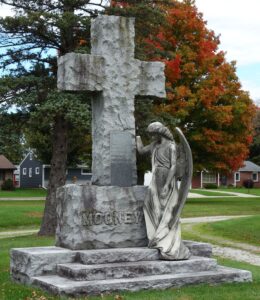
We visited Gethsemane Catholic Cemetery to take a look and found a life-sized statue of an angel near the west entrance, the Mooney family plot. Although weathered and gray, it looks as though the angel was once a white statue.

Mooney memorial, Gethsamane Catholic Cemetery, St. Marys, Ohio. (2021 photo by Karen)

The Archangel Michael is a defender in battle and usually holds a sword. This statue may have held a sword in its right hand at one time, but unfortunately, his right hand is missing.

I stared into the face of the statue through my camera lens and walked away unscathed.

Mooney monument, Gethsemane Catholic Cemetery, St. Marys, Ohio. (2021 photo by Karen)

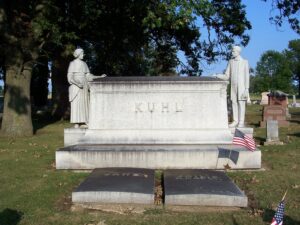
A haunting tale has been spread about a couple in another local cemetery in Van Wert County. The impressive monument of Philip and Jane Kuhl is located in Woodlawn Cemetery, on the edge of Ohio City. Life-sized statues of both Philip and Jane stand at each end of a sarcophagus. Philip and Jane each hold an item in their hands.  

Kuhl monument, Woodlawn Cemetery, Ohio City, Ohio. (2005 photo by Karen)

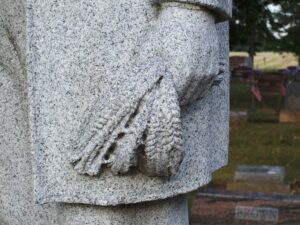
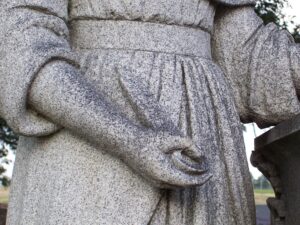
The legend tells that Philip used the rope he is holding to hang Jane. But before Jane died she used her sewing scissors to stab Philip in the heart. Supposedly they both died together, about the same time.

In actuality, they were a nice, happy, ordinary farm couple. When you look closely at the statues you will see that Philip is holding wheat stalks and Jane is holding her sheep-shearing scissors.

Philip Kuhl holding wheat stalks. (2005 photo by Karen)

Jane Kuhl holding sheep shears. (2005 photo by Karen)

Besides, the couple died years apart. Philip in 1908 and Jane in 1920.

Story debunked.     

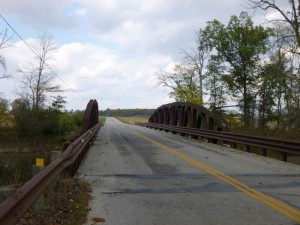
In my Halloween blog post a few years ago I talked about Mercer County’s Cry-Baby Bridge, located on Palmer Road near Mendon. Mercer’s Cry-Baby Bridge is one of several bridges with that same name in the state of Ohio. Bridges that share that name are located all over the state, the nearest being northwest of Bellefontaine, one in Preble County, and another in Darke County. A name like Cry-Baby Bridge conjures up all sorts of images and is probably a good name for a bridge with a notorious story.  

Cry-Baby Bridge, Palmer Road, Mendon, Ohio. (2013 photo by Karen)

Finally, below is a ghostly photo given to me by an acquaintance some years ago. The family was visiting a cemetery in Kentucky where some of their ancestors are laid to rest. They said the day of their visit was very hot, clear, and still. No wind was blowing, but as they approached the cemetery a slight gust of wind from out of nowhere blew into their faces and moved some leaves on the trees. They felt a chill. They felt a presence. Later, when looking at the photos they took that day, the family was shocked to see strange white puffs floating in the air near the cemetery. The thing is, they never saw any white puffs near the cemetery when they were there on that clear day.

Did they have a supernatural encounter with their ancestors?     

Houck Cemetery, Kentucky.

Happy Halloween!


Tombstone Tuesday-Halloween Edition

Halloween is less than a week away and there is no better time to highlight some tombstone art that conjures up Halloween images.

King’s Chapel Burying Ground, Boston (2009 photo by Karen)

You will not usually see tombstone symbols like these around here. Most of these tombstone photos were taken in Boston cemeteries and the markers date back to the 1600s. Many are carved in slate.

The skull and crossbones symbolize mortal remains. Individuals died and their bones were all that remained. The Puritans had a lot of influence during this time.  

Granary Burying Ground, Boston, (2009 photo by Karen)

As time went on the skull image was depicted with a pair of wings and is known as the winged death head. It symbolizes physical death and spiritual regeneration. The winged death head shows the soul fleeing mortality and winging its way to the afterlife. Note the hourglass above the skull, symbolizing the passing of time, the shortness of life, and that time has run out.

Winged Death Head, King’s Chapel Burying Ground, Boston (2009 photo by Karen)

This tombstone shows the Grim Reaper and the Death Angel snuffing out the flame of life. Note the angel figure is holding an hourglass.    

Grim Reaper & Death Angel, King’s Chapel Burying Ground, Boston (2009 photo by Karen)

The soul effigy symbol, or winged cherub, appeared in the late 1600s and features a softer face with human features. The soul effigy image represents the soul winging its way to heaven.

Soul Effigy, King’s Chapel Burying Ground, Boston (2009 photo by Karen)

Tombstone art continued to evolve and one of the earliest gravestone carvings in our area was the weeping willow tree, which became popular in the early 1800s.  


Digging a Pond, 1974

Across the road from Zion Lutheran Church in Schumm is a nice home and farm buildings, owned by Ned Alspaugh in the 1970s and beyond. West of the barn is a pond, dug in 1974.  

Farm ponds are popular. They are pretty. They are a source of recreation, sustain wildlife, birds and fish, as well as a source of water in case of a house or barn fire. We even have a pond in our back yard.

Bennett pond

It seems the farm pond boom took off in the 1960s and 1970s, likely in part because pond-digging equipment became more readily available. It became trendy to have a farm pond, particularly in areas that were low or swampy.

My uncle Alvin Krueckeberg had earth-moving equipment and he dug many farm ponds in the area, including my Grandpa Schumm’s pond, our pond, and Ned Alspaugh’s farm pond.

My mom and dad took these photos of Alvin Krueckeberg excavating and digging Ned Alspaugh’s pond in 1974. You can see Zion Lutheran Church and cemetery in the background, their parsonage, and other farm buildings across the road.

Alvin Krueckeberg digging Ned Alspaugh pond, 1974.

Alvin Krueckeberg digging Ned Alspaugh pond, 1974.

Alvin Krueckeberg digging Ned Alspaugh pond, 1974.

Below is a 2020 aerial Google Earth photo of the former Alspaugh farm and Zion Lutheran Church. From above, the finished pond looks totally different from the photos taken during its construction.

Zion Lutheran, Schumm, former Alspaugh farm and pond, Google Earth image, dated 6 March 2020.

My uncle Alvin Krueckeberg (1928-2019) excavated many farm ponds in our Ohio-Indiana area. And we certainly appreciate our pond, along with the birds, waterfowl, and wildlife.

Unfortunately, we did not take any photos when he dug our pond.