Happy New Year from Karen’s Chatt!
Wishing everyone a healthy, happy, and prosperous 2022!

Dec 31
Happy New Year from Karen’s Chatt!
Wishing everyone a healthy, happy, and prosperous 2022!
Dec 28
An anchor symbol on a tombstone signifies hope.
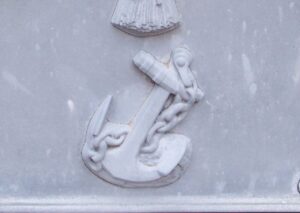
Anchor symbol, Greenlawn Cemetery, Wapakoneta, Ohio.
The anchor is an ancient symbol of hope and early Christians drew a cross, disguised as an anchor, to mark and guide their way to secret meeting places. Crosses and anchors are still used together in designs today.
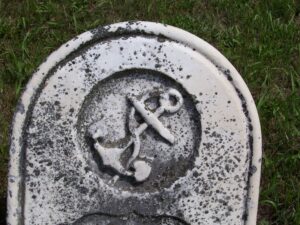
Anchor with cross incorporated in design.
An anchor is mentioned in the Bible, in Hebrews 6:19. This hope we have as an anchor of the soul, both sure and steadfast, and which enters the Presence behind the veil…
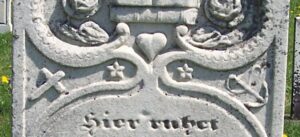
Anchor, among other symbols, Zion Lutheran Cemetery, Schumm, Ohio.
Hope is one of the seven Virtues and is usually depicted as a person leaning on an anchor. Sculpted forms of the seven Virtues are usually found in larger cemeteries, individually or grouped together. Faith, Hope, and Charity are the three theological virtues.
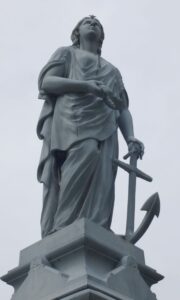
Virtue of Hope, with anchor, St. Joseph Cemetery, Wapakoneta, Ohio.
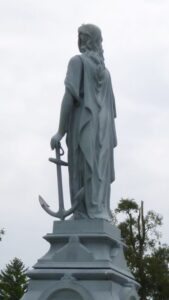
Virtue of Hope, with anchor, St. Joseph Cemetery, Wapakoneta, Ohio.
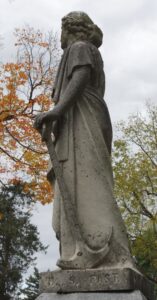
Virtue of Hope, with anchor, Elm Grove Cemetery, St. Marys, Ohio.
An anchor is sometimes used as a seafaring symbol on the grave marker of a sailor, but the Christian usage of this symbol is more prevalent.
Dec 24
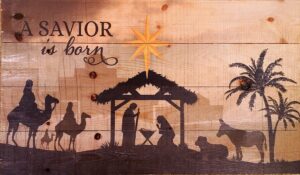
For to us a child is born, to us a son is given, and the government will be on his shoulders and he will be called Wonderful Counselor, Mighty God, Everlasting Father, Prince of Peace. Isaiah 9:6
Merry Christmas from Karen’s Chatt!
Wishing you and your family all the blessings of Christmas!
Dec 21
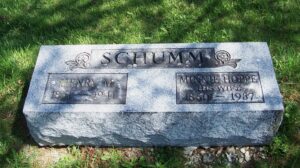
Henry M. & Minnie (Hoppe) Schumm, Zion Lutheran Cemetery, Van Wert County, Ohio. (2012 photo by Karen)
This is the tombstone of Henry M. and Henrietta “Wilhelmina/Minnie” (Hoppe) Schumm, located in row 4 of Zion Lutheran Cemetery, Schumm, Van Wert County, Ohio. The marker is inscribed:
SCHUMM
Henry M.
1861-1941
Minnie Hoppe
His Wife
1860-1937
George Martin Heinrich “Henry M.” Schumm was born, 18 June 1861, the son of Friedrich (1814-1902) and Magdalena (Meyer) (1819-897) Schumm. Henry M. was baptized at Zion Lutheran Schumm on 24 June 1861, with George Schumm Jr, Martin Schinnerer, and Henry Schumm serving as his sponsors.
Henry M. Schumm was enumerated in 1870 with his family: Friedrich Schumm, 56; Magdalena, 50; William, 30; Friedrich, 25; Mary, 19; George, 14; Barbara, 12; Henry, 9; Lewis, 16; and Ferdinand, 6. The father Friedrich was a farmer. [1]
By 1880 most of Henry M.’s siblings had left home. The Friedrich Schumm family in 1880: Friedrich, 66; Magdalena, 59; Barbara, 21; Henry M, 18; and Ferdinand, 16. [2]
Henry M. Schumm was appointed Schumm’s Postmaster on 14 August 1886. He may have been appointed in 1885 but that name is recorded simply as Henry Schumm and there were several Henry Schumms in the area.
Henry M. Schumm married Minnie Hoppe on 5 May 1887 in Fulton County, Indiana, married by Rev. H. Diemer, Ev. Lutheran minister. [3]
Henrietta “Wilhelmina/Minnie” Hoppe was born in Rochester, Fulton County, Indiana, on 26 April 1860, the daughter of John F. (1835-1864) and Abalonia (Guenther) (1837-1923) Hoppe.
The John F. Hoppe family in 1860: John, 25, [born] Hannover; Abby [Abalonia], 22, Bavaria; Minnie, 3 months, Indiana; Frederick Runker, 33, Hanover; and Frederick Froman, 23, Hanover. The father John Hoppe was a grocer in Rochester, Indiana, and Runker and Froman were clerks, likely in John’s store. [4]
John and Abalonia Hoppe had two other children, born in 1862 and 1863, and both died in infancy. Minnie’s father John F. Hoppe died in Rochester, Indiana, 11 August 1864. Minnie’s widowed mother Abalonia (Guenther) married Henry F. Freese 15 July 1870 in Cass County, Indiana.
The Henry Freese family in 1870, living in Logansport, Indiana: Henry Freese, 34, Hanover; Abbie Freese, 32, Bavaria; and Mena Hoppe, 10, Indiana. Henry Freese’s occupation was car inspector. Possibly a railroad car inspector? [5]
The Henry Freese family in 1880, living in Rochester, Indiana: Henry, 44; Abby, 43; and Minnie, 20, stepdaughter. Henry’s occupation was farmer. [6]
Rochester, Indiana, is nearly 100 miles from Schumm, Ohio, but somehow Henry M. Schumm met Minnie Hoppe and they married in Fulton County, Indiana, in 1887. Minnie had some association with Schumm at least two years before their marriage because Minnie was a baptismal sponsor at Zion Lutheran Schumm in 1885. Henry M. and Minnie resided in the Schumm area by 1888, where their first child Agnes was born. Minnie’s parents Henry and Abby/Abalonia Freese moved to the Schumm area some time before 1900. Both Henry and Abby/Abalonia were living with the Henry M. Schumm family in 1900 and both Freeses are buried in Zion Schumm’s cemetery.
The Henry M. Schumm family in 1900: Henry M, 39; Wilhelmina H, 40; Agnes, 12; Alma, 10 Emanuel, 9; Emil, 6; Edna, 4; Clara, 3; Alfred, 2 months; Henry Freese, 63, father-in-law; Abalonia, 61, mother-in-law. [7]
Minnie’s stepfather Henry Freese died in 1902.
Henry M. Schumm entered into a homestead contract in Cheyenne County, Colorado, about 1907 and was not enumerated with his family in Willshire Township in 1910. He seems to be MIA in the 1910 census, but I suspect he was living on his 160 acres in Colorado and was not enumerated there.
Meanwhile, Minnie Schumm was enumerated with her 8 children in Van Wert County in 1910. However, this enumeration raises questions about the children, as Edna’s name is repeated and it appears Agnes was also enumerated in Indiana. Minnie Schumm and children in 1910: Minnie, 50, married, 8 children, all living; Edna [probably Agnes?], 22; [Alma Abalonia?], 20, daughter; Emanuel, 18; Emil, 17; Edna, 15; Clara, 12; Alfred, 10; and Oswald, 8. Abbie Freese, 72, widow, living next door, [Minnie’s mother]. [8]
Several Colorado newspaper items give information about Henry M. Schumm’s time in Colorado. I wrote about this a couple weeks ago. Then we come to the 1920 census, where some family members were enumerated twice.
The Minnie/Wilhelmina Schumm household in Willshire Township, enumerated 7 January 1920: Wilhelmina H Schumm, 59, IN, head; Agnes, 31, OH, daughter; Alma, 30, OH, daughter; Emanuel, 28, OH, son; Clara, 21, OH, daughter; Alfred, 19, OH, son; Oswald, 17, OH, son; and Abalonia Freese, 83, Germany, widow. [9]
The Henry M. Schumm household in Cheyenne Wells, Cheyenne, Colorado, enumerated a little over a month later, on 12-13 February 1920: Henry M Schumm, 58, OH, head; Wilhelmina H, 59, IN, wife; Clara Schumm, 20, OH, daughter; Alfred Schumm, 18, OH, son; Oswald Schumm, 16, OH, son. Henry was a farmer and owned house with a mortgage. [10] Wilhelmina, Clara, Alfred, and Oswald evidently traveled to Colorado after the Willshire census was taken on 7 January and were enumerated there, too.
By 1930 Henry M. Schumm (68) and his wife Wilhelmina (69) were back in Van Wert County, the two of them living in Willshire Township. [11]
Henry M. Schumm’s wife Minnie (Hoppe) died from a cerebral hemorrhage at Schumm on 19 November 1937, at the age of 77 years, 6 months, and 23 days. She was buried on the 22nd. Her obituary:
Mrs. H.M. Schumm
Van Wert, Nov. 20—Mrs. H.M. Schumm, 77, died yesterday following a paralytic stroke at her home in Willshire-tp. The deceased was born April 26, 1860 at Rochester, Ind., and was a daughter of the late Mr. and Mrs. John Hoppe. She had been a resident of the county since her marriage May 5, 1887.
Surviving are three daughters, Alma at home, Eda Schumm of Mechanicsburg, and Clara of Troy, O; and four sons, Emmauel [sic], Alfred and Oswald Schumm at home, and Emil Schumm of Colorado Springs, Col.
Funeral services will be held Monday at 2:30 p.m. at the Schumm Lutheran church. Rev. Alfred Moeller, pastor officiating. Burial will be in the church cemetery. [12]
In 1940 widower Henry M. Schumm lived with his children Alma and Oswald near Schumm. [13]
Henry M. Schumm died from renal problems at Schumm on 1 February 1941 at the age of 79 years, 7 months, and 13 days. He was buried on the 3 February, with Rev. A. Moeller officiating. Henry M. Schumm’s obituary:
Henry M. Schumm
Ohio City, Feb. 1—Henry M. Schumm, 79, died Saturday at his home in Schumm, Willshire, tp, following a prolonged illness. He was born and lived all his lifetime in the Schumm community.
Surviving are seven children, Alma, Emanuel and Oswald at home, Edna of Mechanicsburg, Rev. Alfred Schumm of Rhodes, Mich., Clara M. of Troy, and Emil Schumm of Colorado Springs, Colo.
Funeral services will be held Sunday at 1:30 p.m. at the residence and 2 p.m. at the Zion Lutheran church at Schumm. Interment will be in the church cemetery. [14]
Interesting that both obituaries indicate that Henry M. and Minnie lived their whole married life in the Schumm area, but census records, newspaper clippings, and land records tell a little different story.
Henry M. and Wilhelmine/Minnie (Hoppe) Schumm had the following children:
“Agnes” Wilhelmine Barbara Schumm (1888-1921)
Alma Abalonia Schumm (1889-1972)
“Emanuel” Henry John Schumm (1892-1973), married Edna Scaer
“Emil” Fredrick Schumm (1893-1960), married Louise Stock
Edna Alwine Magdalena Schumm (1895-1990)
Clara Anna Maria Schumm (1898-1984)
Alfred Oswald Ferdinand Schumm, Rev. (1900-1981), married Irma S. Wambsganss
Oswald Hugo Otto Schumm (1902-1987)
[1] 1870 U.S. Census, Willshire, Van Wert, Ohio, p.438B, dwelling 130, family 131, Fred Schumm; digital image, Ancestry.com, viewed 18 Dec 2021.
[2] 1880 U.S. Census, Willshire, Van Wert, Ohio, ED 154, p.450C, family 129, Frede Schumm; digital image, Ancestry.com, viewed 18 Dec 2021.
[3] “Indiana Marriages, 1811-2019,” Fulton County Marriages, Book E, p.129, Henry M Schumm & Henrietta Minnie Hoppe, 5 May 1887; FamilySearch.org (https://www.familysearch.org/ark:/61903/3:1:939Z-BJH6-B?i=63&cc=1410397&personaUrl=%2Fark%3A%2F61903%2F1%3A1%3AVW5X-52N : viewed 18 Dec 2021).
[4] 1860 U.S. Census, Rochester, Fulton, Indiana p.669, dwelling 1074, family 1076, John F Hoppee; digital image, Ancestry.com, viewed 18 Dec 2021.
[5] 1870 U.S. Census, Logansport, Cass, Indiana, p.190B, dwelling 628, family 618, Henry Freese; digital image, Ancestry.com, viewed 18 Dec 2021.
[6] 1880 U.S. Census, Rochester, Fulton, Indiana, ED 41, p.63D, dwelling, family, Henry Freese; digital image, Ancestry.com, viewed 18 Dec. 2021.
[7] 1900 U. S. Census, Willshire, Van Wert, Ohio, ED 97, dwelling 182, family 195, p.9, Henry M Schumm; Ancestry.com, viewed 6 Dec 2021.
[8] 1910 U.S. Census, Willshire, Van Wert, Ohio, ED 114, p.2B, dwelling & family 37, Minnie Schumm; digital image, Ancestry.com, viewed 18 Dec 2021. [Abbie Freese, dwelling & family 38.]
[9] 1920 U.S. Census, Willshire, Van Wert, Ohio, ED 146, p.3A, dwelling & family 48, Wilhelmina H Schumm; Ancestry.com, viewed 6 Dec 2021.
[10] 1920 U.S. Census, Cheyenne Wells, Cheyenne, Colorado, ED 56, p.7B, dwelling 84, house 89, Henry M Schumm; Ancestry.com, viewed 6 Dec 2021.
[11] 1930 U.S. Census, Willshire, Van Wert, Ohio, ED 24, p.5B, dwelling 105, family 108, Henry M. Schumm; Ancestry.com, viewed 6 Dec 2021.
[12] Mrs. H.M. Schumm obituary, The Lima News, Lima, Ohio, 21 Nov 1937, p.2, Ancestry.com.
[13] 1940 U.S. Census, Willshire, Van Wert, Ohio, ED 81-28, p.5A, house visited 88, H M Schumm; Ancestry.com, viewed 6 Dec 2021.
[14] Henry M. Schumm obituary, The Lima News, Lima, Ohio, 2 Feb 1941, p.4, Ancestry.com.
Dec 17
Last week I wrote about Henry M. Schumm (1861-1941), who moved from the Willshire area to Cheyenne County, Colorado, in the early 1900s. Henry M. Schumm homesteaded 160 acres in that eastern Colorado county and lived there for about 15-20 years.
It appears that Henry M. spent more time in Colorado than his wife Wilhelmina and children did. Wilhelmina and some of their children were enumerated in Willshire Township in January 1920 and then a month later with Henry in Colorado. Henry and Wilhelmina moved back to Willshire Township sometime before 1930.
I was able to piece together a small timeline of Henry’s time in Colorado and wrote about that last week. But I still had questions. Why did Henry M. decide to leave Ohio and homestead in Colorado? I asked Henry’s granddaughter about this but she said her father did not talk about it much, only mentioning that Henry was gone some of the time.
In the meantime learned some general information about homesteading during that time period.
Approximately 75 percent of the settlers in northeastern Colorado filed homestead claims after 1900. The activity peaked in 1910. The new settlers on the eastern plains soon emphasized wheat and cattle grazing and sugar beets.
How did homesteading work? President Abraham Lincoln signed the Homestead Act in 1862, giving citizens up to 160 acres of public land, provided they lived on it, improved it, and paid a small registration fee. The process encouraged the settlement and development of American land by American citizens.
Colorado and other western states promoted settlement and agricultural opportunities through homesteading by advertising in newspapers around 1907-08, the same time Henry M. Schumm decided to homestead there. He may very well have read about western homesteading in a newspaper.
Homesteading would not have been easy, but the opportunity for free land, the challenges of the frontier, and health concerns could have been among the reasons Henry M. Schumm decided to homestead in Colorado. Homesteading is no longer used and Alaska was the last state to offer it.
Under the Homestead Act a person could claim 160 acres, file on it, and if he built a home, lived there, and cultivated the land for five years, he could “prove up” his claim and obtain a government patent to it. It would have been a real challenge and a lot of hard work. The homesteader started from scratch, with nothing but his land. The land did not come with a house and homesteaders often lived in tents until they could build a home or some sort of a structure. This may have been the reason Henry M. Schumm’s family traveled to and from Colorado frequently. There were probably more creature comforts back in Willshire Township.
Railroad travel opened to Colorado in the 1870s and contributed to the settlement of eastern Colorado. I wonder if the Schumms traveled to and from Colorado by rail? I cannot imagine driving back and forth by car. It is also interesting to note that Henry’s son Emil Schumm worked for the railroad in Colorado.
On 23 February 1907 Henry M. Schumm entered a Homestead contract in Cheyenne County, with five years to establish claim of his land. Eight years later, in 1915, Henry M. Schumm was issued a Serial Land patent in Cheyenne County, Colorado, serial no. COH0004271, signed by President Woodrow Wilson.
A portion of Henry’s land patent: …a Certificate of the Register of the Land Office at Hugo, Colorado, has been deposited in the General Land Office…pursuant to the Act of Congress of May 20, 1862, “To Secure Homesteads to Actual Settlers on the Public Domain,” and the acts supplemental thereto, the claim of Henry M. Schumm has been established and duly consummated, in conformity to law, for the northwest quarter of Section eight in Township fifteen south of Range forty-three west of the Sixth Principal Meridian, Colorado, containing one hundred sixty acres…Patent Number 489568, 9 September 1915. [1]
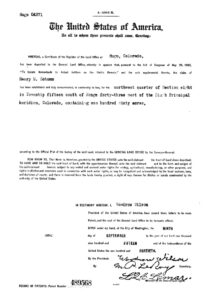
Henry M. Schumm 1915 Colorado land patent.
Below is an old photo from this family. Although the photo is unidentified, I suspect it is a photo of Henry M. Schumm, his wife Wilhelmina, and a some of their children. Their son Emanuel Schumm (1892-1973) is standing on the right. It looks like they could have been in Colorado. It sure doesn’t look like Van Wert County.
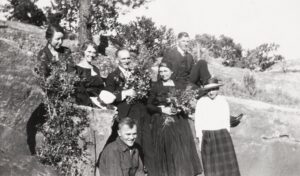
Emanuel Schumm, far right, possibly with his parents and siblings.
I have other photos of Emanuel that appear were taken out west. Was he visiting family in Colorado or just traveling? His brother Emil Schumm also lived in Colorado for the remainder of his life. He could have been visiting him.
I still have not found Henry M. Schumm in the 1910 census. He was not enumerated in Willshire Township with the rest of his family. He was likely living on his 160 acres in Colorado at the time, homesteading, perhaps living in a tent or makeshift cabin. Perhaps the census taker missed him. Perhaps he was not enumerated at all in 1910.
I will keep looking…
[1] “Henry M. Schumm Homesteading, Mining, Ranching, Logging,” Cheyenne Wells, Colorado, Homestead Patent, Serial No.COH0004271, 1915; TheLandPatents.com, https://thelandpatents.com/owners/483990 , viewed 15 Dec 2021.
 |
 |
 |