Memorial Day 2024

Monday we celebrate Memorial Day, the day we honor the men and women who died while serving in the U.S. military.
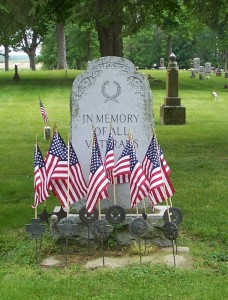
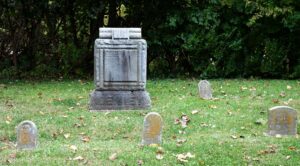
Elm Grove Cemetery, St. Marys, Ohio (2013 photo by Karen)

Originally called Decoration Day, this federal holiday dates back to just after the Civil War, as a way to remember and honor both Union and Confederate soldiers who were killed in battle during that war. In 1868, 30 May was officially proclaimed as the day to decorate Civil War graves. After WWI Memorial Day was extended to honor Americans who died in all wars. Today, many Americans use this holiday as a time to decorate any grave site, whether the deceased served in the military or not.

Memorial Day was declared a U.S. federal holiday in 1971 and is now observed the last Monday in May. In December 2000 the National Moment of Remembrance resolution was passed, which asks all Americans to pause at 3:00 p.m. local time and reflect on the meaning of Memorial Day.

The entire month of May is Military Appreciation Month, officially designated by Congress in 1999 to remind Americans to celebrate this patriotic month that pays tribute to those who have made sacrifices for our freedom.

Although the entire month of May is designated to honor military members and their families, past and present, several specific military holidays occur throughout the month of May. In 2024 these military holiday dates are Loyalty Day (1 May), VE Day (8 May), Military Spouse Appreciation Day (10 May/Friday before Mother’s Day), Children of Fallen Patriots Day (13 May), Armed Forces Day (18 May), Maritime Day (22 May), and Memorial Day (27 May). 

Most towns in our area will have a Memorial Day ceremony at local cemetery, conducted by the local American Legion and/or VFW, who also mark all veterans’ graves with an American flag. A big Thank You to all those volunteers. Many towns will also have a Memorial Day parade.

Proper flag etiquette on Memorial Day: The American flag should be flown at half-staff until noon and then raised to full-staff. During a parade there may be several participants with a flag and it is appropriate to salute only the first flag as it passes by. As the first flag passes everyone should show respect by standing at attention with their right hand over their heart. Those in uniform should give their appropriate formal salute.

In addition to honoring the fallen military members, Memorial Day traditionally marks the beginning of summer.

Wishing everyone a nice Memorial Day as we honor and remember those who sacrificed their lives for our country and for our freedom.

Thanksgiving is a day when we pause to give thanks for the things we have.
Memorial Day is a day when we pause to give thanks to the people who fought for the things we have.

Tombstone Tuesday–Footstones

We are all familiar with tombstones, the permanent memorials that mark the final resting places of our loved ones. Sometimes called headstones, these grave markers have been used to mark burial sites as far back as 3000 B.C. and are positioned at the head of the grave. These markers can be upright or flush with the ground and often provide a vast amount of information about the deceased.

What we don’t see as often in cemeteries in this part of the country are footstones. Footstones are set at the foot of a grave and are less about identity and more about boundary. They were used more frequently a few decades ago.

Set at the opposite end from the headstone, footstones serve to mark the boundary of the burial plot. Like headstones, footstones may be upright or flush with the grass.

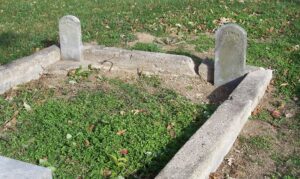
Headstone and footstone at burial site. Pingry Cemetery

Footstones are usually less ornate and are smaller than the headstone. Most are about 1-2 feet wide. They may be engraved with text or images. Since a headstone includes most of the standard information about the person (name, birth date and death date, a quote and some funerary art), the smaller footstone usually features only the person’s initials. They are smaller and less ornate so they do not distract from the headstone.

Footstone, Pingry Cemetery

The headstone marks the upper boundary of the grave site and the footstone marks the lower boundary, helping visitors to avoid walking across the grave, which is sometimes deemed disrespectful or bad luck. In addition, footstones clearly distinguish one gravesite from another for cemetery workers.

Sometimes there is no headstone and a footstone is the only grave marker. In that case the footstone still sits at the foot-end of the grave, but the footstone might be slightly larger so that it can incorporate some of the information that is usually on the headstone. Solitary footstones for individual graves are a more common in modern cemeteries, where site owners are trying to conserve space.

Some cemeteries have family burial plots, consisting of a large upright headstone with the family name, and smaller stones with individual names surrounding the large family stone. These small stones are also considered footstones. Each member of the family has their own footstone near the family headstone.

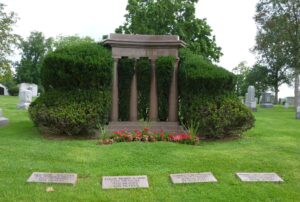
Family burial plot with footstones around the central headstone. Elm Grove Cemetery, St. Marys, Ohio

Family burial plot, with footstones around central marker.

Family burial plot, with footstones near central marker.

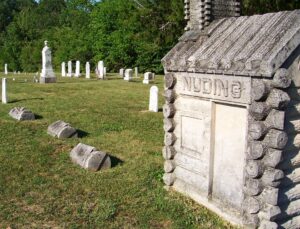
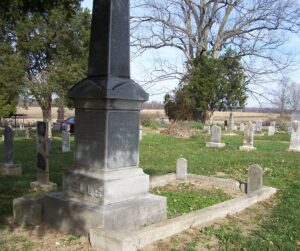
Family burial plot with footstones Mother and Father. Liber Cemetery.

Closer look of family burial plot with footstones Mother and Father. Liber Cemetery.

Some cemeteries limit the number of upright headstones and require that footstones be used instead of headstones.

More Chattanooga Residents

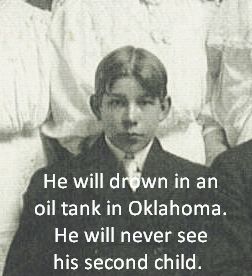
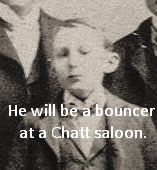
A few more Chattanooga and Chatt-area residents from the past:

Joseph Merkle

Edward Kuehm

Don Caffee

Lester Miller

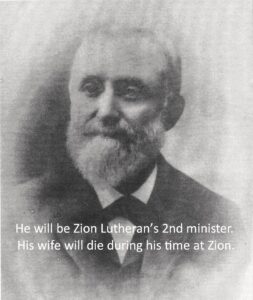
Rev. George Heintz

John Miller

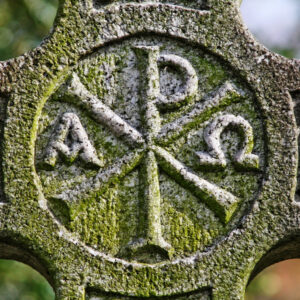
Tombstone Tuesday-Chi Rho Symbol

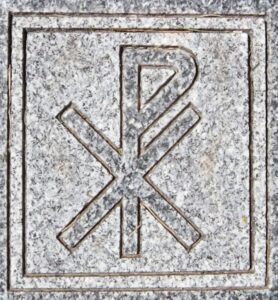
This is the Chi Rho symbol, a Christian symbol for the Greek word ΧΡΙΣΤΟΣ, Christos, which means Christ.

Chi Rho symbol

It is formed by overlapping the first two letters of the word ΧΡΙΣΤΟΣ, Chi (X) and Rho (P). It is one of the earliest forms of a Christian monogram, or a Christogram. Chi Rho, pronounced as KEE-roe.

In Christian art, the Chi Rho is often flanked by the Greek letters alpha and omega, symbolizing Jesus Christ as the Alpha and Omega—the Beginning and the End. The Chi Rho symbol is not mentioned in the Bible, even though these letters are used to form the name “Christ” in Greek.

Chi Rho symbol

The Chi Rho symbol was used by early Christians to symbolize both Jesus and Christianity. It is attributed to Roman Emperor Constantine I, who used it as a military symbol. The first public use of the Chi Rho symbol was on 28 October 213 A.D., on the shields of Constantine’s warriors in the Battle of Milvian Bridge. Constantine’s troops saw a miraculous sign in the sky the day before the battle and Emperor Constantine believed he won the battle because of the Chi Rho symbol on the shields of his men. Several months later, in the Edit of Milan, Constantine declared Christianity legal in the Roman Empire, ending nearly three hundred years of Christian persecution.

This symbol appeared on the coins of Constantine and his successors.

Chi Rho symbol

Even though Christians have used the Chi Rho symbol to represent Christ and Christianity for centuries, Chi Rho has also been used as a good-luck charm and as a talisman for warding off evil. It is believed the symbol was worshiped by pagans in ancient Greece, believing the symbol bestowed good fortune.

The Chi Rho symbol exists today in numerous variations. Some of our altar cloths have this symbol.

The symbol may have lead to the modern practice of using the letter X in Xmas, as an abbreviation for Christmas.

Mothers and Daughters

Happy Mother’s Day!

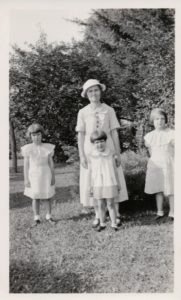
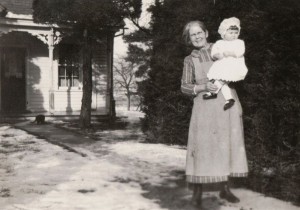
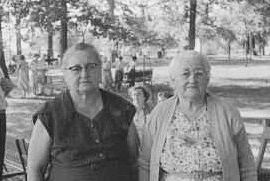
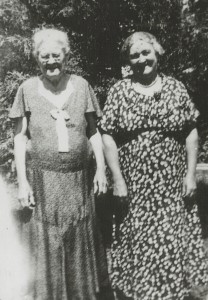
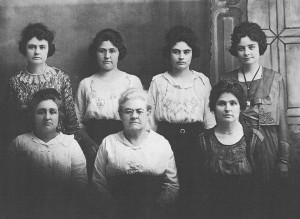
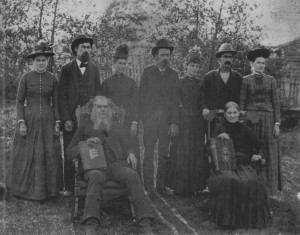
Here are some photos of mothers and daughters and grandmothers in my family, and some sons and husbands as well:

Florence & Karen, c1959

Grandma Hilda (Scaer) Schumm with Amy, Esther, & Florence

Lizzie (Schinnerer) Scaer & Amy Schumm, 1929.

Frieda, Sarah (Breuninger), Cornelius, Louis J Schumm (1905)

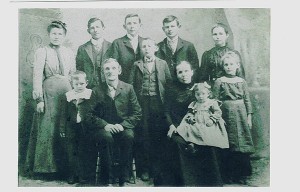
Front: Carl, Jacob, John, Christina (Rueck), Clara, Caroline. Back: Mary, Peter, Jacob Jr, Christian, Maggie.

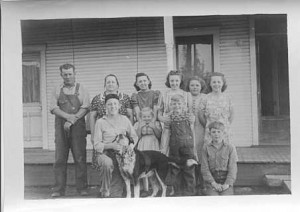
Carl Miller family, front: Herb, Anna Lou, Kenny, Vernie. Back: Carl, Gertrude, Ruth, Helen, Kate, Em.

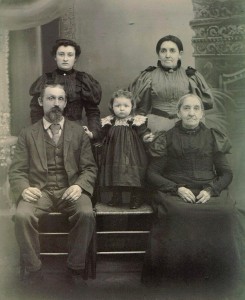
Front: William Reid, Gertrude (Brewster) Miller, Mary Ann (Cotterell) Headington. Back: Pearl (Reid) Brewster, Elvira (Headington) Reid. c1898

Grandma Miller (Gertrude Brewster Miller) and Great-grandma Brewster (Pearl Reid Brewster)

Emily (Bryan) Reid & daughter Pearl (Reid) Brewster (1936 photo) Photo courtesy of Brian Brewster

Emily (Bryan) Reid and her daughters. Front: Pearl, Emily, Laura. Back: Zorphia, Minnie, Edith, Gladys.

John & Hannah (Huey) Bryan, children Emily, Peter, Mary, William Riley, Alta Jane, Hallet, Byantha (c1883)