Last week I wrote about threshing and cooking for threshers and I learned a lot about both events. Threshing and the meal preparation certainly was a whole lot of work, but the families were able to turn the hard work into a social event at the end of the day.
Several of us Miller relatives talk every Friday morning on Skype. My aunt and uncle (my dad’s brother and sister), and a couple of my cousins enjoy talking about the good old days and catching up on the latest news. Last Friday my aunt Ruth, who will be 100 this year, and my uncle Kenny shared some of their memories about threshing on the Miller farm north of Chatt.
Uncle Kenny said he remembers helping out on threshing day when he was about 10 years old, by delivering water to the threshing crew. He said that Johnny Reef had a threshing machine and he recalls the names of some of the men who were on the threshing crew, the threshing ring, as he called it: Homer Carr, Howard Caffee & sons, and Jr Miller. He said my dad also worked with the crew, by sacking grain.
Aunt Ruth recalled that her aunts Caroline (Miller) Caffee and Clara (Miller) Reef came over to help with the threshing meal. Ruth said her mother cooked a lot of roast beef, macaroni and cheese, and pies. Ruth said the macaroni and cheese was her favorite and that grandma made very good cream pies. Kenny thought they had an ice cream social when the threshing was done for the season.
They both said they liked to play on the straw stack and slide down it. In fact, all their siblings liked to play on it. They said the straw stack was quite tall and that the animals would eat from it.
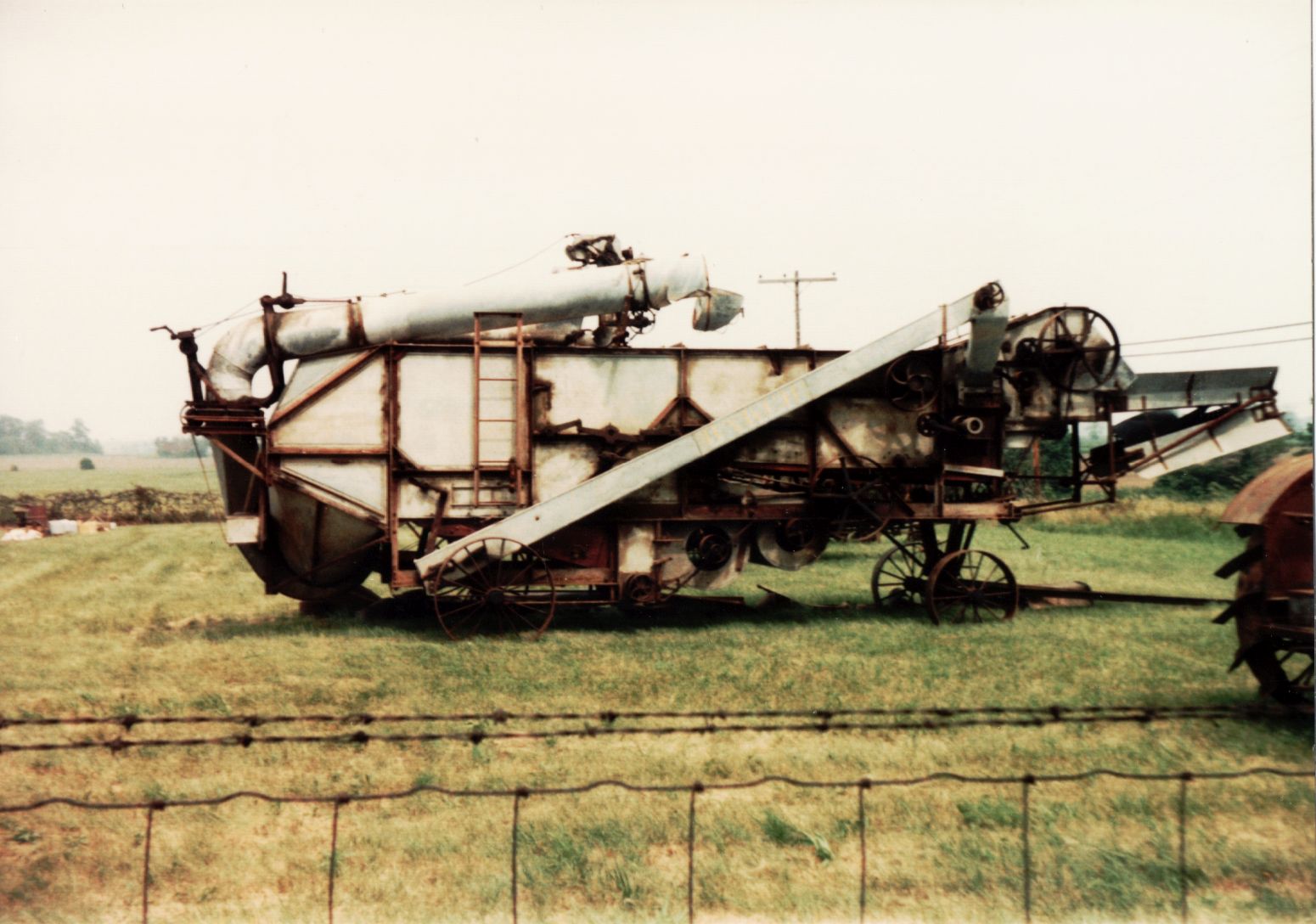
Cornelius L. Schumm threshing machine, at 1986 sale.
My grandpa, Cornelius L Schumm, had a threshing machine and did threshing for some farmers in the Willshire area. These photos are from his last threshing job, threshing for R.L. Stetler in 1952.

C.L. Schumm’s last threshing job, for R.L. Stetler, 1952.
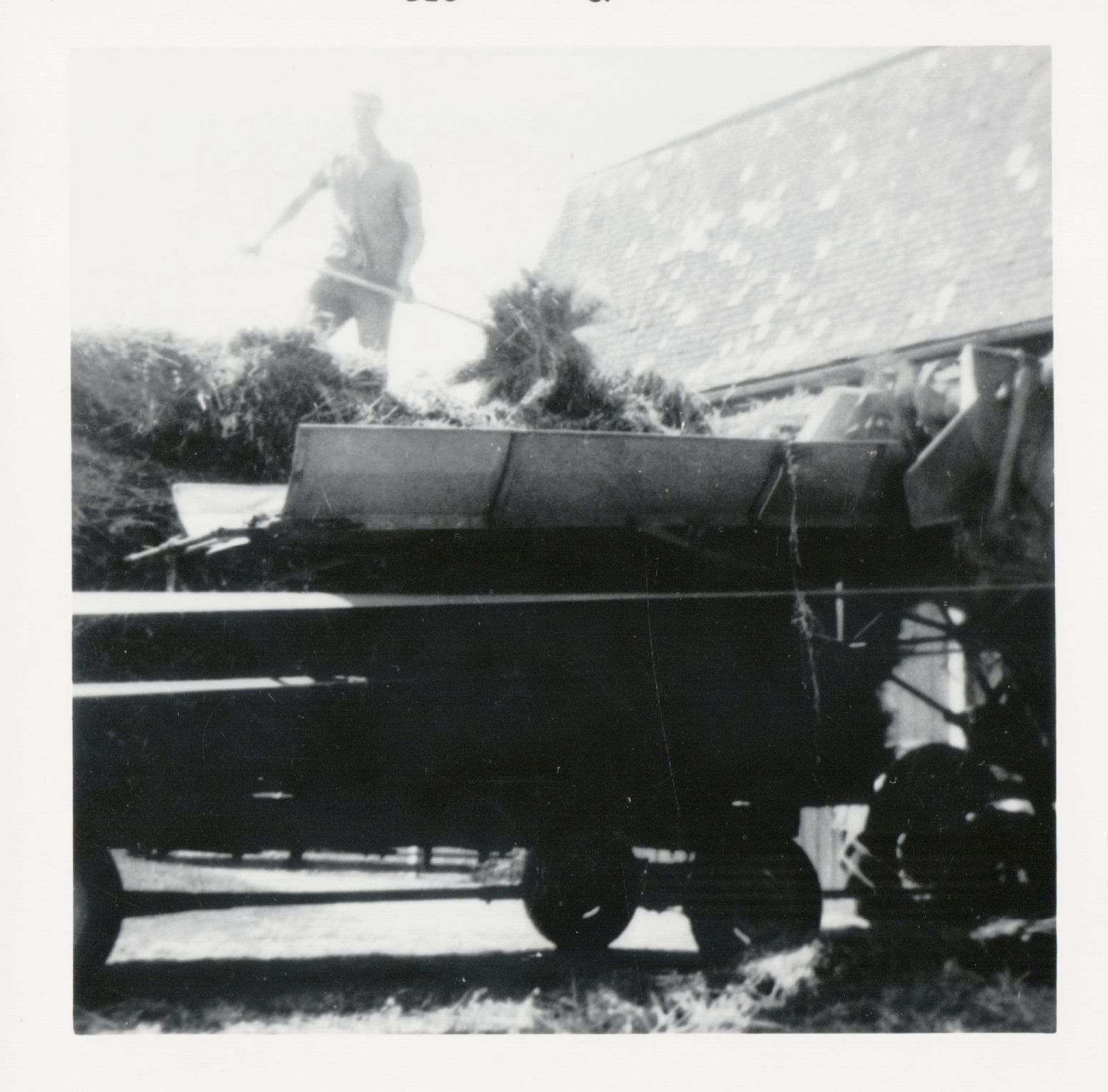
C.L. Schumm Threshing for R.L. Stetler, 1951-2.
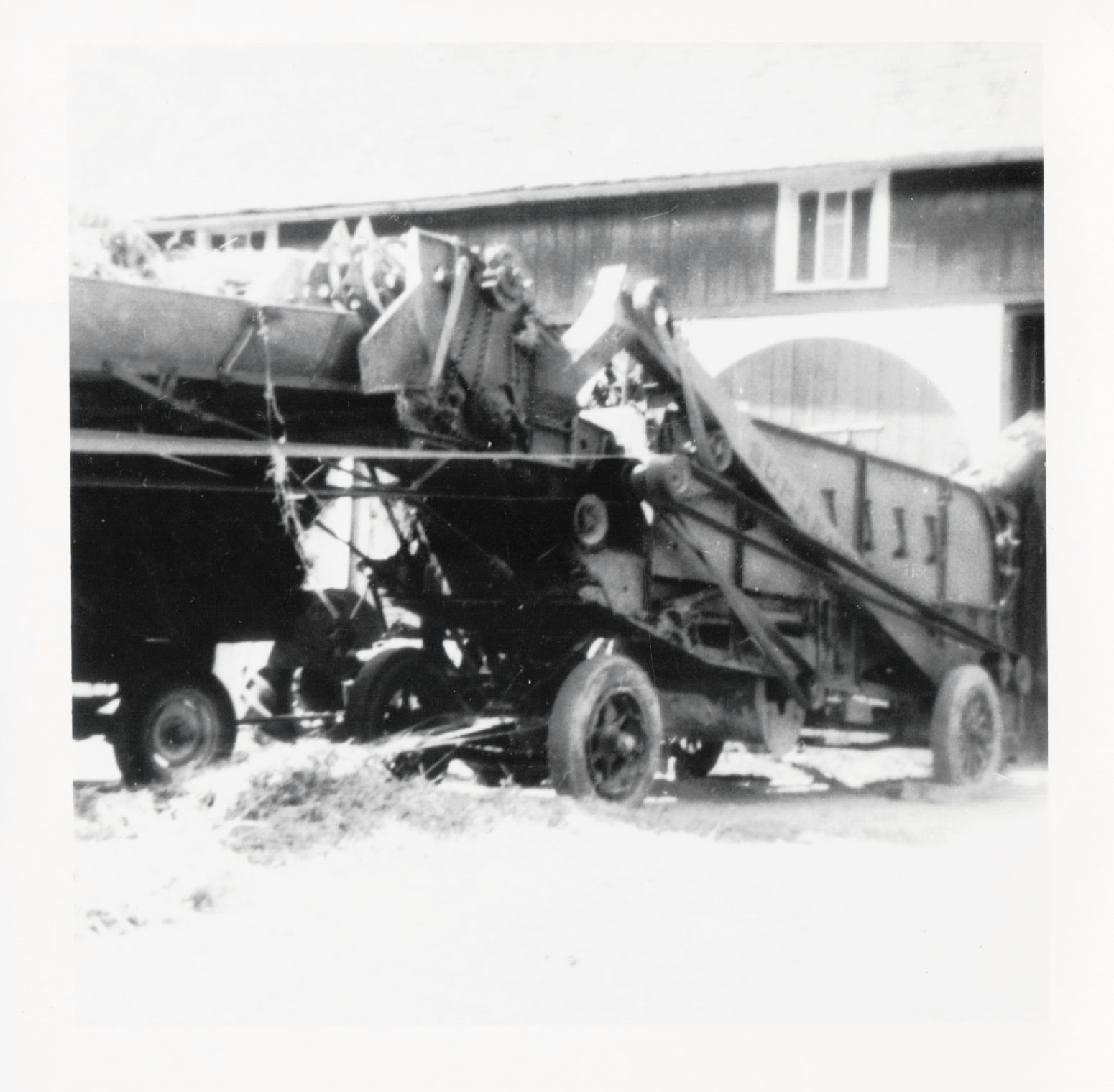
C.L. Schumm, threshing for R.L. Stetler, 1951-2.
Grandpa had a Rumely Oil Pull and he may have used it to power his threshing machine.
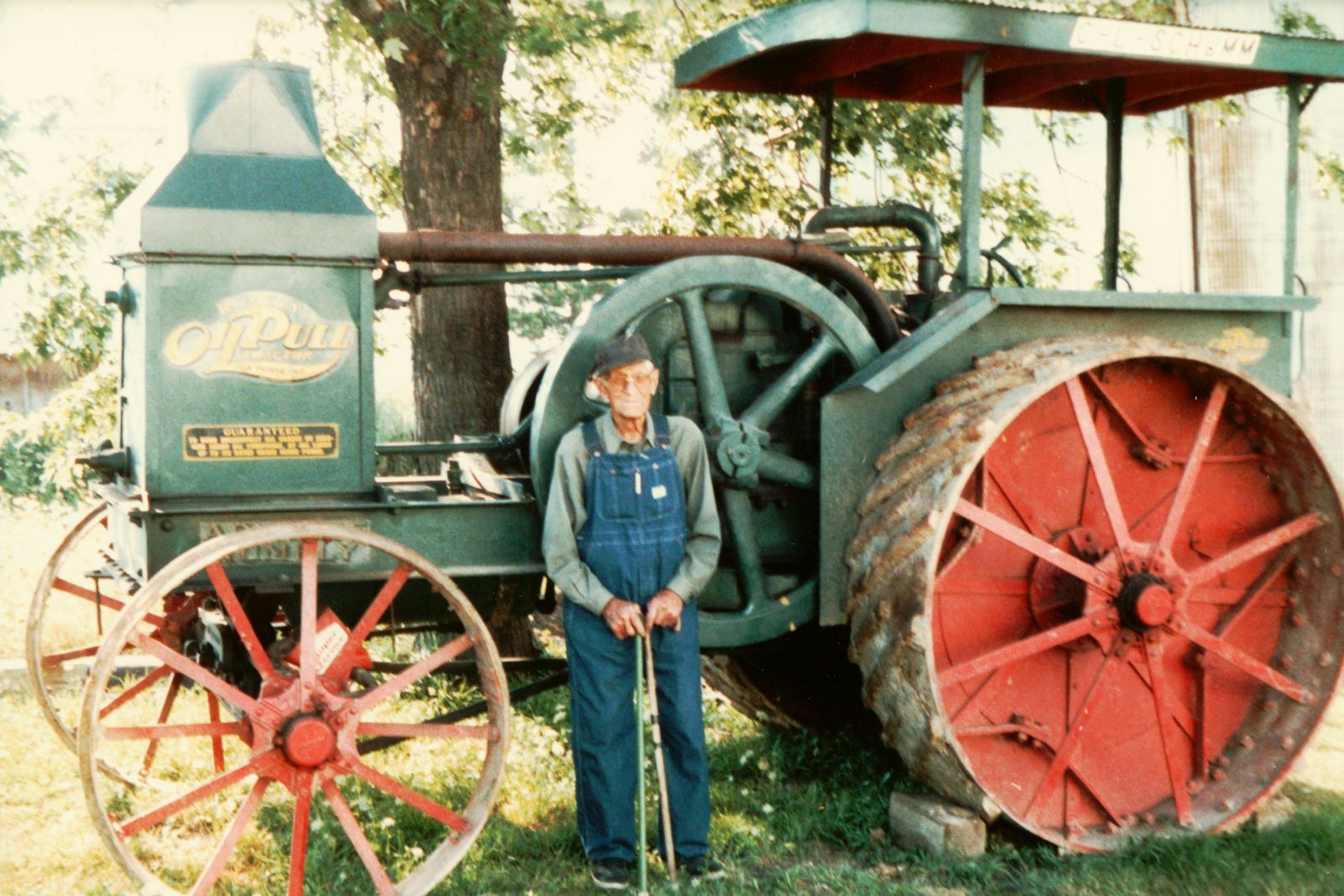
C.L. Schumm by Rumely Oil Pull, 1985.
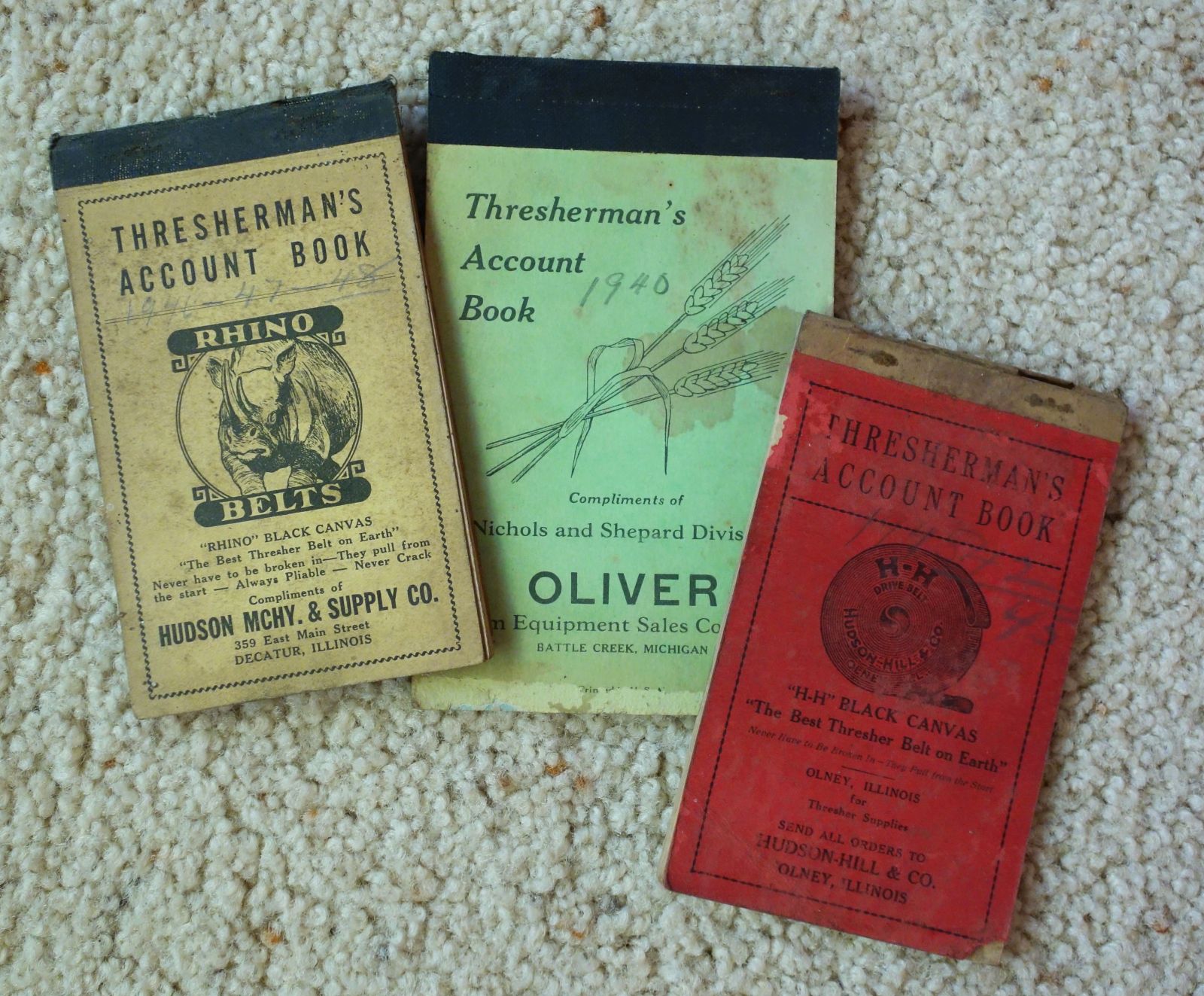
Grandpa Schumm saved a few of his threshing account books, which are dated from 1938-1948, and usually during the months of July and August. The grain was mostly wheat, but there was some oats, rye, and barley. Bushel amounts ranged from 48 to over 400 bushels.
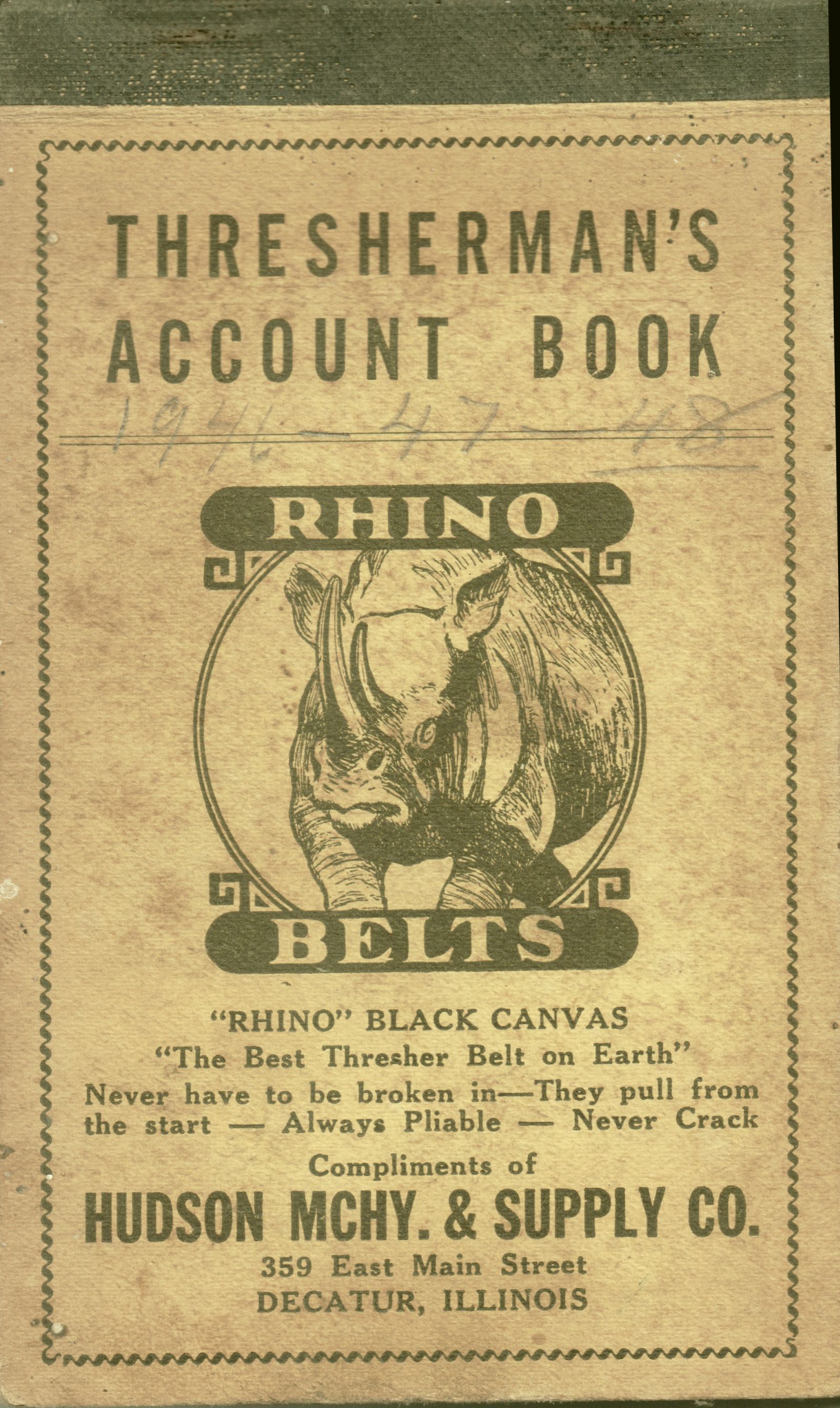
C.L. Schumm’s Thresherman’s Account Book, 1946-48.
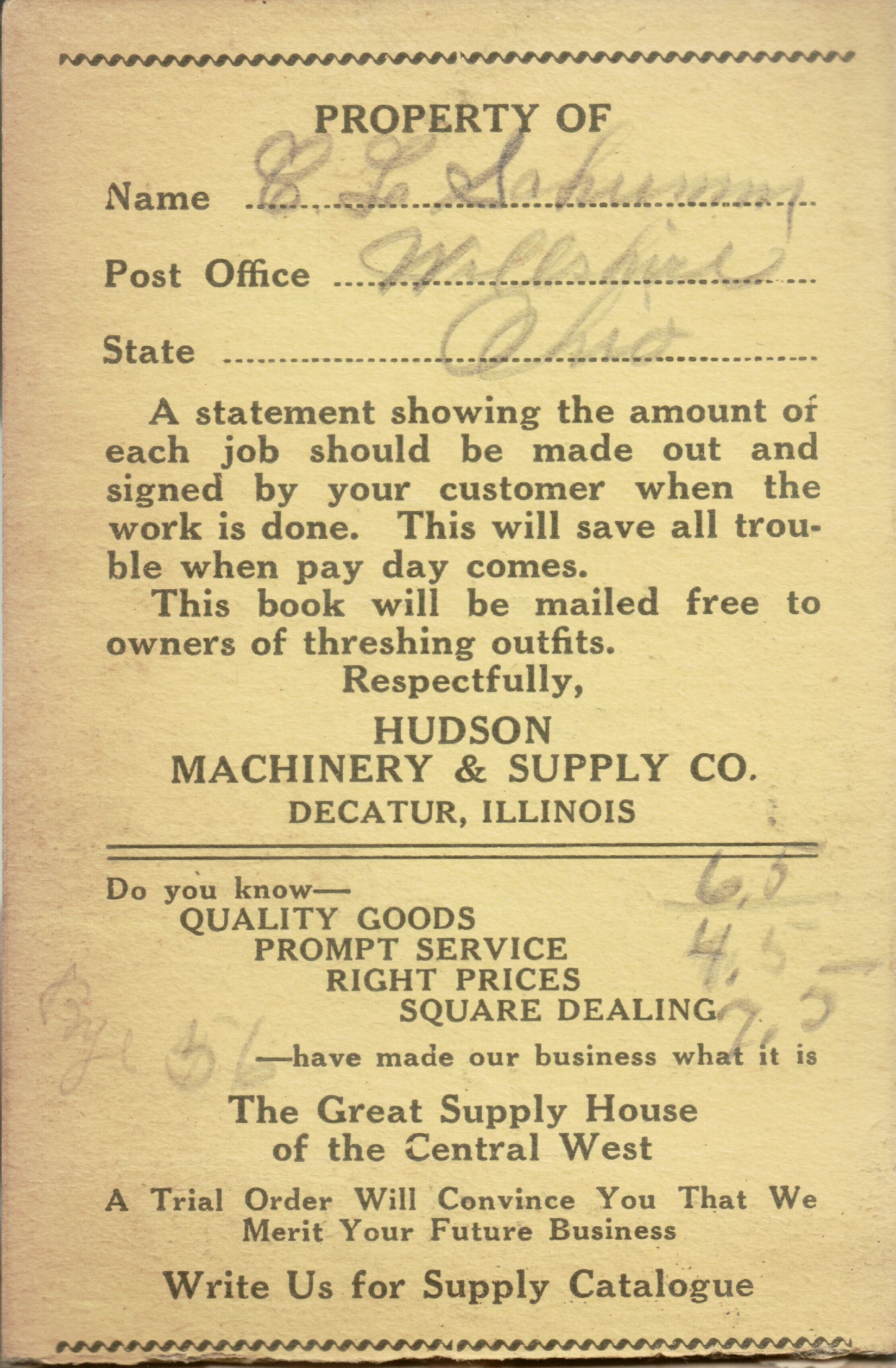
C.L. Schumm’s Thresherman’s Account Book, 1946-48.
For example, one 1948 slip for R.L. Stetler: 76 bushels wheat @ 7¼, total $5.39; 858 bushels oats @ 5¼, total $45.03; minus $5.00 labor; total owed $45.42.
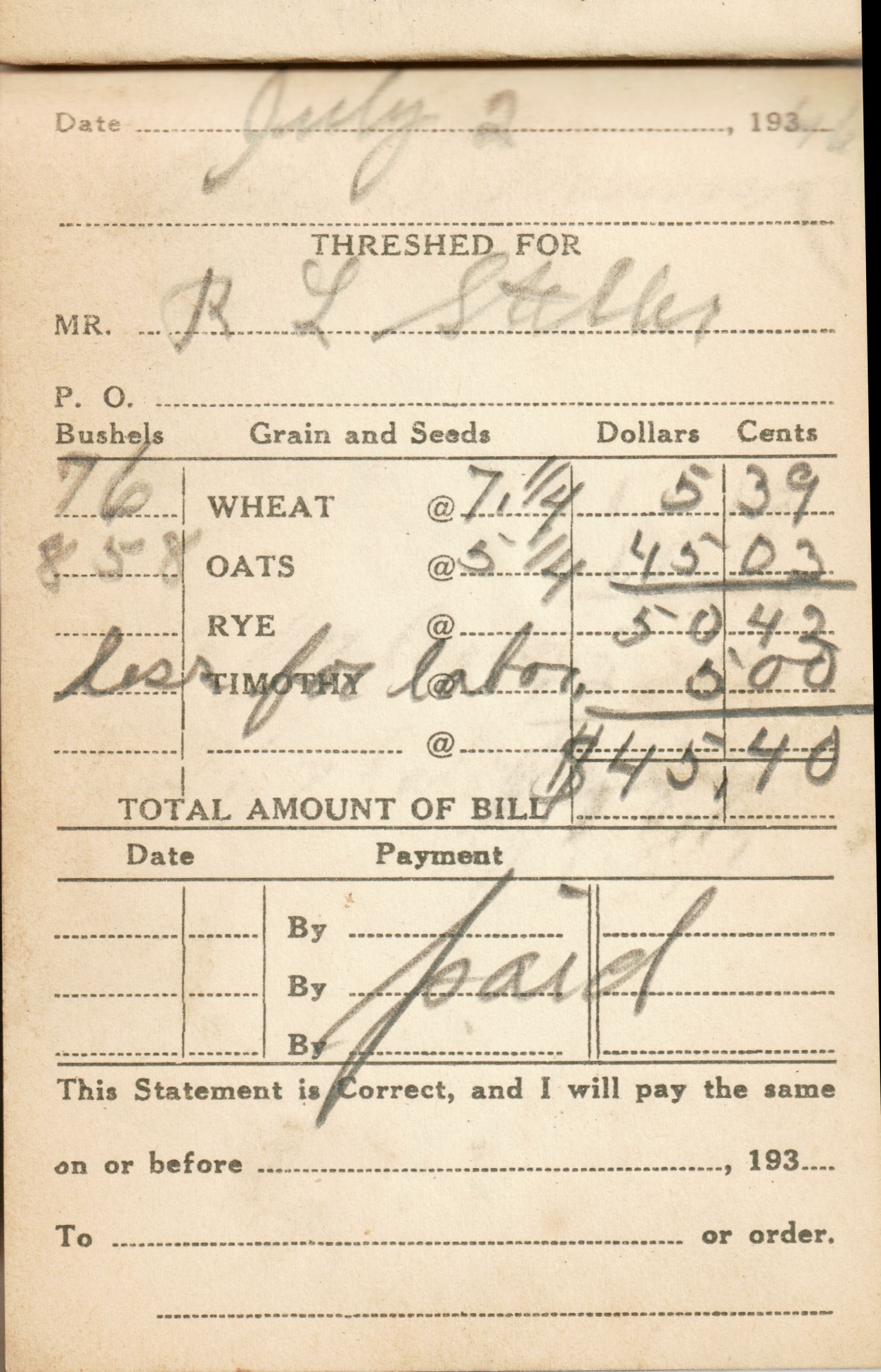
C.L. Schumm threshing account for RL Stetler, 1946.
I assume he took his threshing machine to the individual farms, charged them using a specific number, according to the number of bushels, and deducted the farmer’s labor from his bill. I do not know how that specific number was determined, but it was always 7¼ for wheat and 5¼ for oats. When you do the math it figures to be $0.0725/wheat and $0.0525/oats.
I wonder if the other farmers on the crew helped out for free or if they got paid or compensated in some way. Maybe they volunteered at each farm, knowing the crew would come and thresh at their farm eventually. I would be interesting to know the answers to these questions.
Below are some of the names in his threshing books, the farmers my grandpa Schumm threshed for between 1938-1948. I put them in alphabetical order. Maybe you will see the name of one of your relatives.
R.E. Allmandinger
Rudy Allmandinger
W.L. Allmandinger
Basil Banta (hauling clover seed)
J.H. Becher
Laurel Bowen
Clarence Brandstetter
Emil Brandt
Claude Buchanan
A.H. Buechner
Otis Byers
L.S. Cully
Firmin Dellinger
Frank Dudgeon
O. Dudgeon
Del Eichar
W. Eichar
Engle
Henry Etzler
Ernest Gribler
Sam Haggard
Albert Hamrick
W. Hamrick
Leon Huffine
T.C. Hofmann
Gale Hook
Mrs. J. Hurless
Austin Jones
Frank Ketrow
Kettring
Fred Kidd
Christ Krall
H. Merkle
R.L. Painter
George Putnam
George Roehm
Paul Roehm
Albert Roop
J. Scaer
Oscar Scaer
Glen Schadt
Arthur Schinnerer, Mrs. Minnie Schinnerer
Arnold Schumm
Paul Schumm
W.J. Schumm
Floyd Shoaf
Harold Stetler
R.L. Stetler
Roy Stetler
A.A. Stove
Clarence Trable
Grandpa threshed for quite a few people over the years. I recognize quite a few names. Interesting stuff!