Nimrod Headington Journal, 1852, part 2

Today, the second in a series of blog posts, the transcription the 1852 journal of Nimrod Headington, my fourth great-granduncle. [1]

Nimrod Headington (1827-1913), at the age of 24, set sail from New York in February 1852, bound for San Francisco, California, to join the gold rush and to hopefully make his fortune. The Panama Canal had not been built at that time, so he sailed around the tip of South America to reach the California coast.  
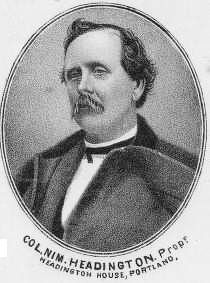
Nimrod Headington (1827-1913)

Nimrod Headington made a hand-written copy of his 1852 journal for his daughter Thetis O. Tate in 1905. This original hand-written copy stayed in the family and was eventually passed down to Nimrod’s great-great-granddaughter, Karen (Liffring) Hill. Karen, a book editor, died of cancer in 2010, at age 55. During the last two years of her life she transcribed Nimrod’s journal, which documents his travels between February of 1852 and the spring of 1853.

The second installment of Nimrod Headington’s 1852 journal, his “Trip to California.”

MARCH 1852

Sunday, March 1st. This does not appear like a Sabbath day to me. All hands working all day putting up masts and spars and passengers engaged in all kind of amusements—some playing cards, dice, or checkers, while others were reading or singing. It is anything to kill time.

March 2nd. Masts all up again, and we now are under full sail again, heading southeast and running 12 knots an hour in latitude 23°15’. It is quite warm so that a number of the passengers slept on deck.

The next day we struck trade winds again in latitude 20°34’. We had good sailing and smooth sea, which is very acceptable after being in a storm and seasick for so many days.

The next day, the passengers began to grumble about not getting enough to eat. The captain was waited on and notified of the condition of things in the galley kitchen, but he paid no heed to our complaint. So under the circumstances, we formed a board of health, and the next evening, we gathered on deck and proceeded to elect officers, making Captain Copeland president, Mr. John Gomd vice president, and L.D. Shelden secretary, and a committee of six to see that the rations were properly cooked and at the proper time and to see that the decks were kept clean and to report to the doctor if any were sick and needed medicine.

Friday, March 5th. Fair winds and plenty of it. We headed south by east, running 14 knots per hour in latitude 14°12’. The wind continued to blow from the same direction until Sunday, March 7th, when the wind changed to northwest and continued from that direction for four days and nights. This morning finds us in latitude 4°30’. We came in sight of another vessel off our lee bow, which seemed to be heading right toward us and soon came up in plain sight, and when about two miles off, she hoisted her colors. Then up went the Stars and Stripes on our gallant ship. She came nearer and nearer until within speaking distance. Our captain came out with his speaking trumpet and hailed the other ship, saying, “Where are you from? How many days out? Where are you bound for?” And she answered from Calio, “40 days out and bound for Hamburg.” She was a Spanish bark. We gave them three cheers, and our colors dropped, and soon we were out of sight.

The next morning, it rained powerful hard. The wind went down, and the sea was calm all day. The next day, we sighted another ship light astern. There being little or no wind, she could not run up to us. The next morning, she was still in sight. Our captain, being anxious to speak to her, set back sails and at eight o’clock a light breeze struck up. We hoisted our colors, and in a minute the beautiful Stars and Stripes were up on the other ship. This was a beautiful sight to see—an American ship plowing her way through the blue water toward us. She soon came up to us, and our captain lowered a lifeboat and four sailors to row and went on board the other ship. What his business was we did not know, but we thought perhaps as we were then getting very short [on food] and on allowance. And were afraid that we should run out entirely. This ship was The Marian of New York bound for Rio de Janeiro.

March 13th. Today we crossed the equator. Four hours after crossing the line, we had finer winds and good sailing. We came in sight of another ship but not close enough to speak. The winds increased, and we are running at a rapid rate. The passengers are all merry on account of such fine sailing and fine weather. When the captain took the sun’s altitude the next day at noon, we were in latitude 5°29’ south latitude. The winds continued from the same direction. The captain began to be afraid of running ashore. He went aloft and saw on our lee bow land. And he immediately came down and changed our course, and we are now running south by east running 10 knots an hour.

The ship’s doctor—we had on board a Dr. Morgan of Philadelphia—had laid in a fine supply of liquors and had it all marked Castor Oil, pretending that it was for the passengers as medical supplies, but some of the stevedores, whose business it is to get provisions and water out of the hold found out that the vessels were filled with cherry brandy of the best kind, and they broke into the caskets and handed out the liquor by the bucketful, and such a drunken set of sailors probably never was seen on board of a ship. All the stevedores, steward’s cooks, and sailors and some of the passengers were drunk. The next day, the captain found out where they got their liquor, and he sent the stevedores down into the hold and had all the caskets marked Castor Oil hoisted up on deck and then rolled it all into the sea.

The next day was very pleasant, and some of the passengers climbed up into the rigging, and the sailors thought it a good time to have some fun, and they followed them up and tied them fast to the rigging. Some of the passengers were too supple and got down without being caught.

Sunday came, and oh, what a beautiful day! We were then in latitude 18°15’, and while I was eating my breakfast, some one of the passengers cried out, “Breakers ahead!” The mate cursed him and told the man he was a damn fool, but he went aloft to see, and there he saw rock on every side. He was not slow coming down, and he called out, “All hands on deck!” to warn the ship. We ran within 50 feet of two rocks on our starboard side and could see a number more on the larboard side [2]. Had it been in the night, we should have been smashed to pieces and gone to the bottom of the sea, but we got off safely, and we were soon out of sight of those rocks, and I hope we shall not encounter another such school of rocks.

The next day it was calm until evening, when the wind set in from the northwest and blew very hard so that we had to reef sail. [3]

To be continued…
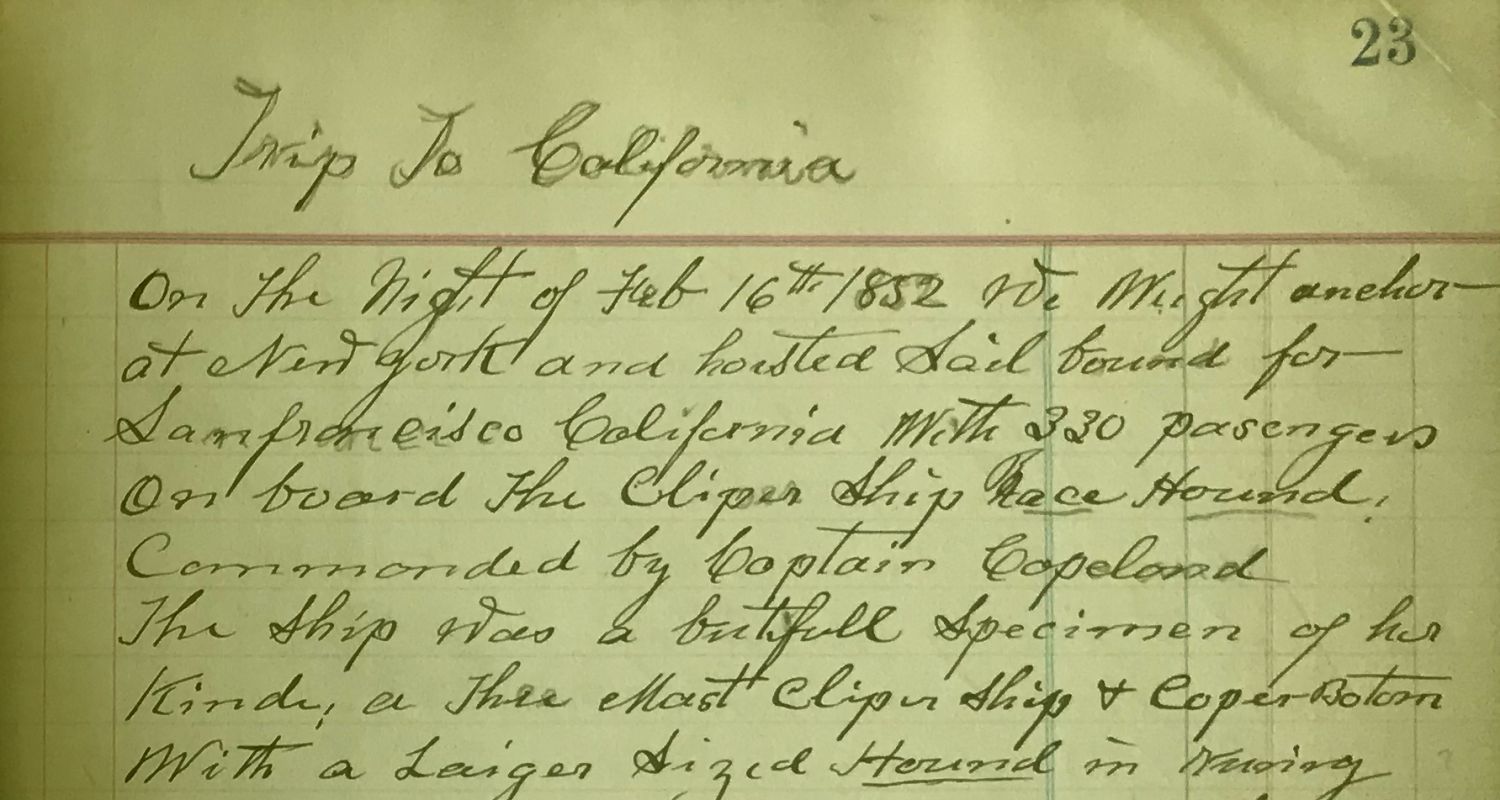
Nimrod Headington Journal, 1852, p.1

I will post Nimrod’s journal in increments, but not necessarily every week.

[1] Nimrod Headington, the son of Nicholas (1790-1856) and Ruth (Phillips) (1794-1865) Headington, was born in Mt. Vernon, Knox County, Ohio, on 5 August 1827. He married Mary Ann McDonald (1829-1855) in Delaware County, Ohio, in 1849 and they had a son a year later. Nimrod moved to Portland, Jay County, Indiana, by 1860 and a couple years later served in the 34th Indiana Infantry during the Civil War as a Colonel, Lieutenant Colonel, and Major. Nimrod died 7 January 1913 and is buried in Green Park Cemetery, Portland. Nimrod Headington is my fourth great-granduncle, the brother of my fourth great-grandfather, William Headington (1815-1879).

[2] Larboard side: archaic term for port side.

[3] Nimrod Headington’s journal, transcription and photos courtesy of Ross Hill, 2019, used with permission.
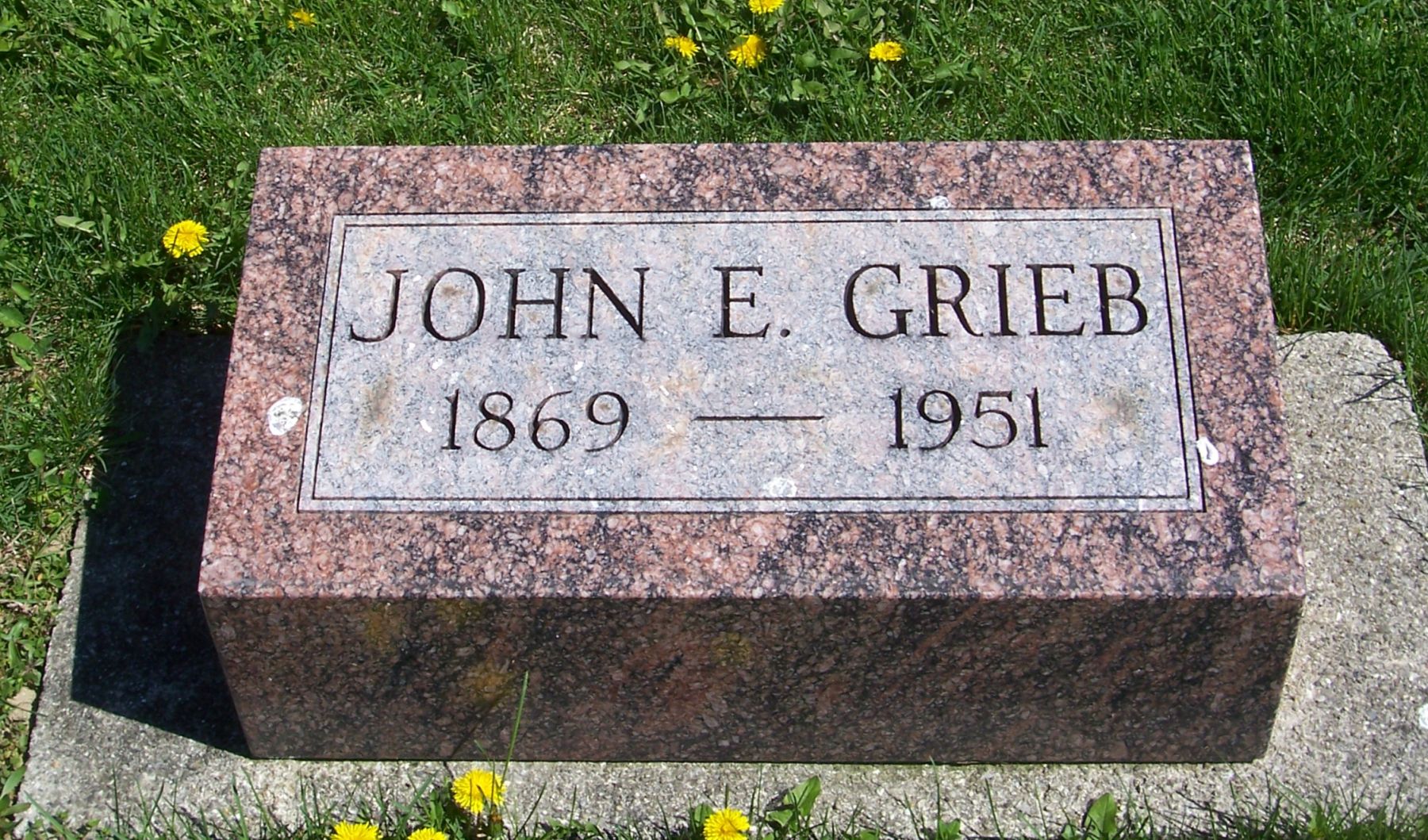
Tombstone Tuesday–John E. Grieb

John E Grieb, Zion Lutheran Cemetery, Van Wert County, Ohio. (2012 photo by Karen)

This is the tombstone of John E. Grieb, located in row 3 of Zion Lutheran Cemetery, Schumm, Van Wert County, Ohio. The marker is inscribed:

JOHN E. GRIEB
1869-1951

Johann Eberhard “John” Grieb, was born 27 August 1869 near Willshire, Ohio, the son of George “Michael” (1819-1903) and Barbara (Geisler) (1839-1929) Grieb. He was baptized at Zion Schumm on 23 January 1870, with Eberhard Zimmerman and Johann Bienz serving as his sponsors.

The Michael Grieb family in 1870: Michael, 50; Barbara, 30; Elizabeth, 2; and John, 11 months. This enumeration indicates that both parents were born in Germany. [1]

The Michael Grieb household in 1880: Michael, 60; Barbara, 40; Margaret E, 13; and John E, 10. [2]  

The 1900 census gives a little more information about the Michael Grieb family: Michael, 86, Maggie, wife, age unknown; Lizzie, 32; and John, 30. The couple had been married 32 years and she had given birth to 2 children, both of whom were living. Michael’s wife is shown as Maggie in this enumeration and the person being interviewed does not know her date of birth or her age. I assume this was his wife Barbara. They were both born in Germany, Michael immigrating in 1852 and Maggie [Barbara?] in 1849. [3] 

John’s father Michael Grieb died in 1903 and in 1910 John lived with his widowed mother and his sister Elizabeth near Willshire: John, 41; Barbara, 70; and Elizabeth, 22. This enumeration indicates that John was single, that he farmed, and that his mother was born in Germany and immigrated in 1850. [4]

The John Grieb household in 1920, shows John living with his widowed mother and his sister: John, 50; Barbara, 82; and Lizzie, 51. John’s occupation was farmer. [5]

John’s mother Barbara (Geisler) Grieb died 14 March 1929. She and her husband Michael are buried in row 8 of Zion Schumm’s cemetery and share the same tombstone.

John and his sister Elizabeth remained in the family’s home after her death and were enumerated in the 1930 census: John, 58; and Elizabeth “Lizzie”, 61. John’s occupation was farmer. No occupation is given for his sister Elizabeth. [6]  

John’s sister Elisabeth Grieb died 28 April 1938 and John lived by himself in 1940: John, 69, still listed as a general farmer. [7]  

John died at the Adams County Home, Rural Route Decatur, of a heart attack on 12 May 1951. He was 81 years old and had been at the County Home for two years. He was buried on the 15th, with Rev. P. Kuhlberg officiating at the service. [8]

John never married.

It was interesting, as well as challenging, to find the Grieb surname in the various census enumerations. Their name was spelled differently in just about every census. The footnotes below show are how Ancestry.com has the Grieb name indexed, to help others find the family in the censuses.

[1] 1870 U.S. Census, Willshire, Van Wert, Ohio, p.436B, dwelling 104, family 105, Michael Croep; digital image by subscription, Ancestry.com (https://www.ancestry.com/search/collections/7163/ : viewed 10 Jan 2020).  

[2] 1880 U.S. Census, Willshire, Van Wert, Ohio, ED 154, p.449B, family 119, Michael Greup; digital image by subscription, Ancestry.com, (https://www.ancestry.com/search/collections/6742/ : viewed 11 Jan 2020).

[3] 1900 U.S. Census, Willshire, Van Wert, Ohio, ED 98, p.10, dwelling 181, family 186, Michael Greeb; digital image by subscription, Ancestry.com (https://www.ancestry.com/search/collections/7602/ : viewed 11 Jan 2020).

[4] 1910 U.S. Census, Willshire, Van Wert, Ohio, ED 114, p.3B, dwelling & family 60, John Grieb; digital image by subscription, Ancestry.com (https://www.ancestry.com/search/collections/7884/ : viewed 11 Jan 2020).

[5] 1920 U.S. Census, Willshire, Van Wert, Ohio, ED 146, p.4B, dwelling 88, family 89, John Grey; digital image by subscription, Ancestry.com (https://www.ancestry.com/search/collections/6061/ : viewed 11 Jan 2020).

[6] 1930 U.S. Census, Willshire, Van Wert, Ohio, ED 24, p.5B, dwelling 113, family 116, John Krieb; digital image by subscription, Ancestry.com (https://www.ancestry.com/search/collections/6224/ : viewed 11 Jan 2020).

[7] 1940 U.S. Census, Willshire, Van Wert, Ohio, ED 81-28, p.10B, home 211, line 75, John Krcib; digital image by subscription, Ancestry.com  (https://www.ancestry.com/search/collections/2442/ : viewed 11 Jan 2020).

[8] Indiana Death Certificates, Coroner’s Certificate of Death, 1951, Roll 5, Indiana Archives and Records Administration, Indianapolis, IN, John Grieb, 12 May 1951; digital image by subscription, Ancestry.com. And, records of Zion Lutheran Church, Schumm, Van Wert County, Ohio.

Nimrod Headington Journal, 1852

It was 1852. Gold was discovered in California a couple years before and young men were rushing to California to stake their claims, hoping to strike it big and make their fortunes.

This was also the dream of one of my ancestors, Nimrod Headington.  

Nimrod Headington (1827-1913)

Nimrod Headington was the son of Nicholas (1790-1856) and Ruth (Phillips) (1794-1865) Headington. Nimrod was born in Mt. Vernon, Knox County, Ohio, on 5 August 1827, and moved to Portland, Jay County, Indiana, by 1860. He served in the 34th Indiana Infantry during the Civil War as a Colonel, Lieutenant Colonel, and Major. Nimrod died 7 January 1913 and is buried in Green Park Cemetery, Portland. Nimrod Headington is my fourth great-granduncle, the brother of my fourth great-grandfather, William Headington (1815-1879). [1]

Nimrod married Mary Ann McDonald (1829-1855) in Delaware County, Ohio, in 1849. [2] They had a son a year later. Despite the fact that he had just started a family, Nimrod took off for California in February of 1852, hoping to stake his claim on a profitable gold mine. As were so many others, he was hoping to strike it rich. In February of 1852 he traveled to New York, where he boarded a ship bound for San Francisco, sailing all the way around the tip of South America to get there. This was before the Panama Canal was constructed and was evidently a good way to get to California from the east coast.  

One of the best things about Nimrod’s journey is that he kept a journal of his travel by ship to California and of his time in the California gold fields, panning for gold.

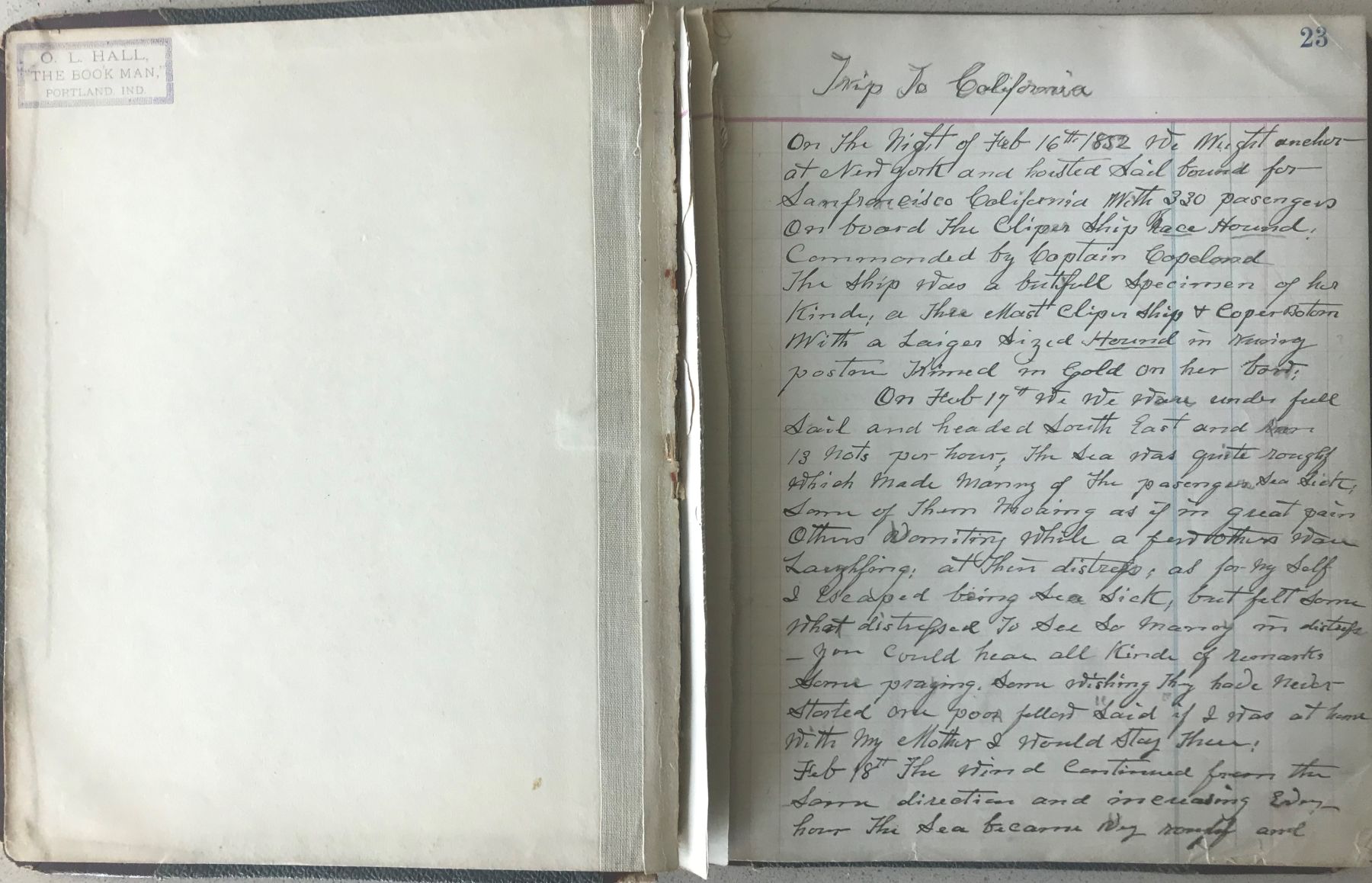
Nimrod Headington Journal, 1852, recopied by him in 1905.

Last year a reader shared Nimrod’s journal with me. His late wife Karen (Liffring) was a great-great-granddaughter of Nimrod Headington and she had acquired the original handwritten journal from her father John Liffring. The journal has been in the Liffring family since 1905, when Nimrod made a hand-written a copy for his daughter Thetis O. Tate. Karen (Liffring), who was a book editor, died of cancer in 2010, at age 55. During the last two years of her life she transcribed Nimrod’s journal, which documents his travels between February of 1852 and spring of 1853. [3]

Nimrod Headington Journal, 1852, recopied by him in 1905.

Today begins a series of blog posts, the 1852 journal of Nimrod Headington. I hope you will find the journal as interesting as I do.

START OF THE TRIP

On the night of February 16th, 1852, we weighed anchor at New York and hoisted sail bound for San Francisco, California, with 330 passengers on board the clipper ship Race Hound. Commanded by Captain Copeland, the ship was a beautiful specimen of her kind: a three-mast clipper ship and copper bottom with a larger-sized hound in running position trimmed in gold on her bow. 

On February 17th, we were under full sail and headed southeast and ran 13 knots per hour. The sea was quite rough, which made many of the passengers sea sick—some of them moaning as if in great pain, others vomiting, while a few others were laughing at their distress. As for myself, I escaped being seasick but felt somewhat distressed to see so many in distress. You could hear all kinds of remarks—some praying, some wishing they had never started. One poor fellow said, “If I was at home with my mother, I would stay there!”

February 18th. The wind continued from the same direction and increasing every hour. The sea became very rough and the waves ran high, and occasionally a spray would dash over the side or bow of the ship, wetting those on deck all over. Then those that escaped would roar with laughter while those who got soaked would hunt for dry clothing.

The wind and the weather continued about the same until Saturday, February 19th, when we struck the trade winds. The wind changed and came from the west, and the sea ran down, and the passengers began to recover from their seasickness.

Sunday came, and it was a beautiful day. The sun shown so brightly on the deep blue water. No land in sight. It was warm and pleasant on deck, and everyone that was able to crawl was on deck. We had some notebooks, and we enjoyed the day in singing, making little speeches, and telling stories. There were quite a number of good singers and some musicians in our company, several violins, and some horns.

About eight o’clock that night, the wind changed to the northwest and blowed tremendous hard at ten o’clock. Our top mast and main [topgallant] mast was carried away by the storm. This left us in a very bad condition. The ship presented a horrible and pitiful-looking spectacle. Many of our passengers were considerably frightened, and I will not say that I felt at all easy over our situation. I made it a point to watch and converse with the sailors. They are so very harshly treated by the ship’s officers that they are glad to talk to anyone who will talk kindly to them, and when I could see that they were not frightened, it made me feel better, as I was not seasick any. I had good opportunities to talk with them when they were not busy.

This storm continued until Wednesday, the 25th, when it cleared up and was pleasant, but the sea waves ran high for several hours. The sailors all hands went to work, taking down the broken spars and ropes and preparing to erect new ones.

On the 26th, a Mrs. Bresler, the wife of a merchant of Philadelphia, Pennsylvania, died. She was on her way to join her husband, who had gone to California a few months before. The funeral service was led by the ship’s captain, and she was buried the same day. There being no minister on board, it is the duty of the captain to officiate. He read the 15th chapter of Corinthians and a few of us gathered around the corpse as it lay on the plank, ready to be lowered into the sea and sang “Jesus, Lover of My Soul.” This was a sad sight for those who had never been to sea.

February 27th. The sea has run down. The day is pleasant and almost calm, which very moves in our favor—being dismasted. It gave the sailors a chance to erect new masts and spars.

February 28th. Two of the ship’s crew got to fighting, and the people on board crowded around. The fighters brought all on one side of the ship until they came very near capsizing us. The captain cried out to trim ship, and a rush was made for the other side, and soon the ship was all right.

To be continued…

I find it interesting that Nimrod mentions the names of people, some of whom died onboard the ship. It makes me wonder if there is any other record of their deaths, or perhaps their families never knew what happened to them.

I will post Nimrod’s journal in increments, but not necessarily every week.

[1] Tombstone Tuesday—Nimrod Headington, Karen’s Chatt, 13 Oct 2013.

[2] “Ohio County Marriages, 1789-2013,” Delaware, Vol. 2, no. 212, Nimrod Headington & Mary Ann McDonald, 22 Nov 1849; online database, FamilySearch.org  (https://www.familysearch.org/ark:/61903/3:1:939K-BG9B-6Y?i=93&cc=1614804&personaUrl=%2Fark%3A%2F61903%2F1%3A1%3AX8XB-BF7 : viewed 16 Jan 2020).

[3] Nimrod Headington journal, transcription and photos courtesy of Ross Hill, 2019, used with permission.
Tombstone Tuesday–Walter L. & Paula H. (Buechner) Allmandinger

Walter L & Paula H (Buechner) Allmandinger, Zion Lutheran Cemetery, Van Wert County, Ohio. (2012 photo by Karen)

This is the tombstone of Walter and Paula (Buechner) Allmandinger, located in row 7 of Zion Lutheran Cemetery, Schumm, Van Wert County, Ohio. The marker is inscribed:

ALLMANDINGER
Walter L.
1900-1969
Paula H.
1901-2004

Walter Leonhard Allmandinger was born in Mercer County, Ohio, on 22 February 1900, the son of William (1867-1919) and Barbara (Hoehamer) (1877-1929) Allmandinger. He was baptized 11 March 1900 at Zion Lutheran Church, Chattanooga, with his parents serving as sponsors. 

At that time the William Allmandinger family lived in Blackcreek Township, Mercer County, where they attended Zion Lutheran at Chatt. About 1904 the family moved to Willshire Township, Van Wert County, where they then attended Zion Lutheran Church at Schumm.

The William Allmandinger household in 1900, living in Mercer County: William C, 32; Barbara S, 22; Richard E, 1; Walter L, 3 months; and Henry Grepner, 29, boarder. The father William was a farmer. [1]

The William Allmandinger household in 1910, living in Van Wert County: William, 43; Barbara, 33; Richard, 11; Walter, 10; Marie, 9; Caroline, 8; Bertha, 6; Hugo, 4; Fredrick, 2; Lila, 3 months; and Leroy Lautzenheiser, 20, servant/farm work. [2] 

The father William Allmandinger died in 1919. His widow Barbara with their children in 1920: Barbara S, 42; Richard E, 21; Walter L, 19; Marie M, 18; Caroline K, 17; Bertha M, 16; Hugo J, 13; Fredrick N, 12; Lillie L, 9; Minnie l, 8; Martin W, 6; Aaron L, 2; and Anna B, 2. [3]

Walter Allmandinger married Paula Buechner at Zion Schumm on 2 June 1929. They were both were members of the congregation and were married by Rev. R.O Bienert. Aaron Buechner and Pauline Hofmann were their witnesses.

Paula Henriette Buechner was born 15 January 1901, the daughter of William (1865-1955) and Katherine (Schumm) (1874-1958) Buechner. She was baptized 27 January 1901 at Zion Schumm. Henriette, Hilda, and Lydia Schumm served as her sponsors.

The William Buechner household in 1910: William, 45; Katharine, 36; Aaron, 11; Paula, 9; Alma, 2; and Ida Stamm, 25, servant. William and Katherine had been married 14 years. Katherine had given birth to 4 children, 3 of whom were living. William’s occupation was farmer. [4]

The William Buechner household in 1920: William, 54; Katherine, 45; Aaron, 20; Paula, 19; and Alma, 12. [5]

By 1930, both of Walter Allmandingers’s parents had died and the some of the younger Allmandinger children went to live with their older, married siblings. Walter and Paula took in two of Walter’s siblings and his brother Richard Allmandinger and wife Frieda (Schumm) took in two other siblings. Walter and Paula lived next door to Richard and Frieda. The Walter Allmandinger household in 1930: Walter, 30; Paula, 29; Aaron Allmandinger, 12; and Anna Allmandinger, 13. Walter’s occupation was farmer. [6]

Walter and Paula had a son, Edgar, born in 1931.

The Walter Allmandinger family in 1940: Walter, 40; Paula, 39; and Edgar, 8. [7]

Walter Allmandinger died at home on 2 October 1969. His obituary:

Walter L. Allmandinger
Willshire—Walter L. Allmandinger, 69, of Rt. 1, Willshire, died at 3:30 a.m. today at his residence. Death was attributed to a heart condition.

 Mr. Allmandinger, who was engaged in farming prior to his retirement, was born Feb. 27, 1900, he was the son of William C. and Barbara S. (Hoehamer) Allmandinger. He was a native of Blackcreek Township, Mercer County.

 Survivors include his widow, the former Paula Buechner, whom he married June 2, 1929; a son, Edgar W. of Anaheim, Calif.; four sisters, Mrs. Walter (Anna) Kammeyer of Fort Wayne, Mrs. Derwood (Minnie) Drydale of Chicago, Mrs. William (Maria) Beard of Rt. 2, Convoy and Mrs. Gilbert (Lillie) Malmberg of Evanston, Ill.; three brothers, Richard of Rt. 1, Willshire and Frederick and Martin, both of Glenmore and three granddaughters.

 Two brothers and two sisters preceded him in death.

 Services will be at 2 p.m. Sunday at the Zion Lutheran Church at Schumm with the Rev. Robert Schuler officiating. Burial will be in the church cemetery.

 Friends may call at the Zwick Funeral Home, Decatur, after 7 p.m. Friday until 11:30 a.m. Sunday and at the church from 12:30 p.m. Sunday until the time of services. [8]

Paula (Buechner) Allmandinger died at the Lutheran Home in Fort Wayne, Indiana, on 13 September 2004, at the age of 103. She was buried on the 18th. [9]

[1] 1900 U.S. Census, Black Creek, Mercer, Ohio, ED 74, p.10A, dwelling 200, family 200, William C. Almandinger; digital image by subscription, Ancestry.com (https://www.ancestry.com/search/collections/7602/ : viewed 9 June 2013).

[2] 1910 U.S. Census, Willshire, Van Wert, Ohio, ED 114, p.4B, dwelling 79, family 80, line Wm. Allmandinger; digital image by subscription, Ancestry.com (https://www.ancestry.com/search/collections/7884/ : viewed 9 June 2013).

[3] 1920 U.S. Census, Willshire, Van Wert, Ohio, PD 146, p.3A, dwelling 52, family, 53, Barbara S Allmindinger; digital image by subscription, Ancestry.com (https://www.ancestry.com/search/collections/6061/ : viewed 10 Jan 2020).

[4] 1910 U.S. Census, Willshire, Van Wert, Ohio, ED 114, p.6A, dwelling 114, family 115, William Buechner; digital image by subscription, Ancestry.com (https://www.ancestry.com/search/collections/7884/ : viewed 13 Jan 2020).

[5] 1920 U.S. Census, Willshire, Van Wert, Ohio, ED 146, p.2A, dwelling & family 34, William A Buchner; digital image by subscription, Ancestry.com (https://www.ancestry.com/search/collections/6061/ : viewed 13 Jan 2020).

[6] 1930 U.S. Census, Willshire, Van Wert, Ohio, ED 24, p.2A, dwelling 37, family 38, Walter Almandinger; digital image by subscription, Ancestry.com (https://www.ancestry.com/search/collections/6224/ : viewed 13 Jan 2020).

[7] 1940 U.S. Census, Willshire, Van Wert, Ohio, ED 81-28, p.5B, household 99, Walter Almandinger; digital image by subscription, Ancestry.com  (https://www.ancestry.com/search/collections/2442/ : viewed 13 Jan 2020).

[8] Walter Allmandinger obituary, Van Wert Times Bulletin, 2 Oct 1969, p.2; digital image by subscription, Ancestry.com, viewed 13 Jan 2020.

[9] Indiana, Death Certificates, 1899-2011, Year 2004, Roll 13, Indiana Archives and Records Administration, Indianapolis, Paula H. Allmandinger, 13 Sep 2004; database on-line, Ancestry.com, viewed 13 Jan 2020. 


1909 Letter to Jesse Pickering

It is interesting to read old letters and documents that give us an idea of what our ancestors did and what impacted their lives years ago.

Recently a reader scanned an old letter family letter that involves some folks from the area a little north of Chatt.

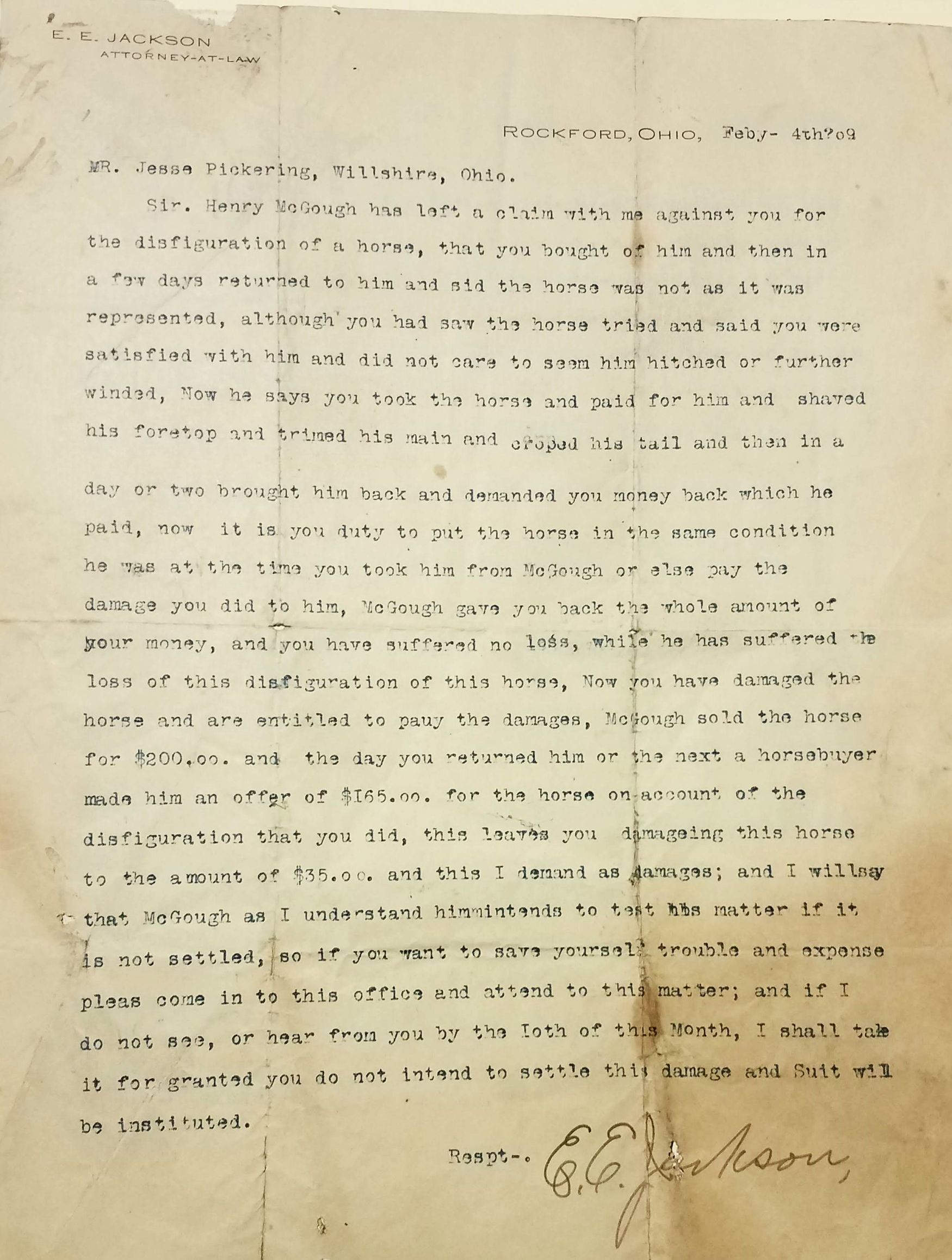
The letter is from Rockford attorney E.E. Jackson, to Jess Pickering, RR Willshire, warning of a potential claim against Jesse, filed by Henry McGough, for the disfigurement of a horse.

1909 letter from attorney EE Jackson to Jess Pickering.

In 1910 Jesse Pickering, farmer, age 27, and his wife Dorothy (Young), lived on State Line Road in Blackcreek Township. He actually lived just around the corner from the Miller farm on Sipe Road. I remember my dad and grandpa Miller mentioning his name. Henry McGough, age 69, and his wife Jane (Slater) lived a couple miles northeast, on “Addy Pike,” according to the 1910 census, which was likely what we know today as Rockford West Road.

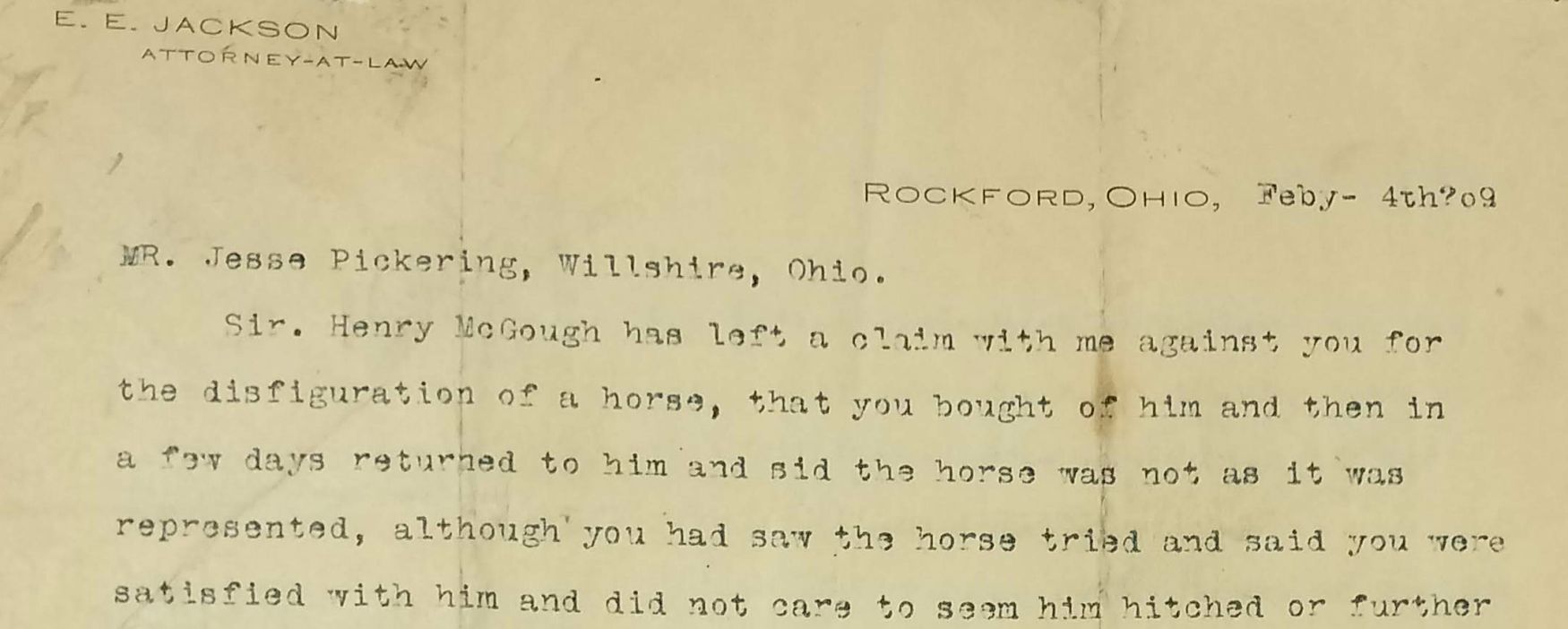
1909 letter from attorney EE Jackson to Jess Pickering.

Attorney Ethelmer Ellsworth Jackson, age 40, had a law office in Rockford and practiced there for over 40 years.

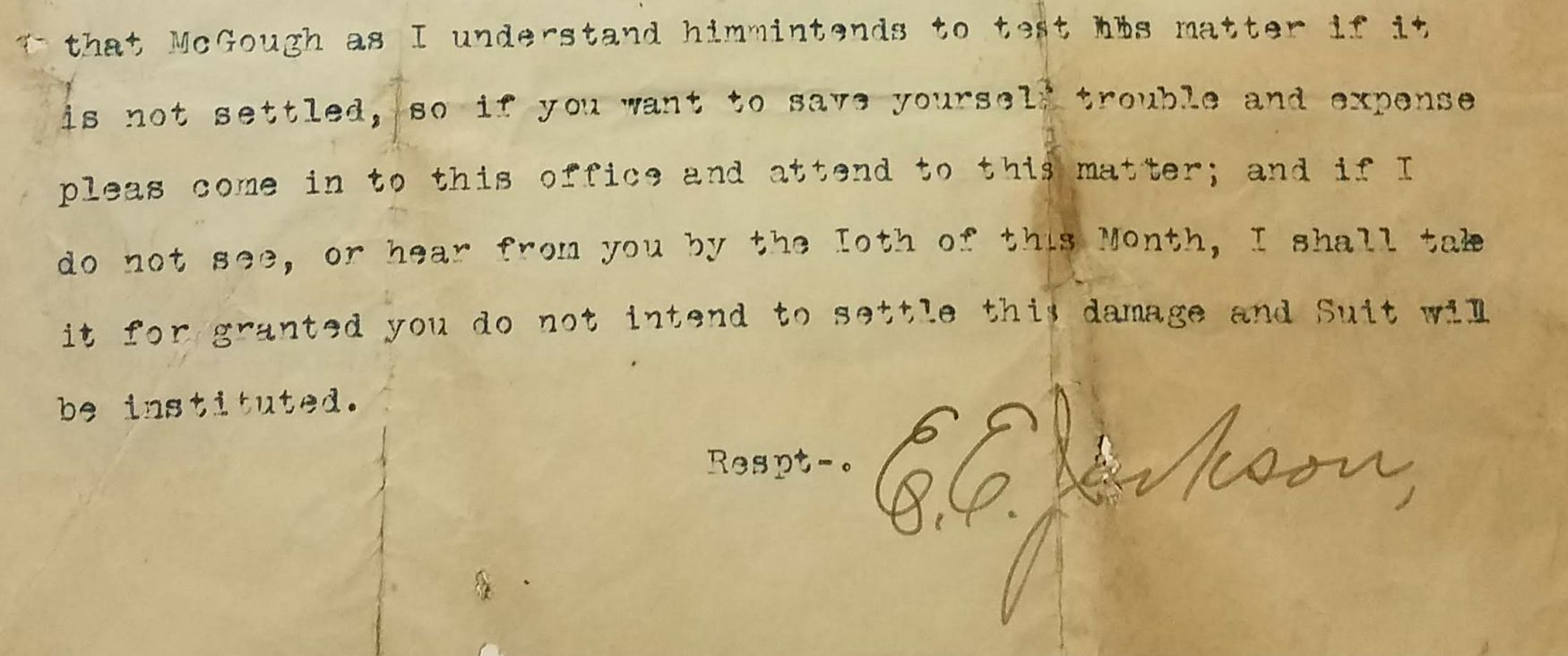
EE Jackson’s signature on 1909 letter to Jesse Pickering.

The letter is interesting to read. Note that Jackson used a comma at the end of each sentence instead of a period. I wonder if he had a secretary back then.

E.E. Jackson
Attorney-at-Law
Rockford, Ohio, Feby-4th? 09

Mr. Jesse Pickering, Willshire, Ohio.

Sir. Henry McGough has left a claim with me against you for the disfiguration of a horse, that you bought of him and then in a few days returned to him and sid [sic] the horse was not as it was represented, although you had saw the horse tried and said you were satisfied with him and did no care to seem [sic] him hitched or further winded, Now he says you took the horse and paid for him and shaved his foretop and trimmed his main and cropped his tail and then in a day or two brought him back and demanded you [sic] money back which he paid, now it is you [sic] duty to put the horse in the same condition he was at the time you took him from McGough or else pay the damage you did to him, McGough gave you back the whole amount of your money, and you have suffered no loss, while he has suffered the loss of this disfiguration of this horse, Now you have damaged the horse and are entitled to pauy [sic] the damages, McGough sold the horse for $200.00. and the day you returned him or the next a horsebuyer made him an offer of $165.00. for the horse on account of the disfiguration that you did, this leaves you damageing [sic] this horse to the amount of $35.00. and this I demand as damages; and I will say that McGough as I understand him intends to test this matter if it is not settled, so if you want to save yourself trouble and expense pleas [sic] come in to this office and attend to this matter; and if I do not see, or hear from you by the 10th of this Month, I shall take it for granted you do not intend to settle this damage and Suit will be instituted.

Respt,
E.E. Jackson

Horses were valuable in those days, so this was probably a big deal. I am surprised that Henry McGough took the horse back and gave Jesse Pickering a total refund. And attorney Jackson asked that Jesse put the horse back in the same condition he was at the time of the purchase. That would a little difficult to do!

Perhaps Jesse was trying his hand at horse grooming. I don’t know much about horses and I don’t know if it was common to trim or groom a horse as described. Would his mane and foretop have grown back? Was it a work horse or a show horse? If the horse could still perform its job, did it really matter how it looked? I thought they looked at a horse’s teeth more than the mane. Goes to show you what I know.

It would be interesting to know how everything was resolved and if a lawsuit was ever filed.

As is so often the case, perhaps there was a little more to this story…

Thanks to Jake Myers for sharing this letter. It is truly an interesting bit of family history.