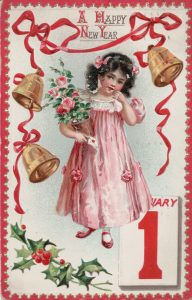
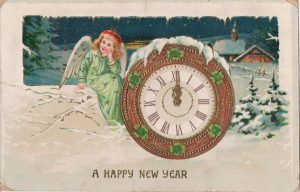
Happy New Year from Karen’s Chatt! Wishing all a happy, healthy, and prosperous 2024.
Dec 29
Happy New Year from Karen’s Chatt! Wishing all a happy, healthy, and prosperous 2024.
Dec 26
Today is the day after Christmas. The anticipation and preparations are over. Cookies and other Christmas treats, lovingly made days before, have mostly been consumed by now. The church Christmas program and candle-light service are past. We completed our Advent calendar puzzle. Presents have been opened and are now in use or put away. Or returned. Most family gatherings are over, although some may still occur between Christmas and New Year. Pretty much all that is left is the tear-down and clean-up.
December 26 is also the Second Day of Christmas of the Christmas festival season, The Twelve Days of Christmas. Traditionally, the Christmas Season ends on the evening of January 5, the Twelfth Night. January 6 is Epiphany, the celebration of the Magi’s visit to Baby Jesus.
I have read that it could be bad luck to leave Christmas decorations up beyond January 5. No problem here. That gives us more time to enjoy them.
Christmas 2024 is now a memory in our minds and in our photographs.
Here are some photos of past family Christmas gatherings. My dad is absent in most of the photos because he was the photographer.
My first Christmas with Grandpa & Grandma Miller and my Miller cousins.
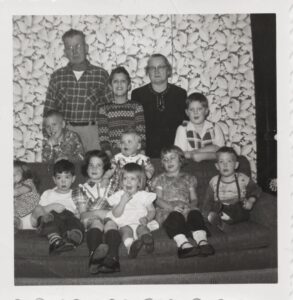
Miller Christmas 1952.
Later that day I fell and cut my head and wasn’t so happy to sit on Santa’s lap, aka Uncle Kenny.
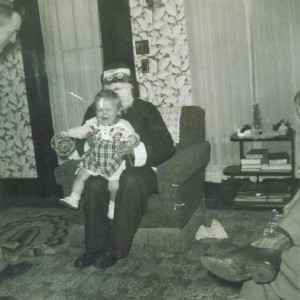
Karen on Scary Santa’s lap. (Santa, aka Uncle Kenny)
The Miller Christmas, about a year later, 1953:
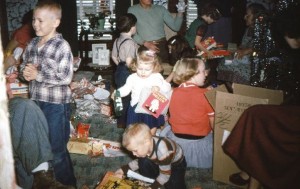
Christmas at the Carl & Gertrude Miller home, c1953.
At Grandma Schumm’s, with cousins, late 1950s:
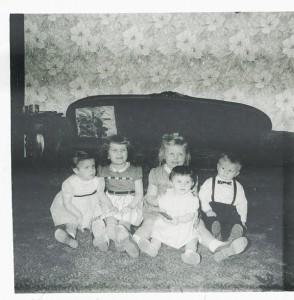
Cousins Susie, Sharon, Karen, Diane, Ron
Christmas dinner at Grandma & Grandpa Schumm’s, in the early 1960s:
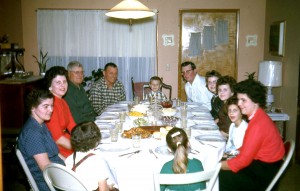
Christmas at Cornelius Schumm home (c1963)
Aunt Amy had Christmas dinner in the early 1970s:
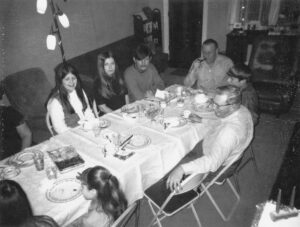
Christmas at Aunt Amy’s, c1970
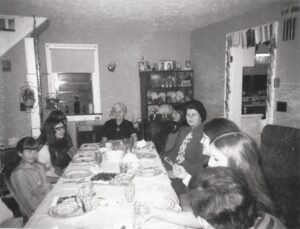
Christmas at Aunt Amy’s, c1970
The Carl Miller family Christmas tree in 1951:
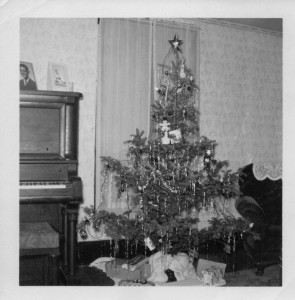
Carl Miller family Christmas tree (1951)
Dec 22
Merry Christmas from Karen’s Chatt! Christmas blessing to you and yours.
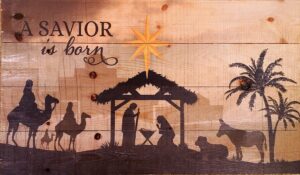
The Nativity, on wood.
For to us a child is born, to us a son is given, and the government will be on his shoulders and he will be called Wonderful Counselor, Mighty God, Everlasting Father, Prince of Peace. Isaiah 9:6
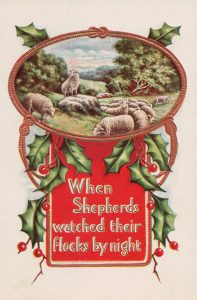
c1911 Christmas postcard to Wilbert Germann
Dec 19
We were going through a cemetery a couple weeks ago and Joe noticed this unusual symbol on a tombstone. I knew this inscription was out there on some tombstone somewhere, but I had never come across one before. The P of H on the inscription gave it away. I recognized it immediately and I was certainly excited.

Grange symbol; “The National Grange of the Order of Patrons of Husbandry.” Evangelical Protestant Cemetery, Convoy, OH (2023 photo by Karen)
The P of H stands for Patrons of Husbandry, more commonly known as the Grange. Their official name is The National Grange of the Order of Patrons of Husbandry, or Order of Patrons of Husbandry, but I will refer to them here as simply the Grange.
The Grange is the oldest American agricultural advocacy group, a social/fraternal organization that encourages families to band together to promote the economic and political well-being of the community and agriculture.
The Grange was founded in 1867 by Oliver Hudson Kelley, a Minnesota farmer and activist. He believed that farmers needed a national organization to represent them like the unions industrial workers had.
Regular Grange membership is open to anyone age 14 or older. The Grange Youth consists of members 13½ to 35 and the Junior Grange is open to children aged 5–14. In 2005, the Grange had a membership of 160,000 in 36 states.
The Grange is a grassroots organization and policies originate at the local level. The Grange is a hierarchical organization ranging from local communities to the National Grange organization. The local Grange level is the Subordinate Grange and usually all the subordinates in a county are grouped together to form a Pomona Grange. The next level is the State Grange. The thirty-five State Granges and Potomac Grange #1 in Washington, D.C. form the National Grange.
Granges hold regular meetings and discuss community issues. In addition, they offer a wide range of locally-oriented programs and activities for all ages and sponsor social events and community service projects.
Legislatively, the Grange represents the views of rural residents and the agricultural community. They have an impressive record of successful lobbying over the years: rural school improvements; laws to lower rates charged by railroads; the establishment of the Extension Service, postal Rural Free Delivery, and the Farm Credit System; making the U.S. Department of Agriculture part of the President’s Cabinet (1889); legislation promoting ethanol as a motor fuel (1906); the Pure Food and Drug Act (1906); the Federal Farm Loan Act (1916); organizing mutual insurance companies that focus on serving farm and rural markets (1920-1950); organizing rural electric, telephone, and water service cooperatives, public utility districts, volunteer fire departments, and state police programs.
In 1871 Chicago entrepreneur Montgomery Ward began his mail order business as a contractor to the National Grange and sold exclusively to Grange members.
The Grange borrowed some of its rituals and symbols from the Free Masons, including oaths, secret meetings, and special passwords necessary to keep railroad spies out of their meetings. I often wondered why we had to use a secret code word to get in if we were late for a meeting. After all, we were in a small community and we all knew each other. I learned from this research that it was because of railroad spies, although I don’t think railroad spies were a big problem in Chatt in the 1960s, but that was their ritual and tradition. However, railroad spies were evidently a big problem at one time.
My family belonged to the Chatt Grange in the 1960s. We attended meetings at the Grange Hall, aka Parish Hall, about a mile east of Chatt on Tama Road, a building that was razed a few years ago. In 1969 I was a member of the Mercer County Grange Youth Drill Team when we won the Ohio State Grange Drill Competition, defeating seven other Ohio counties. Our local Grange also hosted the annual Strawberry Festival and decorated a booth at the Mercer County Fair.
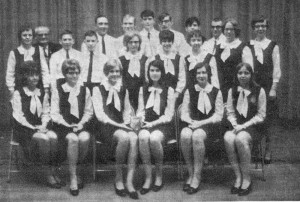
Mercer County Grange Drill Team, State Champions, 1969. [1]
The word “grange” comes from a Latin word for grain, related to a “granary,” or generically a farm. The motto of the Grange is In necessariis unitas, in dubiis libertas, in omnibus caritas, i.e. “In essentials, unity; in non-essentials, liberty; in all things, charity.”
Source: National Grange, of the Order of Patrons of Husbandry.
Dec 15
This is the season of Advent, the first of the six seasons in the church liturgical year. Unlike some of the church seasons that begin on a different date each year and vary in length, Advent is always the same. Advent is always celebrated the four Sundays before Christmas at church and for many the Advent countdown begins December 1st and lasts 24 days. The last day of Advent is Christmas Eve.
During Advent we wait and anticipate the birth of Jesus on Christmas Day. Many Sunday scripture readings are from Old Testament prophecies.
The colors for Advent are violet and blue. Most churches, ours included, have an Advent wreath made up of five candles, three violet and one pink that encircle a white candle. A candle is lit each Sunday as we sing O Come, O Come, Emmanuel. The white candle, the fifth and final candle, is lit with the all the other candles on Christmas Eve.
That is the countdown to Christmas at church.
The countdown here at home includes an Advent calendar. Advent calendars have become a popular family tradition and activity and there are a variety of themes from which to choose. The calendar activity begins on December 1st and you open one treat or do one activity each day through Christmas Eve, a 24-day countdown.
Over the years we have done several different Advent calendars: a cheese advent calendar, a Keurig coffee calendar, and chocolate Advent calendar. The chocolate Advent calendar can be hard to resist. I read this humorous comment about a chocolate Advent calendar early in the Advent season: According to my chocolate Advent calendar there are only three days to Christmas! Chocolate is way too tempting and you have to discipline yourself to one treat a day.
This year we are doing an Advent puzzle. We are both puzzlers so this is a really fun Advent calendar for us.
This Advent puzzle calendar is actually 24 individual puzzles that join together to form one large 27 x 19-inch puzzle, with about 1000 pieces. The pieces of each daily section are in individually numbered boxes and we assemble one box of puzzle pieces per day.
Here is our Advent calendar puzzle on day 15 of Advent:
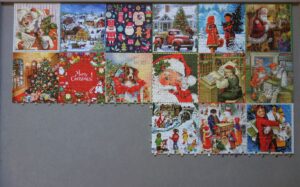
Advent calendar puzzle, day 15
Each day’s puzzle has about 42 pieces and each piece is numbered on the back, according to its day number. That will come in handy when we dis-assemble the puzzle and put it away. We can put the daily pieces into their corresponding numbered box. Or, I may mount the puzzle and reuse the 24 boxes for a different Advent project.
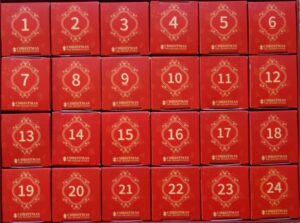
24 individual boxes of Advent puzzle pieces
We did have to laugh about one claim listed on the box: Each Piece is Unique, Automatic Error Correction. This is a false statement. I guess you could say each piece is unique, according to the picture it fits in, but there is no automatic error correction. We have put several pieces in the wrong place and there was nothing automatic about fixing the mistake.
This is what the competed puzzle will look like:
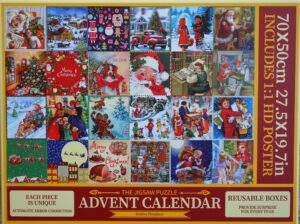
Advent puzzle calendar box, 2023
This is a fun Advent calendar project if you enjoy puzzling. We are certainly enjoying putting it together.
 |
 |
 |