Lunchtime!

It was the half-way point of the school day. We were ready for a break and ready for some time to socialize with our friends and move around. We were hungry and restless. It was lunchtime!

As I was looking through this week’s Photo Star I noticed Parkway School’s breakfast and lunch menus for the following week. We did not have breakfast at school when I went to grade school, but we did have lunch and a mid-afternoon milk break, white or chocolate milk in glass bottles.

I went to elementary school at Willshire Public School. That was before Willshire and Rockford consolidated to form the Parkway Local School system.

I don’t think I ever packed my lunch. Back then the school lunch was 25¢. I purchased a lunch ticket for the whole week for $1.25 and someone would punch the ticket for that day’s lunch before entering into the lunch line. Once in the lunch line each student picked up a tray, eating utensils, and napkin and was handed a plate of food by one of the cooks.

School lunch line

I recall that the cafeteria food was pretty good, probably because our cafeteria cooks were good cooks. I liked most meal items, but I have never been a picky eater, and it shows.

Lunch in the early 1960s was not a smorgasbord. They had one scheduled meal for the day and that is what you got. No major choices.

I did have several favorite school meals.

There was the ever-popular macaroni and cheese, usually served with a peanut butter sandwich. To this day I like to have a peanut butter sandwich with macaroni and cheese.

We had two very good soups, chicken noodle and chili. I always crushed my crackers into the soup and dipped my butter bread into the hot soup. Not the best dining etiquette, but I was just a kid and it tasted good that way. Comfort food.

There were breaded fish sandwiches, usually on Friday, for those who did not eat meat on Friday. I also recall the Johnny Marzetti, meatloaf, and Sloppy Joe sandwiches.

But my very favorite food was an option at the end of the main food line, before the milk. Often times there was a large bowl of warm creamy rice pudding. There were raisins and brown sugar nearby to put on the rice and I usually sprinkled brown sugar on top, which sort of melted on the warm rice. Delicious! More comfort food.

Our school cafeteria food was pretty basic. We didn’t have pizza or tacos back then. I don’t believe I even knew what a taco was in the early 1960s.

After eating with our friends, we took our tray, plate, and utensils up to a window, where they were cleaned for the next day, and threw away our paper trash.

We had smiling, pleasant cooks at Willshire.

I have an incomplete set of The Willow, Willshire Public School’s yearbook, but looking through the copies I have, it appears the first photo of the school’s cooks was in the 1957 yearbook. The cooks that year were Effie Lautzenheiser, Ellie Regedanz, and Bertha Anderson.

Those same three cooks are pictured in the 1960 Willow:

Willshire School cooks, 1960 Willow.

Ellie Regedanz apparently retired after the 1960 school year and Beatrice Acheson replaced her.

The Willshire School cooks in the 1961 Willow:

1961 Willshire School cooks.

These were the same three cooks in 1962. In 1963 Doris Thatcher replaced Bertha Anderson.

I remember seeing their smiling faces every day at lunch. They were friendly and pleasant and obviously enjoyed interacting with the school children. These women kept the school kitchen clean and provided well-balanced, nutritious meals.

Beatrice (Hoblet) Acheson (1903-1964) was married to Gaylord Noble Acheson (1900-1952). She is buried in Willshire Cemetery. 

Bertha (Willis) Anderson (1913-2011), was born in Canada and was married to Edwin Martin Anderson. She is buried in Decatur Cemetery. [I believe this is the person who was the Willshire School cook.]

Ella M. (Huffman) Regedanz (1892-1979) was from Chatt and was married to John Regedanz (1892-1983). She was a member of Zion Lutheran, Chatt, and is buried in Riverside Cemetery, Rockford.

Effie (Cook) Lautzenheiser (1902-1990) was born in Adams County, Indiana, and was married to George Clinton Lautzenheiser (1885-1949). She is buried in Tricker Cemetery, Decatur, Indiana.  

Then after lunch we hurried off to play outside or in the gym.

Those were the days. Good old school days…

Tombstone Tuesday-Christina (Kable) Baumgartner

Christina (Kable) Baumgartner, Chattanooga (Ohio) Mausoleum. (2017 photo by Karen)

This is the burial chamber of Christina (Kable) Baumgartner in the Chattanooga Mausoleum, located on the edge of Zion Lutheran Cemetery, Liberty Township, Mercer County, Ohio. The chamber is inscribed:

Christina Baumgartner
1867-1939

Christina Kable was born in Liberty Township, Mercer County, on 7 April 1867, the daughter of Frederick (1817-1886) and Catharine (Koch) (1837-1911) Kable, both German immigrants. Christina’s older brother Jacob was baptized at Zion Chatt, but Christina was not. However, she was confirmed at Zion Chatt in 1882.

Christina was enumerated with her parents and siblings in 1870 and 1880. The Frederick Kable family in 1880: Frederick, 64; Catharine C, 43; Jacob, 14; Christina, 12; Frederick, 10; and John 2. [1]

Christina’s father Frederick Kable died 29 April 1886.

In 1900 Christina, 33, resided with her widowed mother Catherine (Koch) Kable, 63, head, and three of her unmarried siblings: Jacob, 35, farmer; Frederick, 30, farmer; and John, 23, schoolteacher. [2]

Christina Kable married John A. Baumgartner in Mercer County on 25 August 1905. John was from Adams County, Indiana, was 41 years old, and had been married once before. [3]

Christine’s husband John A. Baumgartner died 30 October 1917. [4]

In 1920 widow Christina (Kable) Baumgartner lived with her widowed brother John H. Kable and his children: John H Kable, 42, widowed; Walter E Kable, 12; Lorena V Kable, 10; Victor D Kable, 8; Bessie Kable, 6; Christina Baumgartner, 52, sister. [5]

Christina (Kable) Baumgartner, age 72, died in Mercer County on 13 September 1939. [6] She died at home of her sister-in-law, Mary (Wendel) Kable, the widow of Christina’s brother Frederich Kable (1870-1934).   

Mrs. Christena Baumgartner
Rockford, Sept. 16- Funeral services were held at St. Paul’s Evangelical church in Liberty-tp Saturday afternoon for Mrs. Christena Kable Baumgartner, 72, who died at the home of Mrs. Mary Kable in Liberty-tp Thursday afternoon. Surviving are two brothers, Jacob Kable of Liberty-tp, and John Kable of Decatur, Ind. Burial in the Chattanooga mausoleum.
[7]

Christine (Kable) Baumgartner had the following siblings:
Jakob Kable (1865-1946), never married
Christina Kable (1867-1939), married John A. Baumgartner
Frederich Kable (1870-1934), married Mary Ann Wendel
Christian Friedrich Kable (1872-1876)
Katharine Kable (1876-1876) 
Johann Heinrich Kable (1877-1957), married Viola L. Baumgartner

[1] 1880 U.S. Census, Ohio, Mercer, Liberty, ED 188, p.473B, dwelling 43, family 45, Frederick Kable; Ancestry.com.

[2] 1900 U.S. Census, Ohio, Mercer, Liberty, ED 85, p.6, dwelling 115, family 120, Catherine Cable [sic]; Ancestry.com.

[3] “Ohio, County Marriages, 1789-2016,” Mercer, Vol. 9, p.152, John Baumgartner & Christena Kable, 25 Aug 1905; digital image, FamilySearch.org.

[4] “Ohio Deaths, 1840-2001,” Van Wert County, Jno A. Baumgartner, 30 Oct 1917; digital image, FamilySearch.org.

[5] 1920 U.S. Census, Ohio, Mercer, Liberty, ED 140, dwelling 196, family 213, John H Kable; Ancestry.com.

[6] “Ohio Deaths, 1908-1953,” Mercer County, Christina Baumgartner, 18 Sep 1939; digital image, FamilySearch.org.

[7] The Lima News, Lima, Ohio, 17 Sep 1939, p.4, Christine Baumgartner obit; NewspaperArchives.com.


The Tenth Schumm Reunion, 1949

Zion Lutheran Church at Schumm celebrated their 175th anniversary as a congregation in 2021. That is quite a milestone.

Later this year the Schumm family will celebrate yet another milestone–the 100-year anniversary of the John George Schumm Family Reunion. It will be the 45th Schumm reunion.  

2016 John George Schumm Family Reunion

Zion Schumm’s congregation is named after one of the first families of the area, the John George Schumm family, and one of the founding families of the church. John George Schumm and his five adult children immigrated from Wuerttemberg in 1833 and settled in the Schumm area about 1837, purchasing 800 acres around Schumm. One of John George’s children, Johann Friedrich Schumm, donated land for the church grounds and cemetery. John George Schumm and his five immigrant children are all buried in Zion Schumm’s cemetery.

The first Schumm reunion was held 10 August 1924 at the original Schumm homestead, behind the church. They took a photo to memorialize the event.

The first Schumm Reunion, 1924, at the Schumm homestead.

The Schumm reunion was held for many years at the Schumm homestead, until the majestic old barn was razed. After that, reunions were held at the farm across the road from the church, to the east, the Ned Alspaugh farm at the time. Now reunions are held at the pavilion at the church.  

The Schumm reunion is usually held every other year in August, but none were held during the WWII years. They skipped two reunions at that time and they were resumed in 1947.    

This is the program from the 10th Schumm family reunion, held 21 August 1949. That reunion was held at the home of Walter Emanuel Schumm (1888-1967), who was married to Erna Teresa Schumm (1894-1971). It was the second reunion held after WWII.

1949 Schumm Reunion program

There was a selection from Mary and Martha Etzler. Mary and Martha were the twin daughters of Leonard (1910-1988) and Amanda Barbara (Schumm) (1916-1965) Etzler. The girls would have been 8 years old at the time. I assume theirs was probably a musical selection.

1949 Schumm Reunion program

Next on the program was The Schumm Family. Perhaps this was something about the history of the Schumm family. Or perhaps it was a skit. Family members used to dress up and perform skits at reunions.

Then, music from Margrete Germann. I believe this was Margrete Germann (1931-2014), the daughter of Kletus (1902-1972) and Hulda Anna (Merkle) (1909-1983). Germann. Margrete would have been 17 at the time.

And another musical selection from the Schumm Quartet. I wish I knew who was in the quartet.

Finally, the business meeting and election of officers, followed by singing God Be with You Till We Meet Again by everyone.

1949 Schumm Reunion program

You may have noticed that the Schumm family enjoys music and is musically talented.

This has always been a very organized and well documented reunion. How many families have regularly held family reunions for 100 years? An event this well organized takes a lot of time and work from many volunteers. After the church service there is a carry-in meal, followed by a business meeting, program, music and singing. A schedule of the afternoon program is printed and distributed. There are reunion officers, including president, secretary, and treasurer. Minutes and details are recorded and there is a treasurer’s report. And like typical, conscientious Germans, nearly everything is recorded is saved. We love having documentation and records!

The last Schumm reunion, the 44threunion, was held in 2021. Over 200 people usually attend the gathering. There are literally thousands of John George Schumm descendants. I know that because I maintain the family genealogy database.

This year the Schumm reunion committee has a number of events planned for the 100th anniversary. I won’t spoil anything here, but they have some interesting and fun events planned.

I am looking forward to another memorable Schumm reunion, a milestone reunion, this August.

Tombstone Tuesday-Jacob Kable

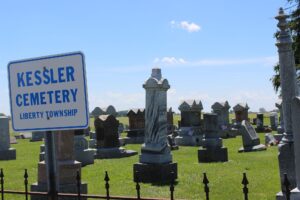
Jacob Kable, Kessler/Liberty Cemetery, Mercer County, Ohio. (2023 photo by Karen)

This is the tombstone of Jacob Kable, located in row 3 of Kessler, aka Liberty Cemetery, Mercer County, Ohio. The marker is inscribed:

JACOB KABLE
1865-1946

Jacob Kable was born in Mercer County, Ohio, on 8 March 1865, the first child born to Frederick (1817-1886) and Catharine (Koch) (1837-1911) Kable. Jacob’s parents were both German immigrants. Jacob was baptized at Zion Lutheran Church, Chattanooga, Ohio, on 9 April 1865, with Jacob Koch and his wife Christina serving as his baptismal sponsors.  

The Frederick Kable family in 1870, residing in Liberty Township, Mercer County: Frederick Kable, 52; Catharine, 33; Jacob, 6; Christina, 3; Frederick, 4 mo. Frederick was a farmer. [1]

The Frederick Kable family in 1880: Frederick, 64; Catharine C, 43; Jacob, 14; Christina, 12; Frederick, 10; and John 2. [2]

Jacob’s father Frederick Kable died 29 April 1886.

In 1900 Jacob resided with his widowed mother Catherine (Koch) Kable, 63, head, and three of his unmarried siblings: Jacob, 35, farmer; Christina, 33; Frederick, 30, farmer; and John, 23, schoolteacher. Jacob’s occupation was farm laborer. [3]

In 1910 Jacob, age 45, single, living alone, was enumerated as a farmer in Liberty Township. He owned his farm and his neighbors included his brother Frederick and his wife Mary Ann, the Frederick and Charles Bollenbacher families, George Painter, and Scudder Wilson. [4]

According to 1914 Mercer County plat maps, Jacob owned 40 acres in Liberty Township, the West half of the East half of the Southwest quarter of Section 20, located on east of State Route 49, between Frahm Pike and Kable Road. His brother Frederick owned the adjacent 40 acres to the east.

Jacob’s mother Catharine (Koch) Kable 5 July 1911.

Jacob Kable was enumerated on his Liberty Township farm in the 1920, 1930, and 1940 and was a general farmer. The enumerations indicate that he could read and write

Jacob Kable died at his home in Liberty Township, Mercer County, Ohio, on 10 January 1946, from complications of old age. He was 80 years, 10 months, and 2 days old. He was buried on the 12th. [5] 

Obituary:

Jacob Kable
Rockford, Jan. 12- Services were to be held at 2 p.m. Saturday at the home of a sister-in-law, Mrs. Mary Ann Kable, and at 2:30 at the St. Paul’s Evangelical and Reformed Church for Jacob Kable, 80, Liberty-tp, lifelong resident of Mercer-co, who died Thursday evening at his home after a long illness due to complication of age. Mr. Kable was a bachelor. One brother survives, John Kable of Decatur.
[6]

Jacob Kable had the following siblings:
Christina Kable (1867-1939), married John A. Baumgartner
Frederich Kable (1870-1934), married Mary Ann Wendel
Christian Friedrich Kable (1872-1876)
Katharine Kable (1876-1876) 
Johann Heinrich Kable (1877-1957), married Viola L. Baumgartner

[1] 1870 U.S. Census, Ohio, Mercer, Liberty, p.148B, dwelling 105, family 97, Fredrick Kable; Ancestry.com.

[2] 1880 U.S. Census, Ohio, Mercer, Liberty, ED 188, p.473B, dwelling 43, family 45, Frederick Kable; Ancestry.com.

[3] 1900 U.S. Census, Ohio, Mercer, Liberty, ED 85, p.6, dwelling 115, family 120, Catherine Cable [sic]; Ancestry.com.

[4] 1910 U.S. Census, Ohio, Mercer, Liberty, ED 119, p.3B, dwelling & family 58, Jake Kable; Ancestry.com

[5] “Ohio Deaths, 1908-1953,” Jacob Kable, 10 Jan 1946; FamilySearch.org.

[6] The Lima News, Lima, Ohio, p.2, 12 January 1946, Jacob Kable obituary; Ancestry.com.

1950 Census Test Form P11, Pleasant Township, Van Wert County

While getting information for the Herbert and Paulena Merkle Tombstone Tuesday post earlier this week, I noticed that they were enumerated using one of the 1950 census test forms that was used in selected areas of the country, one of those areas being Pleasant Township, Van Wert County, Ohio, where the Merkles lived.

The 1950 census was the last census in which most people were visited by an enumerator who used the multi-family form, Form P1. The format of Form P1 had been used for every census since 1850 and in 1950 it was used by the vast majority of areas in the United States. Those forms had 50 lines per page and listed a number of families with the names of all the individuals in a family, one name per line.

However, in 1950 different forms were tested in a very few selected Enumeration Districts in selected counties in Ohio and Michigan. These new forms were called “household” forms and one form was used for each household. Each family was enumerated on its own page, sometimes 2 pages if it was a large family. The forms were filled out by an enumerator in 1950, but today each family completes its own census form.

Van Wert County was one of those selected Ohio counties that used the test census forms in 1950. Some time ago I learned that the village of Willshire (ED 81-38) was selected to use a new form, but this past week I learned that parts Pleasant Township used yet another new form, Form P11.

Form P11, 1950 Census test form

This was the first time I had seen Form P11. The first part of Form P11 contains basically the same questions as the other test forms, but I found questions 40-76 to be quite interesting. They were questions about the family’s living quarters and some household items they owned and used.

Form P11, 1950 Census test form

The first of those housing questions asked about the type of living quarters:

  • Type of Living Quarters: (House/apartment/flat; Trailer; Tent/boat/railroad car; Non dwelling-unit in large rooming house, institution, hotel, tourist court)
  • Type of Structure: (Detached; Semidetached; Attached)
  • Number of dwelling units in structure
  • Business unit in the structure: (Yes/No)
  • Condition: (not DIP; DIP) [this may mean ductile iron pipe.]
  • Final count of persons living here: Have we missed anyone away traveling? Babies? Lodgers?
  • For a Vacant Unit: (Nonseasonal; Seasonal) (For rent?) (For sale only)
  • For Non-farm vacant units only: (If for rent: Monthly rent; If For sale: Sale price asked)

Questions beginning with no. 50 get more interesting:

  • When was this structure built?
  • How many rooms are there in your dwelling unit, not counting bathrooms?
  • What water supply do you have?
    • Hot and cold piped running water inside the building
    • Only cold piped running water inside the building
    • Piped running water outside the building
    • No piped running water or hand pump only
  • What type of toilet do you have?
    • Flush toilet inside the building
    • Flush toilet outside the building
    • Privy, outhouse, or chemical toilet
    • Have no toilet
  • Is toilet shared with any other household?
    • No, not shared with any other household
    • Yes, shared with another household
    • Have no toilet
  • Do you have an installed bathtub or shower (or both)?
    • Yes, for our own household’s use only
    • Yes, shared with another household
    • Have no bathtub or shower
  • Do you have a kitchen sink?
    • Yes, for our own household’s use only
    • Yes, shared with another household
    • Have no kitchen sink
  • Do you have electric lighting?
    • Yes
    • No
  • What type of refrigerator do you have?
    • Electric, gas, other mechanical refrigerator
    • Ice box or ice refrigerator
    • Other refrigeration
    • None
    • Vacant
  • How are your living quarters heated?
    • Piped steam or hot water
    • Warm air furnace
    • Other means-with flue
    • Other means-without flue
    • Not heated
    • Vacant
  • What fuel is used most for heating?
    • Coal or coke
    • Wood
    • Utility gas
    • Bottled gas
    • Liquid feud
    • Electricity
    • Other fuel
    • No cooking
    • Vacant
  • What fuel is used most for cooking? Check one box:
    • [Same fuel choices as above]
  • Is there a radio in these living quarters? (Yes; No)
  • Is there a television set in these living quarters? (Yes; No)
  • Do you own or rent these living quarters?
    • Own
    • Rent
    • Occupy rent free
  • If this is a farm household check the box below and skip the remaining items. This information will be reported on your Agriculture Questionnaire.
  • If you own these living quarters answer these questions:
    • How much would this property sell for?
    • How many separate dwelling units are included in this property?
    • Is there any mortgage (trust) on this property?
    • What is the monthly rent before these quarters?
    • In addition to rent, how much do you pay for each item:
      • Electricity
      • Gas
      • Water
      • Wood
      • Coal
      • Oil
    • Is this unit rented unfurnished or furnished?
    • If rented furnished, what would it rent for monthly if unfurnished?

About 60 Pleasant Township families were enumerated using this form and I summarized the findings of the housing questions of those families:

Most homes there were built before 1919 and most had between five and seven rooms. Most homes had hot and cold running water inside their house, but 2 homes had only cold pumped water and 18 households pumped their water by hand.

Most households had a flush toilet inside the house, but 20 households used a privy, outhouse, or chemical toilet. No household shared a toilet with another household.

Most households had an installed bathtub or shower, but 19 households did not. One household shared a tub or shower with another household.  

All but one household had a kitchen sink.

All households had electric lighting and warm air furnace heating. All but 2 households had an electric, gas, or other mechanical refrigerator. One of those two households had an ice box and the other had no refrigerator at all.    

Most used either coal or liquid fuel for heating and bottled gas or electricity for cooking.

All but one household had a radio and none of the households had a television set.

Although most Pleasant Township households had some modern conveniences in 1950, some of the country households did not. One particular household used a privy or outhouse, had no tub or shower, no kitchen sink, used coal for their heat source, and hand-pumped their water for household use. However, they did have electric lighting, an electric refrigerator, and a radio. Their mortgaged house was worth about $5000.

As for the Herbert Merkle household, which started this whole subject, they resided in a 7-room home built before 1919, hand-pumped water for their house, and had no installed bathtub or shower. They did have electric lighting, an electric refrigerator, and a radio. They used coal to heat their home and cooked with liquid fuel. They owned their home and did not have a mortgage.

Herbert & Paulena Merkle household, 1950 Census, Form P11

How interesting to look back to 1950.