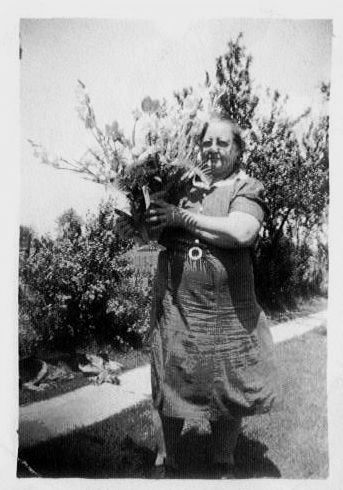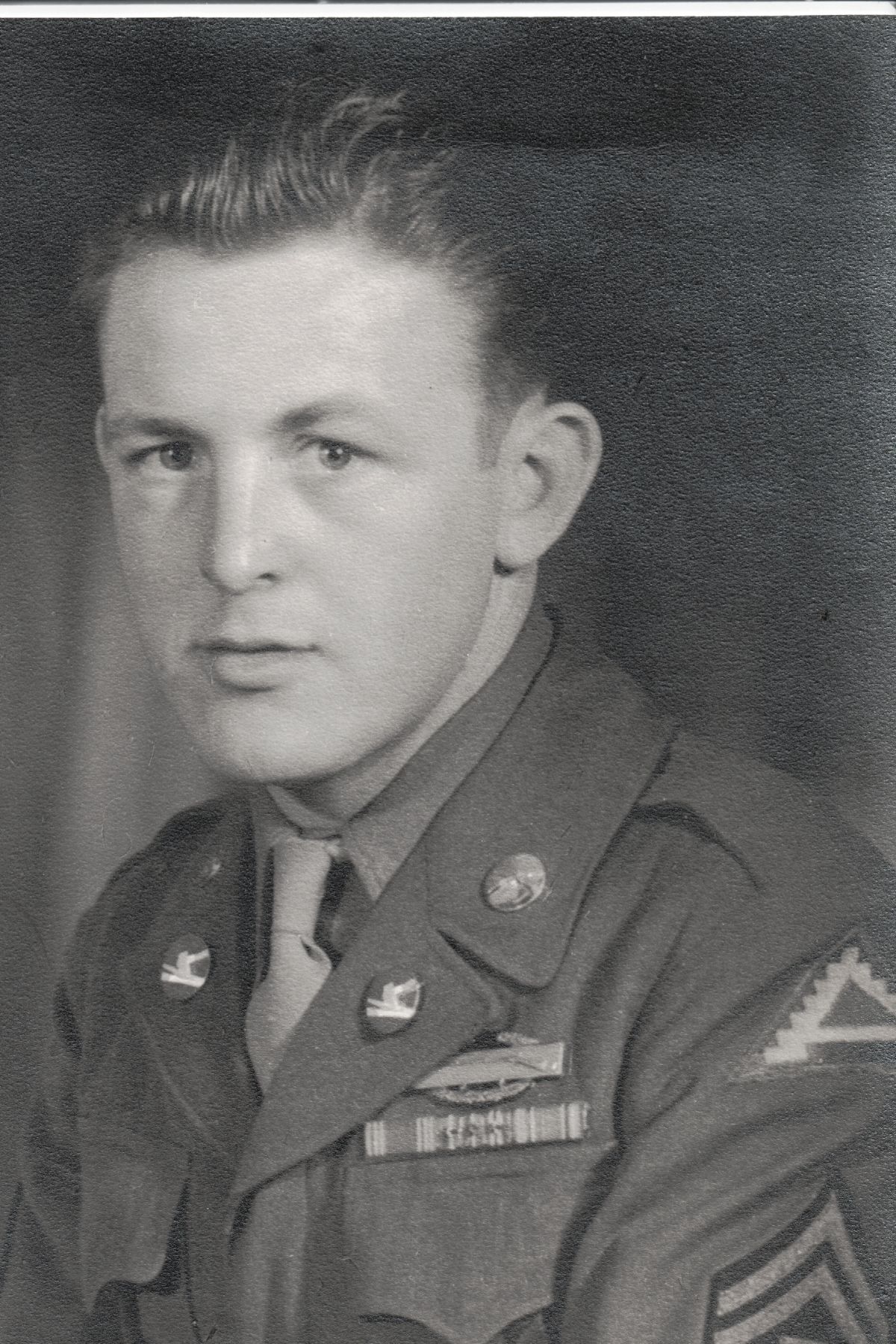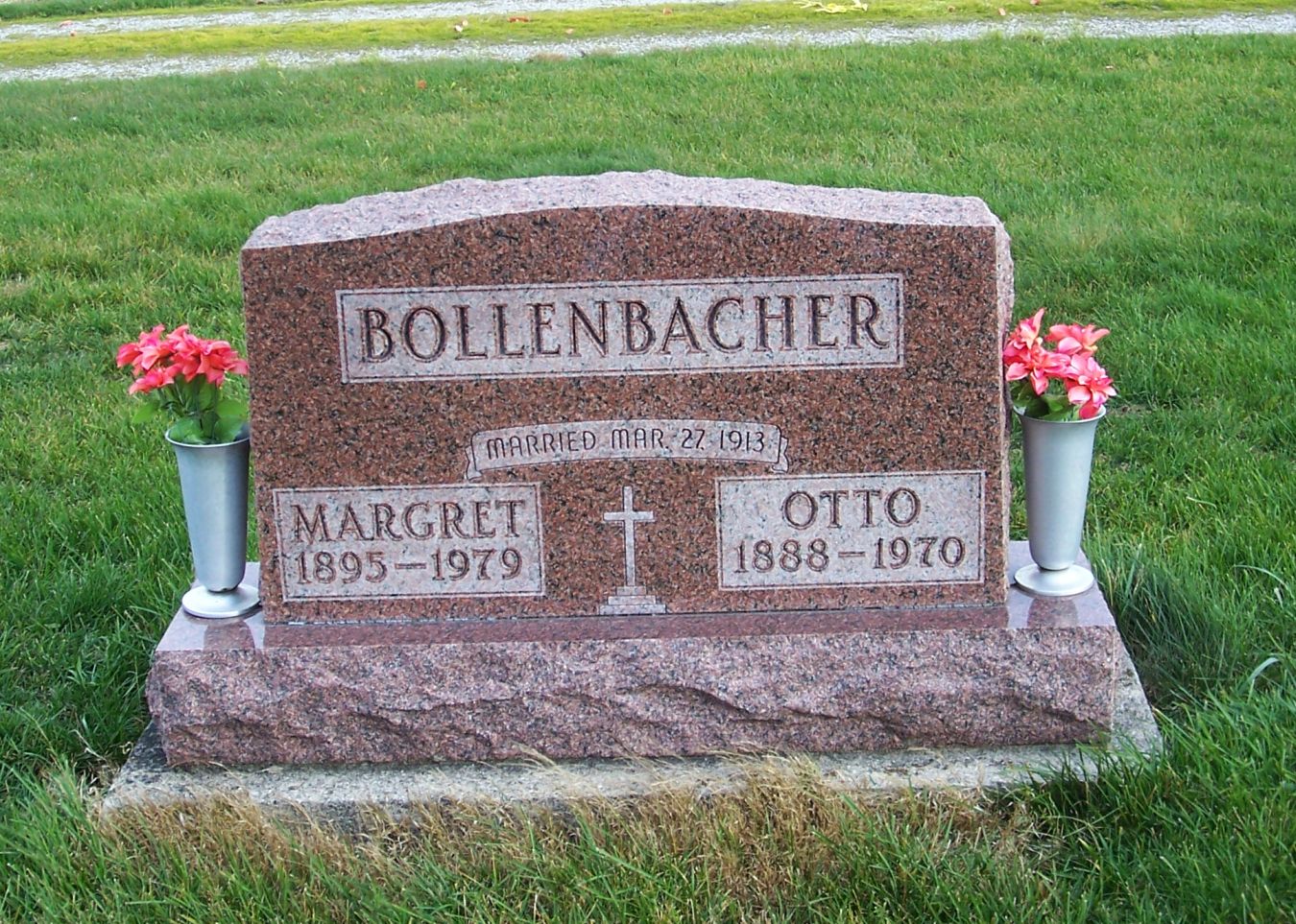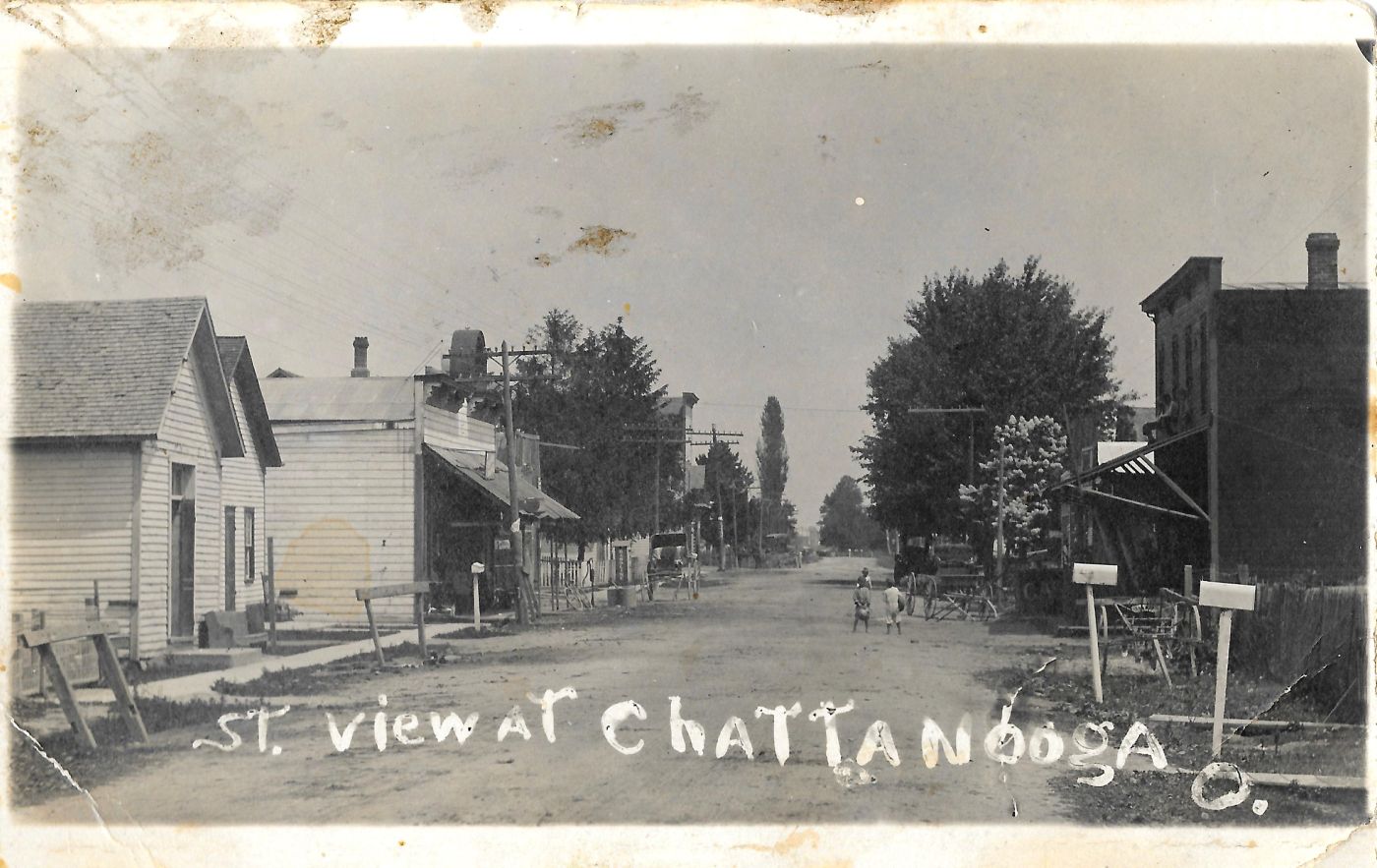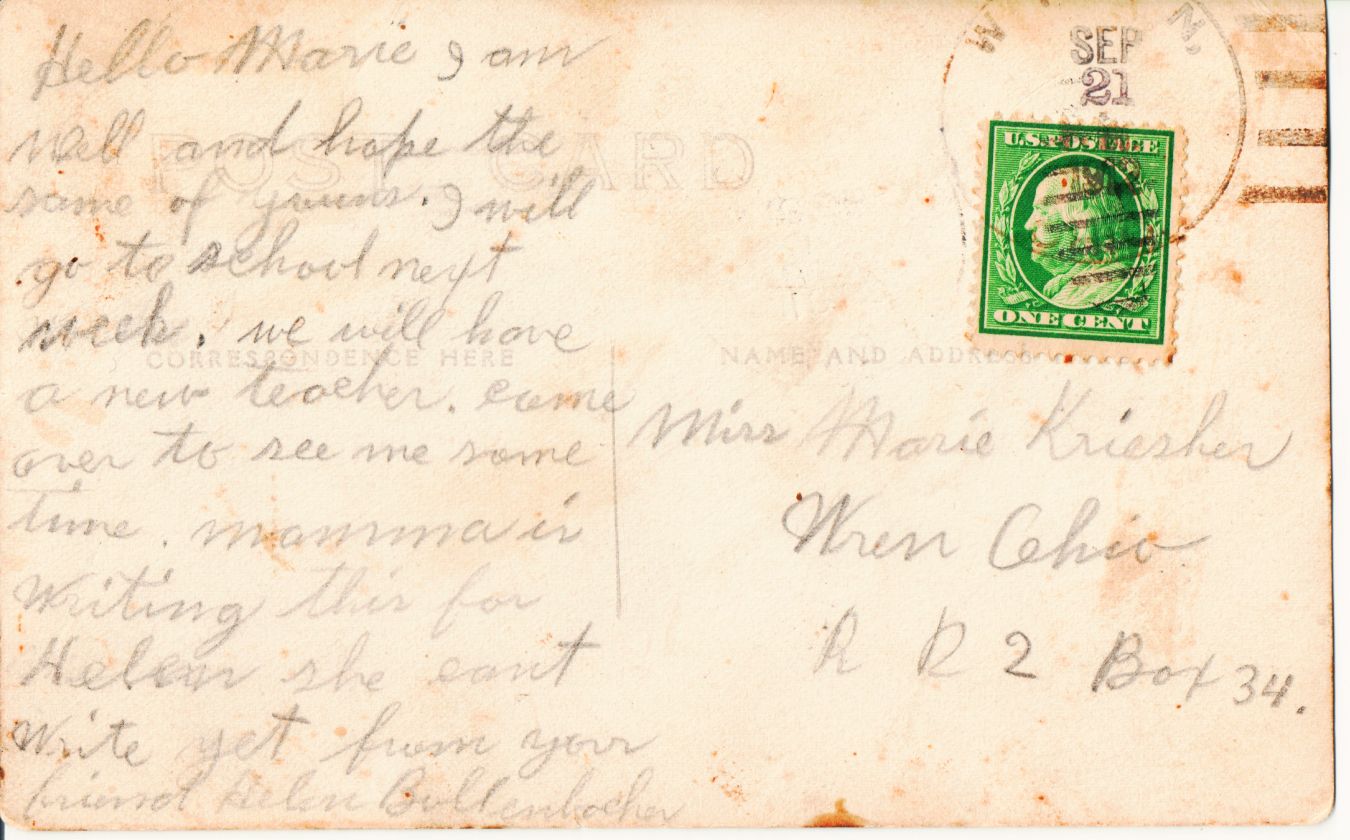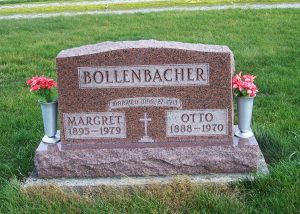
Otto & Margret (Schott) Bollenbacher, Zion Lutheran Cemetery, Mercer County, Ohio. (2011 photo by Karen)
This is the tombstone of Otto and Margret (Schott) Bollenbacher, located in row 10 of Zion Lutheran Cemetery, Chattanooga, Mercer County, Ohio. The marker is inscribed:
BOLLENBACHER
Margret
1895-1979
Otto
1888-1970
Married March 27 1913
Otto Bollenbacher was born 28 February 1888 in Liberty Township, Mercer County, Ohio. His mother Louisa Bollenbacher married Frederick Berron on 26 November 1889. His mother suffered with epilepsy most of her life which made it difficult to care for Otto and his three half-sisters. Some of them, including Otto, were likely raised by family or friends. Louisa died on 5 May 1911.
Otto Bollenbacher married Margret “Maggie” Schott on 27 March 1913 at Zion Chatt. They were married by Zion’s Rev. Lincoln Luther Loehr and Mrs. Loehr served as their witness.
Maggie Schott was born in Liberty Township, Mercer County, on 5 March 1895, the daughter of Michael August and Margarethe Olga (Kuehm) Schott. She was baptized Margaretha Olga Schott on 24 Mar 1895 at the home of her parents. Her baptismal sponsors were Katharine Hoehamer, Lene Kuehm, and George Berron.
Shortly after their marriage Otto and Maggie lived about a mile south of Chatt, between Schaadt and Oregon Roads, but by 1920 they were living in Adams County, Indiana. Their household in 1920 Otto, 31; Maggie, 24; Arveda, 5; and Marguerite A. Letterman, 12, niece. Otto was a farmer. [1]
By 1930 Otto and Maggie had two more children, a son, LeRoy, and a daughter, Marjorie. The Otto Bollenbacher household in 1930: Otto, 42; Maggie, 37; Arveda, 16; LeRoy, 9; and Marjorie, 4 months. They rented their Adams County home and Otto farmed. [2]
Between 1935 and 1940 Otto and his family moved from rural Adams County, Indiana, to Liberty Township, Mercer County, Ohio. They owned their home in Mercer County and Otto was a farmer. Living with them was Maggie’s widowed mother. Their household in 1940: Otto, 52; Maggie, 44; LeRoy, 19; Margery, 10; and Margaret Schott, 84, mother-in-law. [3]
Otto died at Parkview Hospital in Fort Wayne on 12 February 1970 from injuries he sustained in an automobile accident a few days before, near Chattanooga, Ohio. He was 81 years old and resided in Willshire. According to his death certificate he sustained severe lacerations and a fractured left leg. Zwick’s in Decatur was in charge of the funeral arrangements and his son LeRoy Bollenbacher was the informant for the information on his death certificate. [4] Otto was buried on the 15th and Zion’s Rev. Ralph Hershberger was in charge of the service. Otto was survived by his wife, a son, and 2 daughters.
Otto’s obituary:
Crash Injuries Claim Life of Willshire Man
Willshire—Injuries suffered in a two-car accident Sunday noon in Chattanooga have proved fatal for Otto Bollenbacher, 81, of Willshire.
Mr. Bollenbcher was a passenger in a car driven by his wife Margaret, which figured in the accident. The couple was enroute home from church when the accident occurred.
Mr. Bollenbacher was taken to Adams County Memorial Hospital, Decatur, Ind., following the accident and was later transferred to Parkview Memorial Hospital, where he died at 9:15 a.m. Thursday.
He was born Feb. 28, 1888, in Mercer County and he and his wife lived in that vicinity until ab out two years ago when they moved to Willshire.
A retired farmer, he was an active member of the Zion Lutheran Church at Chattanooga.
Survivors include his widow, the former Margaret Schott, whom he married March 27, 1913, two daughters, Mrs. Lawrence (Arveda) Purdy of Rt. 1, Celina, and Mrs. George (Marjorie) Eckrote of Rt. 2, Berne, Ind.; a son, Leroy of Rt. 1, Willshire; three half-sisters, Mrs. Frieda Kreischer of Van Wert, Mrs. Edward (Hulda) Becher of Lakeville, Ind., and Mrs. Emma Zehr of Harlan, Ind.; seven grandchildren and four great-grandchildren.
Funeral services will be at 1:45 p.m. Sunday at Zwick Funeral Home in Decatur and at 2:30 p.m. Sunday in the Zion Lutheran Church. The Rev. Ralph Hershberger will officiate. Burial will be in the church cemetery.
Friends may call at the funeral home after 7 p.m. today.
The family has requested that those who wish may make memorials to the church improvement fund. [5]
According to Zion Chatt’s records Maggie Schott died of cancer on 29 June 1979 in Van Wert County, Ohio. She was buried on 1 July and Zwick’s was in charge of the funeral arrangements.
Otto and Maggie Bollenbacher had the following children:
Arveda (1914-2001), married Lawrence Purdy
LeRoy Michael (1920-1974), married Nora Buchannan.
Marjorie Ilene (1929-2003), married George Eckrote
[1] 1920 U.S. Census, Jefferson, Adams, Indiana, ED 4, p.7B, dwelling 144, family 154, Otto Bollenbacher; Ancestry.com; NARA microfilm T625, roll 420.
[2] 1930 U.S. Census, Jefferson, Adams, Indiana, ED 4, p.3A, dwelling & family 49, Otto Bollenbacher; Ancestry.com; NARA microfilm T626.
[3] 1940 U.S. Census, Liberty, Mercer, Ohio, ED 54-22, p.3B, family 60, Otto Bollenbacher; Ancestry.com; NARA microfilm T627, roll 3114.
[4] Indiana, Death Certificates, 1899-2011, Otto Bollenbacher, 12 Feb 1970; database on-line, Ancestry.com, accessed 7 May 2018; Indiana Archives and Records Administration, Indianapolis, Indiana, Year 1970, roll 2.
[5] Van Wert Times Bulletin, Van Wert, Ohio, 13 Feb 1970, p.1; digital images, Ancestry.com.