Hunting

It is hunting season and we hear and see the hunters around here.

We are not hunters. We have nothing against hunting. We just do not hunt, except for occasionally getting rid of a destructive, pesky varmint such as a groundhog or muskrat. Actually, I don’t know if bagging them is even considered hunting, but Joe used to like to shoot rats in a corn crib and shoot groundhogs.

My grandma Schumm really disliked groundhogs. Quite a few of them had burrowed under their old barn and she invited Joe to come over and shoot them any time he wanted. And he happily obliged.

My dad didn’t hunt and I don’t think that his father Carl was a hunter either. At least not during my lifetime.

But my grandpa Schumm was a hunter.

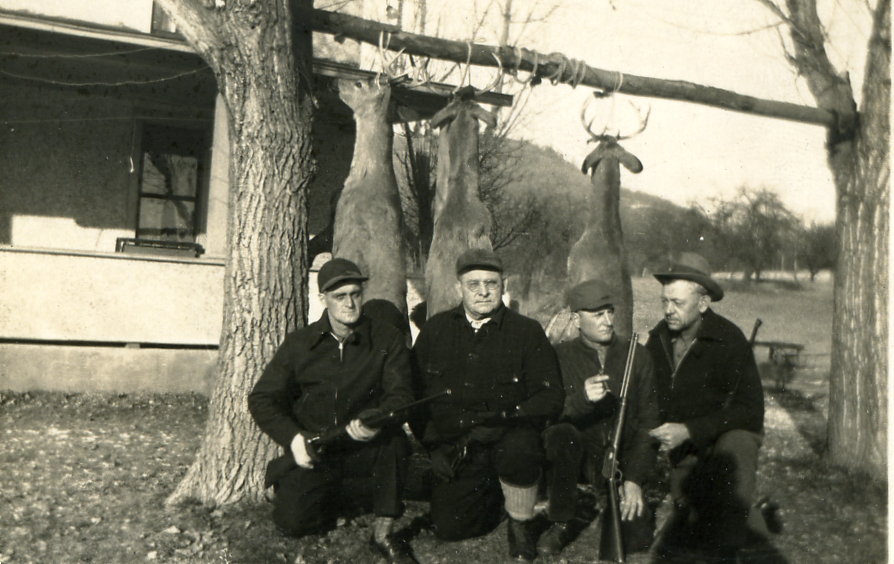
Cornelius L. Schumm, far left.

I found this photo of my grandpa, Cornelius Schumm, with three other men and the deer they shot. I do not know when the photo was taken. Grandpa was born in 1896 and it is hard to tell how old he was in the photo. Maybe someone recognizes the other men in the photo or recognizes the house. It would be interesting to know who they were. Who grandpa hunted with.

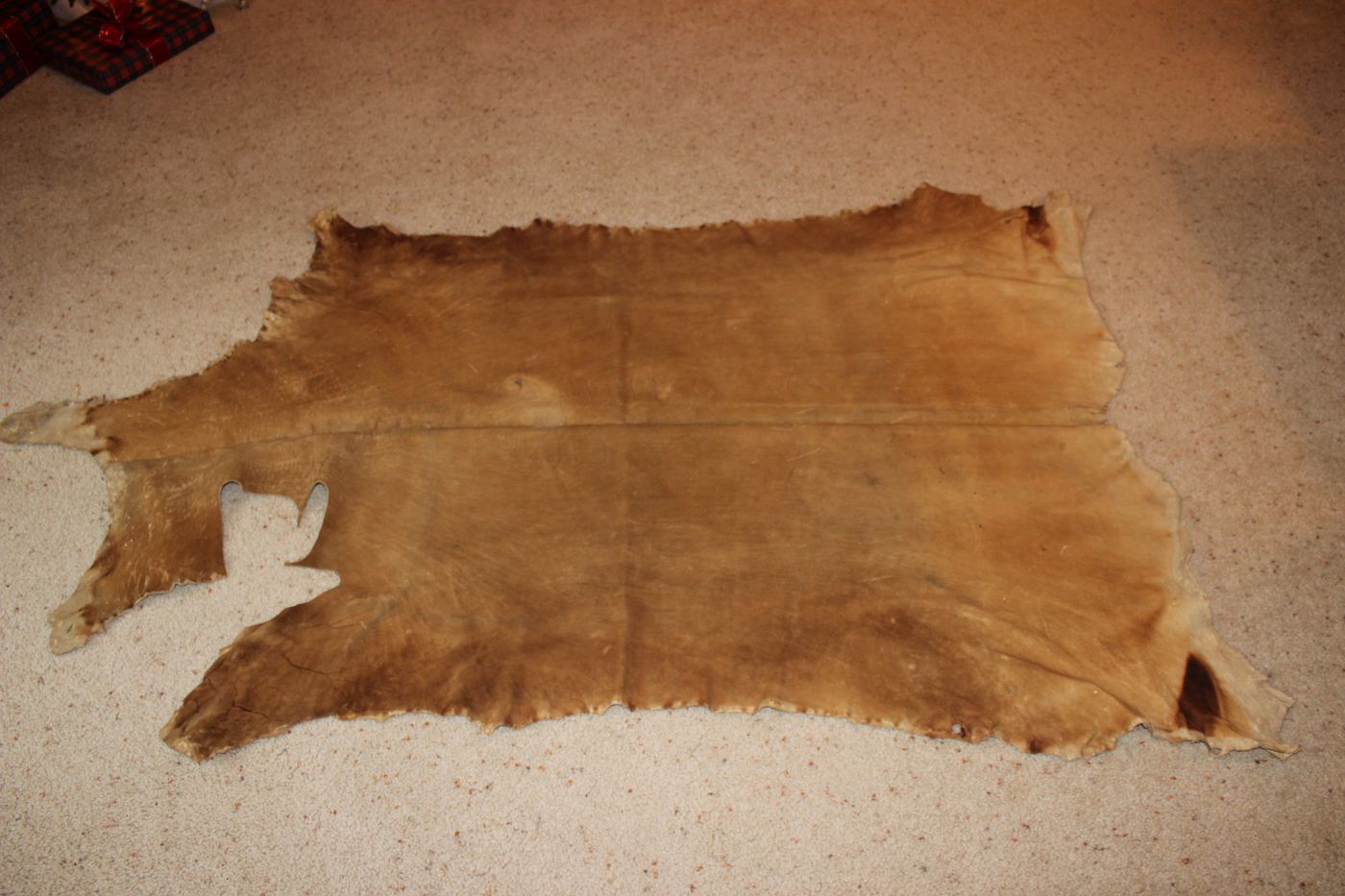
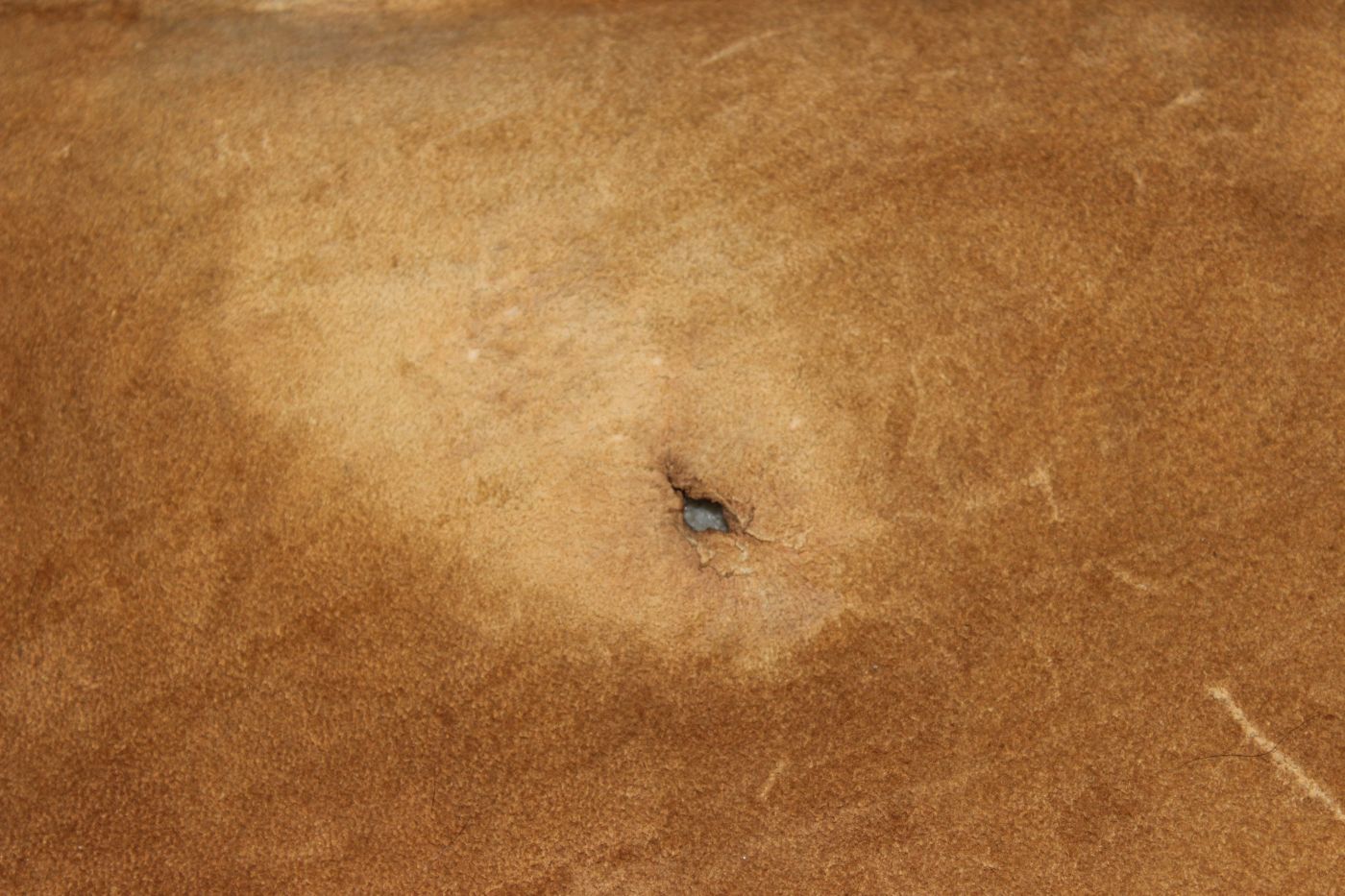
When we went through things at my mom’s house we found this old deer skin. It has a hole in it, likely from the bullet hole or arrow puncture. Perhaps it is one of the deer in the above photo.

Deer skin.

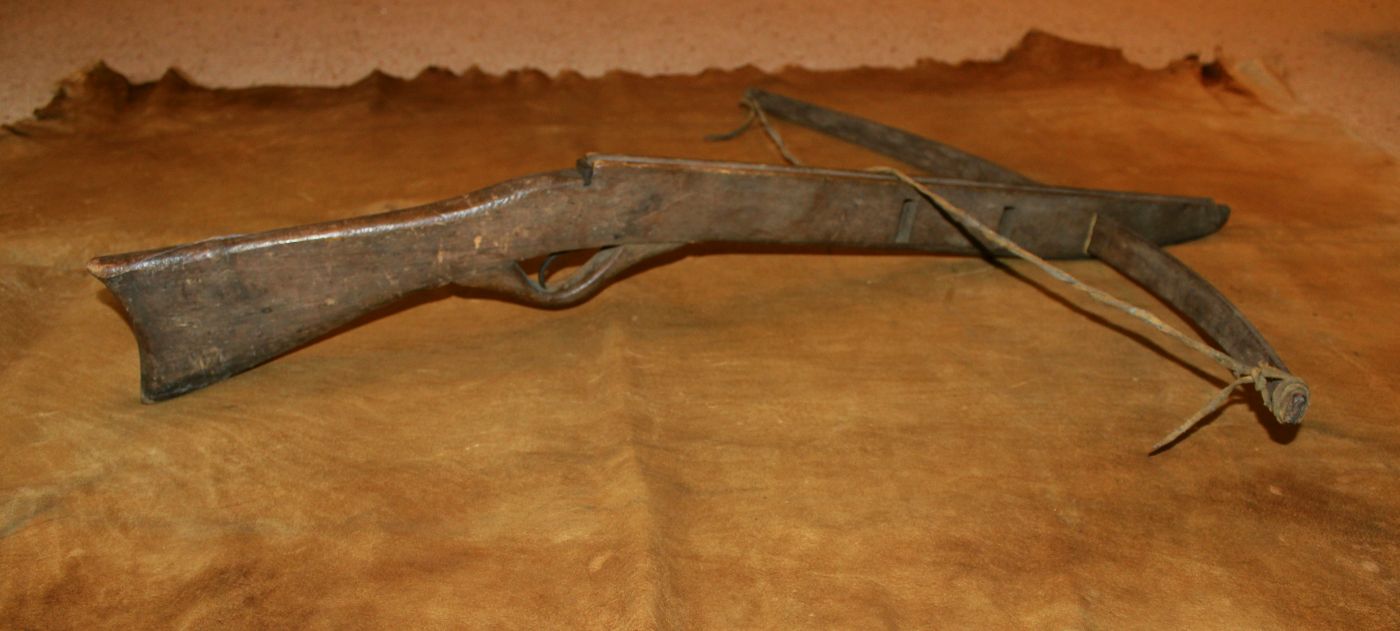
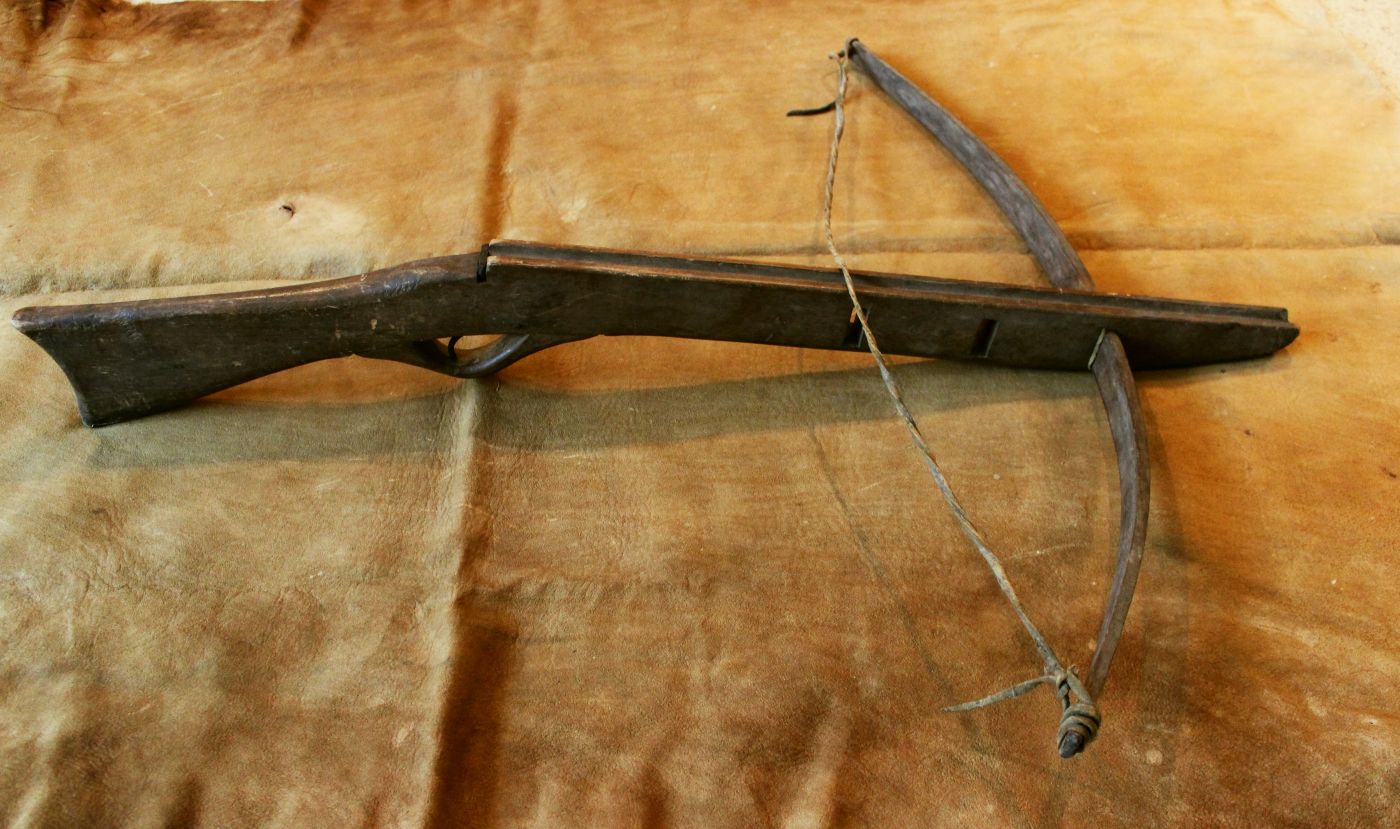
Below is an old bow that belonged to my grandpa Schumm or maybe his father Louis. I do not know how to date something like this so it may be older than I think. It looks like it may have been homemade and maybe one of them made it. I do not know if it was even usable or perhaps it was a toy. It is interesting, nevertheless.

Old wooden bow.

The farther back in time you go the more families had to rely on wild game for their food.

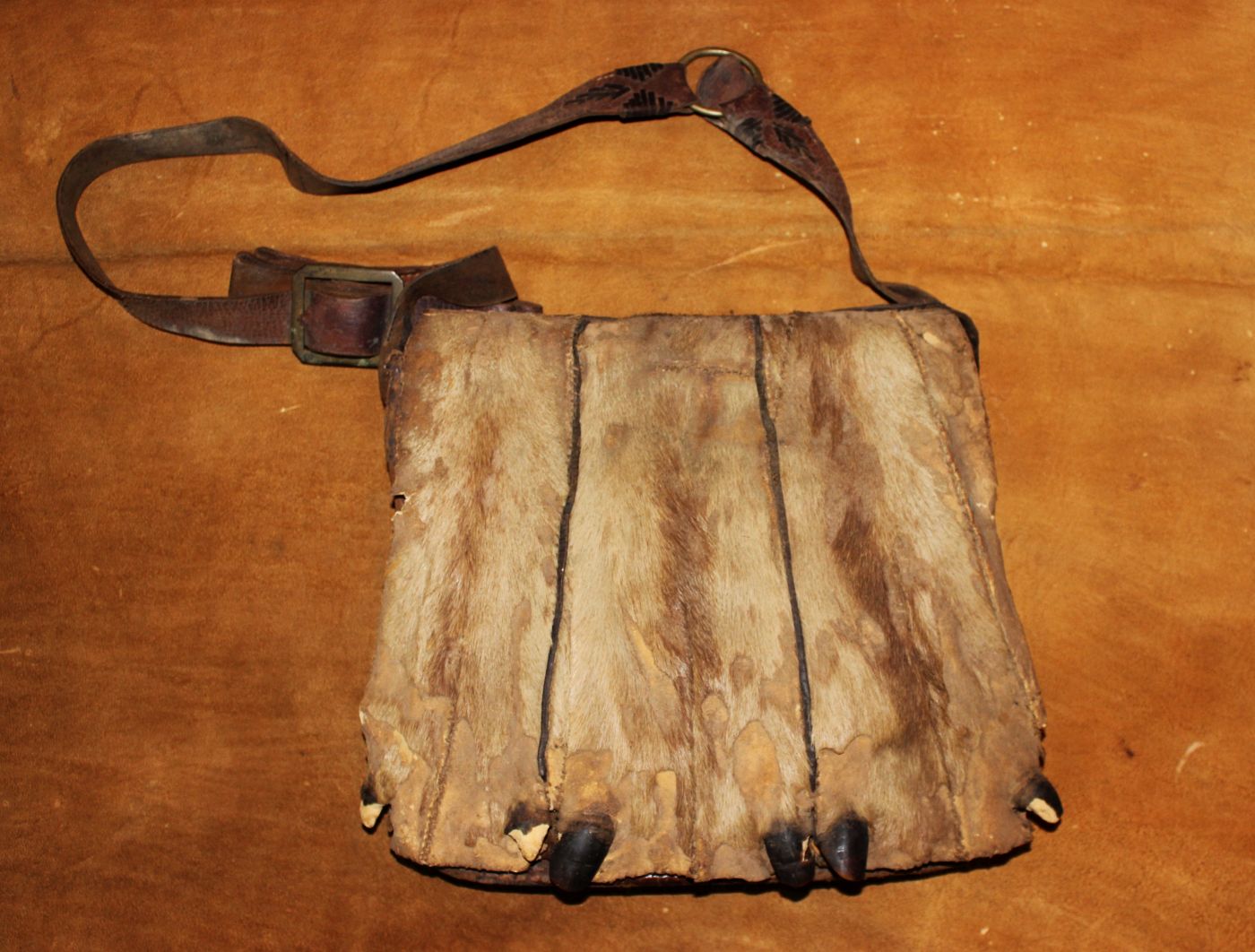
Louis Breuninger’s black powder hunting pouch.

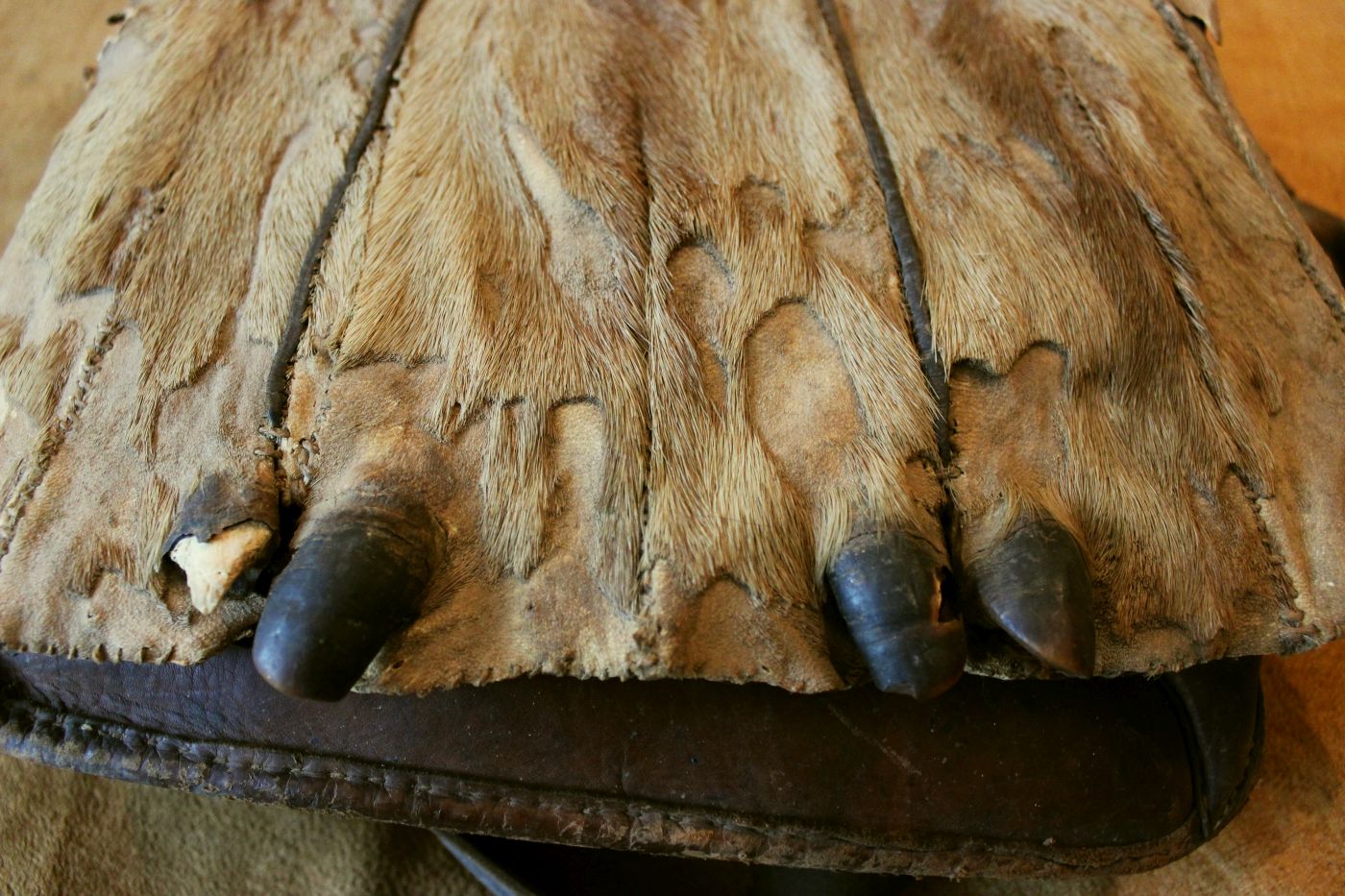
My grandpa Schumm’s grandfather, Louis Breuninger (1819-1890), was a hunter. He had this very interesting black powder hunting pouch with two gun powder flasks and a cloth pouch with some shot still inside. The large pouch appears to be made from an animal claw. Maybe from a bear? He lived in Wisconsin for several years before moving to the Schumm area, so it could be from an animal up there. One of the powder flasks is made of metal and the other appears to be bone. [Note: Thanks to a reader who informed me that the pouch is made from deer legs. Good to know!]

Louis Breuninger’s black powder hunting pouch.

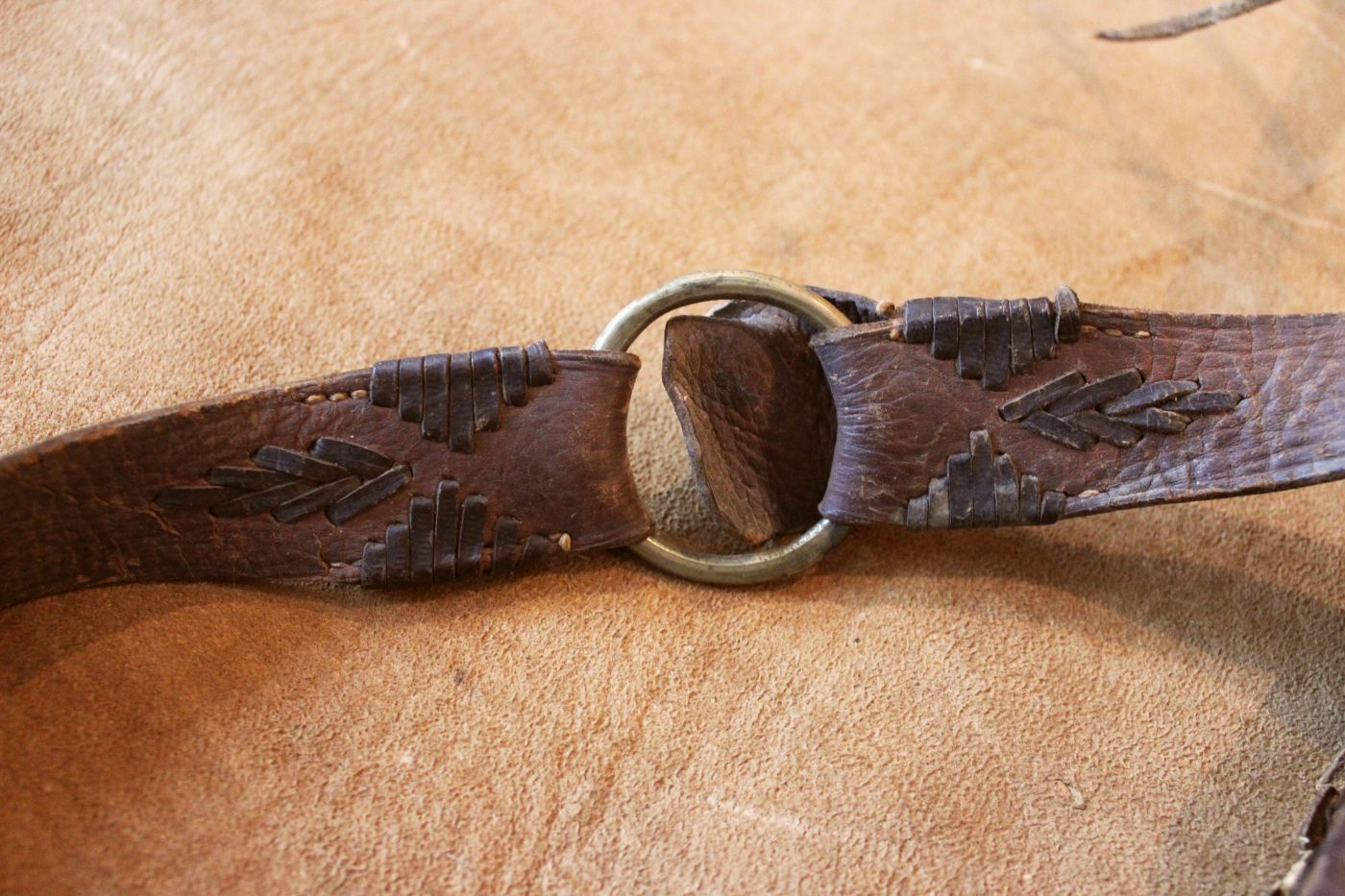
There is some decorative braiding on the leather strap.

Strap of black powder pouch.

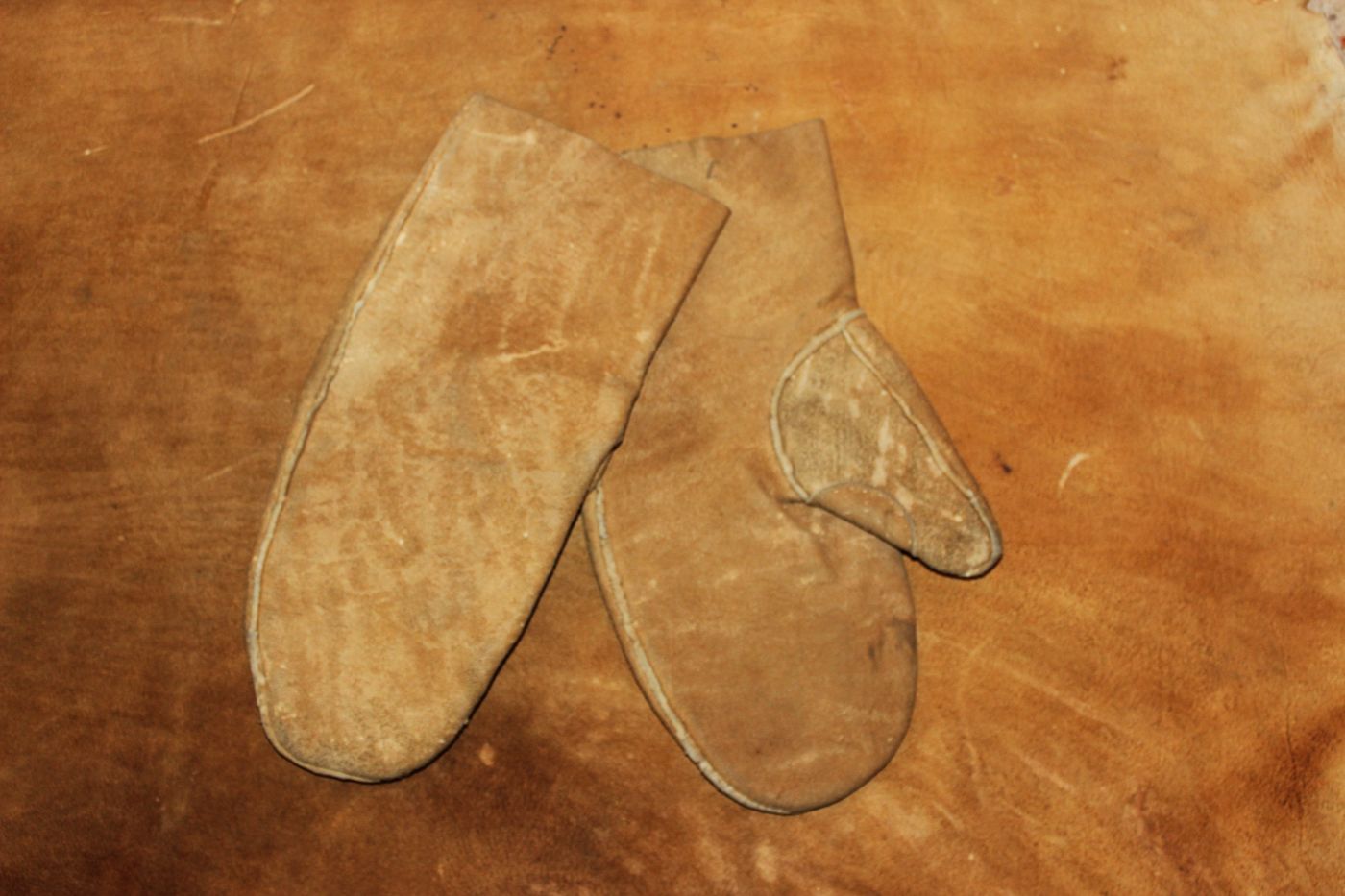
I also have a pair of mittens, made from some animal skin.

Old animal skin mittens.

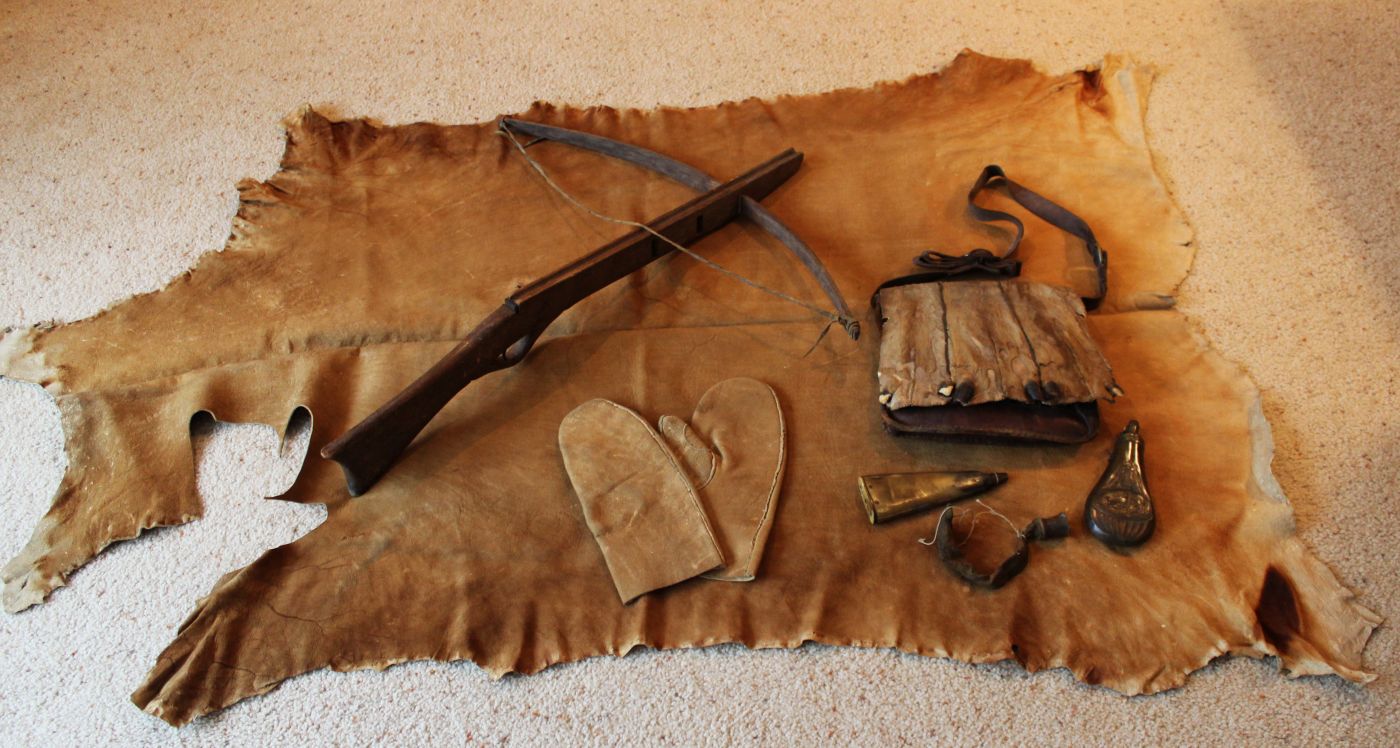
The whole collection:

Some real pioneer items!

Tombstone Tuesday–Luther Weissenborn

Luther Weissenborn [Weisenborn], Zion Lutheran Cemetery, Schumm, Van Wert County, Ohio. (2012 photo by Karen)

This is the tombstone of Luther Weissenborn, located in row 1 of Zion Lutheran Cemetery, Schumm, Van Wert County, Ohio. The marker is inscribed:

Luther Weissenborn
Gestorben
Den 8 Mai 1864
Alter
17 Y. 7 M. 19 T.

Luther Weissenborn died 8 May 1864, age 17 years, 7 months, and 19 days.

This surname is usually spelled Weisenborn, the spelling I will use in this post.

Luther Weisenborn appears to be the only Weisenborn mentioned in Zion Schumm’s records and according to their records he was born 19 September 1846. The record does not give the names of his parents, but they may have been John “Christoph” and Mary Catharine (Schüt) Weisenborn. Zion Schumm’s records agree with his tombstone inscription, that he died on 8 May 1864 at the age of 17 Years, 7 months, and 19 days. Luther drowned while fishing and was buried on the 9th.

In 1850 and 1860 Luther Weisenborn was living with John Christoph and Mary Catharine Weisenborn, but those census enumerations do not give the family relationships. He could have been a relative and not their son. Find a Grave.com indicates that his parents were likely John Christoph and Mary Catharine Weisenborn.

The John C. Weisenborn family lived in Morrow County, Ohio, in 1850. Their household in 1850: John C, 32, Germany; Catherine, 23, Germany; and Luther, 3, Ohio. The father John was a farmer. [1]

By 1860 John C. Weisenborn and his family had moved to Auglaize County, Ohio: John, 42, Prussia; Mary C, 31, Baden; Luther, 13, Oh; John M, 4, OH; John F, 2, Oh; Mary, 2 months, Oh. The family had a post office address of St. Johns and the father John was a farmer. [2]

Sometime between 1860 and 1870 the Weisenborn family moved to Liberty Township, Mercer County, Ohio. The John Weisenborn household in 1870: John, 53; Mary, 43; John M, 13; Louisa, 13; John F, 9; and John H, 4. The parents were born in Germany and the children in Ohio. The father John [Christoph] farmed. [3]

This is probably the same J. Weisenborn family that resided in Section 18 of Liberty Township, Mercer County, as seen in the 1876 and 1888 Mercer County plat maps. They would have lived a couple miles south of Chatt and would explain why the father John [Christoph] Weisenborn is buried in Kessler Cemetery. Godfried Wisenborn is also buried nearby in Kessler Cemetery and could be another family member.

Since I saw that they lived near Chatt I checked Zion Chatt’s records and see that the “Christoph Wissenborn” family attended church there in the mid-1860s and later. Their records indicate that Christoph was married to Mary Catharine (Schüt). Their son John Herman Weisenborn was baptized at Zion Chatt in 1865 and son John Martin was confirmed there in 1871. Christoph and Mary Catharine were from Niederdorla, Thuringen, and Grossherzogtum, Baden, respectively.

[1] 1850 U.S. Census, Bennington, Morrow, Ohio, p.56B, dwelling 802, family 814, John C. Weisenborn; digital image by subscription, Ancestry.com (https://search.ancestry.com/search/db.aspx?htx=List&dbid=8054&offerid=0%3a7858%3a0 : viewed 25 Nov 2018).

[2] 1860 U.S. Census, Union, Auglaize, Ohio, p.377, dwelling 1104, family 1068, John Weisenborn; digital image by subscription, Ancestry.com (https://search.ancestry.com/search/db.aspx?htx=List&dbid=7667&offerid=0%3a7858%3a0 : viewed 25 Nov 2018).

[3] 1870 U.S. Census, Liberty, Mercer, Ohio, p: 148A, dwelling 96, family 88, John Wisenbaur; digital image by subscription, Ancestry.com (https://search.ancestry.com/search/db.aspx?htx=List&dbid=7163&offerid=0%3a7858%3a0 : viewed 26 Nov 2018).

Happy Thanksgiving!

Happy Thanksgiving from Karen’s Chatt!

Wishing each one of you a blessed and happy Thanksgiving. May your home be filled with happiness and joy and thankfulness as you gather with family and friends today.

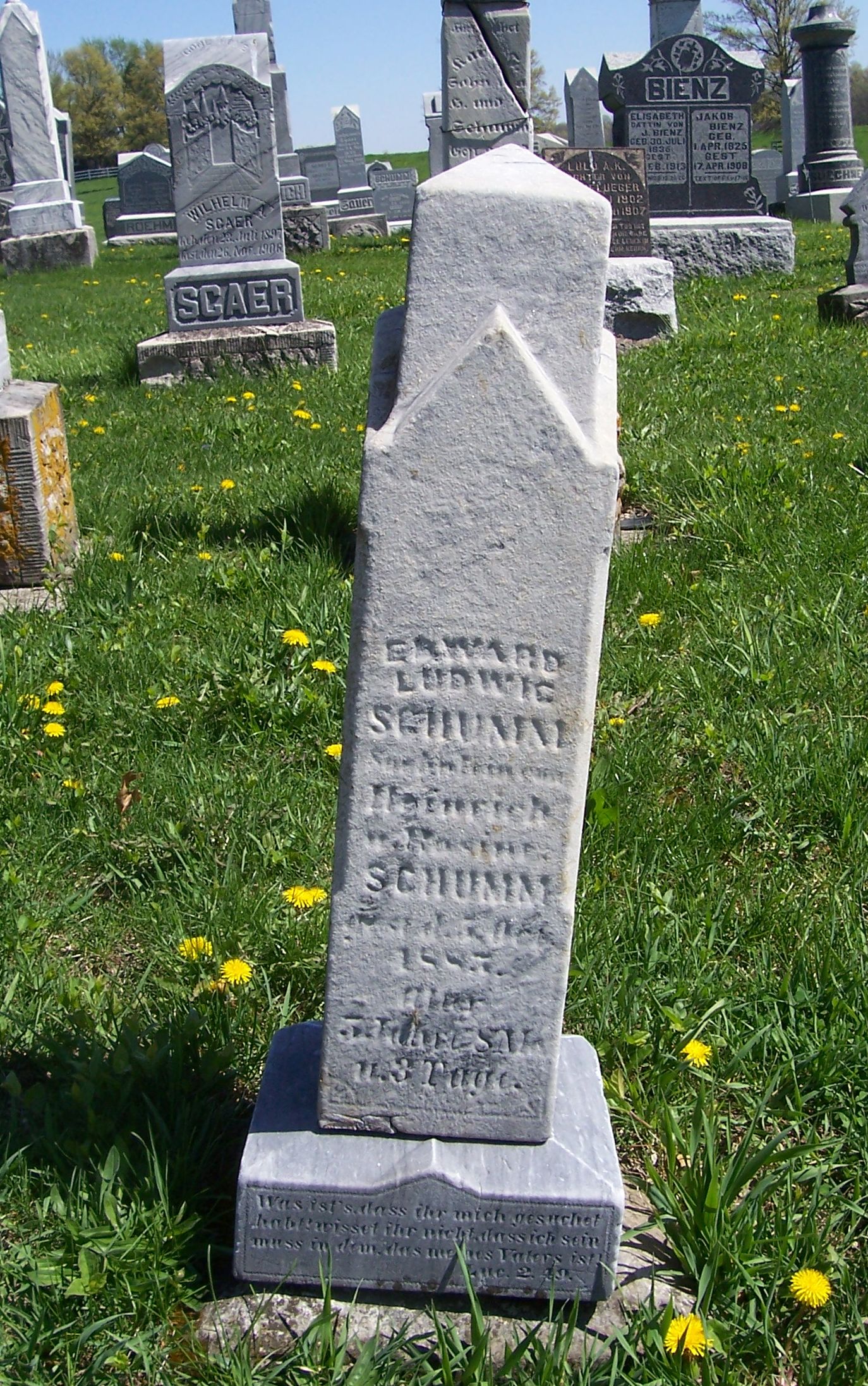
Tombstone Tuesday–Edward Ludwig Schumm

Edward Ludwig Schumm, Zion Lutheran Cemetery, Schumm, Van Wert County, Ohio. (2012 photo by Karen)

This is the tombstone of Edward Ludwig Schumm located in row 1 of Zion Lutheran Cemetery, Schumm, Van Wert County, Ohio. The marker is inscribed:

Edward
Ludwig
Schumm
Sohnlein von
Heinrich
u. Rosina
Schumm
Died 5 Oct.
1885
Alter
5 Jahre, 8 Mo.
u. 3 Tage.

Edward Ludwig Schumm, little son of Heinrich and Rosina Schumm died 5 October 1885, aged 5 years, 8 months, and 3 days.

Edward Ludwig Schumm was born 2 February 1880 to Henry and Rosina (Schinnerer) Schumm.  He was baptized at home on 15 February 1880, with Friedrich Schinnerer and Ludwig Schumm serving as sponsors. Friedrich Schinnerer was most likely the boy’s grandfather and Ludwig Schumm was likely his uncle. His sponsors would have been my great-great-grandfather and my great-grandfather respectively.

Edward Ludwig Schumm was enumerated in one census, the 1880 census, when he was only 4 months old. The Henry Schumm household in 1880: Henry, 35; Rosann A, 26; John C, 6; Clara R E, 4; William M M, 3; Hanah M, 2; and Edward L, 4 months. [1] The father Henry was a farmer.

Little Edward Ludwig Schumm died at 3:00 in the morning of 5 October 1885. He was only 5 years, 8 months, and 3 days old. He was buried on 6 October and his funeral text was Luke 2:49. The literal translation of the Zion Schumm’s records indicate that he died of a sore throat.

The father Henry Schumm was referred to as Heinrich Schumm I in Edward’s church death record, but in the Schumm family he is known as River Henry. There were several Henry Schumms living in the area at that time and to easily differentiate them, this Henry was called River Henry because he lived along the St. Marys River, just east of Willshire.

Henry Schumm and I descend from the same branch of the Schumm family, which is my maternal line. Henry’s parents were immigrants George “Ludwig” and Maris Barbara (Pflueger) Schumm, who were my second and third great-grandparents. And, Henry’s wife Anna “Rosina” Schinnerer was the daughter of my second great-grandfather Friedrich Schinnerer and his first wife Margaretha “Mary” Deier. They were both immigrants, too.

Henry and Rosina Schumm had 10 children before Rosina’s death in 1890. The next year Henry married Lena Geisler and they eventually had 3 children of their own.

In interesting side story about this family is that my paternal great-grandmother Christina (Rueck) Miller stayed with the River Henry Schumm family in the early 1880s. My great-grandmother Christina undoubtedly knew their son Edward Ludwig and probably even took care of him from time to time. In fact, Christina’s daughter Maggie was only about a year older than Edward Ludwig and the two children probably played together.

Christina Rueck had immigrated with her family in about 1880 and her father purchased 80 acres along the St. Marys River, close to where River Henry lived. Christina’s father sold that land and moved to Oregon in about 1882 but Christina stayed behind in Van Wert County, with the Schumms, and eventually married immigrant Jacob Miller, who lived in the Chatt area. During the time Christina stayed with the Schumms, Rosina (Schinnerer) Schumm taught Christina how to quilt, something Christina enjoyed doing the rest of her life. In fact, I have two quilts that Christina and Rosina worked on together, stitched in the early 1880s.


[1] 1880 U.S. Census, Willshire, Van Wert, Ohio, ED 154, p. 443A, dwelling/family 4, Henry Schumm; digital image by subscription, Ancestry.com  (https://search.ancestry.com/search/db.aspx?htx=List&dbid=6742&offerid=0%3a7858%3a0 : accessed 19 Nov 2018).

Linthal, France, Honors WWI Fallen Americans

This past week, on 11 November, marked the 100th anniversary of Armistice Day, the official end of WWI.

In last week’s blog post I mentioned Private August Froning, a soldier from Mercer County, Ohio, who was killed in action in the Vosges Mountains, near Linthal, France, during WWI. Froning and Venedocia native Private Glenn Homer Nichols both served in the 54th Army Infantry and were among nearly 50 soldiers killed near Linthal in September 1918. The fallen were buried in their temporary military cemetery of Oberlauchen. [1]

A Centennial Commemoration was held at that temporary military cemetery at Oberlauchen on 29-30 September of this year to honor the American soldiers killed in action near their town and to restore a monument to those soldiers that had been destroyed by the Nazis during WWII. Over a thousand people took part in this year’s memorial events that included the inauguration of a monument, a celebration of peace, an exhibition, a concert, and ceremonies with the schools.

Linthal, France, 3 Oct 2018

I want to thank all those that planned and participated in this Centennial Commemoration, and a special thanks to Hubert Martin, of Linthal, France, for honoring our two local servicemen and the other American soldiers killed near his home town. This past week Martin sent me 2 newspaper clippings about the event. You can see the nice monument they dedicated. I used Google Translate to translate the news articles since I do not know any French. Although it is a literal translation, you still get a very good idea of what took place at the memorial event.

[Note: a “stele” is an upright stone slab or column decorated with figures or inscriptions.]

Source: Linthal,France, Thursday 4 Oct 2018:

Linthal, France, 4 Oct 2018.

Photo caption: The president of the Guebwilleroise Section of the French Souvenir, Gilbert Meyer, and the students of Haut-Florival laid a wreath in memory of American fighters who had fallen on the Vosges mountains. 

Linthal Great War
A stele for American soldiers 

A stele recalling the sacrifice of American soldiers on the Vosgean peaks in 1918 was inaugurated last weekend at the Oberlauchen pass.

It was a small injustice that was repaired: in June 1940, during the invasion of Florival by the troops of Nazi Germany, the various memorial sites erected after the First World War had systematically been destroyed. Most of the monuments had subsequently been replaced. Only the ephemeral Franco-American cemetery in Oberlauchen (near the Breitfirst, about 1200 m away) was still deprived of a visible place of remembrance.

Various memory associations have seized the file, commemorations of the centenary of the Great War being an ideal pretext to repair this oversight. At the origin of this collective project, the Guebwilleroise section of the French Souvenir, the memorandum association Amitie Florival – Magnoac – Tregor and Alsace – United States-Haut-Rhin.

We wanted to pay tribute to the 113 American soldiers who died on the peaks during the fighting from July to October 1918, detailed the associative leaders. We found some of their family members across the United States. Texas, New Jersey, Florida. 

Saturday morning, the stele was inaugurated in the presence of many elected, military, members of associations and schoolchildren associated with the event. A major American delegation was attending the event, led by Kara McDonald, US Consul General in Strasbourg: relatives of fallen soldiers on the site, including former Texas senator Jerry Patterson but also the military. Dean Patterson, one of the parents of soldiers, spoke on behalf of the family and elect of Count Blunt in Alabama and Clifton Truman Daniel, grandson of President Harry Truman, who fought on the ridges.  

Several sheaves were then deposited at the foot of the monument and the assembly was collected while two clarions of the Soultz firefighters battery played the ringtones to the American and French dead. End of first articl

Source: Linthal, France, Wednesday 3 October 2018:

Linthal, France, 3 Oct 2018

Photo caption: Recollection at the end of the ceremony. 

Linthal Commemoration at the Oberlauchen 
The stele in memory of the Americans inaugurated 

The sacrifice of the American soldiers who fell on the Vosges crest during the First World War was recalled on Saturday at the Oberlauchen pass. A stele was inaugurated in the same time fighters. 

The Clarion Resonne on the clearing and remembered the sacrifice of the American soldiers fallen far from home. This ceremony which took place in the pure military tradition has unveiled the stele installed on the spot by the Guebwiller section of the French Souvenir. The engagement of the American soldiers during the war of 1914-1918 was recalled. 

A large American delegation took part in the event: descendants of fallen soldiers on the site, but also a military delegation of the country and Kara McDonald, consul general of the United States in Strasbourg. The latter were surrounded by a large French delegation: sub-prefect, deputy, mayors and deputies, representatives of patriotic associations, soldiers of Colmar 15/2, schoolchildren Lautenbach-Zell and Linthal – put in contribution for the deposits of sheaves. 

The counsel and the sub-prefect brought down the veil which covered the monument. This solemn moment was followed by speeches including the reading of a message from Dean Patterson speaking on behalf of the families and elders of Count Blunt in Alabama and that of Clifton Truman Daniel, grandson of President Harry Truman fighting on the ridges. 

Several wreaths were placed at the foot of the monument, and the assembly gathered for two clarions from the Soultz firefighters’ drumming drums playing the American and French death ringtones.


Linthal, France, 4 Oct 2018


Thank you Hubert Martin and to all who took part in this memorial event to honor our fallen soldiers.

We must never forget.


[1] Private August Froning and Venedocia native Private Glenn Homer Nichols were killed in action near the village of Linthal, in the Vosges Mountains of France. Both were members of the Army’s 54th Infantry. Froning was killed on 29 September 1918 and Nichols on 21 September 1918. Both were buried nearby, in the temporary military cemetery of Oberlauchen. Today a tombstone monument to August Froning stands in Saint Sebastian Cemetery, Mercer County. August Froning was born in Mercer County on 30 January 1892, the son of Herman and Catherine (Pickenbrook) Froning. He was a resident of rural Chickasaw before the war.