1947 Willshire High School Senior Class Play

I don’t often think of my parents as school students, but they were at one time. And I see that my mom participated in some school activities.

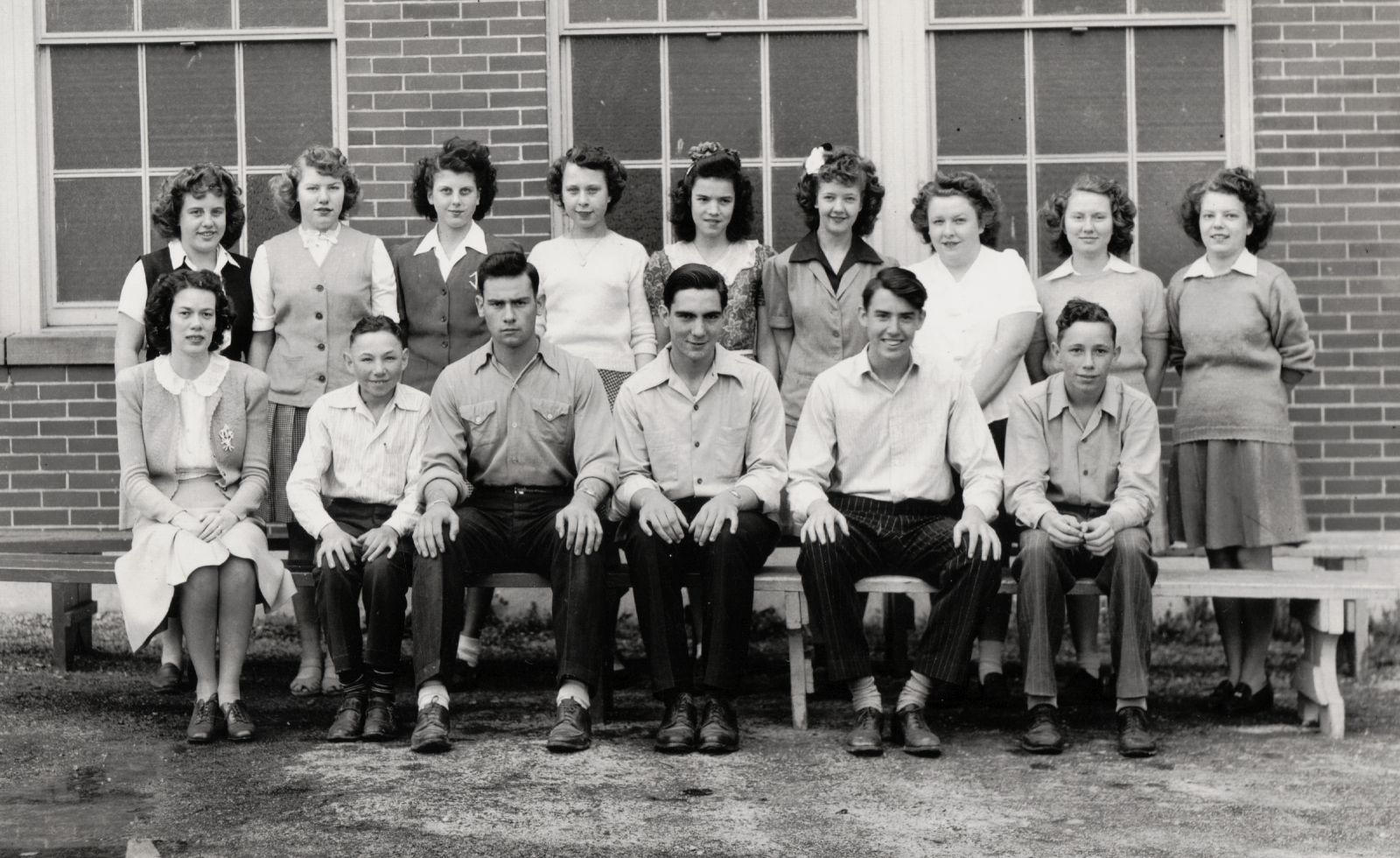
Here is a photo of the 1947 Willshire High School Senior Class play. My mom, Florence (Schumm) Miller, was a member of that class and she was also in their senior class play. Actually, the whole class was in the play. All twelve students from the Class of 1947 are in the photo.

1947 Willshire Senior Class Play. Standing: Ken Luginbill, Florence Schumm, Dorothy Ketrow, Ray Hamrick, Leahline Case, Barbara Painter, Leona Luginbill. Front: Joan Gallant, Charles Myers, Bill Schumm, Tim Agler, Betty Weinman.

I do not know the title of the play but it appears that one fellow, played by Bill Schumm, had some sort of an accident. Bill and the woman standing behind him (Dorothy Ketrow) would marry about 3 years after this photo was taken.

My mom was pretty good about labeling her photos and she put the names of the cast on the back of the photo:

Standing: Kenneth Luginbill, Florence Schumm, Dorothy Ketrow, Ray Hamrick, Leahline Case, Barbara Painter, Leona Luginbill.

Front: Joan Gallant Charles Myers, Bill Schumm, Tim Agler, Betty Weinman.

I recognize a few of the faces and names.

And I remember that old stage in the Willshire School gymnasium, where this 1947 play was likely held. I was in a play on that same stage when I was in the sixth grade.  

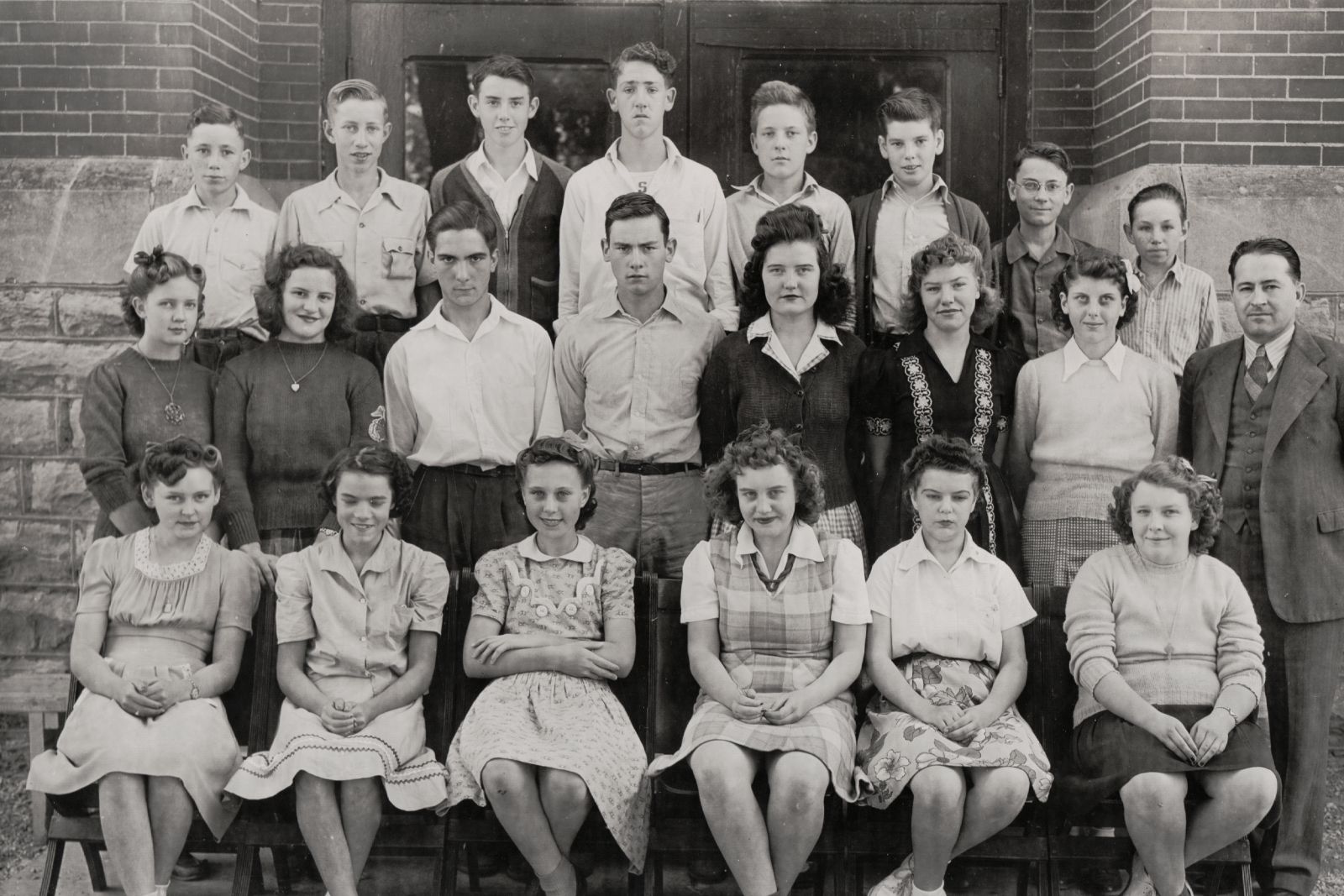
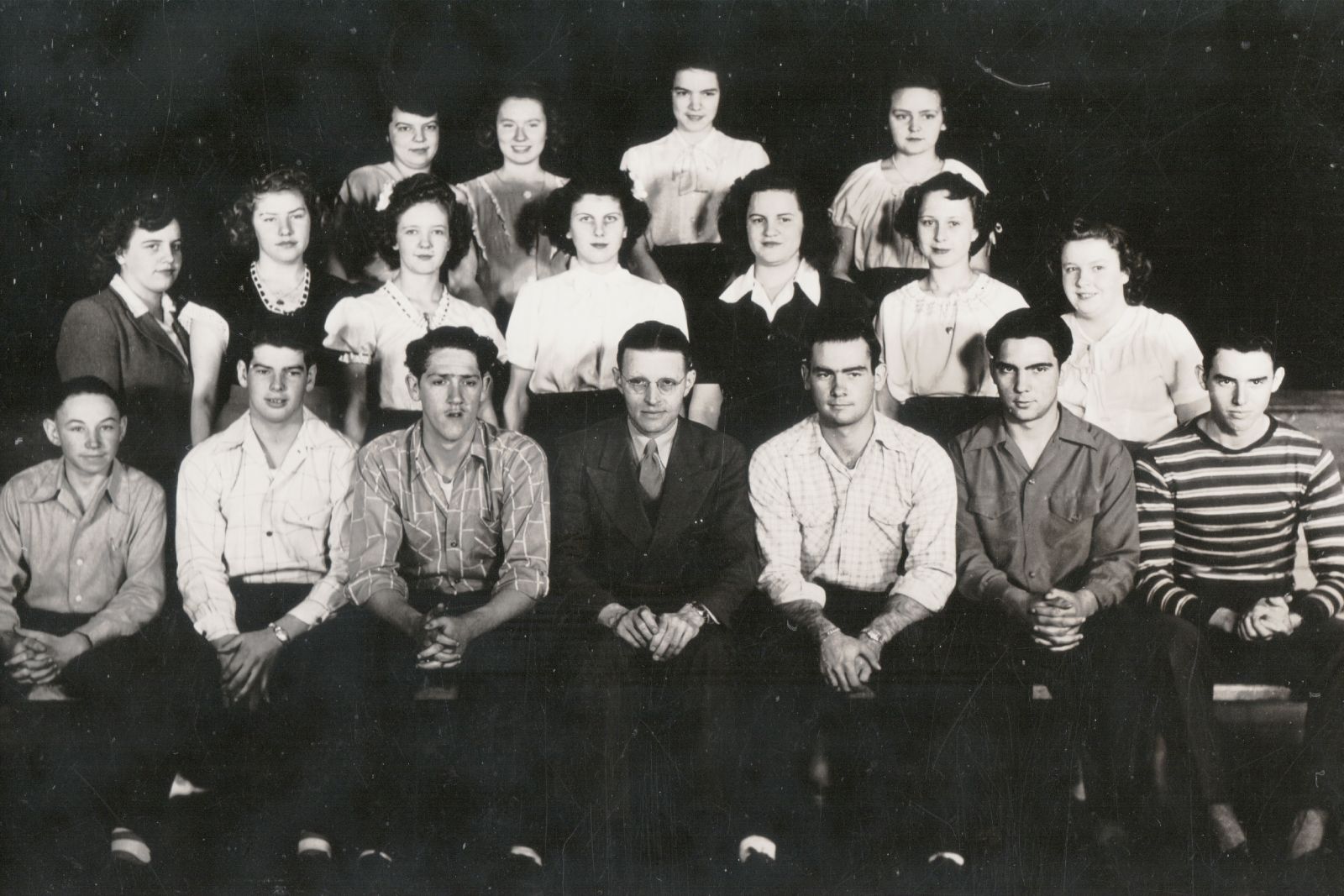
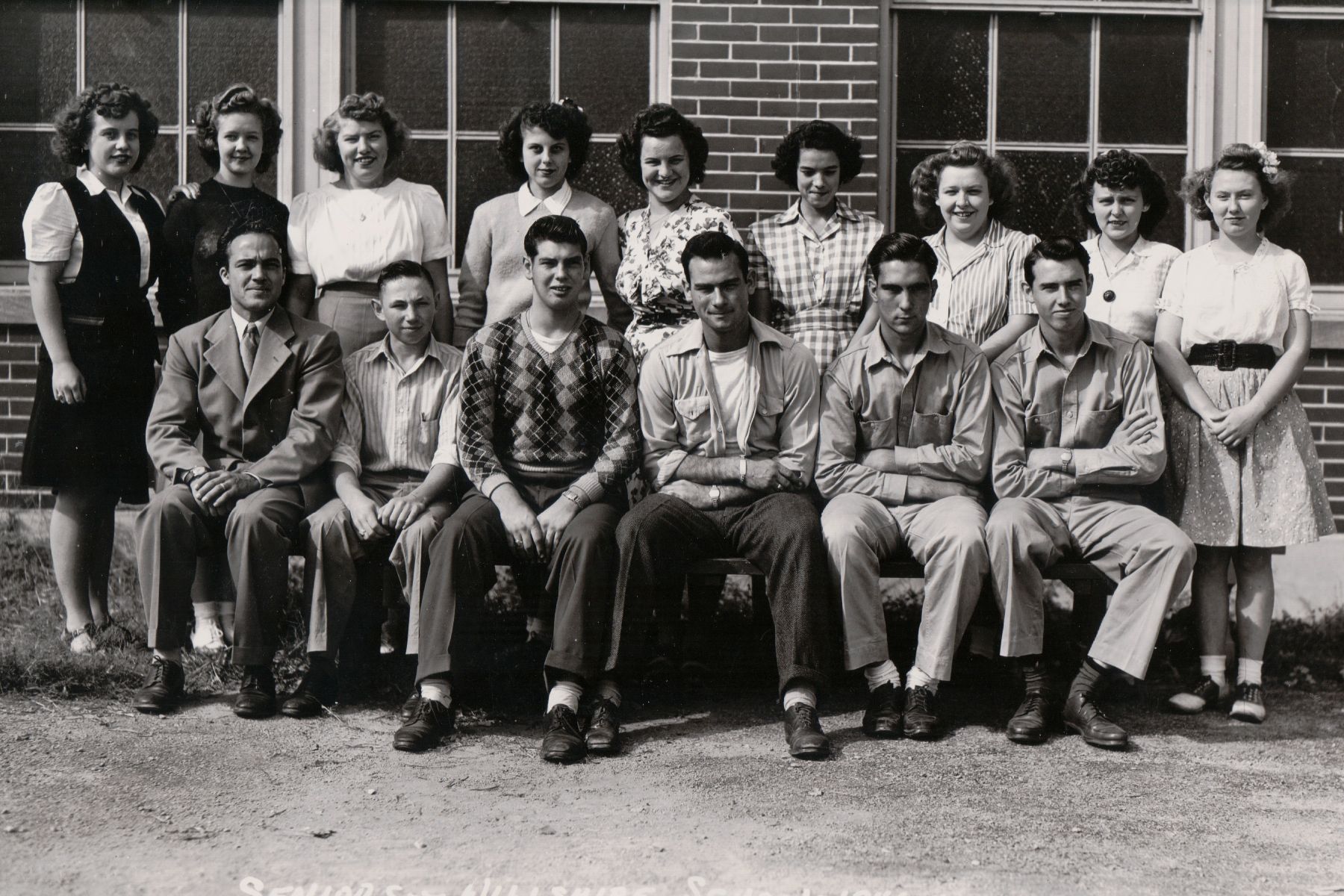
Willshire High School Class of 1947

Above is another photo of the seniors in the Class of 1947. My mom did not label this photo but I recognize most of the people from the class play photo. Women, left to right: [?], Betty (Weinman) Reichard, Barbara Painter, my mom Florence (Schumm) Miller, Dorothy (Ketrow) Schumm, Leona Luginbill, Leahline Case, [?], and Joan Gallant. There are two additional women in this photo and I do not know who they are. Men: Robert Cowan (principal and teacher), Tim Agler, Charles Myers, Kenneth Luginbill, Bill Schumm, and Ray Hamrick.

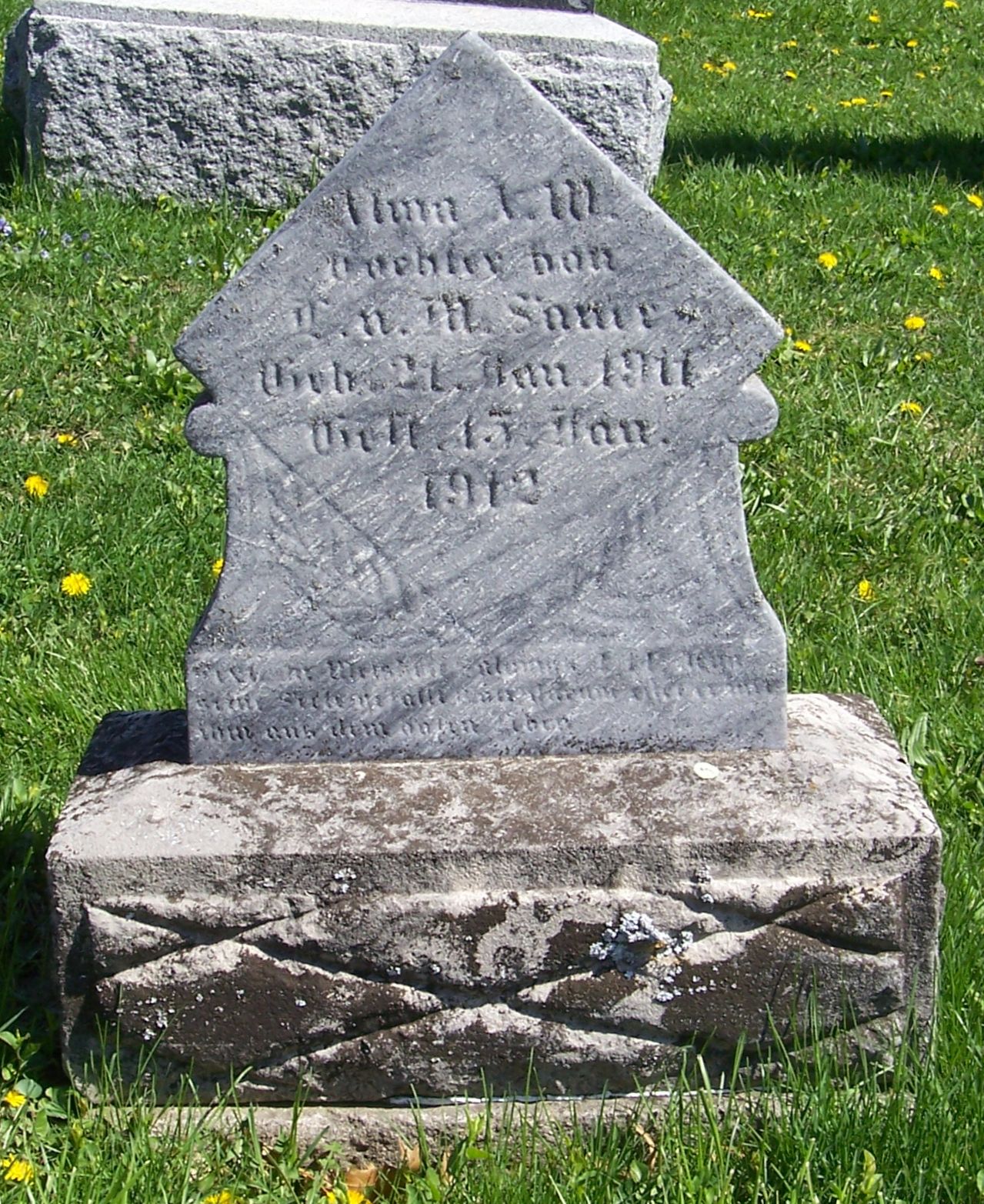
Tombstone Tuesday–Mary T. Roehm

Mary T Roehm, Zion Lutheran Cemetery, Van Wert County, Ohio. (2012 photo by Karen)

This is the tombstone of Mary T. Roehm, located in row 3 of Zion Lutheran Cemetery, Schumm, Van Wert County, Ohio. The marker is inscribed:

MARY T
Dau. of
J. & A. R. Roehm
Died
Jan. 6, 1892
Aged
13 Y, 11 M, 16 D

Maria Theresia Roehm (“Mary”) was born in Willshire Township, Van Wert County, Ohio, on 20 January 1878, the fifth of eight children born to Johann and Rosina (Schumm) Roehm.  Mary was baptized 3 February 1878, with Mrs. Rosina Schinnerer and Mrs. Elisabeth Bienz serving as her sponsors.

Mary Roehm died from typhus at 6:30 in the morning of 6 January 1892 at 6:30. She was just a few days shy of her 14th birthday and Zion Schumm’s church records indicate that she suffered with typhus for a prolonged time. Mary was buried on 8 January.

Mary’s parents John (1842-1932) and Rosina (Schumm) (1842-1932) Roehm had the following children:
Maria Wilhelmina Amalia “Minnie” (1871-1953), married George “Friedrich” Schinnerer
Andreas “Friedrich” George (1872-1926), married Henrietta Amalia Schumm
Mary “Julia” (1875-1957), married William Conrad Franke
Charlotte “Paulina” 1876-1962), married Frederick J Acker
Marie Therese “Mary” (1878-1892)
(Rev.) Johann Ludwig “Louis” (1881-1975), married Anna Peters
Albert Christian (1883-1953)
Alma Sophie (1883-1974), married Herman Kraft, married Justus F. Boese

1954–Willshire Water Tank Doomed by Progress

Progress…make way for changes.

A few months ago I wrote about the old train depot in Willshire, Ohio.

Willshire’s Nickel Plate Depot, unknown date.

Near the depot was a railroad water tower that supplied water for the steam engines.

The depot and the railroad’s water tower were located on the north end of town, south of the current grain elevator, east of US route 33 and about half way to the old railroad bridge that crosses the St. Marys River there. Both the depot and the water tower are gone but the old railroad bridge across the St. Marys River is still standing. Below, a couple photos I took of the old bridge last winter:

Railroad bridge crossing St. Marys River, Willshire, Ohio, 2019.

Railroad bridge crossing St. Marys River, Willshire, Ohio, 2019.

Railroad bridge crossing St. Marys River, Willshire, Ohio, 2019.

Below is a photo of 2 bridges over the St. Marys River at Willshire, on a circa 1910 postcard. One of the bridges may be the railroad bridge:

Photo postcard, c1910, St. Marys River, Willshire, Ohio.

Below is a 1954 newspaper article about the removal of Nickel Plate’s water tower from Willshire. This, at the time when the railroads were phasing out steam engines and replacing them with diesel engines.

1954, Removing Willshire’s RR water tank.

The caption under the photo:

These three Willshire men, who have served the Nickel Plate Railroad for many years, posed for their picture in front of the water tower which will soon disappear from the banks of the St. Marys at Willshire. Left to right they are C.H. Debolt, Oatus Strickler, and J.E. Weyer.

The news article:

WILLSHIRE—Any day now the old railroad tower at Willshire is due to disappear. The Nickel Plate Railroad has ordered it torn down. “We don’t need it any more,” say the officials.

It’s a case of progress and revolution in transportation. Last spring the Nickel Plate, on its Toledo to St. Louis division, began using diesel-powered locomotives which drink oil and scoff at water. No water, no water tank. That’s the story.

Gathered around the tank the other day were three Nickel Plate men, two of whom have been with the railroad even longer than the tank itself. C.H. Debolt, 81, retired in 1947 after serving the line 50 years as telegraph operator and station agent. His last station was in Willshire.

Oatus Strickler, 77, was with the railroad 30 years and before his retirement worked last for eight years at Craigville, Ind., as section foreman.

Still with the Nickel Plate is J.E. Wyer, 67, now in charge of the maintenance crew working between Ohio City and Pleasant Mills. He began his railroad job when he was 20 and has been at it ever since.

All of these three men, Willshire residents, admit they will hate to see the old water tower disappear but are glad that the railroad industry has been making such important strides in recent years with new and better equipment.

The Willshire water tank, erected about 1917, replaced an earlier tower. A steam pump then took water from the St. Marys River for use in the thirsty steam engines. There were many of these engines in those days because approximately 24 trains, including six carrying passengers, went over the line daily through Willshire.

About 1930 the steam pump for the tank was abandoned for one with an electric motor.

The tank was originally erected by the Cloverleaf Railroad which was taken over by the Nickel Plate in the early 1920s. The railroad hauled a great deal of livestock. Willshire itself was quite a livestock center in the early part of the century and still does a creditable business with producers of the area.

Progress means change. The railroad water tower, depot, and rail service are all now part of Willshire’s past.

Thanks to Farrel and Sharon for sharing this interesting newspaper clip.

Tombstone Tuesday–Johann Michael Grund

Johann Michael Grund, Zion Lutheran Cemetery, Van Wert County, Ohio. (2012 photo by Karen)

This is the tombstone of Johann Michael Grund, located in row 3 of Zion Lutheran Cemetery, Schumm, Van Wert County, Ohio. The marker is inscribed:

J. Michael
Sohn von
[?] Maria
Grund
Gestorben
Den. 19, Novbr, 1857
Alter
24 Jahre 19 Tag

J. Michael, son of [?] Grund, died 19 November 1857, age 24 years, 19 days.

Portions of this broken tombstone are nearly impossible to read, but additional information can be obtained from the Zion Lutheran Schumm’s church records.

According to the church records Johann Michael Grund was born in Gerabronn, Wuerttemberg, and was the son of Johann Grund. The records indicate that Johann Michael arrived in America in 1852.

There are several Grunds mentioned in Zion Schumm’s records. The earliest mention is when Rosina Grund, daughter of Mr. Grund, was a baptismal sponsor for Rosina Elisabeth Gaier in 1854. There were also some Grund marriages in the Schumm area. Martin Gaier was married to Margaretha Grund and Adam Büchner married to Rosina Grund in the 1850s. These could very well be the same Grund family.

According to Zion Schumm’s records, Johann Michael Grund died very suddenly on 19 November 1857, at the age of 24 years and 22 days. His date of birth would be 28 October 1833 as calculated from the church records. He was only in this country for about 5 years.

His age, as recorded in the church records, differs from the age inscribed on his tombstone. According to his tombstone his date of birth would be calculated as 31 October 1833.

Threshing in the Willshire & Chatt Area

Last week I wrote about threshing and cooking for threshers and I learned a lot about both events. Threshing and the meal preparation certainly was a whole lot of work, but the families were able to turn the hard work into a social event at the end of the day.

Several of us Miller relatives talk every Friday morning on Skype. My aunt and uncle (my dad’s brother and sister), and a couple of my cousins enjoy talking about the good old days and catching up on the latest news. Last Friday my aunt Ruth, who will be 100 this year, and my uncle Kenny shared some of their memories about threshing on the Miller farm north of Chatt.  

Uncle Kenny said he remembers helping out on threshing day when he was about 10 years old, by delivering water to the threshing crew. He said that Johnny Reef had a threshing machine and he recalls the names of some of the men who were on the threshing crew, the threshing ring, as he called it: Homer Carr, Howard Caffee & sons, and Jr Miller. He said my dad also worked with the crew, by sacking grain.

Aunt Ruth recalled that her aunts Caroline (Miller) Caffee and Clara (Miller) Reef came over to help with the threshing meal. Ruth said her mother cooked a lot of roast beef, macaroni and cheese, and pies. Ruth said the macaroni and cheese was her favorite and that grandma made very good cream pies. Kenny thought they had an ice cream social when the threshing was done for the season.

They both said they liked to play on the straw stack and slide down it. In fact, all their siblings liked to play on it. They said the straw stack was quite tall and that the animals would eat from it.    

Cornelius L. Schumm threshing machine, at 1986 sale.

My grandpa, Cornelius L Schumm, had a threshing machine and did threshing for some farmers in the Willshire area. These photos are from his last threshing job, threshing for R.L. Stetler in 1952.

C.L. Schumm’s last threshing job, for R.L. Stetler, 1952.

C.L. Schumm Threshing for R.L. Stetler, 1951-2.

C.L. Schumm, threshing for R.L. Stetler, 1951-2.

Grandpa had a Rumely Oil Pull and he may have used it to power his threshing machine.

C.L. Schumm by Rumely Oil Pull, 1985.

Grandpa Schumm saved a few of his threshing account books, which are dated from 1938-1948, and usually during the months of July and August. The grain was mostly wheat, but there was some oats, rye, and barley. Bushel amounts ranged from 48 to over 400 bushels.

C.L. Schumm’s Thresherman’s Account Book, 1946-48.

C.L. Schumm’s Thresherman’s Account Book, 1946-48.

For example, one 1948 slip for R.L. Stetler: 76 bushels wheat @ 7¼, total $5.39; 858 bushels oats @ 5¼, total $45.03; minus $5.00 labor; total owed $45.42.

C.L. Schumm threshing account for RL Stetler, 1946.

I assume he took his threshing machine to the individual farms, charged them using a specific number, according to the number of bushels, and deducted the farmer’s labor from his bill. I do not know how that specific number was determined, but it was always 7¼ for wheat and 5¼ for oats. When you do the math it figures to be $0.0725/wheat and $0.0525/oats.

I wonder if the other farmers on the crew helped out for free or if they got paid or compensated in some way. Maybe they volunteered at each farm, knowing the crew would come and thresh at their farm eventually. I would be interesting to know the answers to these questions.

Below are some of the names in his threshing books, the farmers my grandpa Schumm threshed for between 1938-1948. I put them in alphabetical order. Maybe you will see the name of one of your relatives.

R.E. Allmandinger
Rudy Allmandinger
W.L. Allmandinger
Basil Banta (hauling clover seed)
J.H. Becher
Laurel Bowen
Clarence Brandstetter
Emil Brandt
Claude Buchanan
A.H. Buechner
Otis Byers
L.S. Cully
Firmin Dellinger
Frank Dudgeon
O. Dudgeon
Del Eichar
W. Eichar
Engle
Henry Etzler
Ernest Gribler
Sam Haggard
Albert Hamrick
W. Hamrick
Leon Huffine
T.C. Hofmann
Gale Hook
Mrs. J. Hurless
Austin Jones
Frank Ketrow
Kettring
Fred Kidd
Christ Krall
H. Merkle
R.L. Painter
George Putnam
George Roehm
Paul Roehm
Albert Roop
J. Scaer
Oscar Scaer
Glen Schadt
Arthur Schinnerer, Mrs. Minnie Schinnerer
Arnold Schumm
Paul Schumm
W.J. Schumm
Floyd Shoaf
Harold Stetler
R.L. Stetler
Roy Stetler
A.A. Stove
Clarence Trable

Grandpa threshed for quite a few people over the years. I recognize quite a few names. Interesting stuff!