Happy New Year from Karen’s Chatt!
 May 2021 be better than 2020!

Dec 29
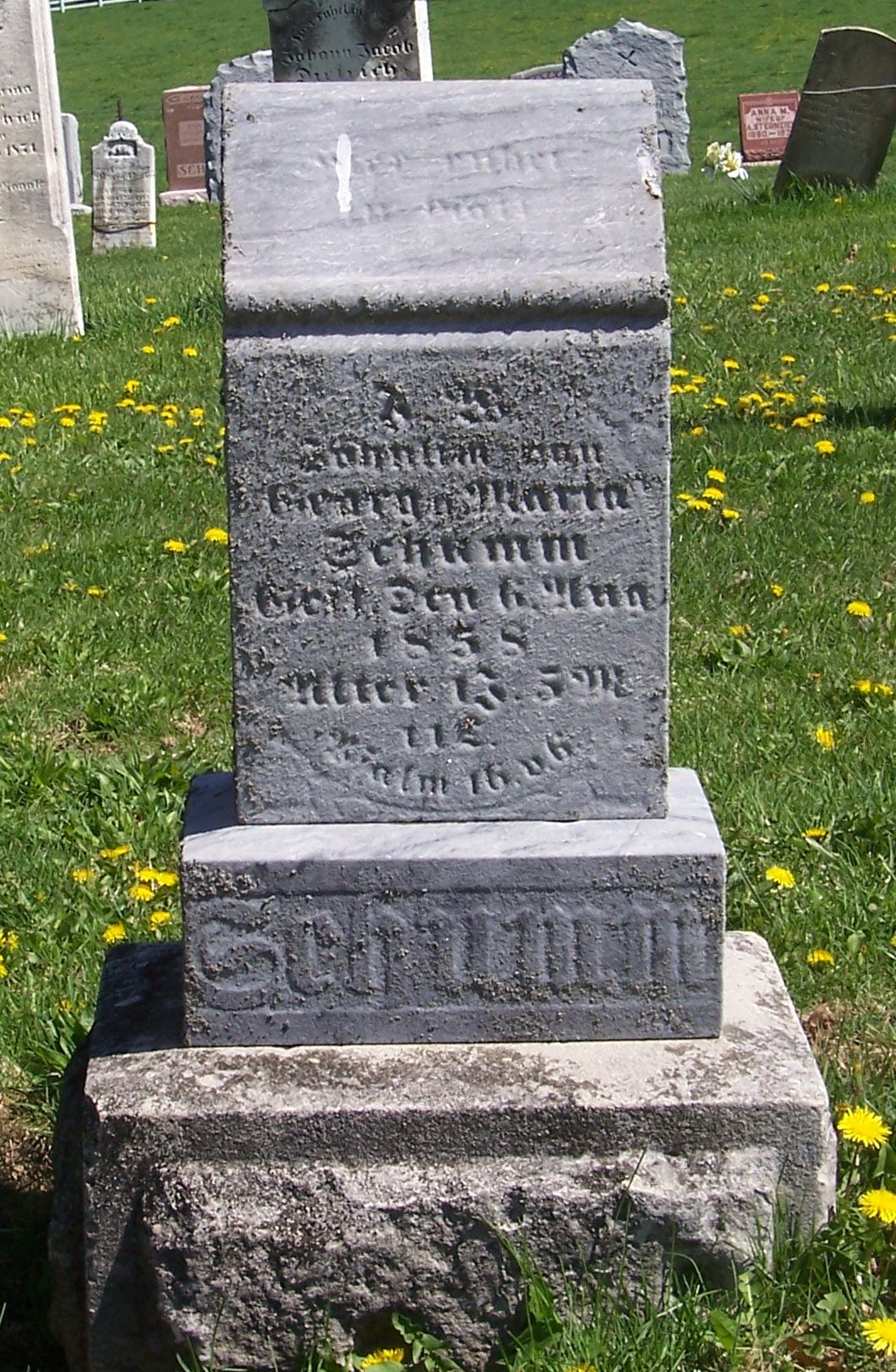
Jakob Wilhelm Schumm, Zion Lutheran Cemetery, Van Wert County, Ohio. (2012 photo by Karen)
This is the tombstone of Jakob Wilhelm Schumm, located in row 4 of Zion Lutheran Cemetery, Schumm, Van Wert County, Ohio. The marker is inscribed:
Hier ruhet
In Gott
J.W.
Sohnlein von
Georg u. Maria
Schumm
Gest. Den 6 Aug
1858
Alter 1J, 5 M
11T
Psalm 16, v. 6.
SCHUMM
Here rests in God, J.W., little son of Georg and Maria Schumm, died the 6 August 1858, age 1 year, 5 months, 11 days. Psalm 16:6. SCHUMM.
Jakob Wilhelm Schumm was born in Willshre Township, Van Wert County, on 25 February 1857, the son of George Martin and Maria (Pflueger) Schumm. Jakob was baptized at home on 27 February 1857 with Friedrich Schumm & his wife serving as his sponsors. Jakob’s parents were both Germany immigrants.
Jakob Schumm died at 7:00 in the morning of 6 August 1858. He was only 1 year, 5 months, and 10 days, according to Zion Schumm’s records. He was buried on the 7th.
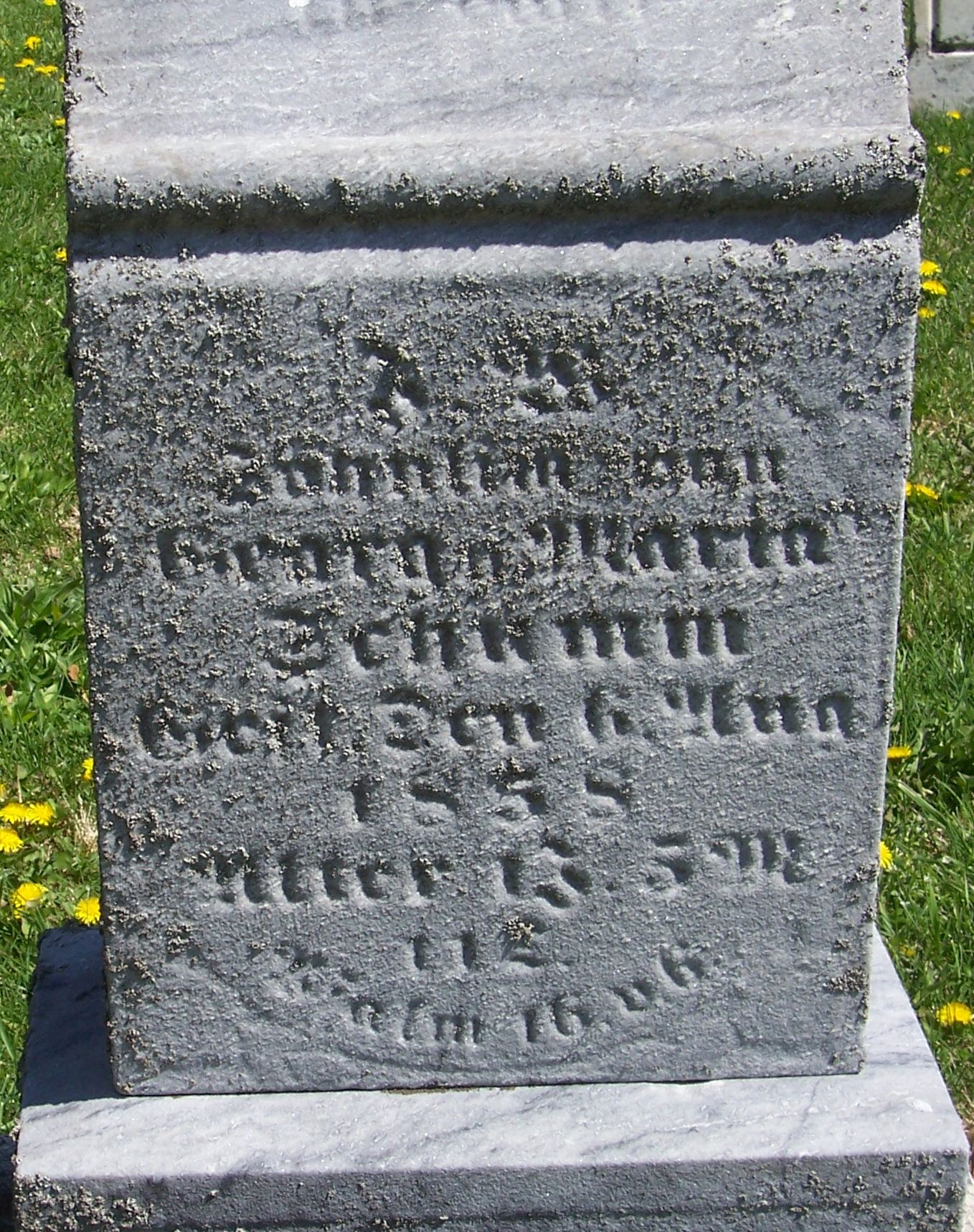
Jakob Wilhelm Schumm, Zion Lutheran Cemetery, Van Wert County, Ohio. (2012 photo by Karen)
Jakob’s parents George Martin and Maria (Pflueger) Schumm had a total of 13 children:
Jacob “Frederick” (1839-1927), married Maria Germann
Louis M (Sr) (1840-1922), married Mina Domke
George M (Rev) (1841-1917), married Charlotte Breuninger; married Amalia Justine Markworth
John (1843-1864)
Anna “Rosina” (1845-1928), married John Roehm
Margaretha Barbara (1847-1851)
Marie “Mary” (1849-c1876), married Claus Peters
George “Jacob’ (1851-1895), married Caroline G “Lena” Kellerman
George “Christian” (1852-1895)
George Henry “H G” (1854-1939), married Anna Roehm; married Wilhelmina “Mina” Kroemer
Jacob Wilhelm (1857-1858)
Jacob “Martin” (1859-1909), married Elizabeth “Lizzie” Ehrenmann
Anna Magdelina “Sophia” (1862-1924)
Dec 22
Today’s tombstone symbol is wheat, a symbol that I do not see very often on a headstone.
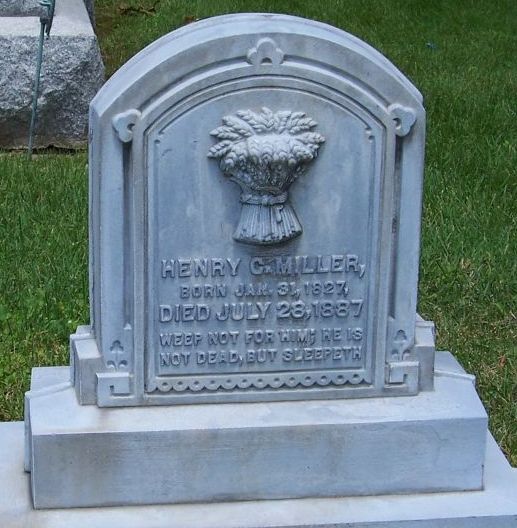
Greenville Union Cemetery, Darke County, Ohio, 1887 Wheat, Henry C Miller.
Wheat and other grains are some of the oldest symbols for growth and life. Wheat used to be harvested by a reaper with a scythe, which brings to mind the Grim Reaper.
On a tombstone, wheat is usually depicted as a sheaf of wheat, but is occasionally is shown as stalks of wheat.
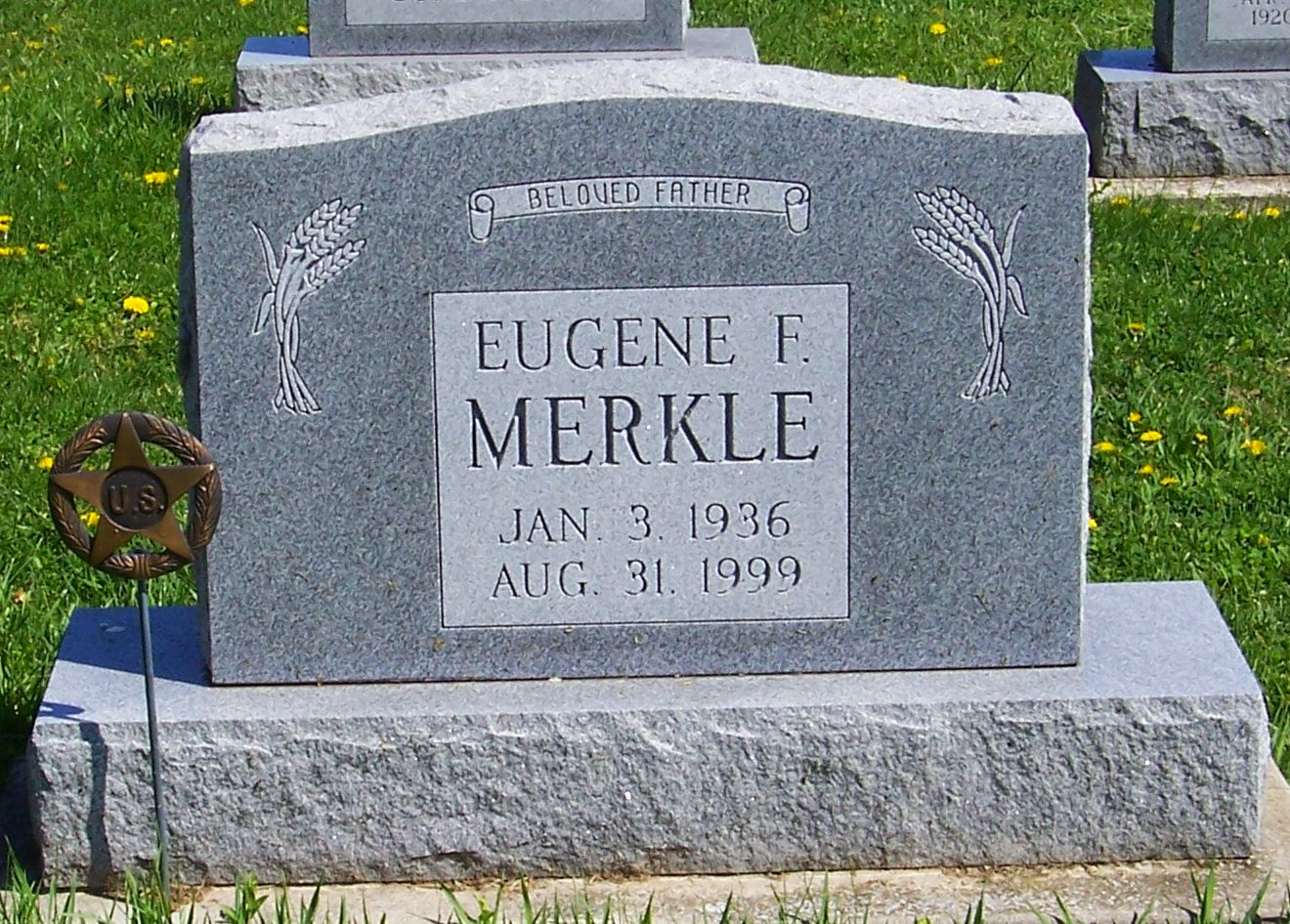
Zion Lutheran Cemetery, Van Wert County, 1999 Stalks of Wheat, Eugene Merkle
Wheat usually symbolizes someone who has lived a long, fruitful life. Someone who has lived to a ripe old age.
Since it is a harvested grain, wheat could signify the resurrection and immortality. Or wheat may symbolize bread or the communion wafer, which are both made from wheat flour.
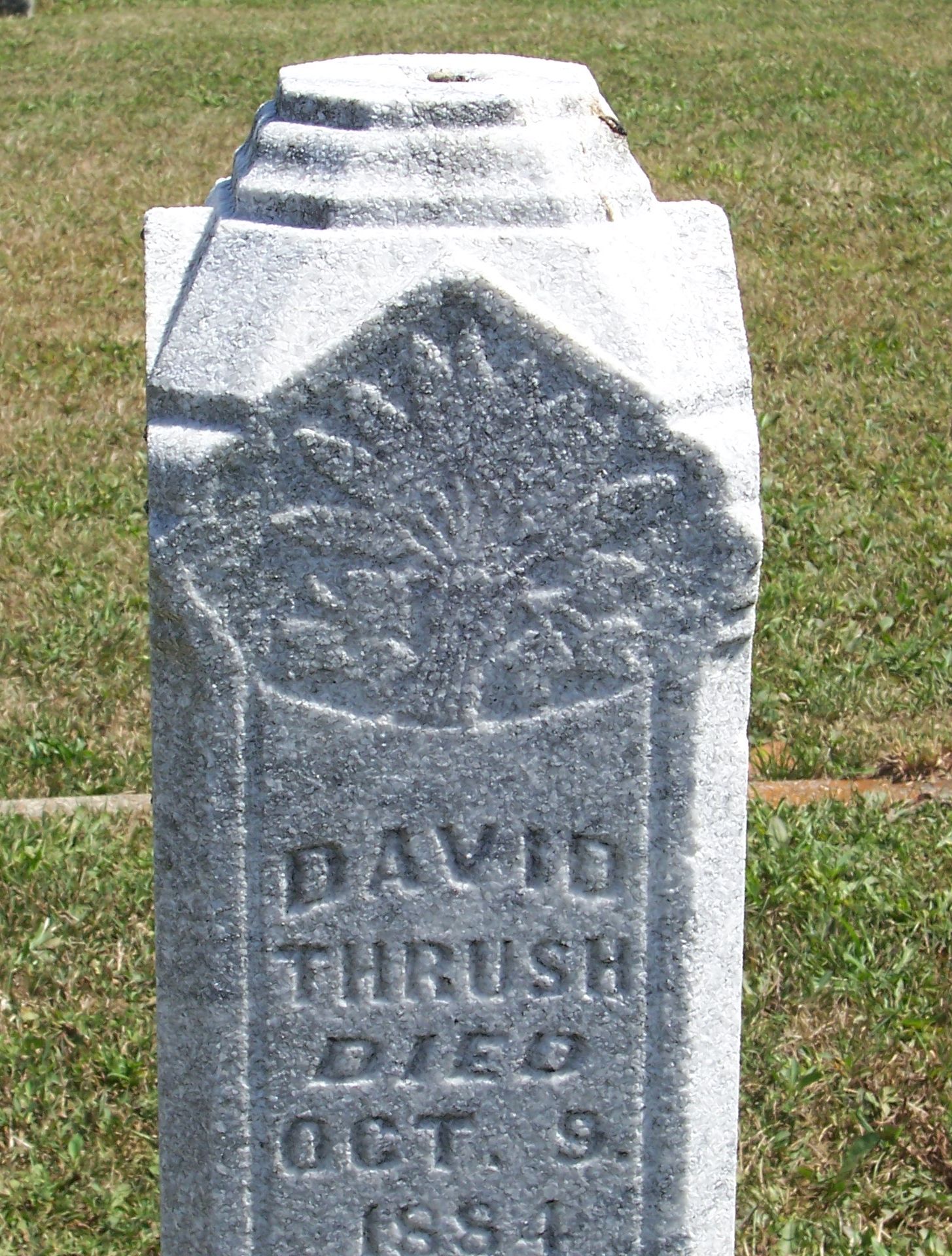
Fountain Chapel Cemetery, Mercer County, Ohio, 1884 Wheat, David Thrush
Finally, the obvious. Wheat carved on a tombstone could just indicate that the deceased was a farmer.
Dec 18
During my first two years of high school at Parkway I took Latin as my foreign language. Parkway offered only Latin and Spanish as their foreign language choices and I thought Latin would be more beneficial for my field of study at college later. All in all, I was a pretty good student but I admit that Latin was not my best (or favorite) subject.
Mrs. Martha Rhoades taught Latin and English at Parkway back then and she was a top-notch instructor. She really knew her stuff and could speak Latin quite fluently. I am certain she could have communicated very well with any ancient Roman citizen she might have encountered. That, despite the claim that the Latin we learned was not a spoken language.
First year Latin went a lot better for me than the second year. I still got As and Bs but my grasp of the Latin language did not seem to expand as we progressed through that second year. I felt as though I really did not deserve the As and Bs I received during that second year. Thank goodness Parkway only offered two years of Latin because I don’t think I could have made it through even one more year.
I mention all this because the other day I ran across an old scrapbook that I made for Mrs. Rhoades’ Latin class. It was a Christmas assignment for one of my two years of Latin, but I can’t remember which year.
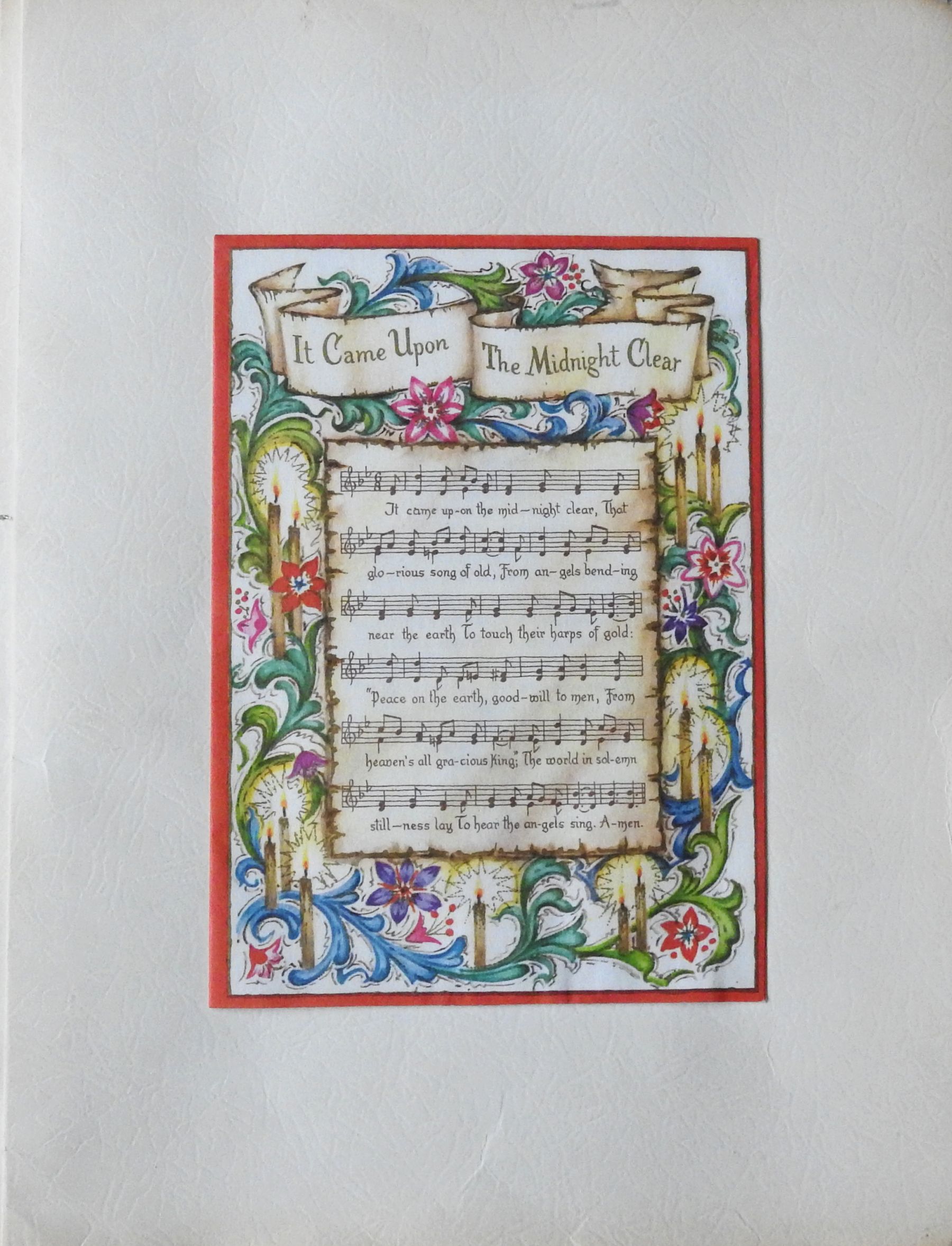
Cover, The Christmas Story, in Latin, by Karen Miller, c1967.
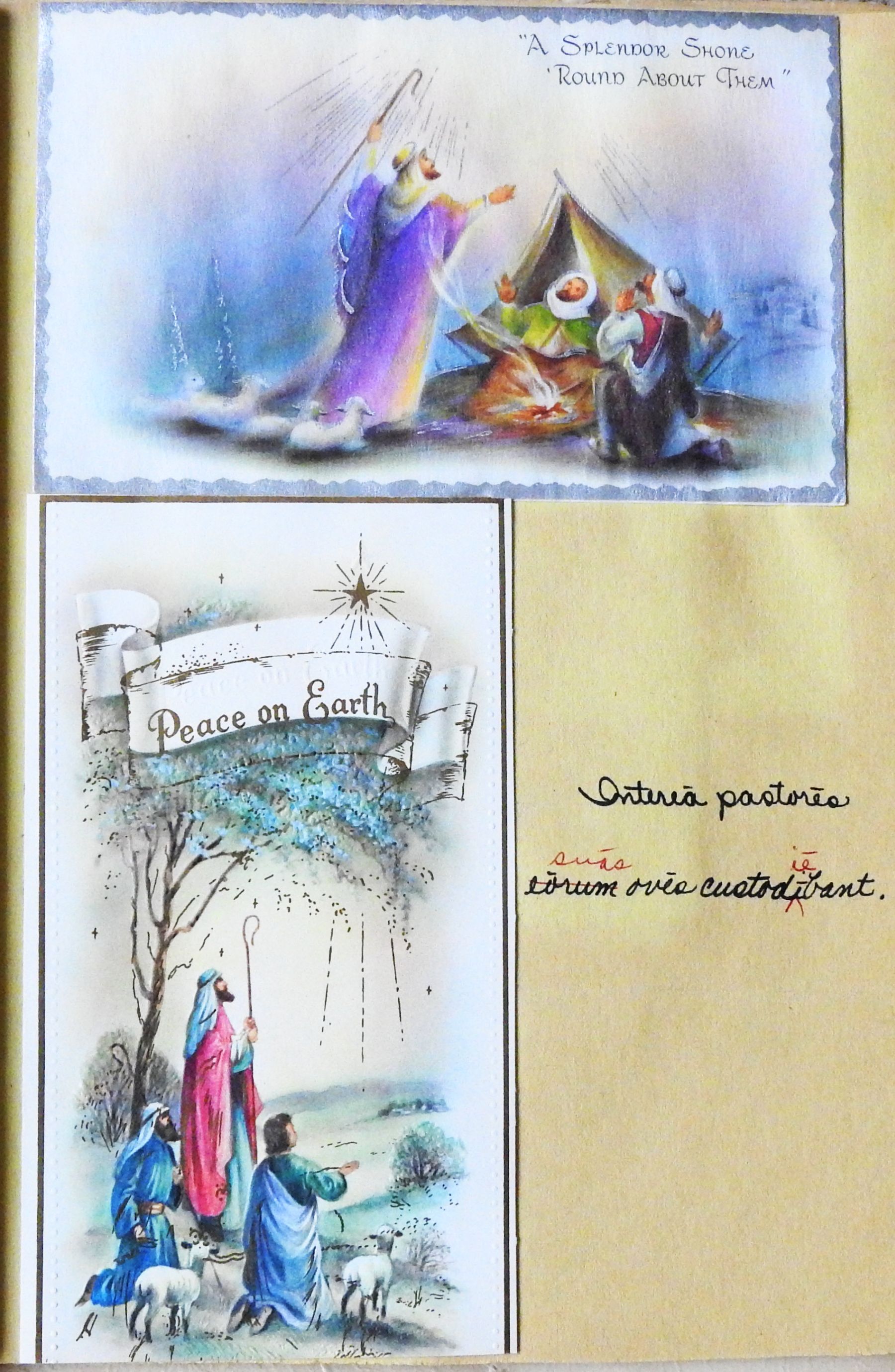
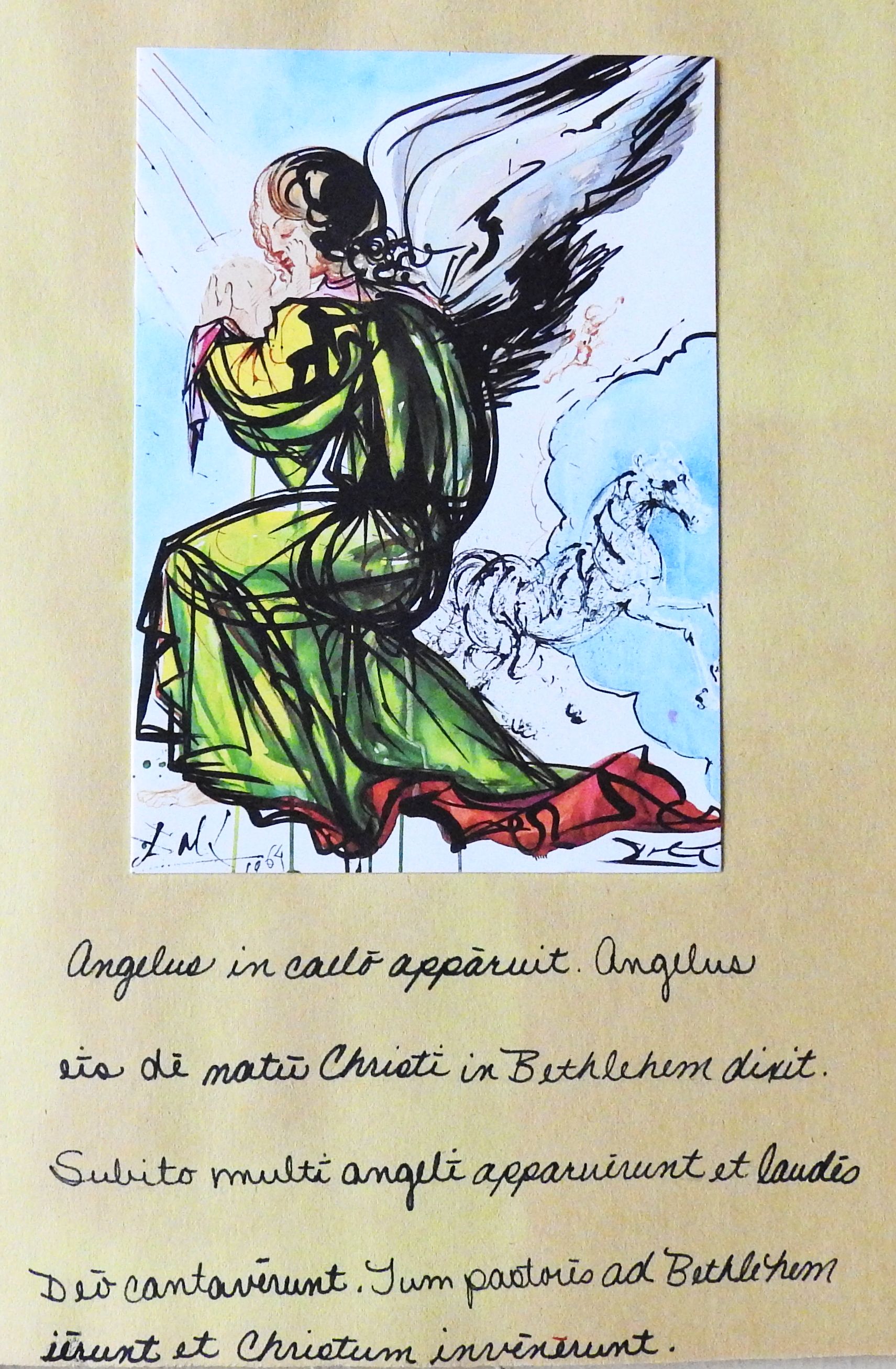
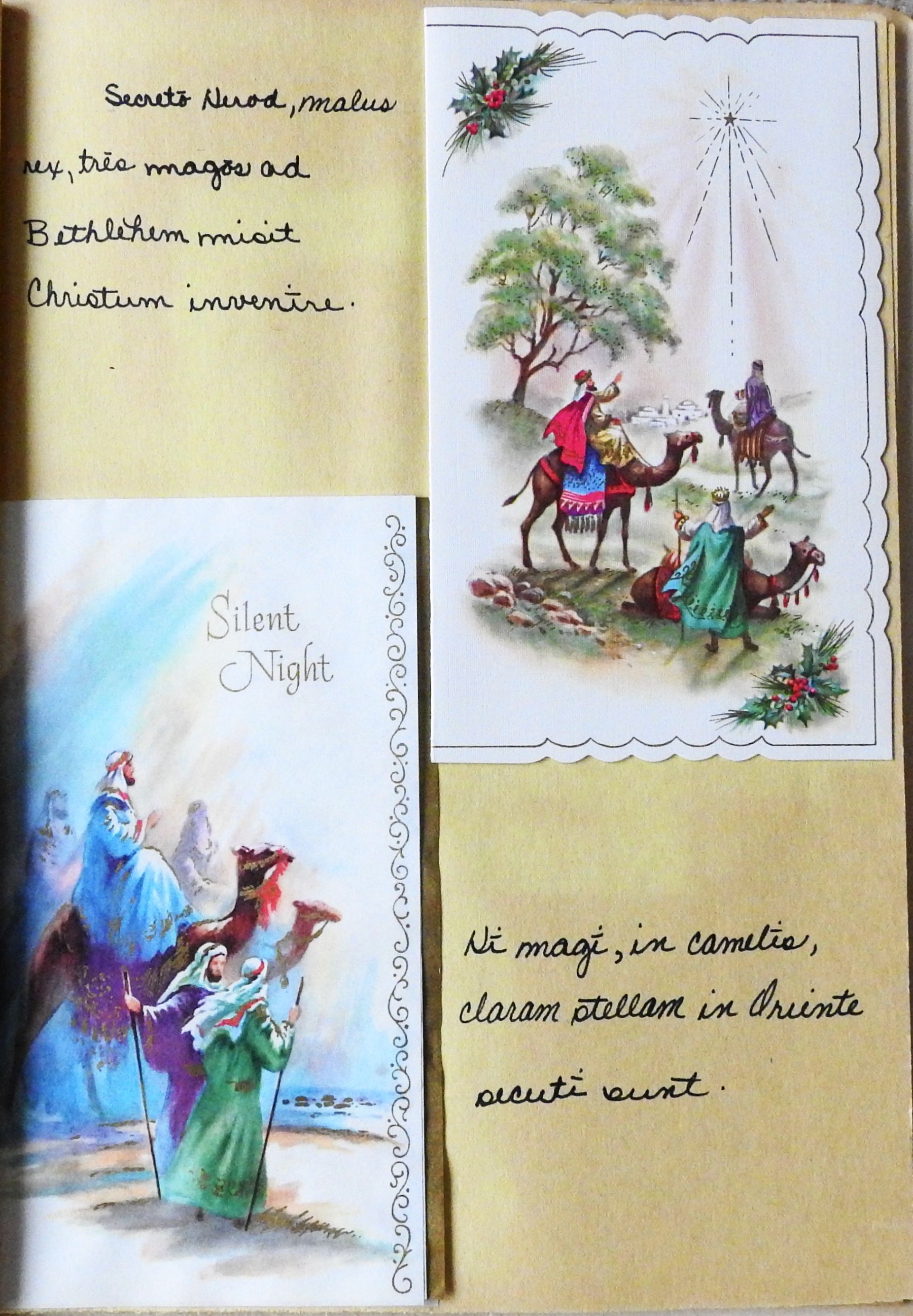
Our assignment was to write the Christmas story in Latin. This was to be my version, complete with translation. As you read my story you may notice that it sounds rather simplistic, written in short sentences. There was a reason for that. I had to compose the story while making sure I could create correct sentences in Latin to match my English sentences. Plus I had to choose the correct Latin words with the correct gender and verb tense. Long, detailed sentences would have been impossible for me to rewrite into Latin. Trust me, the project was a lot more difficult than it looks.
I was graded on this assignment and although Mrs. Rhoades made a few Latin spelling corrections with her dreaded red pen, I did get an A. What a boost to my overall class grade!
Mrs. Rhoades made one comment on the whole assignment: Beautiful cover.
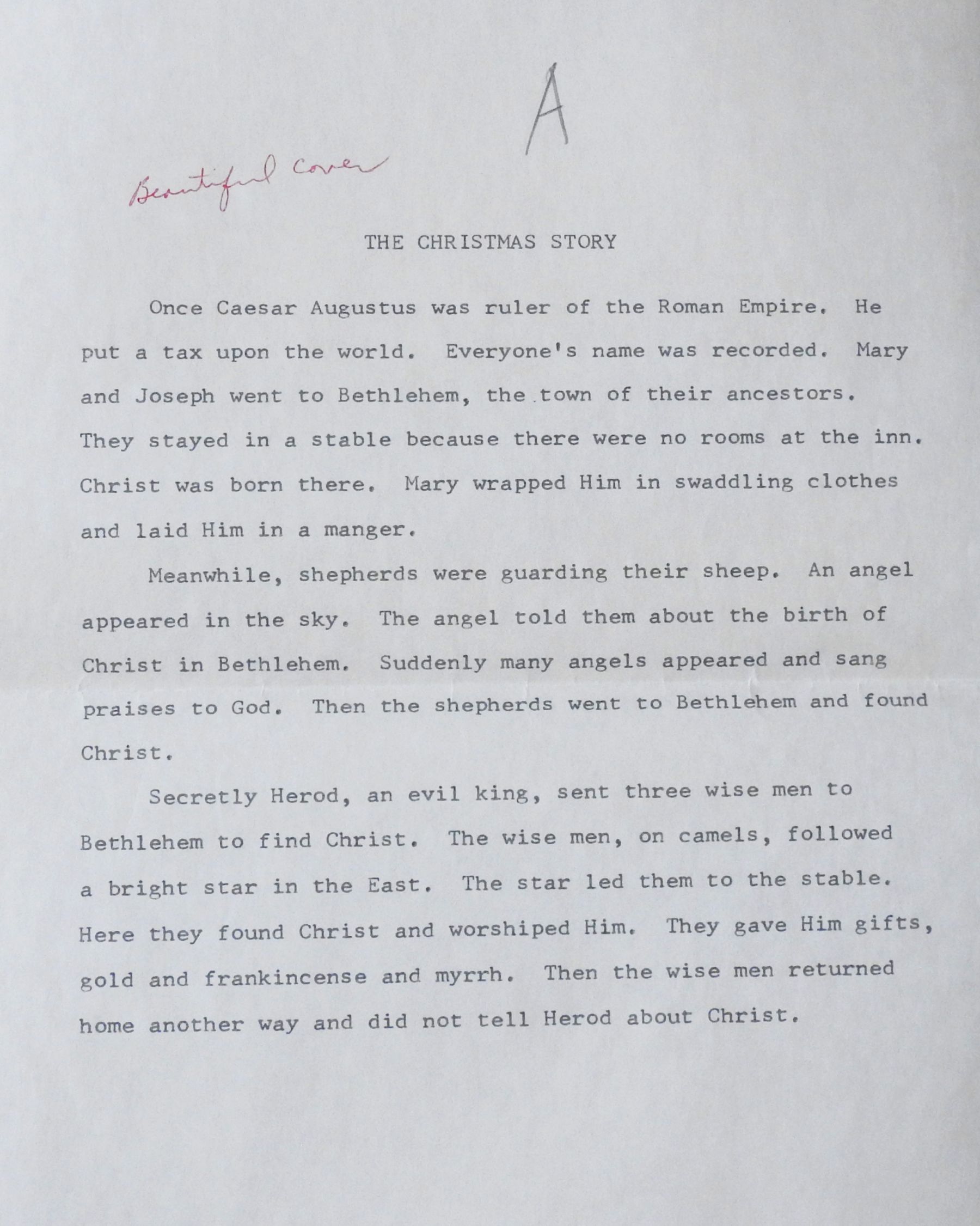
English translation of my Christmas Story in Latin. Note the “A” grade.
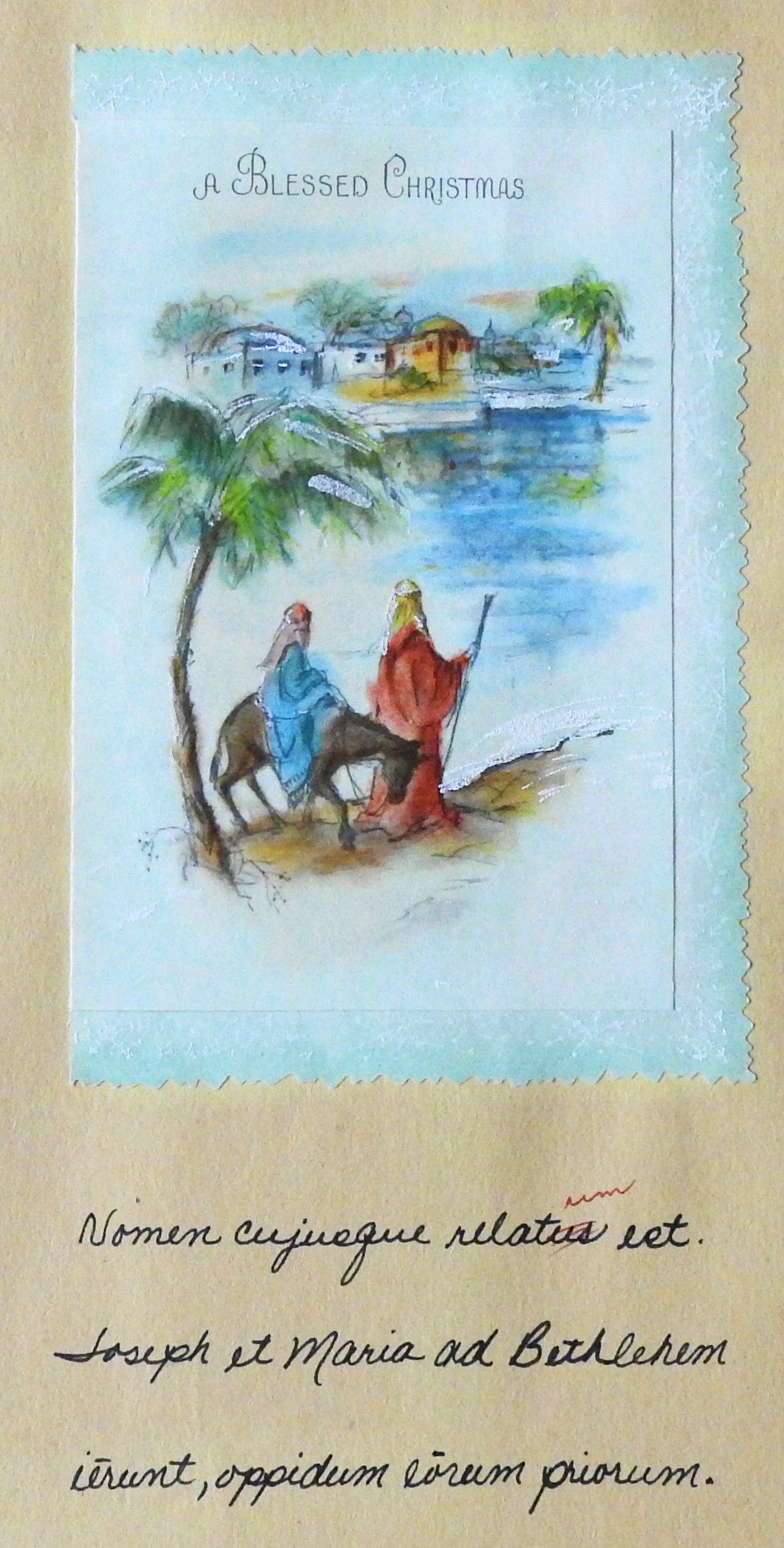
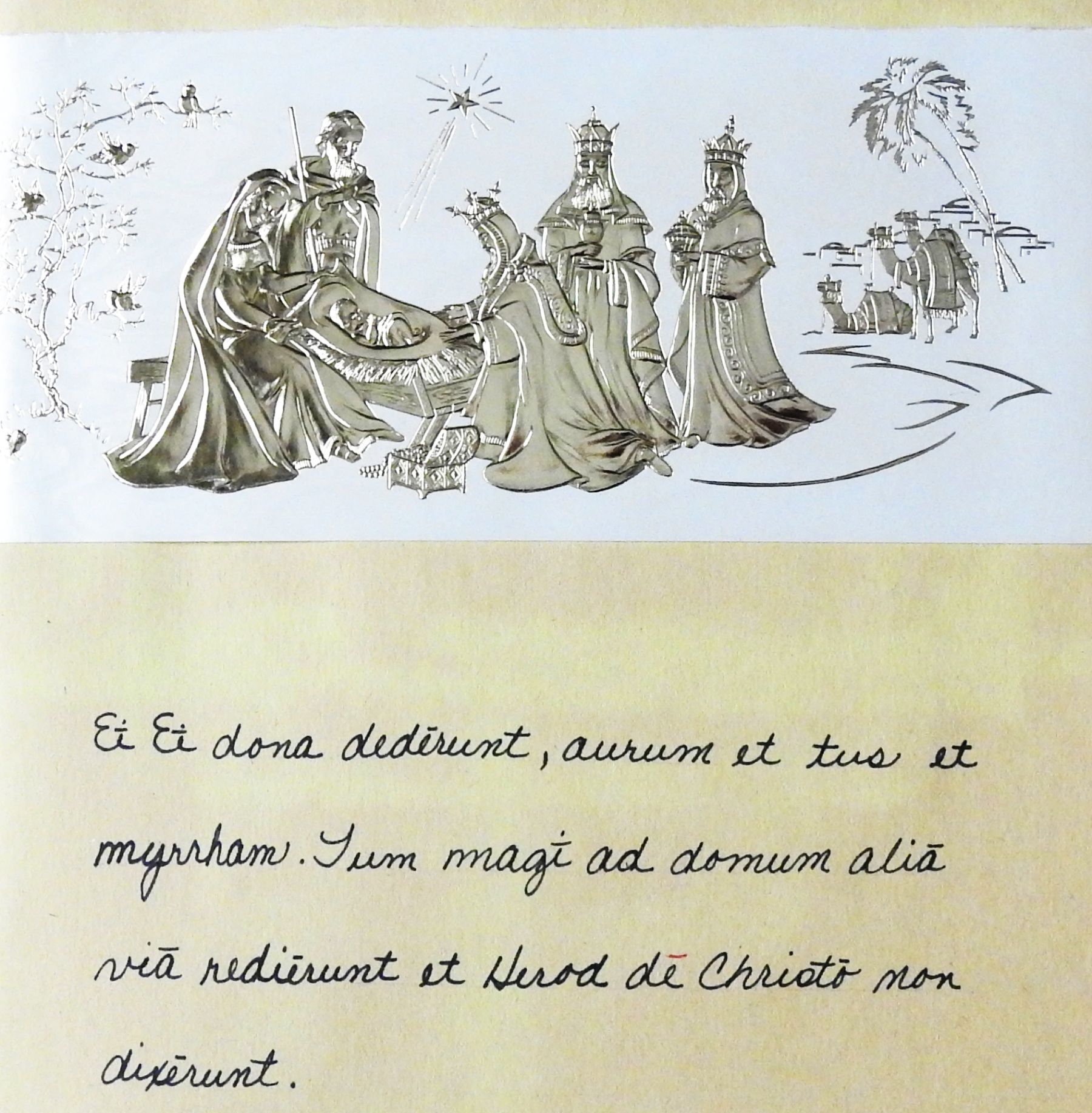
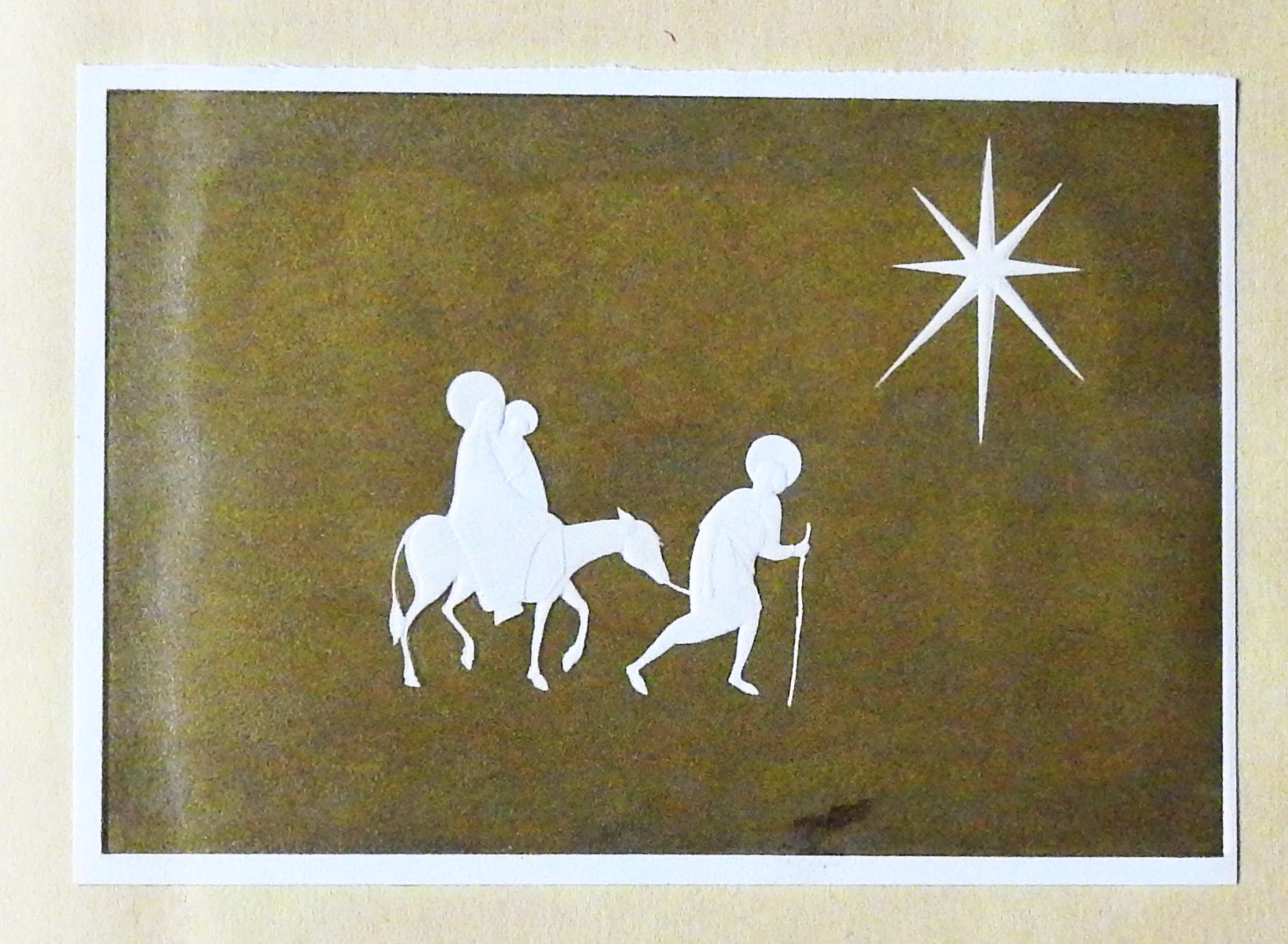
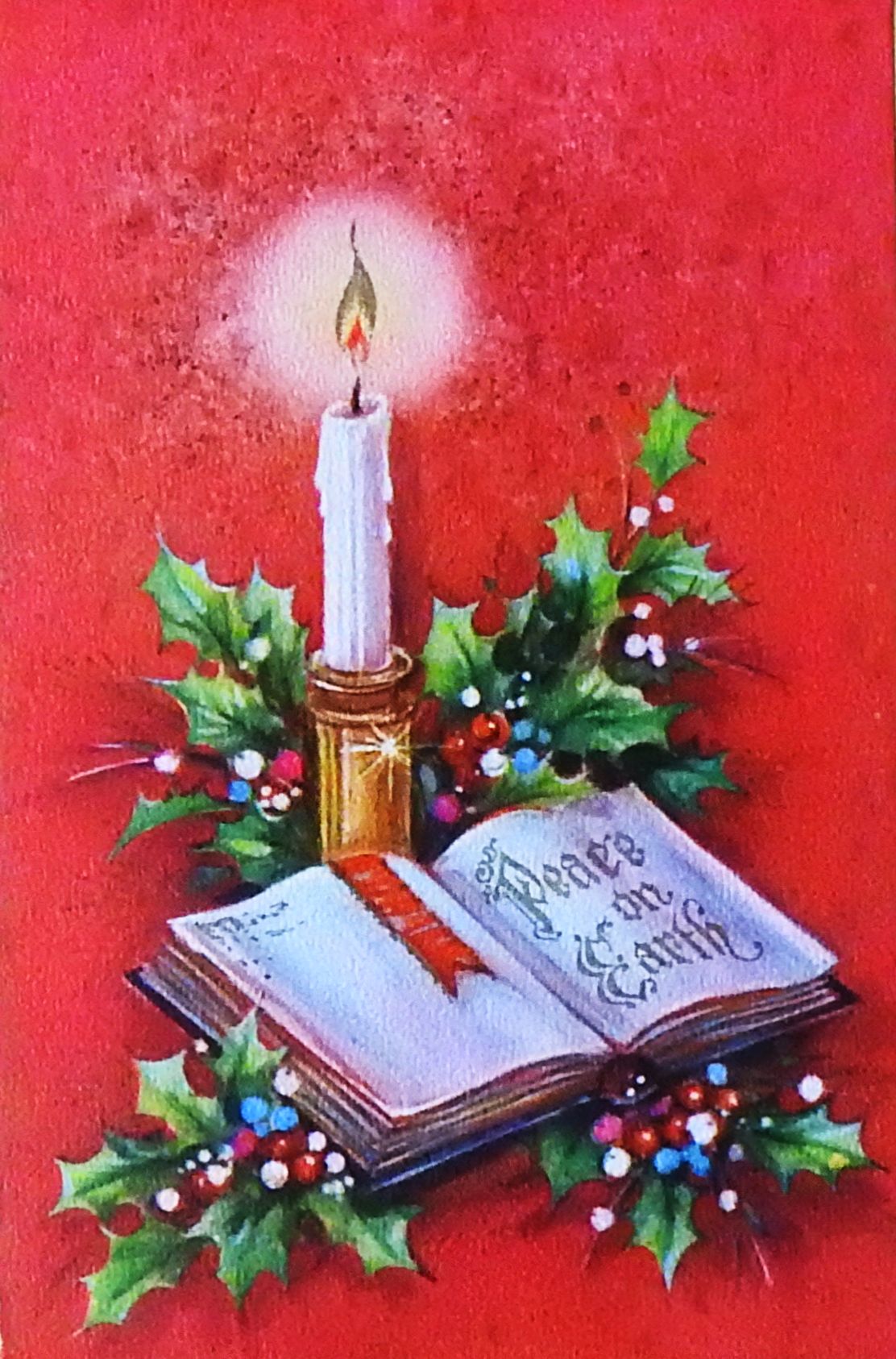
I showed the scrapbook to Joe the other day and he, too, was most impressed by the Christmas cards I used to go along with the story. Thanks, Joe. That’s a very nice compliment but finding the suitable Christmas cards was probably the easiest part of the whole assignment. For sure it was the most fun part of the assignment. Both comments made by Mrs. Rhoades and Joe seem to indicate that perhaps I should have focused my energy on art instead of an ancient foreign language.
So here it is, my version of the Christmas Story in Latin, handwritten by me in about 1967:
The Christmas Story

Once Caesar Augustus was ruler of the Roman Empire. He put a tax upon the world.
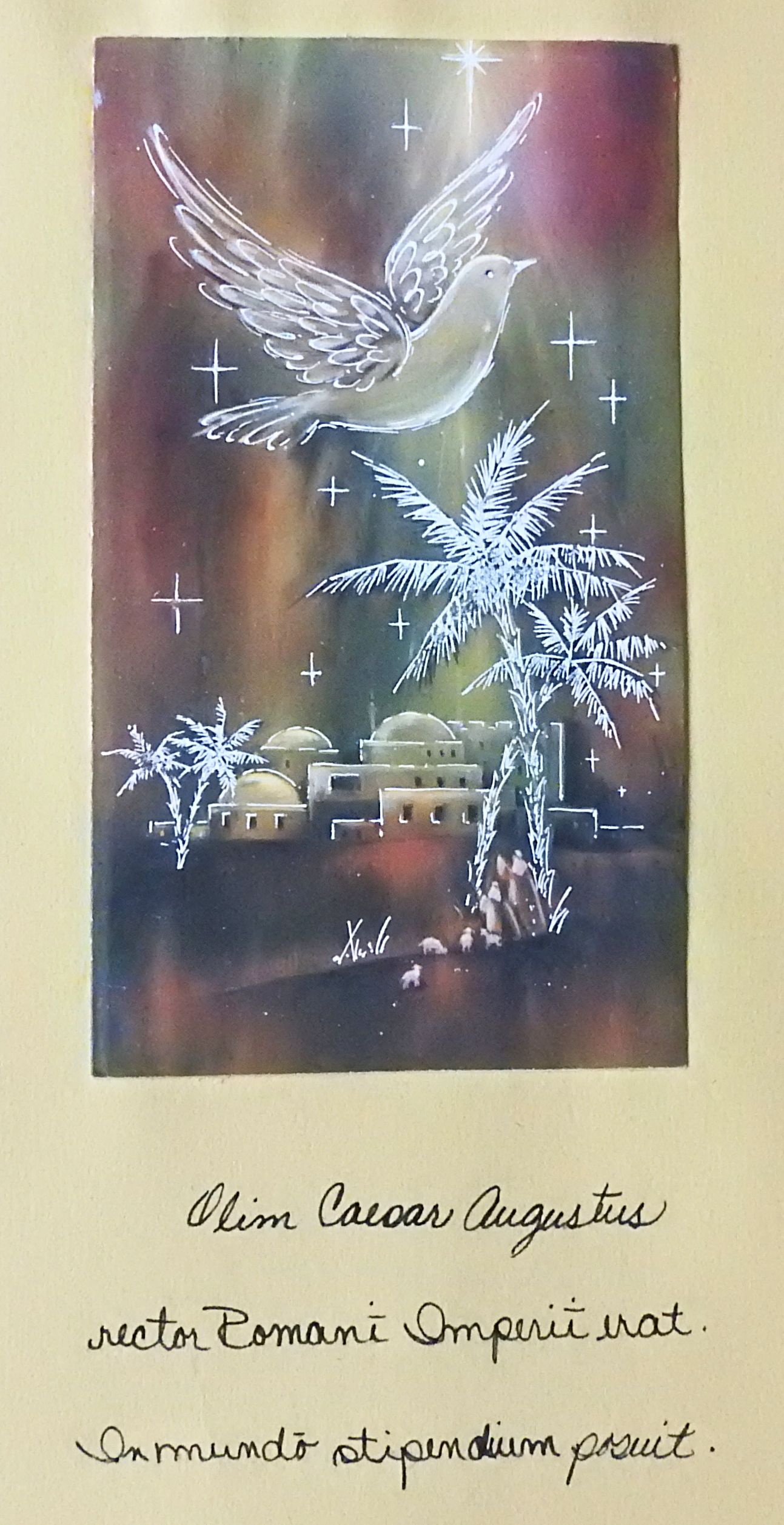
Everyone’s name was recorded. Mary and Joseph went to Bethlehem, the town of their ancestors.
They stayed in a stable because there were no rooms at the inn.
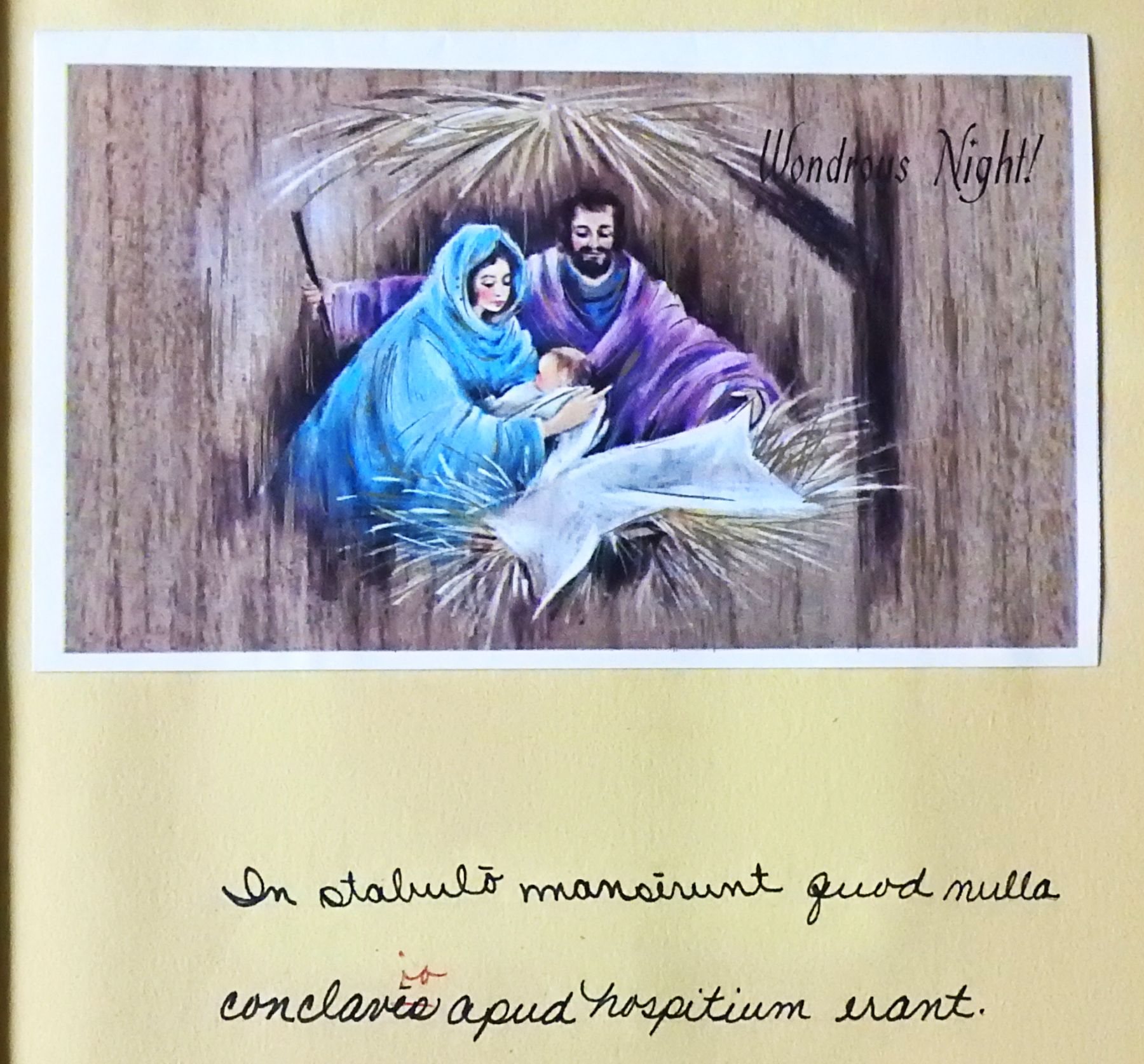
Christ was born there. Mary wrapped Him in swaddling clothes and laid Him in a manger.
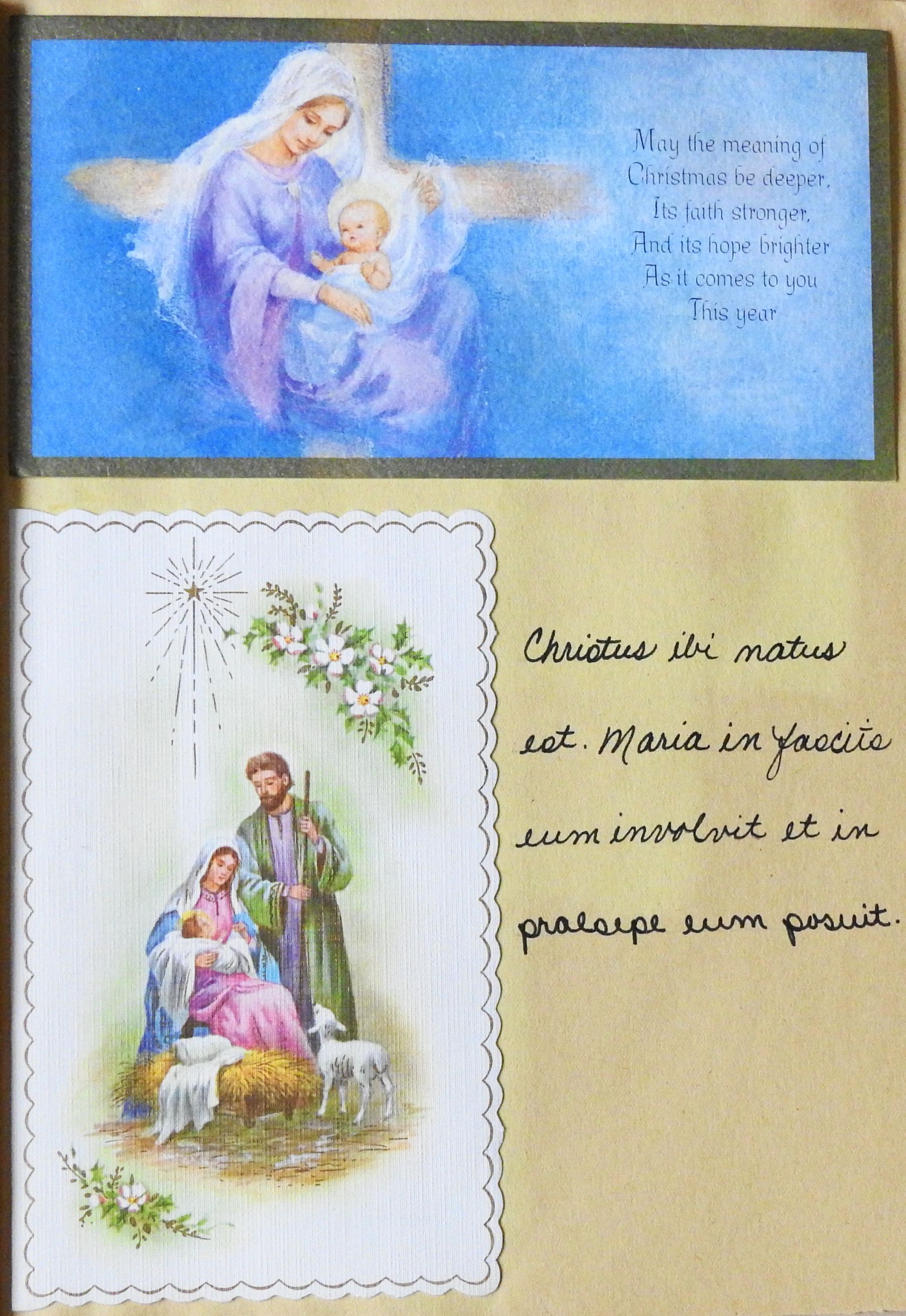
Meanwhile, shepherds were guarding their sheep.
An angel appeared in the sky. The angel told them about the birth of Christ in Bethlehem. Suddenly many angels appeared and sang praises to God. Then the shepherds went to Bethlehem and found Christ.
Secretly Herod, an evil king, sent three wise men to Bethlehem to find Christ. The wise men, on camels, followed a bright star in the East.
The star led them to the stable. Here they found Christ and worshiped Him.
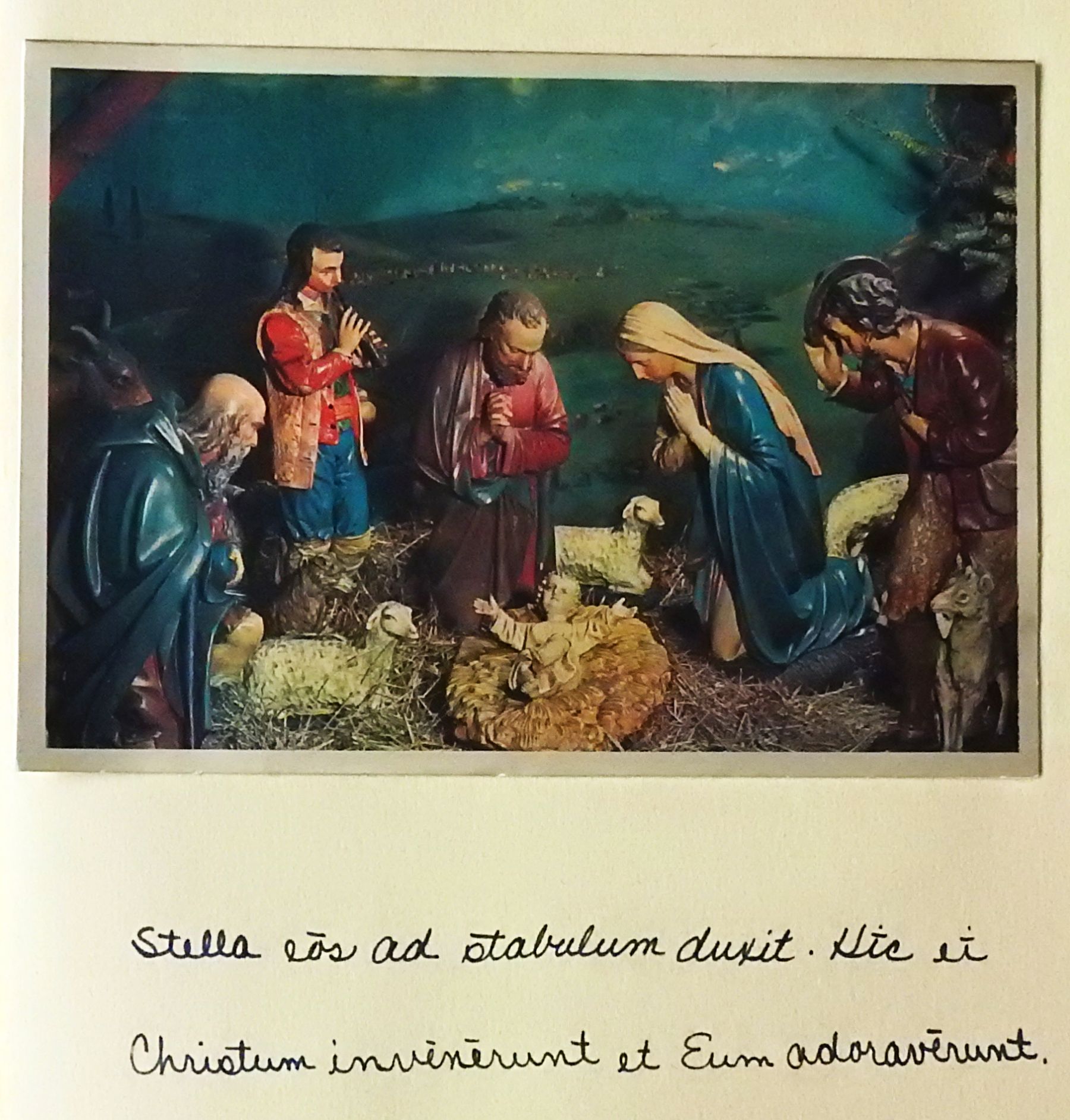
They gave Him gifts, gold and frankincense and myrrh. Then the wise men returned home another way and did not tell Herod about Christ.
 The End
I never grow tired of hearing the Christmas Story, no matter how simply it is written or what language it is written in.
I don’t remember much Latin, mainly just a few verb conjugations. What an odd thing to remember. I also recognize many of today’s words that are derived from Latin words. That’s about all I recall from my two years of intensive Latin study.
Merry Christmas!
 |
 |
 |