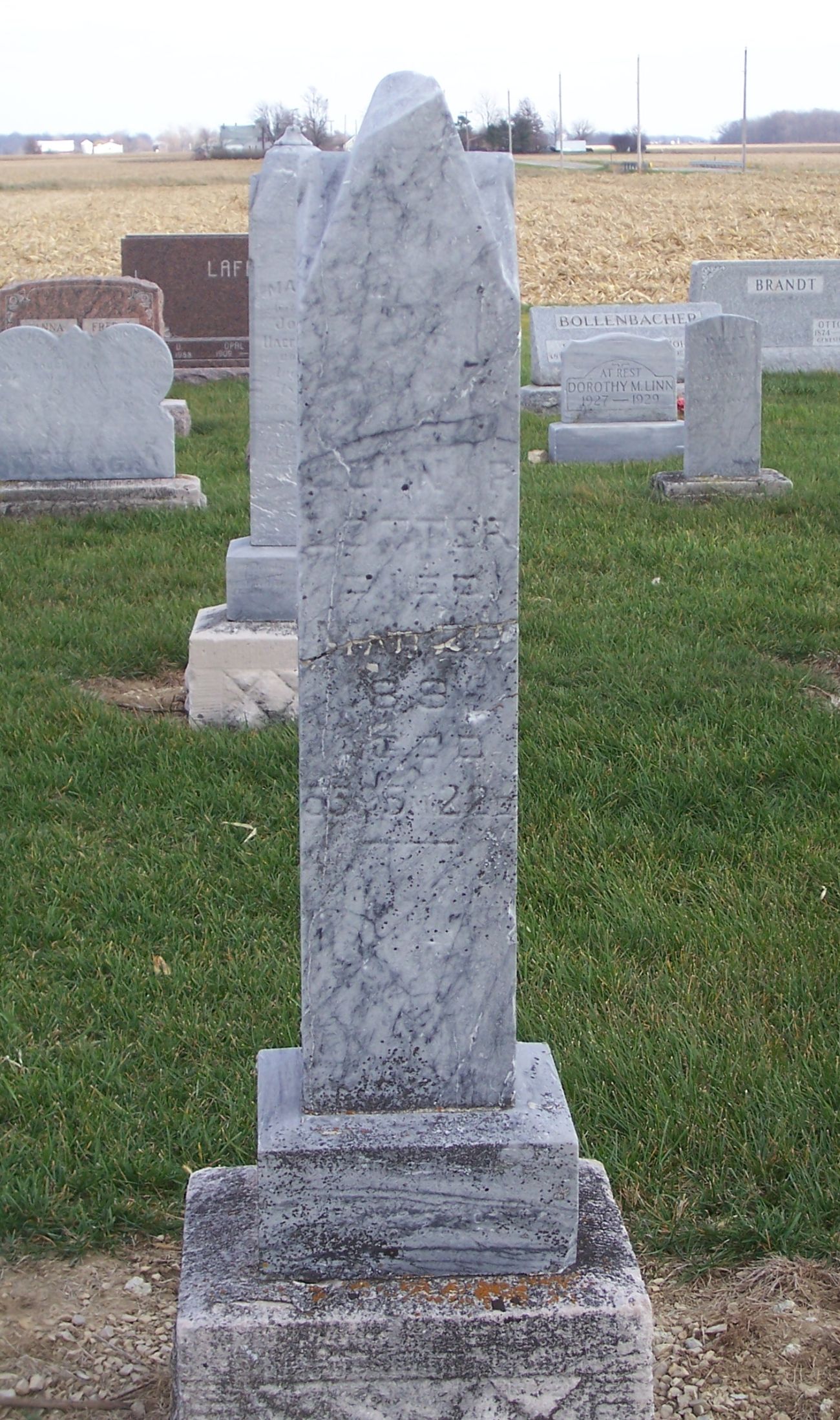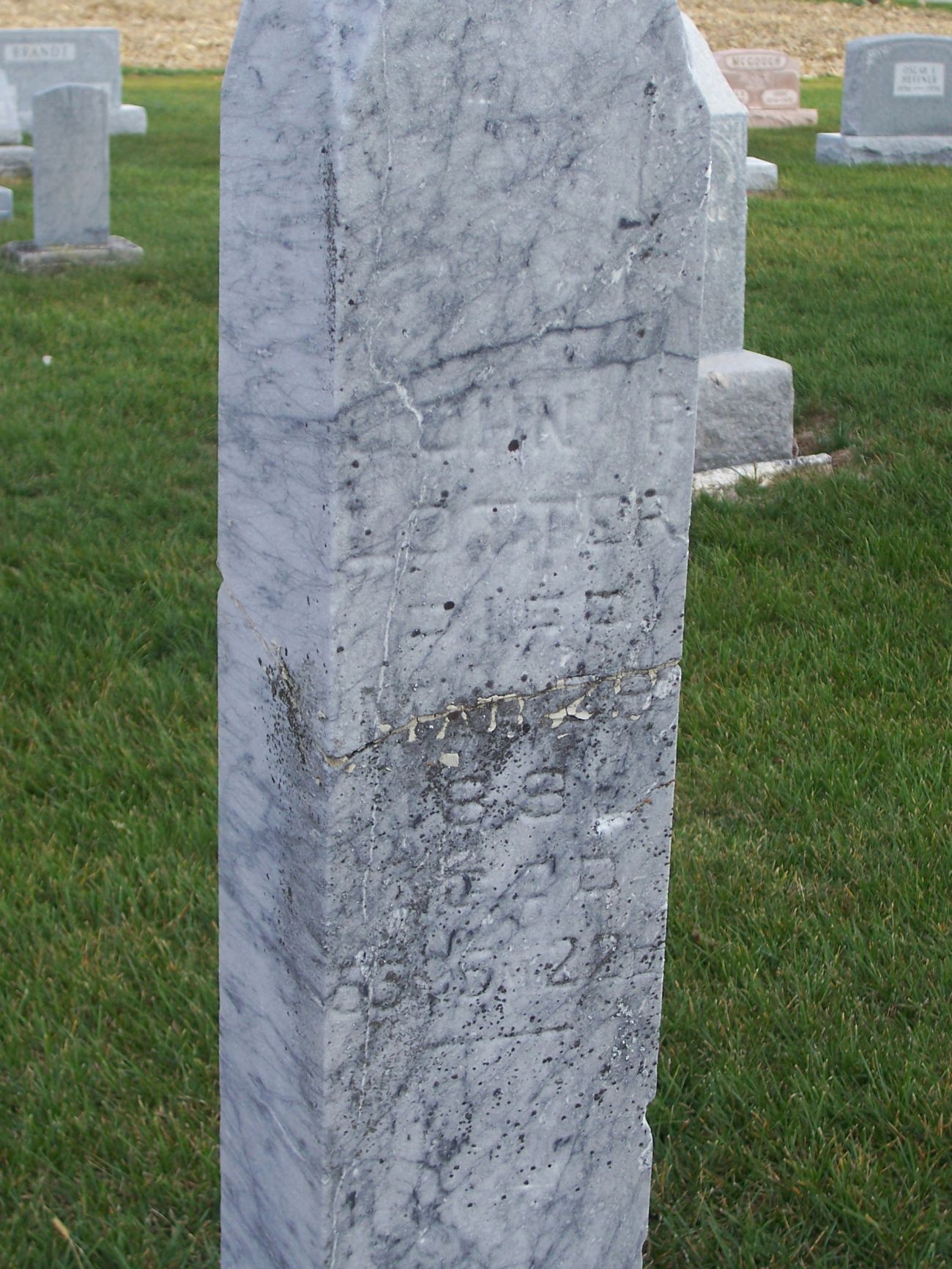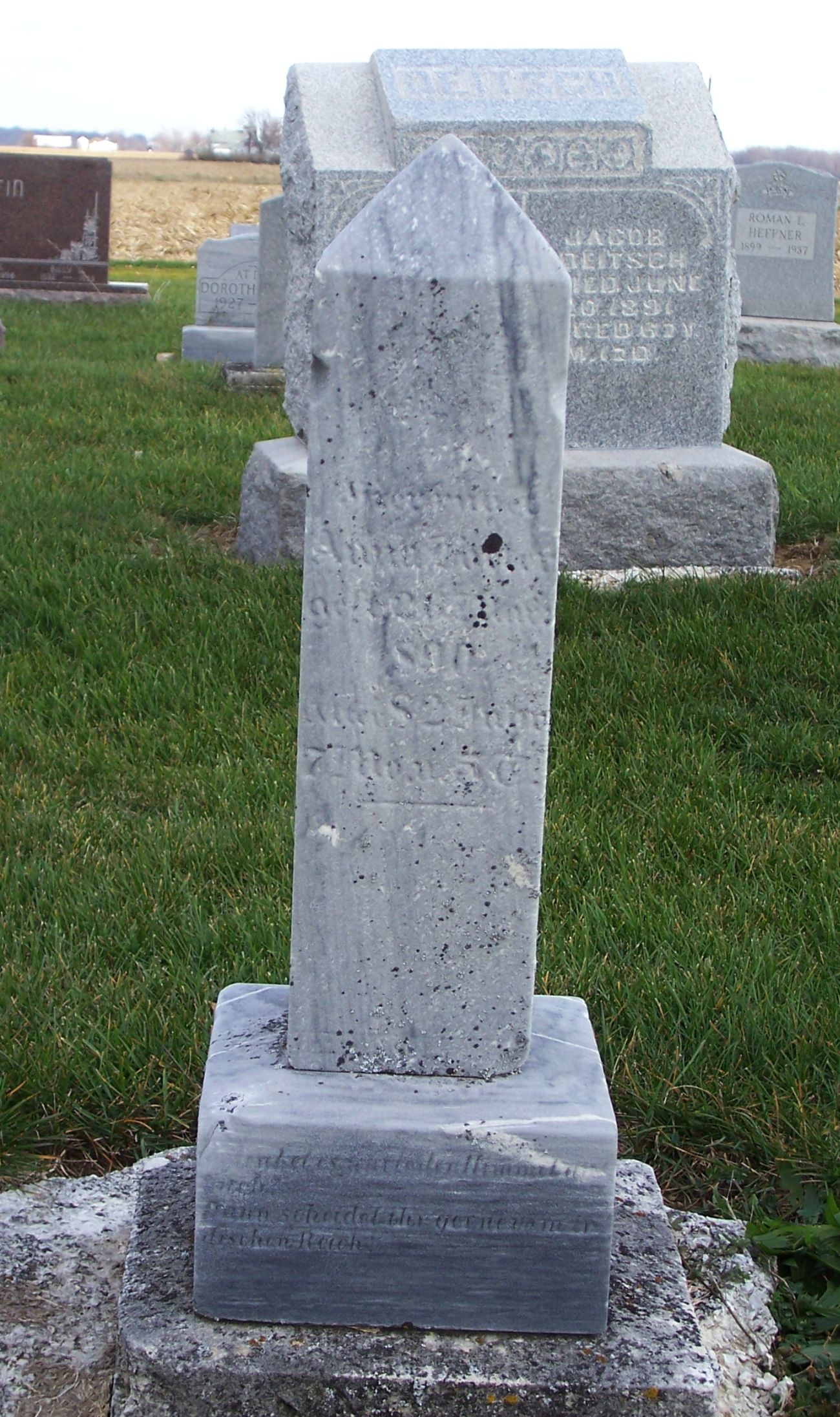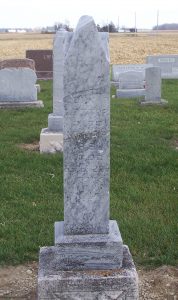
John Peter Lotter, Zion Lutheran Cemetery, Mercer County, Ohio. (2011 photo by Karen)
This is the tombstone of John Peter Lotter, located in row 5 of Zion Lutheran Cemetery, Chattanooga, Mercer County, Ohio. The marker is inscribed:
John P.
Lotter
Died
Mar 29
1891
Aged
55Y 5M 22D
According to Zion Chatt’s records John Peter Lotter was born 8 October 1835 in Zweifelsheim, Bavaria. He was likely the son of Johann “Michael” and Anna Lotter. The church records confirm his mother was Anna Lotter, who died a year before him and is buried next to him. But the church records do not name his father. John Peter’s parents immigrated to America in 1874 and his father died on the voyage here. [1]
John Peter Lotter and his wife Catharine Eichler immigrated to America in 1869, five years earlier than his parents.
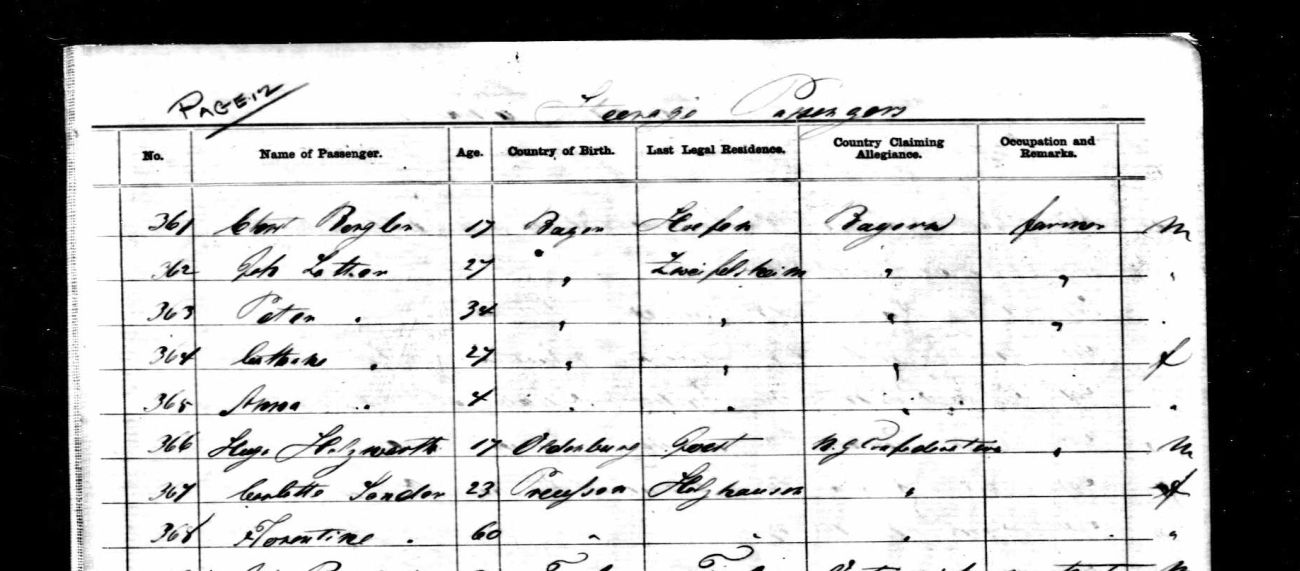
John Lotter, 27, Peter Lotter, 34, Catharine Lotter, 27, and Anna Lotter, 4, arrived in Baltimore, Maryland, on the Steamer Berlin on 2 July 1869. Their last residence was Zweifelsheim, Bayern, and they sailed from Bremen. They were farmers. [2] Perhaps John and Peter were brothers and Anna may have been Peter and Catharine’s daughter. Speculation.
The Lotters lived in Butler County, Ohio, in 1870: Peter, 35, Catharine, 30, and John, 6 months. Their baby John was born in November. Perhaps Anna, the 4 year old who immigrated with them, had passed away. [3]
They eventually moved to the Chattanooga, Ohio, area and later to Jefferson Township, Adams County, Indiana.
The Lotter surname first shows up in Zion Chatt’s communion records, where Johann Lotter was recorded as taking communion on Pentecost in 1875. That was likely John from the passenger list. Several Lotters are mentioned in Zion Chatt’s records but I do not know their relationships to each other. In addition to John Peter and his mother Anna Lotter, Johann “John” Lotter, Katharina/Catharine Lotter, Simon Lotter, and some Lotter children, are mentioned in the records.
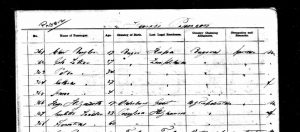
Steam Ship Berlin, 2 July 1869, Baltimore Passenger List, Ancestry.com.
The John Peter Lotter household in 1880 in Adams County, Indiana: Peter, 46; Catharine, 40; John, 10; Andrew, 8; Barbara, 6; Alice, 5; Minnie, 4; George, 2; Lawrence, 14 days. Peter was a farmer and written under the “Health“ column for Catharine was child birth, probably since she had recently given birth to their son Lawrence. Peter and his wife were both born in Bayern. Their oldest five children were born in Ohio and their two youngest sons were born in Indiana. [4]
John Peter and Catharine had twelve children, according to Catharine’s enumeration in the 1910 census. According to that census nine of the twelve children were living in 1910. This is a partial list of their children, according to Zion Chatt‘s baptism and confirmation records, the 1880 census, and Find a Grave.com:
Anna (c1865-c1870) [likely a child of Peter and Catharine who immigrated with them]
Johann “John” W (1869-1940), married Florence
Andreas “Andrew” (1871-1938), married Rachel Emma Evans; married Hester Ruth (Phender) Perkins
Anna Barbara (1873-1938)
Elizabeth Alice (1875-1950), married William A Sprague
Wilhelmine “Minnie” (1876-1947), married John Ferch
Johann “George” (1878-1961)
Lorenz “Lawrence“ (1880-), married Lydia Amanda Blossey
Conrad (1882-1932), married Bessie Garrison
Margaretha Cortha “Cora” (1884-1967), married Fred Mickow
Mary E (1888-1889)
I am not sure if the children listed below are the children of John Peter and Catharine. Their father was listed only as Johann in the church records:
Johann Christof M (1879-)
Peter (1881-)
According to Zion Chatt’s records John Peter Lotter died of enteritis on 29 Mar 1891, at the age of 55 years, 5 months, and 22 days. He was buried on the 31st. Rev. Chr. Reichert was in charge of the funeral service.
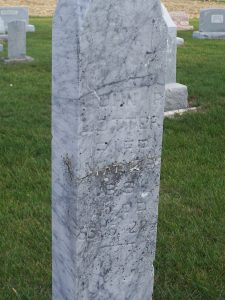
John Peter Lotter, Zion Lutheran Cemetery, Mercer County, Ohio. (2011 photo by Karen)
John Peter’s widow Catharine moved out of the area after his death. She was living with her son John and his wife Florence in Starke County, Indiana in 1900. [5] In 1910 she was living with her daughter and son-in-law Cora and Fred Mickow in Starke County, Indiana. This enumeration indicates that she had given birth to 12 children and 9 were living. Catharine died in 1912 and is buried in Starke County. [6]
[1] Documented Lotter information, submitted to Ancestry.com by T Parkison, indicates that Anna Lotter was the daughter of Johann Leonard and Anna Margaretha (Buttner) Amm. This same information indicates that she was married to Johann “Michael” Lotter, who died on the ship to America in July 1874.
[2] Baltimore, Passenger Lists, 1820-1964, Peter Lotter; digital image by subscription, Ancestry.com (www.ancestry.com : accessed 1 Jan 2017); Records of the US Customs Service, RG36; NAI no. 2655153, NARA Record Group 85.
[3] 1870 U.S. Census, Madison, Butler, Ohio, p.279A, dwelling 48, family 46, Peter Lodder; digital image by subscription, Ancestry.com (www.ancestry.com : accessed 1 Jan 2017); FHL microfilm 552676, NARA microfilm M593, roll 1177.
[4] 1880 U.S. Census, Jefferson, Adams, Indiana, ED 133, p.54A, dwelling & family 119, Peter Lutter; digital image by subscription, Ancestry.com (www.ancestry.com : accessed 1 Jan 2017); NARA microfilm T9, roll 263.
[5] 1900 U.S. Census, Davis, Starke, Indiana, ED 143, p.7A, dwelling & family 133, John Luther; digital image by subscription, Ancestry.com (www.ancestry.com : accessed 1 Jan 2017); FHL microfilm 1240403, NARA microfilm T623, roll 403.
[6] 1910 U.S. Census, Davis, Starke, Indiana, ED 200, p.9B, dwelling 82, family 87, Fred Mickow; digital image by subscription, Ancestry.com (www.ncestry.com : accessed 1 Jan 2017); FHL microfilm 1374392, NARA microfilm T624, roll 379.