The Twelve Days of Christmas

We are in the midst of the Twelve Days of Christmas. It is still the Christmas Season and will be until Epiphany, 6 January. Epiphany, the day the three wise men arrived in Bethlehem for Jesus’ birth, is also known as Twelfth Night, Day of the Magi, Three King’s Day, or Eid al-Ghitas. I had never heard of that last name before.

For me, the Twelve Days of Christmas is a good thing. It is a breather after Christmas and a time to enjoy our Christmas decorations a little longer. I put up artificial trees, so I don’t have to worry about a dry evergreen tree dropping needles. Some consider it bad luck to take down the Christmas tree before Epiphany. That is not a problem here.

At home, growing up, we left our decorations up until New Years Day. We usually had some family gatherings the week between Christmas and New Years Day. My Schumm side of the family, grandparents, aunts and uncles, and cousins, had their Christmas dinner that week, so we kept the decorations up for that.

Christmas at Cornelius & Hilda Schumm home, c1963.

Since it is totally acceptable to leave the Christmas finery out until Epiphany, I don’t rush to take down my decorations. Actually, some Christmas decorations may still be out on display in our basement for weeks after Epiphany. I change out the basement decor for the season, but I have scaled back to just three seasons, Patriotic, Halloween, and Christmas. That works very well and is minimal work. My Patriotic Season doesn’t begin until May so I still have plenty of time to put the Christmas decorations away down there.

At any rate, during each Christmas Season I enjoy the song, The Twelve Days of Christmas. It is a centuries-old song that is still popular today. The original song may have had French origins, but first appeared in print in an English children’s book in 1780. The gifts in the song are partridges, turtle doves, French hens, calling birds, golden rings, geese, swans, maids, ladies, lords, pipers, and drummers. Originally, the four calling birds were called colly birds, colly being old English slang for a blackbird, and the partridge in a pear tree was originally a peacock. Today’s version of the lyrics was created in 1909.

The Twelve Days of Christmas music

A question at Christmas party this year was how many gifts would you receive if you got all the gifts in the song. The answer takes a little more calculating than you think at first. The gifts are cumulative. You give each previous gift with each subsequent gift. That is, on each new day, you receive all the gifts previously given. That would be 12 partridges, 22 turtle doves, 30 French hens, etc, making the total number of gifts 364. Interesting that the number is one gift shy of a gift a day for a whole year. Of the 364 gifts, 184 are birds. Someone liked our feathered friends.

I did not figure all this out myself. The answer to almost everything is online and I do not like to think that hard for fun anymore. And for the mathematicians out there, the solution to the question involves Triangular and Tetrahedral Numbers and Triangular-based Pyramids. I’m not sure what all that even means.

What would all those gifts cost today? In 2024 the cost would have been $201,973. That cost should not be a surprise, with swans costing $1875 each and gold over $2600 an ounce.

Some believe there is a hidden Christian meaning to the song, used to secretly pass on Christian ideology.

Partridge in a pear tree=Jesus
Two Turtle Doves=Old and New Testaments
Three French Hens=Faith, Hope, and Charity (theological virtues)
Four Calling Birds=the four Gospels and/or the four evangelists
Five Golden Rings=the first five books of the Old Testament
Six Geese a-laying=the six days of creation
Seven Swans A-swimming=the gifts of the Holy Spirit/the seven sacraments
Eight Maids A-milking=the eight beatitudes
Nine Ladies Dancing=the nine fruits of the Holy Spirit
Ten Lords A-leaping=the Ten Commandments
Eleven Pipers Piping=the eleven faithful apostles
Twelve Drummers Drumming=the twelve points of doctrine in the Apostle’s Creed

We are on day 10 of the song today, Ten Lords a-leaping, plus all the other gifts from days 1-9. That’s a quite a crowd and a lot of poultry.

It’s a very catchy Christmas song and now I know what those Calling Birds really are.
Happy New Year!

Happy New Year from Karen’s Chatt!

The holiday season is nearly over and another year comes to an end. Today is the last day of 2024 and at midnight we welcome 2025.

Out with the old year, in with the new year. A new year, a new beginning, new resolutions, new hopes.

Wishing everyone a happy, healthy, and prosperous 2025, filled with love, peace, and joy. 

Oranges at Christmastime

When I was in elementary school at Willshire, probably during the first three or four grades, just before Christmas Santa would visit the school and give each a student a gift, a little brown paper bag with an orange in it. There may have also been an apple and a candy cane in the bag, but I distinctly remember the orange.

Oranges

It was a real treat. I was excited to get the gift from Santa, even if it was only an orange. A gift is a gift and oranges are a sweet, tasty fruit treat.

Last week I featured some letters to Santa that were written in 1917. Most of the children at that time asked for fruit and candy. When they asked for fruit, they were likely asking for oranges.

Oranges have long been a popular Christmas gift, often put in a Christmas stocking. In some areas and at certain times, like during the Great Depression, oranges were a rare, special treat that may have been the only gifts under the Christmas tree.

There is an old tale behind the tradition of oranges as Christmas gifts.

Saint Nicholas, aka Santa Claus, was the son of a wealthy merchant who later became a bishop. He lived near a man with three daughters. When the man fell on hard times, Saint Nicholas secretly threw three bags of gold through his window. A bag of gold landed in each daughter’s stocking, stockings that were hanging on the mantle to dry. People eventually learned the identity of the gift giver, called him Saint Nicholas, and oranges came to represent the bags of gold he gave. An orange placed in the toe of the stocking was used to represent good fortune for the recipient.  

Oranges also symbolize giving and sharing during the holiday season because the orange segments can easily be shared with others.

Oranges

Yes, oranges are a symbol of Christmas, a common item included in holiday fruit baskets, and a popular winter fruit.

Merry Christmas!

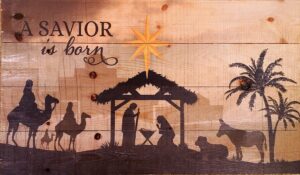
The Nativity, on wood.

For to us a child is born, to us a son is given, and the government will be on his shoulders, and he will be called Wonderful Counselor, Mighty God, Everlasting Father, Prince of Peace. Isaiah 9:6

Merry Christmas from Karen’s Chatt!

Wishing you and your family all the blessings of Christmas!

Letters to Santa, 1917

December 1917. The U.S. had entered World War I a few months earlier and Christmas was right around the corner. Even though we were at war, children were making Christmas lists and writing letters to Santa.

Dear Santa, Celina Democrat, 21 Dec 1917

The Celina Democrat printed a few Dear Santa letters in 1917, most from local children. The children’s wish lists were fairly minimal back then, although one little girl asked for a piano. Candy, fruit, and peanuts were popular Christmas list items. These children also seemed to be conscious of the needs of others.

Dear Santa letters from the 21 December 1917 issue of The Celina Democrat:

Dear Santa Claus:
I will not ask for much. I want a coaster sled and don’t forget my little cousins Horson and Holdy and my brother Vernon would like a pair of mishing [sic?] socks. Don’t forget my cousins out of town. I will close and say my prayer.
John Loyda Bader
(RR Mendon)

I’m not sure what mishing socks were. There were a lot of typos in these letters and mishing may have been a typo.

Dear Santa Claus:
Please bring me a new doll and a piano and some candy and nuts, oranges and fruits. I am four years old. I go to Sunday School. Please don’t forget to bring Evaun and Kahle something…
Marielle Jenkins
(RR Celina)

Dear Santa Claus:
I am a little girl nine years old, and I go to school every day and study my lessons very good. I want you to come to my house and bring me Sleepy Night Stories striped hair ribbons, some candy, nuts, and oranges. I live three miles southwest of Celina. I’ll go to bed early.
Pearl Andrews
(Celina)

Dear Santa Claus:
I don’t go to school. I am five years old. I would like to have an A.B.C. book, a handkerchief, hair ribbon and overshoes and candy, oranges, bananas, and peanuts for Christmas.
Ruth McGee
(Celina)

Dear Santa Claus:
I am eight years old. I go to school and am in the fourth grade. I would like to have a handkerchief, story book, and pretty goods to make my doll a dress, and candy, oranges, bananas, and peanuts for Christmas.
Blanch McGee
(Celina)

James, Romania, William, and Mary Carlin, probably siblings in Columbus, Ohio, each wrote a letter to Santa and each asked Santa not to forget the poor.  They remembered their parents, grandparents, and siblings as well. Each also mentioned that they would have the fire lit when Santa came in so that he could get warm. These are the other items they asked for:

Dear Santa Claus:
I would like to have a machinic [sic] and some candy.
James John Carlin

I would like a doll and some candy.
Romania Marie Carlin

I would like a machine and candy.
William Charles Carlin

I would like a red go-cart and candy.
Mary Elizabeth Carlin

I wonder what that machine was that the two boys asked for.

Things have not changed all that much over the years since 1917. Children still wish for special presents and ask Santa for them, although today’s Christmas lists may be digital Amazon Wish Lists and many of the items are technical electronics. Children still anxiously wait for Santa’s arrival and anticipate the excitement and fun of opening presents on Christmas morning.

A couple weeks ago I featured a letter from a November 1917 issue of The Celina Democrat, written by Albert C.  Heffner, of Chatt, written while he was in basic training in Nebraska. Before he entered the war he and his brother-in-law Jake Bauer were piano dealers in Celina. This was their Christmas ad:

Albert Heffner, piano dealer, Celina Democrat, 21 Dec 1917

Perhaps Santa got a piano for little Marielle Jenkins from their store.