Holmes County–Just Passing Through

This past week we spent a few days in Holmes County. In addition to the beautiful eastern Ohio countryside in this Amish community there is an abundance of shopping opportunities, handcrafted Amish items, cheese, wine, delicious home-style food, and other attractions. It is also the area where several of my ancestors lived for awhile before moving westward.

We enjoy going to this area every year or two and after our 2014 visit I made a list of my ancestors who lived in this area before moving to western Ohio or eastern Indiana, where they made their permanent home. I was surprised by how many of my ancestors passed through here and I wrote the following blog post about them. I am re-posting this 2014 blog post today and adding a few updates from this week.

Ohio is often called the Gateway to the West because so many settlers traveled through Ohio, either overland or on one of Ohio’s waterways. When I sat down and thought about it I was surprised at how many of my ancestors not only traveled through Ohio, but actually lived in the Holmes County area for a few years. Below is a list of my ancestors that once resided in the Holmes County area.

Winesburg, Ohio. (2018 photo by Karen)

Both the Schumms and the Pfluegers lived in Holmes County in the early 1830s. Both families worshiped with the Evangelical United Zion Congregation in Winesburg, where several family members were married and where some of their children were baptized.

Zion Reformed Church, Winesburg, Ohio. (2018 photo by Karen)

Zion Reformed Church, Winesburg, Ohio. (2018 photo by Karen)

Christian Pflueger owned land in the area between Winesburg, Walnut Creek and Berlin. Both families moved to Van Wert County in about 1838. Johann Georg Schumm and Christian Pflueger are my third great-grandfathers.

The Schumms and Pfluegers lived in this area of Holmes County in the 1830s. (2014 photo by Karen)


Schumms and Pfluegers lived in this area in this area around Winesburg, Walnut Creek, and Berlin in the 1830s. (2018 photo by Karen)

My great-grandfather John Scaer was born in Baltic in 1864. This little village is actually located in three counties–Coshocton, Holmes, and Tuscarawas–but John’s obituary states that he was born in Tuscarawas County. John’s family later moved to Monroeville, Indiana.

Baltic, Ohio. (2014 photo by Karen)

The Baltic branch spelled their name “Scarr” and we found Scarr tombstones in West Lawn Cemetery in Baltic. The Monroeville branch probably changed the spelling to Scaer and some of them later went on to change the spelling to Scare. My mom recalls her mother Hilda and Hilda’s brother Oscar Scaer traveling to Baltic to visit their Scarr relatives. We visited the little village of Baltic and walked through West Lawn Cemetery there.

Cemetery, Tuscarawas County, Ohio. (2014 photo by Karen)

Nicholas and Ruth (Phillips) Headington left Maryland about 1820 and settled in Knox County for a few years before moving on to Jay County, Indiana. While in Knox County they lived near Mt. Vernon, where several of their children were born. Nicholas was my fifth great-grandfather and fought in the War of 1812.

Louis Breuninger, my second great-grandfather, was living in Canal Dover in 1840. The town is called Dover today and is in Tuscarawas County. By 1850 Louis had moved to Green Bay, Wisconsin, where he married Maria Seckel in 1851. Louis moved his family to the Schumm area by 1870.

Canal Dover Park. (2018 photo by Karen)

Down the road from Dover is New Philadelphia, where Jackson Brewster and his family stayed for a short time on their way from Fayette County, Pennsylvania, to Adams County, Indiana, between 1860-1870. Jackson is my third great-grandfather.

Signs to New Philadelphia & Dover. (2018 photo by Karen)

Joe has at least one ancestor who lived in the area. His fourth great-grandfather Jonathan Grant came to what is now Holmes County in 1809 and is credited as being the first white settler in the county. A street in Wooster is named in his honor and he lived in the area the remainder of his life. He is buried in a private cemetery in Holmes County. McCulloch Cemetery, near Holmesville, is located on a back road, beyond a field, in a thicket, on an Amish farm. In 2005 we visited Jonathan Grant’s grave and I understand that his tombstone has been replaced with a new military marker, noting his Revolutionary War service.

We drove through Mt. Vernon and through Centerburg, the geographical center of Ohio, the real Heart of Ohio. We took our time and took the scenic route home and marveled at the beautiful countryside where our ancestors once lived.

This year [2018] was just a relaxing trip with some shopping and sight-seeing. Did I mention shopping? We stopped at Holmes County Pottery and saw Cary Hulin’s new kiln. He makes wonderful salt-glazed pottery and it is interesting to hear him explain how he fires the pottery.

Potter Cary Hulin by his new kiln. (2018 photo by Karen)

Holmes County Pottery. (2018 photo by Karen)

I love to stop at Holmes County Pottery and pick up a few Cary’s pieces but his shop is a little challenging to find. We were able to find it easier this year and only made two wrong turns. Same with The Pottery Niche, which sells that colorful Polish Pottery. These little shops on the township roads off the beaten path can be hard to find but the trip through the beautiful countryside is worth it.

We also visited the Warther Museum and Gardens in Dover. The Mooney Warther carvings, consisting mainly of steam engines hand-carved from wood, ivory, and ebony are awesome. He was unbelievably gifted and a visit to his museum is well worth the trip. The gardens around their home are beautiful, too.

Warther train carving. (2018 photo by Karen)

Warther train carving, ivory. (2018 photo by Karen)

Lincoln Funeral Train, by Warther, ebony & ivory. (2018 photo by Karen)

We finished off the day at Breitenbach Winery between Sugar Creek and Dover. They have very good wine and we got to sample dandelion wine. It is good but sweet. I prefer a dry white wine myself but wanted to try the dandelion wine because my grandpa Miller used to make it.

Breitenbach Winery, Dover, Ohio. (2018 photo by Karen)

It was another great trip to Holmes County and we look forward to passing through there again.


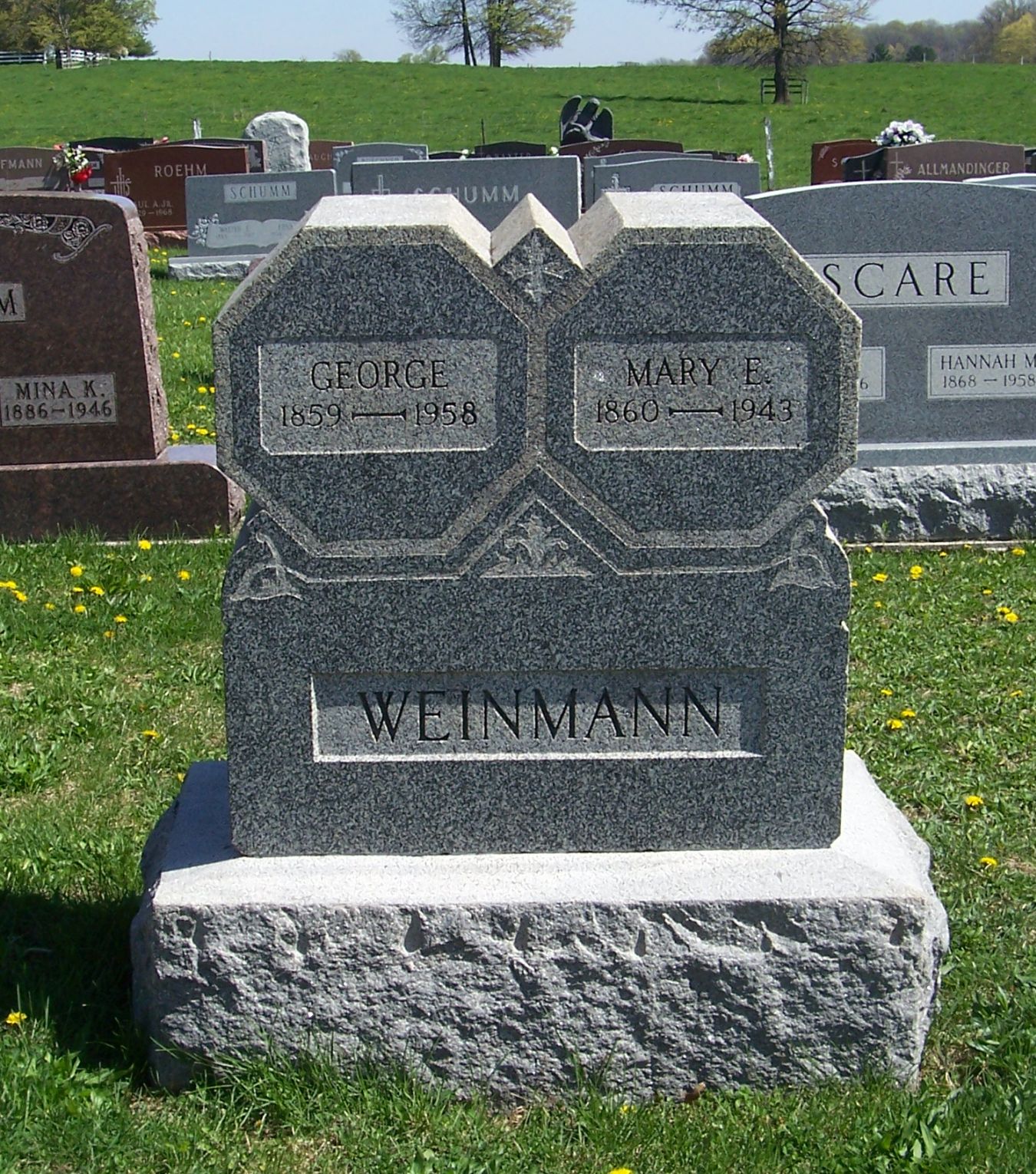
Tombstone Tuesday–Willie H. & Walter T. Weinmann

Willie & Walter Weinmann, Zion Lutheran Cemetery, Schumm, Van Wert County, Ohio. (2018 photo by Karen)

This is the tombstone of brothers Willie H. and Walter T. Weinmann, located in row 2 of Zion Lutheran Cemetery, Schumm, Van Wert County, Ohio. The brothers were the first two children born to George (Jr.) and Mary Elizabeth (Gunsett) Weinmann and they share this weathered marble tombstone. The “front” of the marker faces west and is illegible, if there was ever anything inscribed on the west side. Willie’s inscription is on the north side of the stone and Walter’s is on the south. The marker is inscribed:

Willie H.
Sohn von
G. & M.
Weinmann
Gest. 23 Dec.
1887
Alter
2 J. 4 M. 7 T.
Text Luke 2:10-11

Walter T.
Sohn von
G. & M.
Weinmann
Gest. 21 Nov.
1887
Alter
3 M. & 2 D.

Willie H., son of G. & M. Weinmann, died 23 December 1887, age 2 years, 4 months, 7 days.

Walter T., son of G. & M. Weinmann, died 21 November 1887, age 3 months, 2 days.

Wilhelm Heinrich “Willie” Weinmann was born 16 August 1885. He was baptized at home on 26 August 1885 and his sponsors were Joseph Gunsett (standing in for Jacob Gunsett), John Weinmann (standing in for G. Weinmann Sr.), and Johann Gunsett of Convoy.

Willie Weinmann was sick with malaria in November 1887, about for four weeks before he passed away. Willie died on 23 December 1887, at the age of 2 years, 4 months, and 7 days. He was buried on the 26th and his funeral text was Luke 2:10,11.

Willie H. Weinmann, north side of stone. (2018 photo by Karen)

William’s brother Walter was born about 4 months before Willie’s death.

Walter Theodore Weinmann was born 19 August 1887 and was baptized at the church on 4 September 1887.  His sponsors were Heinrich Gunsett and Heinrich Schinnerer II.

Walter Weinmann died on 21 November 1887, just about a month before his brother Willie. Walter was only 3 months and 2 days old. He has been sick with brain fever for 3 months, pretty much his whole life, and was buried on 23rd.  ­­­­­

Walter T. Weinmann, south side of stone. (2018 photo by Karen)

That must have been very hard for the Weinmanns, losing their two children within about a month of each other.

Tombstone (center) of Willie & Walter Weinmann. (2018 photo by Karen)

According to Zion Schumm’s records George Jr. and Mary (Gunsett) Weinmann went on to have five more children:
Karl Hermann (1888-1971), married Esther Berdie Dull
Minna Katherine (1891-1979), married Philip Sauer
Otto Emanuel (1895-bef 1971), married Annie M. Stetler
Lina Elisabeth (1899-1901)
Edward George (1903-1971), never married

Their parents, George Weinmann Jr. and Maria “Mary” Elizabeth Gunsett, married on 20 November 1884 at the house of the bride’s parents. Both were members of Zion Schumm’s parish. George was born in Germany and Mary was born in Ohio and George was a farmer. Mary (Gunsett) Weinmann died in 1943 and George Weinmann Jr. died in 1958. They are both buried near Willie and Walter in Zion Schumm’s cemetery.

Today the usual spelling for this surname is Weinman.

2018 Vacation Bible School at Zion Chatt

This week was Vacation Bible School for the Chatt community, held at Zion Chatt this year. The two churches in Chatt, Zion Lutheran and the Chattanooga United Methodist Church, take turns hosting the annual week-long event and this year was Zion’s turn. They have combined to host very successful and popular Bible School programs for many years and volunteers of all ages, from both churches, help out.

This year’s Bible School theme was “Shipwrecked—Rescued by Jesus” and those in charge are to be commended and thanked for putting together yet another successful Bible School. The church and basement were decorated with an island theme. Days were packed with Bible stories, upbeat songs, prayer, creative crafts, fun activities, snacks, and more.

2018 Bible School, Zion Chatt, “Shipwrecked”

Last year I took our granddaughter Chloe to our Chatt-area Bible School, her very first time attending Bible School. However, this year Chloe’s church had their Bible School the same week and she was not able to attend here. But I volunteered to help out this year at Zion for several days, assisting with the pre-K/Kindergarten class.

A lot of kids attended this year. There were over 70 there on Wednesday and we had 16 in our class that day. We kept them moving and I don’t think any of them were ever bored.

Bible School is a lot different today than when I attended nearly 60 years ago. My goodness, that was a long time ago!

I spent my summer days with my Miller grandparents. Their neighbor, Helen Jean White, would pick me up at the Miller farm and take me, along with her two children, Martha and Charles, to Zion Chatt’s Vacation Bible School. She would drive us in what I thought was the coolest car, a Pontiac Woody station wagon. For me it was like riding a small bus to Chatt. Back then Helen Jean taught both Sunday School and Bible School at Zion Chatt.

I don’t know if my memory is correct, since it has been a long time since I was little, but I think we had Bible School for two weeks one year. There were a few years that I recall it was a day-long event and we took our lunch each day.

Now we move each class from area to area, where specific persons tell a Bible story, teach the music, lead activities, or hand out the snacks. But back in my day we stayed in our room/area the whole time and had the same teacher for everything. The only time we left our table was for the opening session and for activities and play-time that was held outdoors.

Outdoor activities I remember consisted of games like Red Rover, The Farmer in the Dell, London Bridges Falling Down, Drop the Hankie, tag, and kick-ball. Now activities involve kiddie pools full of water and some ball games. The water felt really good for the kids this year since it was so hot.

Cooling off in the water.

It is sort of a joke around our church but you can count on Bible School week being the hottest week of the summer. Monday and Tuesday didn’t let us down this year. It was very hot and humid. Dreadfully hot, in fact, and downright uncomfortable. It helped that Bible School was held in the mornings, the cooler part of the day, if there was a cooler part of the day. There was a string of years some time ago when Bible School week was the week we got lots and lots of rain—usually so much rain that the basement would flood.

But that would never stop us from having Bible School. Rain or shine. Wet or dry. Hot and humid.

Bible School crafts have come a long way. Ruth, our crafty lady at church, comes up with some great craft ideas. This year the kids made terrariums, wind chimes, and necklaces, as well as stuffing bears to give away. Back in my day I remember gluing pop-sickle sticks together to make a cross, plastic canvas projects, and other crafts that involved cutting, pasting, and coloring. Pretty simple stuff compared to today’s crafts.

Craft time!

The music is much more upbeat today, too. The songs have a brisk tempo and the kids get to use motions and move around to the music. They really get into the music and have a great time. It is amazing how quickly they learn the songs.

Getting into the music!

But the most important thing about Bible School are the Bible stories and showing how they relate to the kids [and all of us] today. We never forget that part of Bible School and of our mission.

Bible Stories.

A big thank you to everyone who helped make Shipwrecked a very successful Bible School week.


Tombstone Tuesday–Christian Roehm

Christian Roehm, Zion Lutheran Cemetery, Schumm, Van Wert County, Ohio. (2012 photo by Karen)

This is the tombstone of Christian Roehm, located in row 2 of Zion Lutheran Cemetery, Schumm, Van Wert County, Ohio. The marker is inscribed:

Christian
Son of
Andrew & [unreadable]
ROEHM
Died
12 July 1863
Aged
13 Y, 11M, 12 D

Christian Roehm was born in Ohio, likely in Tully Township, Van Wert County, on 26 July 1849 to Andreas “Andrew” (1814-1902) and Catharine (Bienz) (1819-1858) Roehm.

His mother’s name on the tombstone is unreadable now, but when the Van Wert County Chapter OGS read the cemetery in 1992, they read her name as “Freidrica.” Friedericka would have been Christian’s step-mother and that may very well be the name inscribed on the tombstone. Christian’s birth mother Catharine died in 1858.

Christian Roehm’s parents Andrew and Catharine (Bienz) married on 16 August 1840 in Van Wert County, Ohio. They were both born in Germany and his father Andrew was a farmer. [1]

The Andrew Roehm family lived in Tully Township in 1850. Their household in 1850: Andrew, 37; Catherine, 31; Mary, 9; John, 7; Elizabeth, 5; Jacob, 3; and Christian, 1. All their children were born in Ohio. [2] Christian’s baptism is not recorded in Zion Schumm’s records, perhaps because they did not live in Willshire Township and did not attend Zion Schumm at that time.

Sometime during the next 10 years the family moved to Willshire Township. Christian’s mother Catherine died in 1858 and the Andrew Roehm family was enumerated in the census two years later. Their family in 1860: Andrew, 45; Mary, 18; John, 16; Elizabeth, 14; Jacob, 13; Christina, 11; Henry, 9; Emanuel, 7; and Anna, 3. [3]

The 1860 census was enumerated on 25 July 1960 and Christian’s father Andrew married widow Friedericke (Gutheil) Rettig (1827-1910) a few months later, on 8 November 1860, in Van Wert County. [4] Friedericke had at 5 children from her first marriage to John Rettig. She and Andrew went on to have at least 5 children of their own.

Young Christian Roehm died 12 July 1863. Zion Schumm’s records tell that he suffered from cramps for a year and was found dead one morning.

Christian’s father Andrew Roehm died 4 January 1902. He and his second wife Friedericka are buried a few rows away, in row 7.


[1] Ohio, County Marriage Records, 1774-1993, Van Wert County, p.4, Andrew Roehm & Catharine Bientz, 16 Aug 1840; database & image on-line, Ancestry.com.

[2] 1850 U.S. Census, Tully, Van Wert, Ohio, p.189A, dwelling 406, family 425, Andrew Reem; Ancestry.com.

[3] 1860 U.S. Census, Willshire, Van Wert, Ohio, p.427, dwelling 1099, family 1093, Andrew Rackin; Ancestry.com.

[4] Ohio, County Marriage Records, 1774-1993, Van Wert County, p.232, Andrew Roehm & Fredrika Guthial, 8 Nov 1860; database & image on-line, Ancestry.com.

Dear Mom & All–WWII Letters from Herb (part 23)

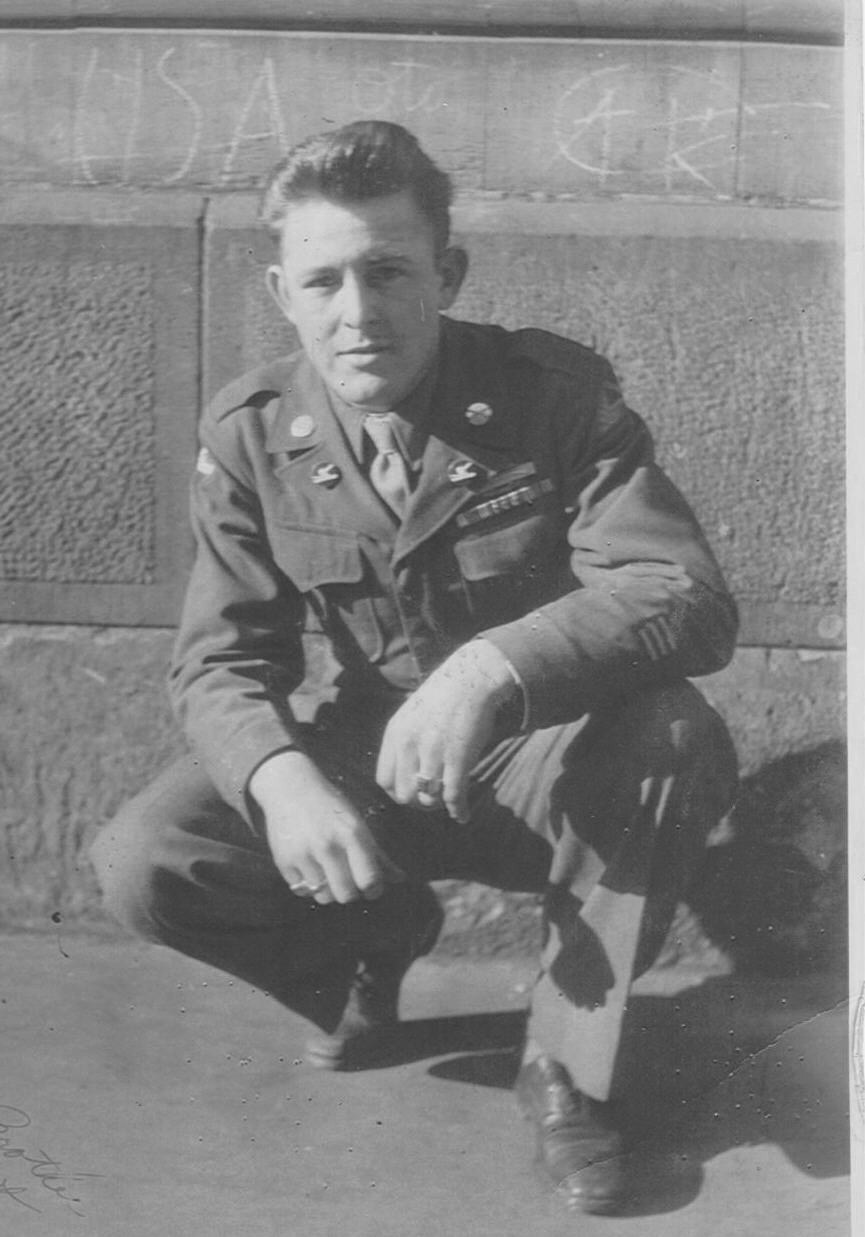
My dad, Herbert Miller, was trained as a replacement troop during the fall of 1944. After he arrived in Europe he was assigned to Company L, 333rd Regiment, 84th Infantry Division. The 84th was known as the Railsplitters. He fought in the Battle of the Bulge in Belgium and later in parts of Luxembourg, Germany, and France.

Herbert M. Miller

I continue with the transcriptions of the letters my dad wrote home while he served his country during WWII. The war was over by the time he wrote these letters and he was serving with the Occupation Force in Germany. His letters give us an idea of what things were like for him during that time.

The first two letters are V-mail letters, tiny letters, reduced in size and rather difficult to read. My dad does some complaining in the third letter, which is rather unusual because he usually didn’t complain much.

Sgt. Fenn, Cpt. McGee, Sgt. Mueller, Cpl Thornton, Herb Miller; Schriesheim, Germany 1945.

V-mail letter from Pfc Herbert Miller to Em & Jack Weitz, Rockford, Ohio:

19 June 1945
Germany

Dear Em & Jack,

It’s about 4:30 in the morning and just got off guard duty. Only have 1½ any more so it isn’t any use to go to bed.

How is everything coming along around Chatt? Do you have all of the crops out yet? I don’t have the least idea where I’m going to be sent but right now we are doing the job of occupational troops and if we stay here 6 months that means 6 months less in the Pacific. The town we are in now is about the size of Celina. These German towns are very old and historic. This particular town has a castle that was built sometime in the 13th century. It is half in ruins, not from the war, and sits right on top of a hill. From there you can see for miles and miles. Oh, yes, the ground is very hilly around here, something like Alabama.

There are very few passes given out. Four men out of forty got passes in the last 6 months. The passes are for Paris, Holland, and Belgium. You don’t need a pass in Germany. You can go into town any night or every night But you can’t associate with the German farms [?] homes [?].

Must close for now.

Love,
Herbie

He was very likely referring to Schriesheim Castle, where he took these photos.

Sgt. Mueller, Cpl. Meyer, Cpl. Thronton, Herbert Miller; Shriesheim Castle, Germany, 1945.

My dad mentions going to the Pacific in the letter above. The rumor was that if the war had continued the 84th would have been sent to the Pacific, but the war with Japan ended in September 1945.

V-mail letter from Pfc Herbert Miller to Em & Jack Weitz, Rockford, Ohio:

30 June 1845
Germany

Dear Em & Jack,

It’s Saturday afternoon and decided to write a couple of letters. How is the farming coming along? OK I hope. Are there any ripe tomatoes yet? How about the corn? Is it up yet? I imagine it is and is getting pretty tall. They don’t raise any corn at all around here or anywhere in Germany. They raise lots of beets and grass [?]. Where I’m at now is way up I the hills, just about like Alabama, hot in the day and cool at night. I’ve had two baths [?] at American bases since I’ve been over here.

Today was pay day. I’ve been sending $15 home every month until the last two times. I’m going to save it for when I go on pass. It will probably be quite a while yet.

I’ve been in the Army a year now. Sure does seem like a long time. In 12 more days I’ll be over seas [?] months.

I must close for now. Am feeling fine and hope you are the same.

Herbie

Sgt. George Mueller, Schriesheim Castle, Germany, 1945.

From Pfc Herbert Miller to Mr. & Mrs. Norval Weitz, Rockford, Ohio. Letter inside stamped Rockford, Ohio, 31 Aug 1945:

10 July 1945
Schriesheim, Germany

Dear Em & Jack,

I received your letter tonight that you mailed July 2, that is 8 days, not so bad. The mail situation is really terrible, when we complain about it they tell us the folks back home have probably stopped writing. There were 14 letters for 160 men. Not very good is it? The day before there were 6 letters and the day before 48. Then they wonder why we feel blue. We were having 3 shows a week and now there is only 2. The theatre is just a small one and only half of the men can go in it. Nobody to talk to. Today for chow we got 1 hot dog, a little sauce on top of it, one biscuit, and a cup of ice water. They are nearly starving us. Then we have 8 hours of training a day. Such a life.

How is farming coming along? Are the crops coming along OK?

Johnies [uncle & aunt, John & Clara (Miller) Reef] asked if we had a refrigerator. I’ve seen two since I’ve been in Germany. The German bread is black and you could leave it sit for a month and it would be just as hard as fresh. They don’t have any fancy food like we do. When we were moving from the Ruhr to the Rhine and from the Rhine to the Elbe, we were moving so fast. We would come or move so fast that when we would clean out a house they would be cooking a meal and it would be on the stove.

I haven’t received a box for quite a while so I am going to request one.

Love,
Herbie

P.S. Please send a box of food.

Taken from Schriesheim Castle, Germany, 1945.

Getting letters and packages was very important to the troops. I am sure they looked forward to mail-time very much and were probably very disappointed when they did not receive anything.